💥Join UPSC 2027,2028 Mentorship (August Batch) + XFactor Notes & Microthemes PDF

GS Paper: GS3-21.Role of External State and Non-state Actors in creating challenges to Internal Security.

  • How IS regroups and its threat to India


    IS has shown its ability to strike by regrouping and co-opting local affiliates be it the case of Ester Sunday attack in Sri Lanka or a recent attack on a  Gurudwara in Afghanistan. For India, the presence of sleeper cells and their links with the Islamic jihad group has internal security implications. We have covered an op-ed dealing with the Gurudwara attack and discussed the futility of the US-Taliban peace deal.

    Security threat of IS to India and South Asia

    • In the immediate aftermath of 9/11, there was speculation about the degree to which al-Qaeda had been able to make inroads in India.
    • In recent years, the focus has shifted to the IS.
    • The creation of an IS-Khorasan (IS-K) in early 2015 with a visible presence in Afghanistan-Pakistan, seemed to suggest that the group is now targeting South Asia.
    • The recent terror attack on a gurdwara in Kabul (March 25) was also claimed by the IS. The IS released a photograph of one of a resident of Kasargod in Kerala
    • According to India’s leading terrorism think-tank SATP (South Asia Terrorism Portal), 99 persons from India were confirmed to have joined the IS in Iraq, Syria and Afghanistan.

    Question about the ” Over-ground worker” of the terrorist organisation was asked by the UPSC in 2019.

    Close intelligence cooperation within and beyond South Asia

    • Last October, the NIA disclosed that it had arrested 127 IS sympathisers from across India since 2014, and the highest number of 33 were from Tamil Nadu.
    • The arrests by NIA were made throughout the country and not from a specific region.
    • This degree of spread is testimony to the close watch the Indian security agencies are maintaining concerning the IS.
    • One may conjecture that close intelligence cooperation has been established within and beyond South Asia.
    • The pattern that now obtains is that countries like Sri Lanka, Bangladesh and Afghanistan have their own internal surveillance in place to monitor the activities of the IS-K.

    Ability of IS to regroup and ally with a domestic affiliate

    • The IS has demonstrated a proclivity to re-group by co-opting or merging with credible domestic affiliates, even if they are little-known.
    • In Afghanistan, the IS-K has sought to position itself favourably in the factional tussle, and the Kabul gurdwara attack is seen as part of this murderous strategy.
    • Pakistan connection: Islamic terror groups in the Af-Pak region are deemed to be as credible as the support that they receive from the deep-state in Pakistan.
    • It is pertinent that the main accused in the Kabul gurdwara attack is Aslam Faroqi, a Pakistani national.

    Conclusion

    The ability of IS to co-opt a local affiliate makes it a credible threat for India where there is a significant presence of the sleeper cells. In the light of that threat India and the other affected nations will have to strive individually and collectively to foil such nefarious designs.

  • Explained: Sir Creek Dispute


    Former Pakistan Minister recalls plan for Sir Creek pact.

    Sir Creek

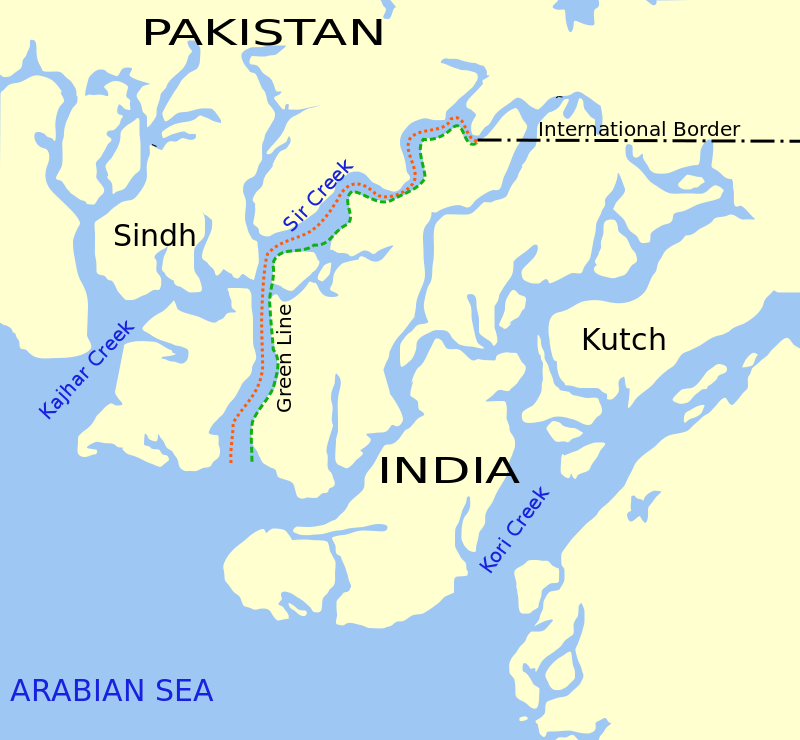
    • Sir Creek is a 96-km strip of water disputed between India and Pakistan in the Rann of Kutch marshlands. Originally named Ban Ganga, Sir Creek is named after a British representative.
    • The Creek opens up in the Arabian Sea and roughly divides the Kutch region of Gujarat from the Sindh Province of Pakistan.

    What’s the dispute?

    • The dispute lies in the interpretation of the maritime boundary line between Kutch and Sindh. Before India’s independence, the provincial region was a part of the Bombay Presidency of British India.
    • But after India’s independence in 1947, Sindh became a part of Pakistan while Kutch remained a part of India.
    • Pakistan claims the entire creek as per paragraphs 9 and 10 of the Bombay Government Resolution of 1914 signed between then the Government of Sindh and Rao Maharaj of Kutch.
    • The resolution, which demarcated the boundaries between the two territories, included the creek as part of Sindh, thus setting the boundary as the eastern flank of the creek popularly known as Green Line.
    • But India claims that the boundary lies mid-channel as depicted in another map drawn in 1925, and implemented by the installation of mid-channel pillars back in 1924.

    The Genesis 

    • The marshland of Sir Creek first became disputed in the early 20th century when the Rao of Kutch and the Chief Commissioner of Sindh Province of British India, due to different perceptions of the boundaries, laid claims over the creek.
    • The case was taken up by then Government of Bombay, which conducted a survey and mandated its verdict in 1914.
    • This verdict has two contradictory paragraphs, which make the India and Pakistan contenders on the same issue.
    • Paragraph 9 of this verdict states that the boundary between Kutch and Sindh lies ‘to the east of the Creek,’ (Green Line) which effectively implied that the creek belonged to Sindh and, therefore, to Pakistan.
    • On the other hand, Paragraph 10 states that since Sir Creek is navigable most of the year.
    • According to international law and the Thalweg principle, a boundary can only be fixed in the middle of the navigable channel, which meant that it has be divided between Sindh and Kutch, and thereby India and Pakistan.
    • India has used this para to consistently argue that the boundary needs to be fixed in the middle of the creek.
    • Pakistan, however, claims that Sir Creek isn’t navigable but India claims that since it’s navigable in high tide, the boundary should be drawn from the mid channel.

    What’s the importance of Sir Creek?

    • Apart from the strategic location, Sir Creek’s core importance is fishing resources. Sir Creek is considered to be among the largest fishing grounds in Asia.
    • Another vital reason for two countries locking horns over this creek is the possible presence of great oil and gas concentration under the sea, which are currently unexploited thanks to the impending deadlock on the issue.

    UNCLOS supports India’s stand

    • If Thalweg principle is to be upheld, Pakistan would lose a considerable portion of the territory that was historically part of the province of Sindh.
    • Acceding to India’s stance would mean shifting of the land/sea terminus point several kilometres to the detriment of Pakistan, leading in turn to a loss of several thousand square kilometres of its Exclusive Economic Zone under the United Nations Convention on Law of the Sea (UNCLOS).

    War in 1965 and tribunal

    • After the 1965 war, British Prime Minister Harold Wilson successfully persuaded both countries to end hostilities and set up a tribunal to resolve the dispute.
    • The verdict of the tribunal came in 1968 which saw Pakistan getting 10% of its claim of 9,000 km (3,500 sq. miles).
    • Since 1969, 12 rounds of talks have been held over the issue of Sir Creek, but both sides have denied reaching any solution.
    • The region fell amid tensions in 1999 after the Pakistan Navy shot down a MiG-21 fighter plane, but the last rounds of talks were held in 2012. Since then it’s been status quo.
  • Conviction of Hafiz Saeed

    The Lashkar-e-Taiba founder (LeT) and Jamat-ud Dawa (JuD) chief Hafiz Saeed was convicted by a Pakistan court in two terror-financing cases and sentenced to five-and-a-half years in prison concurrently.

    Why such move?

    • With pressure from the international community building up, Pakistan has been trying to convince the Financial Action Task Force (FATF) to prevent it getting blacklisted.
    • Saeed’s conviction is perhaps a reflection of Pakistan’s changing approach towards its treatment of terror groups, given the FATF’s actions and warnings.

    Who is Hafiz Saeed?

    • Hafiz Saeed is the founder and leader of the fundamentalist terrorist organisation Lashkar-e-Taiba (LeT), which is a group that follows an extreme interpretation of religious texts.
    • It was founded in 1990 and its goals include conducting jihad, preaching the true religion and training the new generation along true religious lines.
    • Some of its goals are aligned with that of Pakistan, including the liberation of Kashmir from India.

    Why his conviction matters?

    • Saeed is also the mastermind of the 2008 Mumbai terrorist attacks.
    • Other attacks that LeT has been involved in include the 2001 shootout at Parliament House in New Delhi, and, most recently, the 2016 attack on the military headquarters in Uri.
    • In 2012, in order to support India in its attempt to extradite Saeed, the US State Department offered a bounty of up to $10 million for information that could lead to his arrest or conviction.
    • Moreover, the US Department of the Treasury has marked Saeed as a Specially Designated Global Terrorist since 2012.
    • ISI and the Pakistani government too help the LeT bring in funds, and it is believed to have fund-raising offices in Bangladesh, Nepal, Maldives and the Gulf region.

    A shield against FATF actions

    • The FATF placed Pakistan in the grey list in July 2018 nonetheless.
    • Before Saeed’s arrest, the FATF had warned Pakistan to deliver on its commitments to curb terror financing. Pakistan feared being a part of FATF’s “Grey List”.
    • Significantly, if Pakistan did not follow up on FATF’s warnings, it could potentially be downgraded to the Black List, which would make things more difficult for the country.
    • FATF is de facto run by the US Treasury Department.
  • [op-ed snap] Maoist rebellion: policy fade-out, policy fade-in

     Context

    When much is made of peace talks with rebels in Northeast India, avoidance of peace talks with Maoist rebels is strange.

    States left to deal with the Maoists

    • Scale and extent of the problem: Officially in 2019, there are 11 states and 90 affected districts.
    • State subject: This is because policing and maintaining law and order are matters devolved to states.
    • The approach adopted to deal with the problem: According to MHA-
      • Capacity building: Primarily by capacity building of the state governments.
      • Areas of capacity building: Capacity building is to be carried out in areas of security and development. This will continue with the-
      • Better police training.
      • Better intelligence gathering.
      • Reinforcing police stations in conflict zones.
      • And recruiting locals into auxiliary forces.
    • Support by MHA: MHA will continue to provide the Central Reserve Police Force (CRPF) and other paramilitaries under its command.
      • Support of NTRO: Intelligence gathering outfits such as the National Technical Research Organisation (NTRO).
      • NTRO has in the past year increased drone surveillance over the densely forested Abujhmad area in southwest Chhattisgarh, which remains the main rebel hub.

    The success achieved so far

    • Influence reduced to 90 districts: The policies so far has certainly contained the rebels across 90 affected districts.
    • Surrender and rehabilitation policy: Most Maoist-affected states in India have a surrender and rehabilitation policy.
    • Surrender policy along with search and destroy : Surrender policy rides in tandem with search-and-destroy missions that police and paramilitaries provide.
    • This pincer has massively depleted rebel leadership and ranks with regular killings, arrests, and surrender of its leaders and cadres.

    Return of conflict displaced people

    • It is crucial for the conflict-displaced to return to their homes.
    • Issues related to return of displaced: Agencies discourage those returning from going back to their old home and instead are offered state-mandated enclaves.
      • No or little economic imperatives: Those returning are offered little economic imperative besides daily wage labour and scrambling for government handouts.
      • Some government jobs: For some, jobs are offered in
      • That is, in any case, the present for much of the 50,000 or so who did not manage to escape to Telangana and elsewhere.

    Conclusion

    • The central government would do well to focus here and in beginning negotiations for peace.
    • The Left-wing rebellion, a reality for over 50 years, is difficult to end until poor governance is improved.


  • Explained: What is the NIA Act, and why is Chhattisgarh challenging it?

    The Chhattisgarh state govt. moved the Supreme Court against the 2008 National Investigative Agency (NIA) Act, stating it is violative of the Constitution. In its civil suit, the government told the apex court the NIA should have no power over state policing matters.

    What is the NIA Act, 2008?

    • The NIA Act, 2008 governs the functioning of India’s premier counter-terror agency.
    • It was introduced by then home minister P Chidambaram in the wake of the 26/11 Mumbai terrorist attacks and was passed in Parliament with very little opposition.
    • The Act makes the NIA the only truly federal agency in the country, along the lines of the FBI in the United States, more powerful than the CBI.
    • It gives the NIA powers to take suo motu cognizance of terror activities in any part of India and register a case, to enter any state without permission from the state government, and to investigate and arrest people.

    Objections made by CG

    • In its petition, the Chhattisgarh govt. said the Act is “ultra vires the Constitution” and “beyond the legislative competence of the Parliament”.
    • According to the state, the 2008 Act allows the Centre to create an agency for investigation, which is a function of the state police.
    • ‘Police’ is an entry in the State List of the Constitution’s 7th Schedule.
    • The petition says the 2008 Act takes away the state’s power of conducting an investigation through the police, while conferring unfettered, discretionary and arbitrary powers” on the Centre.
    • The provisions of the Act leave no room of coordination and pre-condition of consent, in any form whatsoever, by the Centre from the State govt. which clearly repudiates the idea of state sovereignty as envisaged under the Constitution.

    Changes made to the NIA’s powers last year

    • The 2019 NIA Amendment Act expanded the type of offences that the investigative body could investigate and prosecute.
    • The agency can now investigate offences related to human trafficking, counterfeit currency, manufacture or sale of prohibited arms, cyber-terrorism, and offences under the Explosive Substances Act, 1908.
    • The amendment also enables the central government to designate sessions courts as special courts for NIA trials.
    • The Unlawful Activities (Prevention) Amendment (UAPA), also passed in 2019, allows an NIA officer to conduct raids, and seize properties that are suspected to be linked to terrorist activities without taking prior permission of the DG of Police of a state.
    • The investigating officer only requires sanction from the Director General of NIA.