💥Join UPSC 2027,2028 Mentorship (August Batch) + XFactor Notes & Microthemes PDF

GS Paper: Governance, Transparency & Accountability, Citizens Charters

  • On ANI’s defamation suit against Wikipedia

    Why in the News?

    The news agency ANI filed a defamation lawsuit against the Wikimedia Foundation, over a description on the site that portrayed the agency as a promoter of government propaganda.

    Why has the news agency ANI filed a lawsuit against the Wikimedia Foundation?

    • ANI has filed a defamation lawsuit against the Wikimedia Foundation over the description of the agency on Wikipedia. The page accused ANI of being a “propaganda tool” for the Indian government, citing sources like The Diplomat, EU DisinfoLab, and The Caravan magazine.
    • ANI claims that these descriptions are defamatory and is seeking ₹2 crore in damages from the Wikimedia Foundation.
    • Wikipedia’s policies emphasize neutrality and reliable sourcing, though it’s often accused of liberal bias. OpIndia claims the site propagates liberal “propaganda” and has criticised the site’s description of the riots for allegedly downplaying attacks by Muslim rioters.
    • Wikipedia has faced government criticism for vandalism, such as on Arshdeep Singh’s page. It lacks a blocking procedure under Indian law, unlike social media platforms.

    What has the Delhi High Court asked the Foundation to reveal?

    • The Delhi High Court ordered the Wikimedia Foundation to provide details about the users who edited ANI’s Wikipedia page. Specifically, the court asks for information about three users involved in the contentious edits.
    • The suit invokes provisions of the Information Technology Act, particularly Section 79, which outlines the responsibilities of intermediaries like Wikipedia.
      • Section 79 provides a framework for the exemption from liability for intermediaries in India regarding third-party content.
    • Justice Navin Chawla has issued a notice to Wikipedia and scheduled the next hearing for August 20, 2024. The court has acknowledged the right of Wikipedia to express opinions but will examine whether the claims made about ANI are backed by facts.

    Will Wikipedia be blocked in India?

    • During the case hearing, the Delhi High Court judge verbally threatened to order the Indian government to block Wikipedia if the Wikimedia Foundation did not comply with its request for user information.
    • Although Wikipedia has faced censorship in countries like China and partial censorship in Russia, it has not yet been blocked in India. However, the current legal proceedings could lead to a similar action if compliance is not met.

    Conclusion: The Indian government should ensure that any legal actions respect user privacy rights while compelling platforms like Wikimedia to cooperate with legitimate legal requests for information, balancing transparency with data protection laws.

  • Shabd Portal provides technical terms in 22 Indian languages

    Why in the News?

    The Commission for Scientific and Technical Terminology (CSTT), under the Union Education Ministry, has launched a unique website, shabd.education.gov.in, providing technical terms in all 22 official Indian languages.

    About Commission for Scientific and Technical Terminology (CSTT)

    • The Union Education Ministry established the CSTT in December 1960 to develop scientific and technical terminology in Hindi and other Indian languages.
    • It works to evolve, define, and standardize scientific and technical terms in Hindi and other Indian languages.
    • It publishes textbooks, monographs, and glossaries, and releases quarterly journals like Vigyan Garima Sindhu and Gyan Garima Sindhu.
    • It has developed over 450 glossaries, creating more than 3 million standardized words in Indian languages.
    • It prepares administrative glossaries for government departments and institutions to ensure consistent terminology in official documents.

    About the Shabd Portal

    • The portal aims to serve as a central repository for technical terminologies across Indian languages, hosting glossaries from CSTT as well as other institutions and agencies.
    • The portal currently hosts 450 dictionaries comprising 3 million words, making it a vast resource for users seeking scientific and technical terms in Indian languages.
    • Search Features:
      • Users can search for equivalent terms by language, subject, dictionary type, or language pairs.
      • Specific searches can also be made within a particular glossary or across the entire collection.
      • The platform also allows users to provide feedback on the terms prepared by the CSTT.

    Significance of the Portal

    • The launch comes amid efforts to promote technical education in Indian languages, including fields like medicine and engineering.
    • The portal is an essential step in ensuring accessibility of scientific and technical education in regional languages, supporting the vision of multilingual education.

    PYQ:

    [2014] Consider the following languages:

    1. Gujarati

    2. Kannada

    3. Telugu

    Which of the above has/have been declared as ‘Classical Language / Languages’ by the Government?

    (a) 1 and 2 only

    (b) 3 only

    (c) 2 and 3 only

    (d) 1, 2 and 3

  • [10th September 2024] The Hindu Op-ed: Regulatory reform stuck in a loop in Health Ministry

    [10th September 2024] The Hindu Op-ed: Regulatory reform stuck in a loop in Health Ministry

    PYQ Relevance:

    Q Bringing out the circumstances in 2005 which forced amendment to the section 3(d) in Indian Patent Law, 1970, discuss how it has been utilized by the Supreme Court in its judgement in rejecting Novartis’ patent application for ‘Glivec’. Discuss briefly the pros and cons of the decision. (UPSC IAS/2013)

    Q What do you understand by Fixed Dose drug Combinations (FDCs)? Discuss their merits and demerits. (UPSC IAS/2013)

    Mentor comment: Today’s editorial highlights ongoing challenges within India’s Health Ministry regarding the implementation of necessary regulatory reforms. This topic is significant due to the critical need for effective healthcare governance, especially in light of recent public health emergencies, such as the emergence of Mpox (monkeypox) cases in India.

    Following the Mpox case, the Union Health Ministry issued advisories urging states to enhance screening and contact tracing efforts. This reflects the urgent need for a robust regulatory framework to manage public health threats effectively.

    The article discusses how regulatory reforms are essential for improving the responsiveness and efficiency of the health sector, particularly in crises. 

    _

    Let’s learn!

    Why in the News?

    Due to the ongoing regulatory challenges, the Health Ministry has established a National Task Force to address healthcare challenges. 

    • The stagnation in reforms and public policy efforts could hinder the government’s ability to manage current and future public health challenges effectively.
    The Drugs Controller General of India (DCGI) introduced new policy initiatives in April 2024, which aimed at enhancing public health through recall guidelines, good distribution practices, and regulations against similar brand names.
    However, these measures are criticized for lacking legal enforcement and being poorly conceived, perpetuating a cycle of ineffective reforms.

    Key highlights by the 59th Report Parliamentary Standing Committee (PSC):

    • Storage Standards: The issue of lack of proper standards for storage of drugs, especially during transportation was raised by the Supreme Court in Swantraj & Ors vs State Of Maharashtra (1974).
    • Confusing Brand Names: The issue of similar brand names for different drugs leading to prescription errors was flagged by the Court in Cadila Healthcare Limited vs Cadila Pharmaceuticals Limited (2001).
    • Stagnation in Reforms: Despite over a decade of discussion, these issues remain unresolved due to bureaucratic inertia. 
    • Lack of Guidelines: Drugs ordered to be withdrawn in one State due to quality concerns were being sold in a neighboring state.
    • Non-Binding Guidelines: Recent drug recall guidelines lack legal enforcement, perpetuating ineffective reforms.

    What are the challenges around Procedural implementation?

    • Lack of Consensus: After the PSC report, a proposal to adopt good distribution practices guidelines formulated by the WHO came up for discussion in 2013.
      • The distribution practices and guidelines were to be made legally binding but it faced opposition from DCC because it was difficult to implement across the estimated six lakh retail outlets in the country.
    • Ineffective Laws and Procedures: After receiving a rap on its knuckles from the Delhi High Court in 2019, the ministry created a rule requiring pharmaceutical companies to provide a self-declaration that their proposed brand name was not similar to any of the existing brand names in the market.
      • In most other countries, it is the duty of the regulator to vet the brand name, to ensure that it is not confusing or misleading from a public health perspective.
      • When trademark applications are filed, the Registrar of Trade Marks conducts a perfunctory “confusion analysis” that does not include a public health perspective.
    • Enforcement issues: In practical, the DCGI lacks the legal power to make rules that are binding and have the force of law. Only the Ministry of Health has that power under the Constitution.

    Need to break the procedural loop:

    • With every newly appointed joint secretary, files go through with repeated consultations with stakeholders in the pharmaceutical industry.
    • In each of these consultations, the trade associations of pharmacies and pharmaceutical companies use every trick to stall the concrete action.
    • Hence, regulatory governance needs to be consistent and avoid the higher political interference.
  • On the challenges to road safety in India  

    Why in the News?

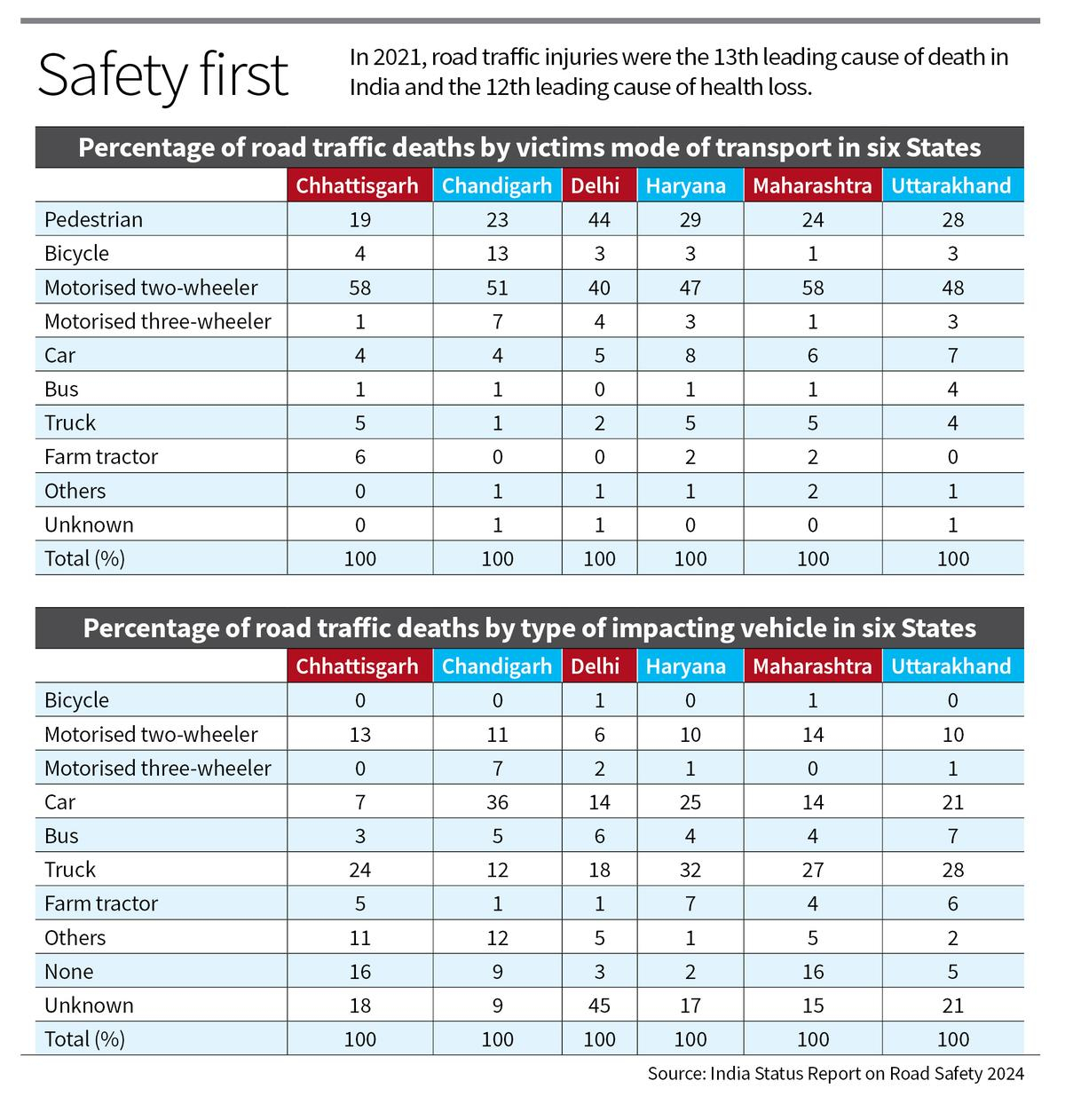
    The India Status Report on Road Safety 2024 highlights India’s slow progress in reducing road fatalities and stresses the need for tailored approaches to improve road safety.

    What does the ‘India Status Report on Road Safety 2024’ state?

    • The report highlights India’s limited success in reducing road accident fatalities, despite the country’s efforts in other sectors. The report stresses that most Indian States are not on track to meet the UN Decade of Action for Road Safety goal to halve traffic deaths by 2030.
      • It emphasizes the connection between road construction, mobility, and safety,
    • Road traffic injuries remain a significant public health challenge. In 2021, these injuries were the 13th leading cause of death and the 12th leading cause of health loss (measured in Disability-Adjusted Life Years or DALYs).
    • The report reveals significant disparities in road traffic death rates across Indian States, with vulnerable groups such as motorcyclists and truck-involved crashes being particularly high.

    Note: The report used FIR data from six States and audits of State compliance with Supreme Court directives on road safety.

    Which States have the lowest rates of road accident deaths?

    • West Bengal and Bihar have the lowest rates of road accident deaths, with 5.9 per 1,00,000 people in 2021

    What is a crash surveillance system?

    • A crash surveillance system is a national-level database that records detailed data on road accidents, including specific variables like the mode of transport of victims.
    • India lacks such a system, with current data being aggregated from police station records, limiting the depth of analysis and effectiveness of interventions.
    • Implementing this system would enhance road safety management and allow for better evaluation of policy interventions.

    Way forward: 

    • Establish a National Crash Surveillance System: Implement a comprehensive database for road accidents to enable detailed analysis and improve targeted interventions for road safety. This would enhance data accuracy and guide more effective policies.
    • Prioritize State-Specific Road Safety Strategies: Tailor interventions to the unique challenges of each State, focusing on vulnerable road users like motorcyclists and improving safety infrastructure, such as helmet usage, traffic calming, and trauma care facilities.
  • A tourism policy ill-suited for Jammu and Kashmir  

    Why in the News?

    Kashmir’s fragile environment faces severe damage from urbanization, commercialization, and climate change, underscoring the urgent need for a resilient and sustainable tourism model.

    Aims and Objectives of J&K Tourism Policy

    • Promoting all forms of Tourism: The policy aims to promote traditional recreational tourism as well as adventure, pilgrimage, spiritual, and health tourism. This diversification can attract a wider range of tourists.
    • Sustainable Practices: The policy emphasizes the need for sustainable tourism practices that minimize environmental degradation, conserve water, and protect biodiversity.
    • Infrastructure Development: It seeks to improve infrastructure, including hotels, roads, and recreational facilities, to accommodate the growing number of tourists.
    • Community Engagement: The policy aims to include local communities in tourism planning and decision-making processes, promoting their involvement in conservation efforts and sustainable practices.
    • Diversification of Tourism: By promoting various forms of tourism, such as eco-tourism, adventure tourism, and cultural tourism, the policy aims to reduce over-reliance on traditional tourist spots and distribute tourist footfall more evenly across the region.

    What are the effects of the new Policy? 

    Positive Impacts  Negative Impacts:
    • Increased Tourist Influx: Since the announcement of the New Tourism policy in 2020, over 40 million tourists have visited Kashmir.
    • Increase in Employment: The policy helps to generate employment of approximately 50,000 people per year, which can significantly boost the local economy.
    • Promotes Culture and Festivals: The policy promotes city-wise events and festivals with a pre-defined calendar to attract tourists.
    • Boosting Exports and Collaborations: The policy helps the handicraft industry, which was earlier limited to select destinations, to directly export and collaborate both nationally and internationally.
    • Environmental Stress: The rapid increase in tourist activities has led to significant ecological disturbances, including deforestation, waste accumulation, and pollution of water bodies.
    • Increase in Infra-strain: It also resulted in encroachment on natural habitats and increased pressure on local resources, such as water and electricity.
    • Climate Change Impact: The region is experiencing accelerated effects of climate change, including glacial depletion and erratic weather patterns, which threaten agricultural sustainability and water availability.

    Major Challenge: Fragility of the Region

    • Natural Disasters: Jammu and Kashmir is prone to natural disasters such as earthquakes, floods, and landslides, which can be exacerbated by unchecked commercialization and environmental degradation.
    • Ecological Sensitivity: The region’s delicate ecosystems are highly vulnerable to the impacts of tourism and urbanization, necessitating careful management to prevent irreversible damage.
    • Resource Depletion: The increased demand for water and energy resources is leading to the depletion of aquifers and heightened reliance on hydroelectric projects, which disrupt local aquatic ecosystems.

    Need for a Resilient Tourism Model (Way Forward)

    • Sustainable Tourism Practices: There is an urgent need to adopt a resilient and sustainable tourism model that prioritizes eco-friendly practices, waste reduction, and conservation of natural resources.
    • Community Involvement: Engaging local communities in tourism planning and decision-making is crucial for fostering sustainable practices and ensuring that the benefits of tourism are shared equitably.
    • Infrastructure Resilience: Developing infrastructure that can withstand extreme weather events and diversifying tourism offerings beyond peak seasons will help mitigate the impacts of climate change.
    • Policy Integration: A cohesive approach that integrates sustainable tourism policies with broader economic and environmental strategies is essential for preserving the region’s natural beauty while supporting local economies.
  • State changes in Rape law

    Why in the News?

    Due to the ongoing protest in Kolkata, the WB Assembly has unanimously passed a Bill mandating the death penalty for rape cases where victims die or are left in vegetative states.

    Features of West Bengal’s Aparajita Bill:

    • Death Penalty: The Bill mandates the death penalty for individuals convicted of rape if the victim dies or is left in a permanent vegetative state. It also introduces the death penalty as the maximum punishment for all rape cases.
    • Amendments to Existing Laws: The Bill amends the Bharatiya Nyaya Sanhita, 2023, Bharatiya Nagarik Suraksha Sanhita, 2023, and the Protection of Children from Sexual Offences Act, 2012, to strengthen penalties for sexual offenses.
    • Special Task Force and Courts: It establishes a district-level Aparajita Task Force for investigating rape cases and mandates the creation of Special Courts to expedite trials, aiming to complete investigations within 21 days.
    • Increased Penalties for Repeat Offenders: The Bill enhances punishments for repeat offenders, replacing simple life imprisonment with rigorous life imprisonment.
    • Privacy Protections: It introduces penalties for unauthorized disclosure of a victim’s identity and for publishing information related to court proceedings in rape cases.
    • Focus on Speedy Justice: The Bill aims to reduce the time frame for investigations and trials, emphasizing a victim-centered approach to minimize trauma.

    How Bengal’s Aparajita Bill differ from the Andhra Pradesh and Maharashtra laws?

    Dimensions West Bengal (Aparajita Bill) Andhra Pradesh (Disha Bill) Maharashtra (Shakti Bill)
    Scope of Death Penalty Death is mandatory in cases of rape leading to the victim’s death or vegetative state Death penalty for the rape of minors below 16, gang rape, and repeat offenders Similar to Andhra Pradesh, it introduced the death penalty for heinous cases, such as acid attacks and severe rape cases, but it also does not mandate death in all instances.
    Special Institutions Aparajita Task Forces and Special Courts in every district specifically for rape cases, ensuring expedited legal proceedings with strict timelines. Propose Special Police Teams and Exclusive Special Courts for dealing with crimes against women, along with a registry for offenders. Formation of special courts but also emphasizes digital cooperation
    Timeframes for Legal Processes: Investigation time is 21 days (extendable to 15 more), and trials must be completed within 30 days post-chargesheet. Investigation time is  seven days and mandates trials be completed within 21 days. Completed within 15 working days after an FIR is filed, with an extension of up to 7 days if the investigating officer provides written reasons for the delay and the trial must be completed within 30 working days from the date of filing the charge sheet.
    Amendments to POCSO Introduces the death penalty for penetrative sexual assault under the POCSO Act. Amended the POCSO Act to include death penalties, particularly for heinous offenses, but do not make it mandatory in all cases. Same as Disha bill
    Use of Digital Platforms No available No available Unique features penalizing social media platforms and intermediaries that fail to provide requested data for investigations.

    Why President’s Assent is essential?

    • Criminal law falls under the Concurrent List of the Indian Constitution, meaning both state and central legislatures can legislate on the subject. However, state laws require the President’s approval to take precedence over existing central laws.
    • Without presidential assent, the provisions of the Aparajita Bill, as well as those from Andhra Pradesh and Maharashtra, cannot be enforced, rendering them ineffective despite being passed by the respective state assemblies.

    Conclusion:

    The state should launch public awareness campaigns and involve stakeholders to build broad-based support, emphasizing the Bill’s objectives of enhancing victim protection and delivering speedy justice to encourage timely presidential approval.

  • Rule 170 of Drugs and Cosmetics Act, 2018

    Why in the News?

    The Supreme Court has raised concerns over the AYUSH ministry’s notification, which advised state licensing authorities not to take action under Rule 170 of the Drugs and Cosmetics Act in the context of the ongoing case against Patanjali Ayurved.

    Rule 170 of the Drugs and Cosmetics Act, 2018:

    Details
    What is it? Rule 170 was introduced in 2018 to regulate the manufacture, storage, and sale of Ayurvedic, Siddha, and Unani medicines, focusing on controlling misleading advertisements in the AYUSH sector.
    Requirements • AYUSH drug manufacturers must obtain approval and a unique identification number from state licensing authorities before advertising their products.
    • Required documentation includes textual references, rationale, indications for use, and evidence of safety, effectiveness, and quality.
    Key Provisions
    • Prohibits advertisement of AYUSH products without prior state authority approval.
    • Advertisements may be rejected if they:
      – Lack of contact details of the manufacturer.
      – Contain obscene or vulgar content.
      – Promote products for enhancing sexual organs.
      – Feature endorsements from celebrities or government officials.
      – Refer to government organizations.
      – Convey false impressions or make misleading or exaggerated claims.
    Rationale Behind   • Introduced following a parliamentary standing committee’s concerns about misleading claims in the AYUSH sector.
    • Aims to ensure proactive measures by the AYUSH ministry against such advertisements.
    Challenges   • AYUSH drug manufacturers are required to obtain licenses from drug controllers similar to allopathic medicines.
    • Unlike allopathic drugs, AYUSH drugs do not need to undergo Phase I, II, or III trials for approval.


    PYQ:

    [2019] How is the Government of India protecting traditional knowledge of medicine from patenting by pharmaceutical companies?

  • [pib] DoT notifies Telecommunications (Administration of Digital Bharat Nidhi) Rules, 2024

    Why in the News?

    The Centre has published the first set of rules under the Telecommunications Act, 2023 (44 of 2023), titled ‘Telecommunications (Administration of Digital Bharat Nidhi) Rules, 2024.’

    About Telecommunications (Administration of Digital Bharat Nidhi) Rules, 2024:

    Description
    Legislation Introduced under the Telecommunications Act, 2023
    Fund Digital Bharat Nidhi (DBN): Replaces the Universal Service Obligation Fund (USOF) under the Indian Telegraph Act, 1885
    Role of Administrator Responsible for overseeing the implementation and administration of DBN
    Key Focus Areas • Enhancing telecommunication services in underserved and remote areas
    • Promoting access to mobile and broadband services
    • Improving telecom security
    • Supporting next-generation telecom technologies
    Target Beneficiaries • Marginalized groups (e.g., women, persons with disabilities, economically weaker sections)
    • Remote and underserved regions
    Project Criteria • Provision of telecom services and equipment
    • Enhancing telecom security
    • Improving access and affordability
    • Promoting innovation, R&D, and indigenous technology
    • Supporting start-ups
    • Encouraging sustainable and green technologies
    Funding Conditions Entities receiving DBN funding must provide telecom services on an open and non-discriminatory basis
    Vision Alignment Aligned with Viksit Bharat (Developed India) by 2047
    Sustainability Focus Emphasizes the promotion of green technologies in telecommunications


    PYQ:

    [2019] In India, which of the following review the Independent regulators in sectors like telecommunications, insurance, electricity, etc.?

    1. Ad Hoc Committees set up by the Parliament
    2. Parliamentary Department Related Standing Committees
    3. Finance Commission
    4. Financial Sector Legislative Reforms Commission
    5. NITI Aayog

    Select the correct answer using the code given below:

    (a) 1 and 2

    (b) 1, 3 and 4

    (c) 3, 4 and 5

    (d) 2 and 5

  • Why did the Centre alter its pension plan?

    Why in the News?

    The Union Cabinet approved a new Unified Pension Scheme for Central government employees, set to launch on April 1, 2025, benefiting 23 lakh employees.

    What are the main features of the Unified Pension Scheme? 

    • Assured Pension: Employees will receive half of their average basic pay from the last 12 months of service as a monthly pension, provided they have served at least 25 years. A minimum pension of ₹10,000 is guaranteed for those with at least 10 years of service.
    • Family Pension: Dependents will receive 60% of the government worker’s pension upon their demise (death of a person).
    • Inflation Adjustment: Pension incomes will be adjusted for inflation, similar to the dearness relief provided to current employees.
    • Lump Sum Superannuation Payout: A lump sum equivalent to 1/10th of an employee’s salary and dearness allowance for every six months of service, in addition to gratuity benefits.
    • Contributory Mechanism: Employees will contribute 10% of their salary to the pension pool, while the government will contribute 18.5%.

    How is it different from the current pension system?  

    1. Old Pension Scheme (OPS): Provided an assured pension at 50% of the last drawn salary with no contributions required from employees.
      1. It also offered an additional pension for pensioners above 80 years and adjustments based on Pay Commission recommendations.
    2. National Pension System (NPS): Introduced in 2004, it was a defined contribution scheme with 10% contributions from both employees and the government, but without guaranteed pension amounts.
    3. Unified Pension Scheme (UPS): Combines the assured pension model of OPS with the contributory mechanism of NPS, but with a higher government contribution (18.5%) and a guarantee of certain pension benefits.

    Why did the government feel the need to bring about this change? 

    1. Employee Dissatisfaction with NPS: Government employees, especially those who joined post-2004 under the NPS, were dissatisfied with the uncertainty in pension incomes compared to their predecessors under the OPS.
    2. Political and Electoral Considerations: The issue became politically sensitive, with opposition parties promising to revert to OPS in some states, prompting the central government to address these concerns.
    3. Balancing Aspirations with Fiscal Prudence: The government aimed to find a middle ground that would satisfy employees while maintaining fiscal discipline.

    How have government employees responded?  

    • Positive Reception: Government employees have largely welcomed the UPS as it addresses concerns with the NPS by reintroducing assured pension benefits and increasing the government’s contribution, offering greater financial security in retirement.
    • Reservations: Despite the positive aspects, there are concerns about the continued contributory nature of the scheme and the absence of a commutation option, with employees seeking more clarity on these issues.

    What will be the cost to the exchequer?

    1. Immediate Costs: The UPS is expected to cost an additional ₹7,050 crore this year due to the higher government contribution and arrears for some employees.
    2. Future Financial Impact: While the initial impact will be the additional 4.5% contribution from the government, the assured pensions will increase future government liabilities. However, economists believe this can be managed through higher revenue growth and can be compared to the impact of Pay Commission revisions.

    Way forward: 

    • Ensure Clear Communication and Transparency: The government should provide detailed guidelines and clarify any remaining ambiguities about the Unified Pension Scheme (UPS).
    • Plan for Long-Term Fiscal Sustainability: To manage the increased financial burden from the UPS, the government should incorporate these commitments into its fiscal planning, potentially exploring new revenue sources to maintain fiscal prudence while ensuring the long-term sustainability of the pension scheme.
  • [31st August 2024] The Hindu Op-ed: The collapse of categories and post-individualism

    [31st August 2024] The Hindu Op-ed: The collapse of categories and post-individualism

    PYQ Relevance:
    Mains
    Q An athlete participates in Olympics for personal triumph and nation’s glory; victors are showered with cash incentives by various agencies, on their return. Discuss the merit of state sponsored talent hunt and its cultivation as against the rationale of a reward mechanism as encouragement. (UPSC IAS/2014)

    Prelims:
    Consider the following statements in respect of the 32nd Summer Olympics:​(UPSC IAS/2021)
    1. The official motto for this Olympics is ‘A New World’.​
    2. Sports climbing, Surfing, Skateboarding, Karate, and Baseball are included in this Olympics.​
    Which of the above statements is/are correct?​
    a) 1 only ​
    b) 2 only​
    c) Both 1 and 2 ​
    d) Neither 1 nor 2​

    Mentor comment: The concept of categories (like citizenship, crime, and gender) is increasingly seen as fluid, leading to conflicts and challenges in governance. Modernity promotes individualism, viewing traditional social norms and communities as outdated, which can lead to fragmentation in society.

    Historically, sex was seen as a clear binary (male and female), but emerging views suggest that gender is a personal choice, complicating traditional beliefs. Some argue that while biological sex is often viewed as fixed, the idea of gender as a choice is gaining traction, challenging long-held views. In today’s editorial the recent events, like controversies in sports regarding gender identity, illustrate the complexities and challenges of categorizing individuals based on sex and gender.

    Let’s learn!

    __

    Why in the News?

    The 2024 Paris Olympics has exposed the complexities in categorizing athletes based on sex and gender, with rigid weight classes contrasting with the fluidity and personal choice aspects of gender identity.

    •  This debate has become a source of significant social and political tension in the USA.
    What are the complexities and controversies surrounding categorization?

    Indian wrestler Vinesh Phogat was disqualified for being 100 grams overweight for her category, demonstrating the rigidity of weight categories.
    Algerian boxer Imane Khelif’s sex was questioned after winning gold. The International Boxing Association (IBA) had previously disqualified her for failing a confidential sex test, though the Paris Olympics organizers accepted her passport identifying her as a woman.

    Other fluidity of categories:

    The fluidity of categories has historically posed a governance challenge, leading to conflicts and wars over definitions of citizenship, crime, and legitimate politics.

    • Contemporary Issues: Current debates include the ethnic identity of Kamala Harris and the categorization of Scheduled Caste and Scheduled Tribes for social justice.
    • Modern Individualism: Modernity promotes individualism, viewing traditional communities as regressive, and emphasizing individuals as the primary units in politics and society.
    • Impact of Gender Perception: Historically, male and female categories were widely accepted across various fields.
      • The increasing view of sex as a matter of personal choice, influenced by gender perception, challenges traditional understandings and creates societal tensions.

    The Modern Discourse on Gender Identity:

    • Contentious Issues Debate: According to the Canadian Institutes of Health Research, sex is usually categorized as female or male, while gender exists along a continuum and can change over time. In short, sex is what one is, and gender is what one feels.
      • This debate raises questions about consent age, public school involvement, and healthcare facilitation, especially in the U.S. political landscape.
    • Transition and Liberalism’s Issue: Gender-affirming transitions challenge the old belief that feelings should adjust to biological facts. Now, the idea is that our bodies should change to match how we feel inside.
      • Transitioning doesn’t erase the idea of being male or female; instead, it aims to align the body with one of these identities.
      • The idea of letting people define their own identities creates a conflict within liberal values, which can lead to confusion and division in society.

    Conclusion:

    The collapse of rigid traditional categories, particularly in gender and identity, reflects broader societal changes and tensions between individualism and traditional norms.