Women-led development is central in this year’s Budget, with Gender Budget allocations reaching 1% of GDP and over ₹3 lakh crore for pro-women programs.
About Gender Budgeting in India:
The Gender Budget Statement (GBS) was introduced in the 2005-06 budget.
GBS has consistently represented an average of 5% of total budgetary allocations since its introduction, with minor fluctuations.
In the 2024-25 budget, the share of allocations to pro-women schemes has increased to approximately 6.8% of the total budget expenditure.
Different Components of the Gender Budget Statement
The Gender Budget Statement (GBS) is structured into three main parts:
Part A: This section includes schemes and programs that have 100% allocation specifically for women.
Part B: This part covers schemes with more than 30% but less than 100% of their allocations directed towards women.
Part C: Introduced recently, this section reports pro-women schemes that have less than 30% provisioning for women.
Instances of Missing Allocations Reported by Experts:
Pradhan Mantri Awas Yojana (PMAY): Initially, only a portion of PMAY’s budget was reported under Part B, which led to an underrepresentation of its impact on women. The entire allocation of ₹80,670 crore for 2024-25 was later moved to Part A, raising concerns about the accuracy of reporting since not all beneficiaries are women.
PM Employment Generation Programme (PMEGP): The GBS reported an allocation of ₹920 crore, which was claimed to be 40% of the total allocation to PMEGP, without a clear rationale for this percentage.
Mahatma Gandhi National Rural Employment Guarantee Scheme (MGNREGS): Although women constituted 59.3% of all person-days under MGNREGS, only 33.6% of its total outlay was reflected in the GBS, indicating a significant underreporting of women’s engagement and benefits from the scheme.
How should these anomalies be rectified by the Government (Way forward):
Incorporate Explanations: Providing clear explanations for the allocations reported in the GBS would enhance transparency and accountability.
Audit of Budgetary Allocation: The government should involve regular audits and assessments of how budgetary allocations impact gender equality.
Engage Stakeholders: Involving experts and stakeholders in the process of developing the GBS can provide insights into the specific needs of women and help ensure that the budget effectively addresses those needs.
Mains PYQ:
Q Women empowerment in India needs gender budgeting. What are requirements and status of gender budgeting in the Indian context? (2016)
The Minister of State for Personnel, Public Grievances, and Pensions has conferred the Anubhav Awards 2024.
ANUBHAV Awards
Details
Purpose
To recognize the contributions of retired officials to nation-building and document the administrative history of India through their written narratives.
Portal Launch
Launched in March 2015.
Organizing Body
Ministry of Personnel, Public Grievances & Pensions, Department of Pension & Pensioners’ Welfare.
Objectives
– Create a database of significant suggestions and work experiences.
– Utilize the experience of retiring employees for nation-building.
– Enable Ministries/Departments to consider useful and replicable suggestions.
Criteria
Retiring Central Government employees and pensioners, who can submit their Anubhav write-ups 8 months prior to retirement and up to 1 year post-retirement.
Award Process
Write-ups are assessed by the concerned Ministries/Departments, published, and then shortlisted for the Anubhav Awards and Jury Certificates.
Awards and Recognition
– ANUBHAV Awardees: Receive a medal, certificate, and a prize of ₹10,000.
– Jury Certificate Winners: Receive a medal and a certificate.
PYQ:
[2021] Consider the following statements in respect of Bharat Ratna and Padma Awards :
1. Bharat Ratna and Padma Awards are titles under the Article 18(1) of the Constitution of India.
2. Padma Awards, which were instituted in the year 1954, were suspended only once.
3. The number of Bharat Ratna Awards is restricted to a maximum of five in a particular year.
The recent brutal rape and murder case in Kolkata has sparked widespread calls for the death penalty for the accused.
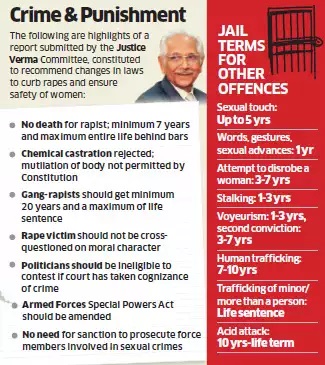
The Justice J.S. Verma Committee, formed in response to the 2012 Delhi gang rape, recommended against the death penalty for rape, even in the rarest of rare cases, arguing that it would be a regressive step.
About Justice J.S. Verma Committee Recommendations
Recommendations on
Explanation
Rape
• It recognized rape as a Crime of Power, not just passion.
• Expand definition to include all forms of non-consensual penetration.
• Remove marital rape exception; marriage should not imply automatic consent. (European Commission of Human Rights in C.R. vs U.K)
Sexual Assault
• Broaden definition to include all non-consensual, non-penetrative sexual acts.
• Penalty: Up to 5 years of imprisonment or fines.
Verbal Sexual Assault
• Criminalize unwelcome sexual threats.
• Punishable by up to 1 year in prison or fines.
Sexual Harassment at Workplace
• Include domestic workers under protections.
• Replace internal complaint committees with Employment Tribunals.
• Employers to compensate victims of sexual harassment.
Acid Attacks
• Propose a 10-year minimum punishment, separate from grievous hurt.
• Establish a compensation fund for victims.
Women in Conflict Areas
• Review AFSPA; exclude government sanction for prosecuting sexual offenses by armed forces.
• Appoint special commissioners to monitor offenses.
Trafficking
• Comprehensive anti-trafficking laws beyond prostitution.
• Protective homes for women and juveniles overseen by High Courts.
Child Sexual Abuse
• Define ‘harm’ and ‘health’ in the Juvenile Justice Act to include both physical and mental aspects.
Death Penalty
• Opposed chemical castration and death penalty for rape.
• Recommend life imprisonment.
Medical Examination of Rape Victims
• Ban the two-finger test; victim’s past sexual history should not influence the case.
Reforms in Case Management
• Set up Rape Crisis Cells, increase police accountability, allow online FIR filing.
• Encourage community policing and increase police personnel.
Union Cabinet’s Decision on the Death Penalty
The Union Cabinet, while clearing an ordinance on sexual assault in 2013, chose NOT to adopt the committee’s recommendation against the death penalty.
Key amendments included:
Section 376A: Death penalty for rape leading to the death of the victim or reducing her to a persistent vegetative state.
Section 376E: Death penalty for repeat offenders.
2018 Amendments: Death penalty for gang rape of a victim under 12 years (Section 376DB) and life imprisonment for rape of a victim under 16 years (Section 376DA).
The Bharatiya Nyaya Sanhita (BNS) includes similar provisions for rape, with specific sections detailing the punishment, including the death penalty for certain cases.
PYQ:
[2014] We are witnessing increasing instances of sexual violence against women in the country. Despite existing legal provisions against it, the number of such incidences is on the rise. Suggest some innovative measures to tackle this menace.
Union Minister of Information and Broadcasting has launched 25 challenges as part of the ‘Create in India Challenge – Season 1’ for the World Audio Visual & Entertainment Summit (WAVES).
About WAVES
It is an international summit organized by the Ministry of Information & Broadcasting, Government of India.
The first edition will take place from 20-24 November 2024 in Goa.
The summit will be hosted in Goa in collaboration with the State Government of Goa.
The Entertainment Society of Goa will act as the Nodal Agency for the event, following an MOU with Ministry of Information & Broadcasting.
It is supported by industry partners like the Federation of Indian Chambers of Commerce & Industry (FICCI) and the Confederation of Indian Industry (CII).
Purpose:
WAVES aims to be a pivotal forum for fostering dialogue, trade collaboration, and innovation within the evolving media and entertainment industry.
The summit will showcase India as a hub for innovation and excellence in the media and entertainment sector, attract investments, and position India as a global leader in the entertainment business.
Location & Collaboration:
WAVES is designed to promote sustainable growth in the media and entertainment industry.
It will help attract global trade and investment to India, positioning the country as a key player in the global entertainment landscape.
The summit will bring together industry leaders, stakeholders, and innovators to explore new opportunities, tackle challenges, and shape the future of the sector.
PYQ:
[2014] Though 100 percent FDI is already allowed in non-news media like a trade publication and general entertainment channel, the government is mulling over the proposal for increased FDI in news media for quite some time. What difference would an increase in FDI make? Critically evaluate the pros and cons.
Q How globalization has led to the reduction of employment in the formal sector of the Indian economy? Is increased informalization detrimental to the development of the country? (UPSC IAS/2016)
Q Examine the role of ‘Gig Economy’ in the process of empowerment of women in India. (UPSC IAS/2021)
Q Besides the welfare schemes, India needs deft management of inflation and unemployment to serve the poor and the underprivileged sections of the society. Discuss. (UPSC IAS/2022)
Mentor comment: The Karnataka Platform-based Gig Workers (Social Security and Welfare) Bill, which was introduced on June 29, 2024, aimed to regulate the welfare and rights of gig workers in the state. It is the second such legislation in India after the state of Rajasthan. The proposed ‘quota-for-local’ Bill in Karnataka aims to reserve a significant percentage of jobs for locals, mandating that 70% of non-management and 50% of management positions be filled by Kannadigas. This legislation has raised concerns about its impact on migrant workers, who comprise a substantial portion of the workforce in IT and gig economy jobs.
Let’s learn!
__
Why in the News?
Karnataka’s Gig Workers Bill has raised concerns about its impact on migrant workers, which comprises a substantial portion of the workforce in IT and gig economy jobs.
Key Features of the Bill:
•Rights Protection: The Bill is designed as a rights-based framework, ensuring gig workers have protections against unfair dismissals and arbitrary payment deductions. •Social Security Fund: A welfare fund will be established, funded by a fee from aggregators based on gig workers’ earnings. This fund aims to provide social security benefits to registered gig workers. •Contractual Clarity: Aggregators must provide clear contracts detailing termination grounds and must give a 14-day notice before contract changes. •Grievance Redressal: The Bill mandates a two-level grievance redressal mechanism, requiring aggregators with over 50 workers to form an internal dispute resolution committee. •Transparency in Operations: Aggregators must disclose parameters related to work allocation and automated decision-making processes affecting workers.
How does the proposed ‘quota-for-local’ Bill impact migrant workers?
Job Opportunities: The bill could limit job opportunities for migrant workers, as companies would be required to prioritize local candidates. This may lead to a reduction in the already precarious employment options available to migrants, who often fill lower-skilled positions.
Increased Competition: The migrant workers might face intensified competition for fewer available roles, particularly in sectors where they have traditionally been employed, such as delivery services and hospitality.
Economic Migration: The bill could lead to a demographic shift in the labor market. Migrants may choose to relocate to states with more inclusive hiring practices, impacting the state’s economy and workforce diversity.
Exploitation Risks: The present Bill could make migrants more vulnerable to exploitation, as companies may feel less inclined to hire them, leading to further marginalization of these workers.
Industry Concerns: Business leaders and industry representatives have expressed concerns that the bill could deter investment and talent from flowing into Karnataka, potentially leading to job losses and reduced economic growth. The focus should be on skills rather than reservations.
What measures can be taken to protect migrant workers from exploitation?
Right to Change Employers: States need to ensure that migrant workers have the freedom to change employers without facing penalties, which can reduce their vulnerability to abuse and exploitation.
Empower Migrant workers: The government/ Private sector needs to provide comprehensive information regarding workers’ rights, including recruitment processes, legal protections, and avenues for reporting abuse.
Strengthening labor laws and legal assistance with counseling services that protect migrant workers and ensure strict enforcement through regular inspections of workplaces is a need of the hour.
Social Security and Housing Access: States need to ensure that migrant workers have access to social services, housing, and healthcare, which can help mitigate their vulnerabilities.
NITI Aayog in its report”India’s Booming Gig and Platform Economy”has said that fiscal incentives such as tax breaks or startup grants may be provided for businesses that provide livelihood opportunities where women constitute a substantial portion of their workers.
International Cooperation: Encourage countries to adopt and implement international standards and conventions that protect the rights of migrant workers, promoting safe and ethical recruitment practices.
Conclusion: The Karnataka Bill, like the Code on Social Security, 2020 and the Rajasthan Act 2023, fails to address employment issues in India. This oversight needs a rightful strategy to look into the issue concerning the gig economy as well as the migration pattern in India in past decades.
Resident doctors across India are on strike, demanding safety laws after a young doctor was tragically raped and murdered at R.G. Kar Medical College in Kolkata on August 9.
Why are Healthcare Workers Protesting?
Response to Violence: The protests were triggered by the brutal rape and murder of a young doctor at R.G. Kar Medical College and Hospital in Kolkata on August 9, 2024.
Demand for Safety: Healthcare workers are demanding laws and measures that ensure their safety while on duty.
Historical Context: Violence against healthcare workers is not a new issue in India. Previous incidents, such as the case of Aruna Shanbaug, a nurse who was sexually assaulted in 1973, underscore a long-standing pattern of violence in healthcare settings.
Working Conditions of Junior Doctors, Interns, and Nurses
Poor Working Environment: Junior doctors, interns, and nurses often work in ill-lit and poorly secured hospital environments.
Long Shifts and Exhaustion: Many healthcare workers, including the victim of the recent incident, are subjected to excessively long shifts—in this case, a 36-hour duty shift—without adequate rest or safe spaces to recuperate.
Mental Health Concerns: The stressful working conditions, combined with the threat of violence, have raised significant concerns about the mental health and well-being of healthcare workers.
Key Demands of the Protesters
Central Protection Act: The Indian Medical Association (IMA) is advocating for a Central protection law specifically for healthcare workers, similar to measures in other countries that classify assaults on medical staff as serious offenses.
Enhanced Security Measures: Protesters are calling for hospital security protocols that match those of airports, including the installation of CCTV cameras, deployment of security personnel, and improved lighting in hospital corridors and wards.
Safe Work Environment: There is a demand for immediate systemic reforms to improve working conditions, including better security arrangements and the establishment of healthcare facilities as safe zones.
Accountability and Justice: The IMA has requested a thorough investigation into incidents of violence against healthcare workers, with a focus on timely and professional handling of cases and ensuring that perpetrators face exemplary punishment.
Government Response: Following the protests, the Ministry of Health and Family Welfare issued an order mandating that any violence against healthcare workers must be reported and acted upon swiftly, with institutional FIRs to be filed within six hours of an incident.
Sole responsible for the safety of Health workers:
State Governments: Health and law enforcement are primarily state subjects in India, meaning that state governments are primarily responsible for ensuring the safety of healthcare professionals. They are tasked with implementing laws, providing adequate security in hospitals, and ensuring a safe working environment for medical staff.
Central Government: The central government plays a role in formulating national policies and frameworks that support the safety of healthcare workers.
Recent initiatives include the Ministry of Health and Family Welfare’s order mandating the filing of FIRs within six hours of any violence against healthcare workers, indicating a push for accountability and swift action.
Way forward:
Implement a Central Protection Law for Healthcare Workers: The government should fast-track the enactment of a Central law specifically designed to protect healthcare workers from violence.
Improve Working Conditions and Mental Health Support: Hospitals should prioritize creating safe and well-secured environments for healthcare workers, including reasonable shift hours, adequate rest periods, mental health support, and robust security protocols to prevent future incidents of violence.
On July 29, 2024, Rahul Gandhi (Leader of the opposition) pointed out the absence of SC/ST officers in framing the 2024 Budget.
Issue of Upper Caste Domination in Services:
Lack of Representation: During his parliamentary address, the Leader of the opposition (Rahul Gandhi) highlighted the absence of Scheduled Caste (SC) and Scheduled Tribe (ST) officers among the 20 officials involved in framing the 2024 Budget proposals. He pointed out that only one officer from the minorities and one from the Other Backward Classes (OBC) were included, underscoring a systemic lack of representation for marginalized communities in key government functions.
Upper Caste Dominance: The dominance of upper castes in senior civil service positions was confirmed by Minister of State (Jitendra Singh), who stated that out of 322 officers holding Joint Secretary and Secretary posts, 254 belonged to the general category, while only 16 were from SC, 13 from ST, and 39 from OBC categories. This indicates a significant underrepresentation of SC/ST officers in policy-making roles.
About Eligibility:
Age Limits: General category candidates can appear for the civil services examination between 21 and 32 years, with a maximum of six attempts.
SC/ST candidates can take the exam until 37 years of age with unlimited attempts.
While OBC candidates have an upper age limit of 35 years with nine attempts.
The upper age limit for Persons with Benchmark Disabilities (PwBD) is 42 years.
Reason behind the underrepresentation of SCs, STs and OBCs in upper posts of civil services:
Late Entry Disadvantage: SC/ST and PwBD candidates often join the civil services later in life and are unable to reach the highest positions due to retirement before attaining senior roles.
Cabinet Secretariat data (2nd ARC) from 2004 shows that on average, unreserved candidates enter the service at the age of 24.7 years, whereas SC, ST, and OBC members do so at 27.6 years, 26.9 years, and 27.1 years respectively.
The Solution Lies in Having a Fixed Tenure: (Way forward)
Fixed Tenure Proposal: To address the disparity, it is proposed that all civil servants, regardless of their age of entry, should have a fixed tenure of service, such as 35 years.
Retirement Age Adjustment: The retirement age limits could be adjusted to ensure all civil servants retire by around 67 years of age, with annual medical fitness checks after the age of 62.
Independent Committee Recommendation: It is suggested that an independent, multi-disciplinary committee with adequate SC/ST, OBC, and PwBD representation be established to examine this fixed tenure proposal to ensure social justice and broader representation at the highest levels of government.
Mains PYQ:
Q What are the two major legal initiatives by the state since Independence, addressing discrimination against Scheduled Tribes (ST)? (UPSC IAS/2017)
Despite growing concerns, India’s decadal Census has been delayed by over three years. In fact, there is an overwhelming misconception among officials about substituting the Census with alternative ways and means of counting the population.
Significance of Calculating Census
Comprehensive Population Data: The Census provides a detailed population count, which includes locational, familial, and individual information.
For instance, the Census can reveal insights into population density, age distribution, educational attainment, and employment status.
Foundation for Surveys and Indicators: The Census acts as a foundational frame for large-scale surveys like the National Family Health Survey (NFHS) and Periodic Labour Force Survey (PLFS).
Support for SDG Monitoring: In the context of Sustainable Development Goals (SDGs), Census data is crucial for generating accurate indicators, particularly those requiring disaggregated data below the sub-national level.
For instance, to monitor progress on goals related to poverty reduction, gender equality, and health, precise demographic data is necessary to identify disparities and target interventions effectively.
Demographic Transition Insights: The Census is vital for capturing changes in population composition, familial structures, and occupational distribution, especially during periods of rapid demographic transition.
Global Implications: Given India’s significant influence on global population trends, accurate Census data is crucial for global demographic studies and projections.
For example Global Health Security Index and Multidimensional Poverty Indices.
Changes to understand before taking Census Count
Population Dynamics: Since the last Census, significant changes in population count and composition must be understood, including shifts due to migration, fertility, and mortality rates.
For example: In India, the average annual growth rate of the population has slowed from 2.2% in 1971 to 1.1% in 2021, with projections indicating further declines to 0.58% by 2036.
Impact of COVID-19: The pandemic has had a profound impact on health, employment, and livelihoods, which need to be accurately captured in the Census.
For example, The Indian government reported over 500,000 COVID-19 related deaths, which have affected overall mortality statistics and health indicators.
Socio-economic Transformations: Changes in education, occupation, and employment patterns over the last decade are crucial to understanding current societal trends.
For example, The literacy rate in India has improved significantly, rising from 64.8% in 2001 to 77.7% in 2011, with further increases expected.
Infrastructure and Development Changes: The transformation in physical and digital infrastructure, as well as regional development patterns, must be considered to accurately reflect the current state of the nation.
For example, the COVID-19 pandemic accelerated the adoption of digital technologies, with a reported increase in internet users from 560 million in 2019 to over 800 million in 2022. This digital transformation has reshaped how people work and access services.
Demand for Caste Census in India
Political Motivations: The demand for a caste Census is largely driven by political interests, aiming to establish differential entitlements based on perceived representation and deprivation.
For instance, leaders from the Indian National Developmental Inclusive Alliance (INDIA) have emphasized the need for a caste Census
Historical Context: Caste auditing was part of earlier Census exercises but was discontinued for specific reasons.
For example, Caste auditing was part of earlier Census exercises, with the British-era Censuses from 1881 to 1931 enumerating all castes. However, after independence, the Government of India decided not to enumerate castes in the 1951 Census, except for Scheduled Castes (SC) and Scheduled Tribes (ST).
Assessment of Mobility: There is a lack of systematic assessment of social mobility in education and occupation across caste lines, despite decades of affirmative action. A caste Census could potentially address this gap but is viewed with skepticism.
For instance, while reservations exist for OBCs and SCs, the actual impact on social mobility remains unclear due to insufficient data.
Way forward:
Incorporation of Caste Data: Need to amend the Census Act of 1948 to mandate the enumeration of caste data alongside other demographic information. This would provide a legal framework for collecting comprehensive caste-wise data.
Independent Studies and Pilot Surveys: The government should conduct independent studies at district and state levels to gather data on castes and sub-castes.
Mains PYQ:
Q Has caste lost its relevance in understanding the multi-cultural Indian Society? Elaborate your answer with illustrations. (2020)
The Teesta dam breach and Himachal floods highlight the urgent need to evaluate development projects based on their environmental impact, especially in fragile mountain regions.
What are the underlying issues in the cities of IHR?
Inadequate Planning Models: Planning institutions in the IHR often use models from the plains, which are ill-suited to the region’s unique conditions, leading to ineffective implementation and failures.
Human Resource Deficit: City governments in the IHR face a severe shortage of human resources, with staffing levels falling short by nearly 75%, hampering effective urban management.
Uncontrolled Urban Expansion: Cities are expanding into village peripheries, encroaching on common lands and natural resources, as seen in Srinagar, where built-up areas increased by 75.58% from 2000 to 2020, while water bodies shrank by 25%.
Environmental Strain:Urbanization, high-intensity tourism, and unsustainable infrastructure development are exacerbating environmental pressures in the IHR, further worsened by changing precipitation patterns and rising temperatures.
Financial Constraints: The IHR cities lack the capacity to generate capital for infrastructure needs, highlighting the need for the Finance Commission to address urban financing in this region, given the high costs and absence of industrial corridors.
What can be done?
Every town needs to be mapped, with layers identifying vulnerabilities from geological and hydrological perspectives. The planning process should involve locals and follow a bottom-up approach.
Consultant-driven urban planning processes should be shelved for Himalayan towns, with the urban design based on climate resilience.
Current intergovernmental transfers from the centre to urban local bodies constitute a mere 0.5% of GDP. This should be increased to at least 1% of GDP.
Himalayan towns must engage in wider conversations about sustainability, with the focus on urban futures being through robust, eco-centric planning processes involving public participation.
Case Study
Nainital: Integrated Development Plan
Nainital district in Uttarakhand implemented an Integrated Development Plan that aimed to balance urban growth with environmental conservation.
The plan involved mapping vulnerable areas, restricting construction in ecologically sensitive zones, and promoting sustainable tourism practices.
Community participation and awareness programs were also part of the initiative to ensure long-term sustainability.
Dharamshala: Green Building Norms
The Dharamshala Municipal Corporation in Himachal Pradesh has adopted green building norms for new constructions, focusing on energy efficiency, water conservation, and waste management.
The city has also invested in public transportation and pedestrian-friendly infrastructure to reduce vehicular emissions and promote sustainable mobility
Mains PYQ:
Q How can the mountain ecosystem be restored from the negative impact of development initiatives and tourism? (UPSC IAS/2019)
The government has introduced the Waqf Act Amendment Bill 2024, in order to improve administration and management of the Waqf properties.
Aim: To address existing issues in the management and administration of Waqf properties, ensuring better transparency and efficiency.
It also seeks to improve the legal framework governing Waqf boards and their operations across India.
Background:
The Waqf Board Amendment Bill 2024 proposes changes to the Waqf Act of 1995.
The Waqf Board Act, initially enacted in 1995, is a legal framework governing the administration of Waqf properties in India.
Waqf refers to the endowment of property for religious or charitable purposes, and the act outlines the structure, functions, and powers of Waqf boards responsible for managing these properties.
The Central Waqf Council is a statutory body that advises and oversees the functioning of state-level Waqf Boards in India, established under the Waqf Act.
Wakf board’s income is exempt from Income Tax but revenue generated from leasing of properties can be taxed under the service tax and GST laws.
Features of the Proposed Bill:
Waqf Board will mandatorily have two Non-Muslim members.
District magistrates may be involved in overseeing waqf properties to ensure proper management. The survey is to be carried out by the district collector, not by Waqf.
Properties are to be registered through a Centralized Portal for better scrutiny. Properties already claimed by boards will undergo new verification processes to resolve disputes and prevent misuse.
Waqf will lose the right to decide whether any property is a Waqf Asset or not.
Present Composition of Waqf Board
Chairperson
Leads the Board
State government nominees
Representatives appointed by the state. (The Waqf Board operates under the supervision of the state government as per the provision of the Wakf Act 1995).
Legislators and parliamentarians
State representatives from the Muslim community
State Bar Council members
Muslim Legal experts providing guidance
Mutawalis
Managers of waqf with an annual income of Rs 1 lakh and above
Islamic scholars
Religious experts contributing to decision-making
Significance of the Waqf Board Amendment Bill 2024:
The bill seeks to bring about significant administrative reforms and ensure more inclusive and efficient management of Waqf assets. Here are some of the significances of the Waqf Board Amendment Bill 2024:
Enhanced Transparency: The bill includes provisions to digitize records and create a centralized database. This will make it easier to track and manage Waqf properties, reducing the potential for fraud and mismanagement.
Improved Governance: Administrative reforms proposed in the bill by the government will lead to more professional and efficient management of Waqf properties. This could result in better utilization of these resources for charitable and religious purposes.
Protection of Waqf Properties: The bill aims to protect Waqf properties by regulating leasing and preventing encroachments. Unauthorized use and exploitation of these properties will be prevented, ensuring they are used for their intended religious and charitable purposes.
Inclusion and Representation: Including Muslim women and non-Muslims in Waqf Boards is a step toward more inclusive governance, ensuring diverse perspectives in decision-making.
Efficient Dispute Resolution: The new dispute resolution mechanism will help in resolving conflicts related to Waqf properties more effectively, reducing the burden on regular courts and ensuring quicker justice.
![[19th August 2024] The Hindu Op-ed: New migrant realities in Karnataka’s gig sector](https://www.civilsdaily.com/wp-content/uploads/2024/08/19-Aug-1568x882.jpg)