The Health Ministry has requested the Sports Authority of India (SAI) and the Board of Control for Cricket in India (BCCI) to implement measures to prevent surrogate advertisements of tobacco and alcoholrelated products by sportspersons.
AboutSports Authority of India (SAI)
Details
Establishment
Founded in 1984 by the Ministry of Youth Affairs and Sports, Government of India
Headquarters
Jawaharlal Nehru Stadium Complex, New Delhi, India
Objectives
Promote sports and physical education
Develop sports infrastructure
Identify and nurture sports talent
Conduct coaching and training programs
Key Programs
National Sports Talent Contest Scheme (NSTC)
Special Area Games (SAG)
SAI Training Centres (STC)
Centres of Excellence (COE)
National Sports Academies (NSA)
Major Facilities
Jawaharlal Nehru Stadium, New Delhi
Indira Gandhi Stadium Complex, New Delhi
Major Dhyan Chand National Stadium, New Delhi
Netaji Subhas National Institute of Sports (NSNIS), Patiala
Notable Initiatives
Khelo India Program
Target Olympic Podium Scheme (TOPS)
Mission Olympic Cell (MOC)
About Board of Control for Cricket in India (BCCI)
Details
Establishment
Founded in December 1928
Headquarters
Cricket Centre, Wankhede Stadium, Mumbai, India
Objectives
Promote and develop cricket in India
Organize domestic and international cricket matches
Identify and nurture cricket talent
Maintain cricket infrastructure and facilities
Key Responsibilities
Selection of national cricket teams (men’s, women’s, and junior)
Organization of domestic cricket tournaments
Administration of Indian Premier League (IPL)
Conducting training and coaching programs
Major Tournaments
Indian Premier League (IPL)
Ranji Trophy
Vijay Hazare Trophy
Syed Mushtaq Ali Trophy
Duleep Trophy
Irani Cup
Funding and Support
Funded through sponsorships, broadcasting rights, and match revenues
Provides financial assistance and contracts to cricketers
Reforms
Justice Lodha Committee: Result of the report submitted by the Justice Mukul Mudgal Committee after an investigation into the 2013 IPL betting scandal.
PYQ:
[2021] Consider the following statements in respect of the ICC World Test Championship:
1. The finalists were decided by the number of matches they won.
2. New Zealand was ranked ahead of England because it won more matches than England.
Mains: Q1 Has digital illiteracy, particularly in rural areas, coupled with lack of Information and Communication Technology (ICT) accessibility hindered socio-economic development? Examine with justification. (UPSC IAS/2021)
Q2 What do understand by the concept “freedom of speech and expression”? Does it cover hate speech also? Why do films in India stand on a slightly different plane from other forms of expression? Discuss. (UPSC IAS/2014)
Note4Students:
Mains: Issues related to Broadcasting Regulation Bill, 2024;
Mentor comments: Could Dhruv Rathee and Ravish Kumar’s YouTube videos have swayed voter preferences in the 2024 general election? This question arises in the context of a Union government that anticipated a return to power with a larger majority but instead was re-elected as a coalition with a reduced mandate. Recognizing a threat to its authority, the government seeks to undermine digital creators through the Broadcasting Regulation Bill, 2024. Data from two CSDS-Lokniti surveys reveal that 29% of voters consume political content daily on digital platforms, suggesting a shift towards a “content election” where digital media increasingly challenges traditional television news.
Let’s learn!
__
Why in the News?
The Broadcasting Bill, 2024 exhibits clear characteristics of a digital authoritarianism initiative aimed at controlling online narratives.
Recent changes Convergence of IT and broadcasting ministries:
Ashwini Vaishnaw remains the Minister for Electronics and Information Technology (MeitY) and has also been given the Ministry of Information and Broadcasting (MIB) portfolio. This reflects a growing convergence and interest of these ministries in controlling digital content.
Key highlights of the Bill
Expanded Definition of Broadcasters: The Bill classifies individual commentators as “Digital News Broadcasters” and content creators as “OTT Broadcasters.”
This allows the Ministry of Information and Broadcasting (MIB) to set and modify thresholds for subscribers or users, mandating registration for those who meet these criteria, thus significantly broadening government oversight over digital media.
New Compliance Requirements: The Bill introduces additional compliance measures for online platforms, establishing a new safe harbor regime separate from the Information Technology Act, 2000.
It enables the MIB to enforce censorship and require platforms like YouTube to implement specific compliance measures entities.
Expanding legal powers for censorship: A formal legal basis for this censorial partnership was established through the IT Rules, 2021 which expanded MeitY’s powers, including a traceability mandate compromising end-to-end encryption.
The rules also granted the MIB new powers to require registration and block digital news media and online entertainment streaming apps. The MIB has publicly disclosed enforcement action only when it aligns with nationalistic themes fitting its political interests.
Creation of an Autocratic Weapon for Digital Censorship
Expansion of IT Rules: Following the inadequacies of the IT Rules, 2021, the Union Government expanded its powers twice in 2023, first by establishing Grievance Appellate Committees (GACs) to handle appeals regarding digital content and then by amending the IT Rules to allow the government to remove content deemed “fake, false, and misleading.“
Broadcasting Services (Regulation) Bill, 2023: The introduction of this bill is seen as a significant step towards increased government control over digital content.
If passed, it would require online creators, such as those on YouTube and Instagram, to register and operate under the Ministry of Information and Broadcasting (MIB), effectively granting the government unprecedented authority over digital expression.
Concerns Over Transparency and Accountability: Critics argue that the Broadcasting Bill, 2023, and its subsequent version, the Broadcasting Services (Regulation) Bill, 2024, would enhance government powers while reducing transparency and accountability. This could lead to an erosion of fundamental rights, particularly freedom of expression.
Secrecy and Lack of Public Access: The latest draft of the Broadcasting Bill, 2024, has not been made public, and access has been restricted to select stakeholders under stringent conditions.This secrecy contradicts the government’s own Pre-Legislative Consultation Policy, raising concerns about the democratic process and public participation in law-making.
Way forward:
The government should adhere to its own Pre-Legislative Consultation Policy and make the latest draft of the Broadcasting Services (Regulation) Bill, 2024, publicly accessible to allow for meaningful public participation and scrutiny.
Processes should be put in place to ensure transparency in the decision-making process of the Grievance Appellate Committees (GACs) and the enforcement actions taken by the Ministry of Information and Broadcasting (MIB).
The Union government will set up a committee led by MoS Home Nityanand Rai to address concerns and expedite the 125th Constitutional Amendment Bill, which aims to empower tribal autonomous councils in northeastern states.
What is the Controversy over the 125th Amendment Bill?
The Constitution (125th Amendment) Bill, 2019 aims to grant more financial, executive, and administrative powers to tribal autonomous councils under the Sixth Schedule of the Constitution.
The Bill has faced delays due to unresolved issues between the Union government and the tribal councils, prompting the formation of a committee to address these concerns.
Tribal leaders argue that the Bill is essential for streamlining administrative systems, ensuring proper resource flow, and enhancing the capacity of councils to implement policies beneficial to their communities.
The Bill has been pending since its introduction in the Rajya Sabha in February 2019 and has faced scrutiny from the Departmental-Related Standing Committee on Home Affairs, which flagged multiple issues.
What are Tribal Autonomous Councils?
Tribal autonomous councils are local governance bodies established under the Sixth Schedule of the Constitution to provide autonomy and protect the rights of tribal populations in certain northeastern states of India.
As of now, there are 10 autonomous councils across Assam, Meghalaya, Mizoram, and Tripura, which have the authority to legislate on matters related to land, public health, and agriculture.
These councils are intended to empower tribal communities by allowing them to manage their resources and governance independently from state governments.
About the North Eastern Council (NEC) and Its Structural Mandate
The North Eastern Council (NEC) was established in 1972 as a statutory body to promote the economic and social development of the northeastern states of India.
The NEC’s primary mandate includes coordinating the planning and implementation of development programs, facilitating inter-state cooperation, and addressing issues specific to the northeastern region.
The NEC comprises the Chief Ministers of the northeastern states, along with a nominated representative from the central government, ensuring representation from both state and central authorities.
The Council focuses on various sectors, including infrastructure development, education, health, and cultural preservation, aiming to enhance the overall development of the northeastern states.
Conclusion: The Union government should initiate a transparent and inclusive consultation process involving all stakeholders, including tribal leaders, local communities, and state governments. This process should aim to address the concerns raised by tribal councils and ensure that their voices are heard in the legislative process.
The Karnataka State Employment Bill, 2024, proposing private sector reservations for Kannadigas, is on hold after backlash from business and industry leaders.
What Does the Constitution Say?
Equality of Opportunity (Article 16):
Article 16(1): Guarantees equality of opportunity in public employment and prohibits discrimination based on race, religion, caste, sex, descent, place of birth, or residence.
Article 16(3): Allows Parliament to prescribe residence requirements for public office in a specific state or Union Territory, but this power does not extend to state legislatures.
Freedom of Movement and Residence (Article 19):
Article 19(1)(d): Ensures the freedom of movement throughout India.
Article 19(1)(e): Grants the right to reside and settle in any part of India.
Article 19(1)(g): Protects the right to practice any profession or carry on any occupation, trade, or business.
Legislative Powers (Article 35):
Article 35(a): Designates Parliament as the sole authority to make laws concerning residence requirements for employment or appointments to public offices, thereby restricting state legislatures from enacting such laws.
Why Is the constitutionality of the Karnataka State Employment of local candidates in the Industries, factories and Other Establishments Bill, 2024, being doubted?
Absence of Provision for Private Sector Reservation: The Constitution does not provide for reservation in the private sector, leading to concerns about the legality of such mandates at the state level.
Legislative limits on residential criteria: State Assemblies lack the power to prescribe residential criteria for private sector employment, as such powers are reserved for Parliament under Article 35(a).
Impact on Fundamental Rights:
The Bill may infringe on citizens’ rights under Article 19(1)(d) and (e), restricting their freedom of movement and right to reside or settle in different states.
The quota system might violate Article 19(1)(g), impinging on individuals’ freedom to pursue occupations of their choice.
What Is the Status of Similar Laws in Other States Such as Haryana?
Haryana State Employment of Local Candidates Act, 2020: Mandated 75% reservation in the private sector for jobs with salaries up to ₹30,000. This Act was struck down by the Punjab and Haryana High Court, and the matter is pending before the Supreme Court.
Andhra Pradesh Employment of Local Candidates in Industries/Factories Act, 2019: Proposed 75% reservation for local candidates and allowed a three-year period for training and engagement. This Act has faced legal challenges and has not been zealously implemented by the government.
Jharkhand Definition of Local Persons Bill: Initially faced resistance from the Governor over its constitutionality, especially regarding 100% reservation for locals in certain job categories. The bill was re-enacted in December 2023 despite concerns about its constitutionality.
Way forward:
Inclusive Dialogue: The Karnataka government should engage in comprehensive consultations with all stakeholders, including industry representatives, legal experts, and civil society, to understand their concerns and suggestions.
Impact Analysis: Need to conduct a detailed socio-economic impact assessment of the proposed reservation policy can provide insights into its potential benefits and drawbacks.
Mains PYQ:
Q The reservation of seats for women in the institutions of local self-government has had a limited impact on the patriarchal character of the Indian Political Process.” Comment. (2019)
Q1 National Education Policy 2020 conforms with the Sustainable Development Goal-4 (2030). It intends to restructure and reorient the education system in India. Critically examine the statement. (UPSC IAS/2020)
Q2 The quality of higher education in India requires major improvement to make it internationally competitive. Do you think that the entry of foreign educational institutions would help improve the quality of technical and higher education in the country? Discuss. (UPSC IAS/2015)
Note4Students:
Prelims: About NTA and its function
Mains: Challenges and issues related to NTA
Mentor comments:The National Testing Agency (NTA) has faced widespread protests from students across India over alleged irregularities in exams like NEET-UG, CSIR-UGC NET, and UGC-NET, including suspected question paper leaks and technical glitches. Students have demanded a re-examination of affected tests, a thorough investigation into the irregularities, and the scrapping of the NTA due to its lack of transparency and accountability. Prominent student organizations like ABVP, NSUI, AISA, and SFI have organized nationwide strikes, demonstrations, and protests outside the Ministry of Education headquarters, with some calling for the Education Minister’s resignation.
Let’s learn!
Why in the news?
The NTA faced severe criticism after awarding grace marks to 1,563 candidates in the NEET-UG exam due to delays at seven examination centres. This led to a record 67 candidates sharing the top rank, prompting allegations of inflated marks
About the National Testing Agency (NTA):
The National Testing Agency (NTA) was established by the Government of India in 2017 to conduct entrance examinations for professional courses.
It aimed to conduct Multiple Choice Question (MCQ)-type examinations electronically, utilizing specialists in the science of testing to set up question banks and evaluator frameworks.
NTA conducts over 15 entrance exams, including the Common University Entrance Test (CUET), NEET-UG, and various UGC courses.
It operates as a lean organization with most work outsourced and is headed by a chairman and a chief executive officer (typically an IAS officer).
Challenges and issues related to NTA:
Lack of Transparency and Accountability:
The NTA has been embroiled in allegations of irregularities in the conduct of exams like NEET-UG, including suspected question paper leaks, distribution of wrong question papers, and technical glitches.
This has significantly dented the credibility and trust in the NTA among students, parents, and educators.
Operational and Administrative Challenges: The centralized nature of the NTA has created operational and administrative challenges, with many of the empanelled test centers lacking proper infrastructure like CCTV monitoring.
The award of grace marks to candidates and the unusual spike in the number of students securing full marks in exams like NEET have raised questions about the procedures adopted by the NTA.
The continued use of traditionalpen-and-paper mode exams creates multiple opportunities for malpractice, from the setting and printing of the paper to its distribution and delivery.
Steps taken by the Government:
Institutional Initiatives:
The government has appointed a reform Dr. K. Radhakrishnan committee, to recommend reforms to enhance the exam processes of the NTA.
Govt. also appointed Pradeep Singh Kharola as the new chief of NTA.
The education ministry has sought a detailed report from the Bihar Police’s Economic Offences Unit regarding the purported irregularities in the NEET (UG) 2024 exam held in Patna.
Strengthening Security and Processes:
The Govt. has recognized the need to strengthen the NTA’s security infrastructure, adopt advanced technologies, and enhance the overall efficiency and transparency of its examination processes.
In response to the controversy over the award of grace marks, the NTA decided to retract the grace marks given to 1,563 students and offered them the option to take a re-test.
Impact on the School System due to entrance exam:
Rise of Coaching Centers:
The prominence of national-level entrance exams has shifted the focus from regular school education to specialized coaching centers designed to prepare students specifically for these exams.
The proliferation of coaching centres has led to the emergence of ‘dummy’ schools where students are enrolled only to meet regulatory requirements but primarily attend coaching classes.
Neglect of Holistic Education: The emphasis on entrance exams has led to the neglect of holistic education that schools traditionally provide, focusing instead on rote learning and exam-specific strategies.
Declining Standards: The school system’s academic standards are declining as students and educators prioritize entrance exam preparation over comprehensive education.
Students are missing out on foundational knowledge and skills that are critical for their overall development and future academic success.
Way forward:
Holistic Evaluation:
Reinstate the practice of incorporating school-leaving marks into the final entrance exam scores to ensure a more holistic evaluation of students.
Emphasize the importance of school education by making it a significant component of the entrance examination process.
Comprehensive Curriculum:
Enhance the school curriculum to ensure it provides a strong foundation in various subjects, critical thinking, and problem-solving skills.
Encourage a balanced approach to education that values both school learning and entrance exam preparation.
The Gumla district administration in Jharkhand has announced that the Asur community, a particularly vulnerable tribal group (PVTG) residing in the Netarhat plateau region of Gumla, will soon benefit from the Forest Rights Act (FRA), 2006.
About Asur Community
The Asur tribe primarily resides in the districts of Gumla, Lohardaga, Palamu, and Latehar in Jharkhand, India.
They speak Asuri, a Munda language belonging to the Austroasiatic language family.
Traditionally, the Asur were skilled iron-smelters, practicing metallurgy using indigenous techniques.
Over time, many have shifted to agriculture, although some are still involved in mining work.
The Asur community has a traditional council (jati panch) to settle disputes.
They maintain kinship ties with neighboring tribes like Kharwar and Munda.
Social Structure of Asur Community:
They live in forest-surrounded clearings called pats, with houses made of mud walls, wooden poles, and roofs covered with paddy straw.
Asurs follow a religion that combines animism, animatism, naturalism, and ancestral worship.
Their chief deity is Singbonga, and they celebrate festivals like Sarhul and Karma.
Marriage is significant, following rules of monogamy with exceptions for barrenness or widowhood.
Widow remarriage is allowed, and marriages occur within the tribe (endogamy).
Back2Basics: Forest Rights Act, 2006
Details
Purpose
Recognizes and vests forest rights in Forest Dwelling Scheduled Tribes (FDST) and Other Traditional Forest Dwellers (OTFD).
Eligibility
Individuals or communities residing in forest land for at least 3 generations (75 years)prior to December 13, 2005.
Rights Recognized
Title Rights: Ownership up to 4 hectares for cultivation.
Use Rights: Includes Minor Forest Produce and grazing areas.
Relief and Development Rights: Rehabilitation and basic amenities in case of eviction.
Forest Management Rights: Conservation and sustainable use of community forest resources.
Authority
Gram Sabha initiates the process of determining Individual Forest Rights (IFR) or Community Forest Rights (CFR).
Conservation
Balances forest conservation with livelihood and food security of FDST and OTFD.
PYQ:
[2021] At the national level, which ministry is the nodal agency to ensure effective implementation of the Scheduled Tribes and Other Traditional Forest Dwellers (Recognition of Forest Rights) Act, 2006?
(a) Ministry of Environment, Forest and Climate Change
Q) Examine the role of ‘Gig Economy’ in the process of empowerment of women in India. (UPSC IAS/2021) Q) Can the strategy of regional-resource-based manufacturing help in promoting employment in India? (UPSC IAS/2019)
Prelims: Consider the following statements: (UPSC IAS/2017) 1. The Factories Act, 1881, was passed with a view to fix the wages of industrial workers and to allow the workers to form trade unions. 2. N.M. Lokhande was a pioneer in organizing the labour movement in British India.Which of the statements give above is/are correct? (a) 1 only (b) 2 only (c) Both 1 and 2 (d) Neither 1 nor 2
Note4Students:
Prelims: Right to Employment; Social Welfare Policies of the Government;
Mains: Gig Workers and Economy; Minimum Wage Policies adopted in India;
Mentor comment: Last time we discussed that Gig workers are independent contractors, freelancers, or often through online platforms, rather than being employed in traditional long-term employer-employee relationships. We also studied the key highlight of the Bill proposed for the welfare of gig workers. Gig workers are often excluded from social security and labor legislation due to their ambiguous employment status. In India, we lack a comprehensive code coverage for their security. In this aspect, we need to study the areas of scope where we can bring out significant change in governance and policy frameworks.
However, critics argue that this model does not address the employment relations of gig workers, which is a crucial aspect of their working conditions.
The rise of Gig work and the work issues associated in India:
As per the Economic Survey 2020–21, India has emerged as one of the world’s largest countries for flexible staffing, or gig workers.
Gig Economy Growth: •Current Size: Approximately 7.7 million workers. • Future Projections: Expected to rise to 23.5 million by 2029-30. •Proportion of Livelihood: Comprising around 4% of overall livelihood in the country.
The growing gig economy: The number of gig and platform workers in India is rising rapidly, projected to reach 23.5 million by 2030. Gig work is providing livelihoods amid an overall slowdown in employment generation.
Work Issues with Gig Employment:
Unresolved Issues: Lack of employment relations means no application of protective labor laws. Many gig workers have protested against issues like revenue sharing, working hours, and poor working conditions.
No Minimum Earnings: No guarantee of minimum earnings even when available for work.
No Regulation on Working Hours: Regular incidents of overwork and accidents. Gig workers demand fair treatment, improved working conditions, and access to social security.
Employment Relations: The existing labor laws are inadequate as they are based on traditional employer-employee relationships, which are absent or complicated in the gig economy.
Aggregator companies consider gig workers as independent contractors, while workers see them as employers who control the terms of service.
Case Study: U.K. Ruling: • The UK Supreme Court Ruled that Uber drivers need to be classified as workers who are entitled to minimum wage and paid leave. • This verdict helped in setting a precedent for gig economy workers, potentially leading to significant compensation and improved conditions, due to Uber’s control over their work.
The issue with the Code and Social Security assigned to Gigworkers in India:
Prevailing unclear Law:
In the Code on Social Security 2020, the Gig workers are included as informal self-employed. Even in other codes, there is no mention of ‘gig workers’ on Wages, Industrial Relations, and Occupational Safety.
Now at present, the issue is that the recent legislations introduced in Rajasthan and Karnataka do not define employment relations, using the term “aggregator” instead of employer.
Limitations of the Welfare Board Model
The welfare board model adopted by Rajasthan and Karnataka provides some benefits but does not replace institutional social security like provident fund, gratuity, or maternity benefits available to regular workers.
Historically, welfare boards have been poorly implemented, as seen with the Construction Workers Welfare Act of 1996 and the Unorganized Workers Social Security Act, where funds were inadequately used.
Lack of minimum wage and working hour protections
The Karnataka Bill discusses income security regarding payment deductions (through cess) but does not guarantee minimum income, wage entitlements, or revenue sharing between aggregators and gig workers.
The bill only requires weekly payments without specifying a minimum amount.
Conclusion: The Karnataka Bill, like the Code on Social Security, 2020 and the Rajasthan Act 2023, fails to address employment relationships in the gig economy. This oversight confuses employment relations and absolves employers of legal obligations, making it difficult to fully protect workers’ rights
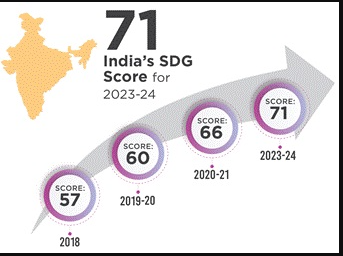
Overall SDG score for the country is 71 for 2023-24, significant improvement from 66 in 2020-21 and 57 in 2018 (Baseline report).
About SDG India Index:
The SDG India Index is a comprehensive tool developed by NITI Aayog to measure the progress of India and its states/UTs towards achieving the Sustainable Development Goals (SDGs).
The index tracks the progress on 113 indicators aligned with the National Indicator Framework of the Ministry of Statistics and Programme Implementation (MoSPI).
Key highlights and results from the fourth edition of the SDG India Index:
Top Performers: Uttarakhand and Kerala secured the top spots with a score of 79 out of 100, showcasing strong performance across Sustainable Development Goals (SDGs) such as poverty eradication, health, education, and environmental sustainability.
National Improvement: India’s overall SDG score improved from 66 points in 2020-21 to 71 points in 2023-24, indicating significant progress in achieving the SDGs nationwide. This improvement reflects efforts in poverty reduction, economic growth, and environmental conservation.
State-wise Variations: Bihar ranked lowest with 57 points, indicating areas needing more attention and development. States like Punjab, Manipur, West Bengal, and Assam showed notable improvements, with Punjab leading the pack with an increase of 8 points to reach 76 points.
Goal-specific Insights: Goals such as “No Poverty,” “Decent Work and Economic Growth,” and “Life on Land” saw the highest increases in scores, reflecting advancements in income equality, employment opportunities, and biodiversity conservation efforts.
Challenges and Focus Areas: Gender Equality received the lowest score at 49 points, highlighting persistent challenges in achieving parity in workforce participation, education access, and political representation. Addressing issues related to hunger and nutrition remains a priority, with the “Zero Hunger” goal scoring 52 points, emphasizing the need for nutritious food access and combating malnutrition.
How did States and UT performed?
Score Ranges: States’ scores range from 57 to 79, while UTs score between 65 and 77. This indicates an improvement compared to the 2020-21 scores, where the range was 52 to 75 for States and 62 to 79 for UTs.
Front Runner Category: There has been a significant increase in the number of States and UTs achieving Front Runner status. In the latest edition, 32 States/UTs scored between 65 and 99, up from 22 in the previous edition. Notably, 10 new States and UTs entered the Front Runner category, including Arunachal Pradesh, Assam, Chhattisgarh, Madhya Pradesh, Manipur, Odisha, Rajasthan, Uttar Pradesh, West Bengal, and Dadra and Nagar Haveli and Daman and Diu.
Score Improvements: Across all States and UTs, there has been improvement in composite scores ranging from 1 to 8 points since the 2020-21 edition. Leading in score improvements are Assam, Manipur, Punjab, West Bengal, and Jammu and Kashmir, each showing an increase of 8 points.
Methodology: The methodology involves compiling raw data for indicators, setting 2030 targets, normalizing data to a 0-100 score, and calculating Goal scores as means of relevant indicators. The composite score represents an average of all Goal scores, excluding Goal 14 focused solely on coastal States.
Way forward:
Targeted Interventions for Lagging States: Implement customized, data-driven interventions in States with lower scores, such as Bihar, to address specific challenges in poverty, health, and education.
Enhance Focus on Gender Equality and Nutrition: Strengthen policies and programs aimed at improving gender equality and combating malnutrition, particularly by increasing female workforce participation and ensuring access to nutritious food.
In February 2023, the Ministry of Corporate Affairs (MCA) established a Committee on Digital Competition Law (CDCL) to assess the necessity for distinct legislation concerning competition within digital markets.
What is an ex-post framework?
An ex-post framework refers to a regulatory approach where authorities intervene and enforce regulations after potentially harmful activities or behaviors have already occurred.
In the context of competition law, it means that enforcement actions are taken against anti-competitive practices only after they have been observed or reported.
How is an ex-post framework different from an ex-ante framework?
Timing of Intervention:
Ex-post framework: Intervenes after anti-competitive conduct has occurred and its effects are observed. It relies on retrospective enforcement based on complaints or identified issues.
Ex-ante framework: Proactively sets rules and obligations before anti-competitive behavior happens, aiming to prevent market distortions and protect competition from potential harms.
Nature of Regulation:
Ex-post framework: Reactive in nature, focusing on remedial measures and enforcement actions against established instances of anti-competitive behavior.
Ex-ante framework: Proactive in nature, establishing upfront rules and obligations to guide behavior and prevent market abuses by dominant players before they occur.
Focus and Objectives:
Ex-post framework: Focuses on addressing past harms to competition, ensuring fair market practices, and correcting market distortions post-occurrence.
Ex-ante framework: Focuses on maintaining competitive markets, promoting innovation, and protecting consumer choice by setting clear rules and preventing anti-competitive behavior from developing in the first place.
Why does the draft Bill encourage an ex-ante competition regulation?
Proactive Prevention: Digital markets exhibit characteristics such as rapid growth, network effects, and economies of scale that can lead to quick and irreversible market dominance. An ex-ante framework allows regulatory authorities to preemptively set rules and obligations to prevent anti-competitive practices before they occur, thereby maintaining market competition and ensuring consumer choice.
Timely Intervention: The existing ex-post framework under the Competition Act, 2002 is considered inadequate for digital markets, where traditional enforcement mechanisms may be too slow to effectively address evolving market dynamics and prevent potential harms to competition. An ex-ante approach enables timely intervention and regulatory oversight to curb monopolistic tendencies and promote a level playing field for all market participants.
What framework does the European Union follow?
The European Union follows an ex-ante competition framework under the Digital Markets Act (DMA). It regulates large digital platforms identified as gatekeepers, imposing specific obligations to ensure fair competition.
Objectives: To promote competition, innovation, and consumer choice in digital markets by proactively addressing potential market distortions caused by dominant players.
What are systemically significant digital enterprises (SSDEs)?
SSDEs are digital enterprises identified as dominant in specific digital market segments under the draft Digital Competition Bill.Identified through quantitative tests based on financial strength and user reach in India, or qualitatively based on significant influence and market impact.
SSDEs are required to operate transparently, refrain from anti-competitive practices like self-preferencing and data misuse, and ensure fair access to their platforms for other businesses.
Conclusion: Ensure that the criteria used to designate SSDEs are well-defined and balanced. Conduct periodic reviews to adjust these criteria based on market dynamics and technological advancements to accurately capture entities with significant market power without overly burdening smaller players.
Mains PYQ:
Q Examine the impact of liberalization on companies owned by Indians. Are they competing with the MNCs satisfactorily? Discuss. (UPSC IAS/2013)
The Bureau of Police Research and Development (BPRD) has issued Standard Operating Procedures (SOPs) to assist police officers in implementing these new provisions in the criminal laws.
With the new criminal laws coming into effect, how have the basic duties of police officers changed?
Registration of FIRs: The officer in charge cannot refuse to register an FIR due to jurisdiction issues. They must register a zero FIR and transfer it to the respective station. Non-registration can attract penal action.
Electronic Filing of FIRs: Information for FIRs can be given electronically, which must be signed within three days.
Mandatory Videography: Videography is now required during searches, crime scene documentation, and property possession processes. This is to ensure transparency and integrity in investigations.
Display of Arrest Information: Information about arrested individuals must be displayed prominently in police stations, ensuring transparency and accountability.
What are some of the changed provisions concerning arrests of elderly and infirm people?
Permission from an officer not below the rank of DySP is required to arrest individuals above 60 years or those who are infirm for offenses punishable by less than three years.
Handcuffing is restricted and can only be used if there is a possibility of the person escaping custody or causing harm. This aligns with the Supreme Court guidelines.
What about preserving electronic evidence?
The new laws emphasize maintaining the sequence of custody for electronic devices to ensure the integrity of evidence.
The investigating officer must inform the informant or victim about the progress of the investigation within 90 days.
How can electronic evidence be stored?
Use of eSakshya App: A cloud-based mobile app, eSakshya, allows police to capture photos and videos, ensuring they are geo-tagged and time-stamped.
Integration with ICJS: The data captured via eSakshya is part of the Inter-operable Criminal Justice System (ICJS), making it accessible to the judiciary, prosecution, and forensic experts.
Training and Equipment: Investigating officers must be provided with electronic devices and proper training to handle and preserve electronic evidence effectively.
Challenges and Implementation Issues:
Implementation and Training: The transition to new protocols, such as mandatory videography and electronic filing of FIRs, requires extensive training for police officers.
Ensuring that all officers are proficient with the new technology and understand the updated procedures can be a significant logistical and financial challenge.
Infrastructure and Connectivity: Effective implementation of electronic evidence preservation and zero FIR registration demands robust digital infrastructure and reliable internet connectivity, especially in remote or rural areas.
Many police stations may lack the necessary resources or face frequent connectivity issues, potentially hindering the timely and accurate processing of electronic evidence and FIRs.
Way forward:
Need Enhanced Training Programs: Implement comprehensive training programs for police officers nationwide to familiarize them with the new criminal laws and technological advancements.
Need Improved Digital Infrastructure: Invest in upgrading digital infrastructure and ensuring reliable internet connectivity across all police stations, especially in rural and remote areas.
Mains PYQ:
Q The jurisdiction of the Central Bureau of Investigation (CBI) regarding lodging an FIR and conducting probe within a particular State is being questioned by various States. However, the power of the States to withhold consent to the CBI is not absolute. Explain with special reference to the federal character of India. (UPSC IAS/2021)
![[31st July 2024] The Hindu Op-ed: A Licence Raj for digital content creators](https://www.civilsdaily.com/wp-content/uploads/2024/07/31-july-1568x882.jpg)
![[17th July 2024] The Hindu Op-ed: Centralised examinations have not aced the test](https://www.civilsdaily.com/wp-content/uploads/2024/07/17-july-1568x882.jpg)
![[15th July 2024] The Hindu Op-ed: The problem with the Karnataka Gig Workers Bill](https://www.civilsdaily.com/wp-content/uploads/2024/07/15-july-1568x882.jpg)