💥Mains Ready By December. Smash Mains & Smash PYQ Admissions Open

GS Paper: Government Scheme/Policies

  • Divesting States of the power to determine backwardness hits federalism

    The article highlights the issues with the Supreme Court judgement in the Maratha reservation case.

    Three findings from Maratha reservation judgement

    • Recently, the Supreme Court of India declared as unconstitutional a Maharashtra law which provided for reservation to the Maratha community.
    • Three primary findings emanated from the judgement-
    • 1) Maratha not backward class: The Court held that the Maratha community did not constitute a socially and educationally backward class.
    • 2) Breach of 50% limit: The bench said that the law was in breach of a rule previously set by the Court disallowing reservations made in excess of 50% of the total available positions.
    • 3) Power of the States: The Court held that State governments had no independent power to declare a group as a backward class.

    Issues with the judgement

    The latter two findings run against the values of equality and federalism, which the Court has long regarded as integral to India’s democracy.

    1)  50% limit does not stem from the Constitution

    • Articles 16(4) and 15(4) which confer power on the government to make reservations do not contains 50% limitation.
    • Reservation as an exception: Originally, however, these clauses were seen by the Supreme Court as exceptions to a broad rule of formal equality envisioned by the Constitution.
    • To that end, the Court held that to allow reservation in excess of 50% would lead to an exception overriding a rule. 
    • Reservation as basic guarantee: Countering the reservations as an exception position, a seven-judge Bench, in State of Kerala vs N.M. Thomas (1975), held that a programme of reservation was inherent in the Constitution’s basic guarantee of equal treatment.
    • This judgment held that affirmative action by the state was compelled by an objective of attaining substantive equality.
    • With this judgement the rule requiring that reservations stay under 50% ought to have been deemed incongruous.
    • But when the Court sat as a nine-judge Bench in Indra Sawhney vs Union of India (1992) it sustained the 50% limit.
    • The majority on the Bench ruled, on the one hand, that N.M. Thomas was correct in seeing reservations as embedded in a constitutional vision of substantive equality.
    • On the other hand, the bench accepted that reservation made in excess of 50%, barring exceptional circumstances, was harmful to that very vision. 

    2) Interpretation of 102nd Amendment curtails the powers of the State governments to declare groups as backward

    • After Indra Sawhney judgement, the determination of backward classes was made by the National Commission for the Backward Classes, at the level of the Centre, and by regional commissions at the level of the State governments.
    • This division in power, gave States autonomy to classify groups as backward.
    • In contrast, the power to prepare lists of Scheduled Castes and Scheduled Tribes, vested solely with the Union government.
    • The 102nd Amendment (2018), introduced Article 342A.
    • Article 342A stipulated that the President of India may, after consultation with the State government, notify groups of persons within such a State who are deemed to be socially and educationally backward.
    • Any such “Central List”, the clause clarified, could only be altered by Parliament.
    • Article 366(26C) was also added, and “socially and educationally backward classes” was defined as “such backward classes as are so deemed under Article 342A for the purposes of this Constitution”.
    • In interpreting these changes, a majority in the Maratha reservation judgement concluded that the power for determination of other backward classes rests solely with the Centre.

    How this interpretation goes against the federalism

    • This interpretation of 102nd Amendment altogether dispossess States from exercising a time-honoured authority.
    • But yet the amendment, in the Court’s belief, did not violate the Constitution’s basic structure.
    • This was because, according to the majority, the alterations neither took away “the very essence of federalism” nor denuded the States of their effective power to legislate.
    • But divesting states of power this critical, to classify groups as backward, entitling many communities to protection under Articles 15(4) and 16(4) is offensive to the “essence” of federalism.
    • The changes, as interpreted by the Court, directly impede the ability of States to secure just social order.

    Consider the question “What are the implications for the States of the interpretation of the 102nd Amendment by the Supreme Court in the Maratha reservation case?” 

    Conclusion

    It is imperative that Parliament amend the Constitution and grants to States an express power to determine backwardness. Any other result will offend the delicate balance at the heart of Indian federalism.
  • Section 142 of the Social Security Code – 2020 Notified

    Aadhaar mandatory

    • The Union government has made Aadhaar mandatory for availing social security benefits, and for registration on a national informal workers’ database being developed for migrants.
    • The labour ministry has notified section 142 of the social security code.
    • It allows authorities to collect Aadhaar details for the database of beneficiaries under various social security schemes.
    • The move will be applicable to both formal and informal workers and may also help in curbing duplication of data by keeping imposters at bay, authorities said.
    • However, people who don’t have Aadhaar will not be denied of benefits, the ministry claims.

    National informal workers’ database

    •  National database for unorganized workers is at an advanced stage of development by National Informatics Centre.
    • The portal is aimed at collection of data for unorganized workers, including migrant workers for the purpose of giving benefits of the various schemes of the government.
    • An inter-state migrant worker can register himself on the portal on the basis of submission of Aadhaar alone.

    ——————————————————//—————————————–

    BACK2BASICS

    • The Code on Social Security, 2020 is a code to amend and consolidate the laws relating to social security with the goal to extend social security to all employees and workers either in the organised or unorganised or any other sectors.
    • The Social Security Code, 2020 brings unorganised sector, gig workers and platform workers under the ambit of social security schemes, including life insurance and disability insurance, health and maternity benefits, provident fund and skill upgradation, etc. The act amalgamates 9 central labour enactments relating to social security.
    • To access complete Act, you can click on the link given below:

    https://labour.gov.in/sites/default/files/SS_Code_Gazette.pdf

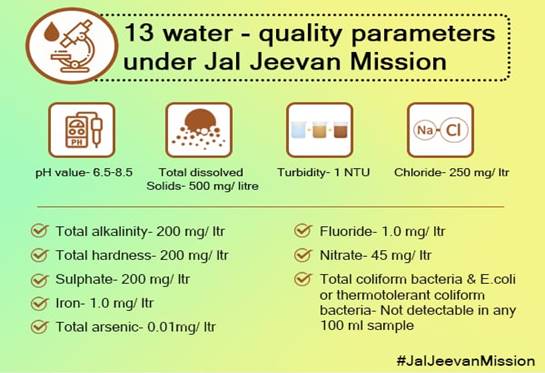
  • [pib] Kerala presents its Annual Action plan under Jal Jeevan Mission

    Annual Action Plan presented

    • Annual Action Plan (AAP) on planning and implementation of Jal Jeevan Mission (JJM) in Kerala was presented.
    • Kerala State officials outlined the roadmap of the financial year 2021-2022 to the national committee via video conferencing.
    • The State plans to achieve the target of ‘Har Ghar Jal’ by 2024.
    • The State also plans to provide potable water in all quality-affected habitations by June 2021 through piped water supply or Community Water Purification Plants (CWPP).
    • The national committee analysed and advised on the plan presented by the State.
    • The committee emphasized the preparation of Village Action Plans and the constitution of Village Water &Sanitation Committee/ Pani Samiti as a sub-committee of Gram Panchayat with a minimum 50% of women members.
    • Also, emphasis is required on Water Quality Monitoring & Surveillance (WQM&S) activities to ensure Field Test Kit testing at Gram Panchayat level, Aanganwadi centres and schools.

    About Jal Jeevan Mission

    • Jal Jeevan Mission is the flagship programme of Government of India, which aims to provide household tap water connection to every rural household by 2024.
    • Since announcement of the mission in August 2019, 4.17 Core new tap connections have been provided in the rural areas of the country during this period.
    • As a result, 7.40 Crore (38.56%) rural households have tap water supply vis-à-vis 3.23 Crore (17%) in 2019.
    •  Efforts are made to dovetail all available resources by convergence of different programmes viz. MGNREGS, SBM, 15th Finance Commission Grants to PRIs, CAMPA funds, Local Area Development Funds, etc.

    Allocation for the JJM

    •  In 2021-22, Rs. 50,000 Crore budgetary allocation has been made for Jal Jeevan Mission.
    • In addition to this, there is also Rs. 26,940 Crore assured fund available under the 15th Finance Commission tied grants to RLBs/ PRIs for water & sanitation, matching State share and externally aided projects.
    • Thus, in 2021-22, more than Rs. 1 lakh Crore is planned to be invested in the country on ensuring tap water supply to rural homes.
    • This huge investment will give a boost to manufacturing activities, create employment opportunities in rural areas as well boost the rural economy.
  • Making social welfare universal

    The article highlights the need for universal social protection scheme in India and suggests a way to achieve it.

    Need for universal social security

    • The pandemic has revealed that leveraging our existing schemes and providing universal social security is of utmost importance.
    • This will help absorb the impact of external shocks on our vulnerable populations.
    • The country has over 500 direct benefit transfer schemes for which various Central, State, and Line departments are responsible.
    • However, these schemes have not reached those in need.

    Lessons from Poor Law System in Ireland

    • An example of a universal social protection scheme is the Poor Law System in Ireland.
    • In the 19th century, to deal with poverty and famine, Ireland introduced the Poor Law System to provide relief that was financed by local property taxes.
    • These laws were notable for not only providing timely assistance but maintaining the dignity and respectability of the poor while doing so.
    • They were not designed as hand-outs but as necessary responses to a time of economic crisis.
    • Today, the social welfare system in Ireland has evolved into a four-fold apparatus that promises social insurance, social assistance, universal schemes, and extra benefits/supplements.

    Issues with the existing social protection schemes in Inda

    • Existing schemes in India cover a wide variety of social protections.
    • However, they are fractionalised across various departments and sub-schemes.
    • This causes problems beginning with data collection to last-mile delivery.

    How universal system would help

    • Having a universal system would improve the ease of application by consolidating the data of all eligible beneficiaries under one database.
    • It can also reduce exclusion errors.
    • The Pradhan Mantri Garib Kalyan Yojana (PMGKY) is one scheme that can be strengthened into universal social security.
    • It already consolidates the public distribution system (PDS), the provision of gas cylinders, and wages for the MGNREGS.
    • Generally, social assistance schemes are provided on the basis of an assessment of needs.
    • Having a universal scheme would take away this access/exclusion barrier.
    • For example, PDS can be linked to a universal identification card such as the Aadhaar or voter card, in the absence of a ration card.
    • This would allow anyone who is in need of foodgrains to access these schemes.
    • It would be especially useful for migrant populations.
    • Making other schemes/welfare provisions like education, maternity benefits, disability benefits etc. also universal would ensure a better standard of living for the people.
    • To ensure some of these issues are addressed, we need to map the State and Central schemes in a consolidated manner.
    • This is to avoid duplication, inclusion and exclusion errors in welfare delivery.
    • The implementation of any of these ideas is only possible through a focus on data digitisation, data-driven decision-making and collaboration across government departments.

    Consider the question “What are the issues with existing social security schemes in India? What would be the benefits of replacing all these social security schemes with universal social security scheme?”

    Conclusion

    India is one of the largest welfare states in the world and yet, with COVID-19 striking in 2020, the state failed to provide for its most vulnerable citizens. This underlines the need for a universal social protection scheme in India.

  • [pib] PM launches distribution of e-property cards under SWAMITVA scheme

    e-Property cards under SWAMITVA scheme

    • The Prime Minister launched the distribution of e-property cards under the SWAMITVA scheme on National Panchayati Raj Day (24 April).
    • 4.09 lakh property owners were given their e-property cards on this occasion, which also marked the rolling out of the SVAMITVA scheme for implementation across the country.
    • Under the scheme, the entire village properties are surveyed by drone and property card are distributed to the owners.
    • The Scheme has infused a new confidence in the villages  as property documents remove uncertainty and reduce the chances of property disputes while protecting the poor from exploitation and corruption.
    • This eases credit possibility also.

    About SWAMITVA Scheme

    • SVAMITVA (Survey of Villages and Mapping with Improvised Technology in Village Areas) was launched by Prime Minister on 24th April 2020.
    • It is a Central Sector Scheme to promote a socio-economically empowered and self-reliant rural India.
    • The Scheme has the potential to transform rural India using modern technical tools of mapping and surveying.
    • It paves the way for using the property as a financial asset by villagers for availing loans and other financial benefits.
    • The Scheme will cover around 6.62 Lakh villages of the entire country during 2021-2025.
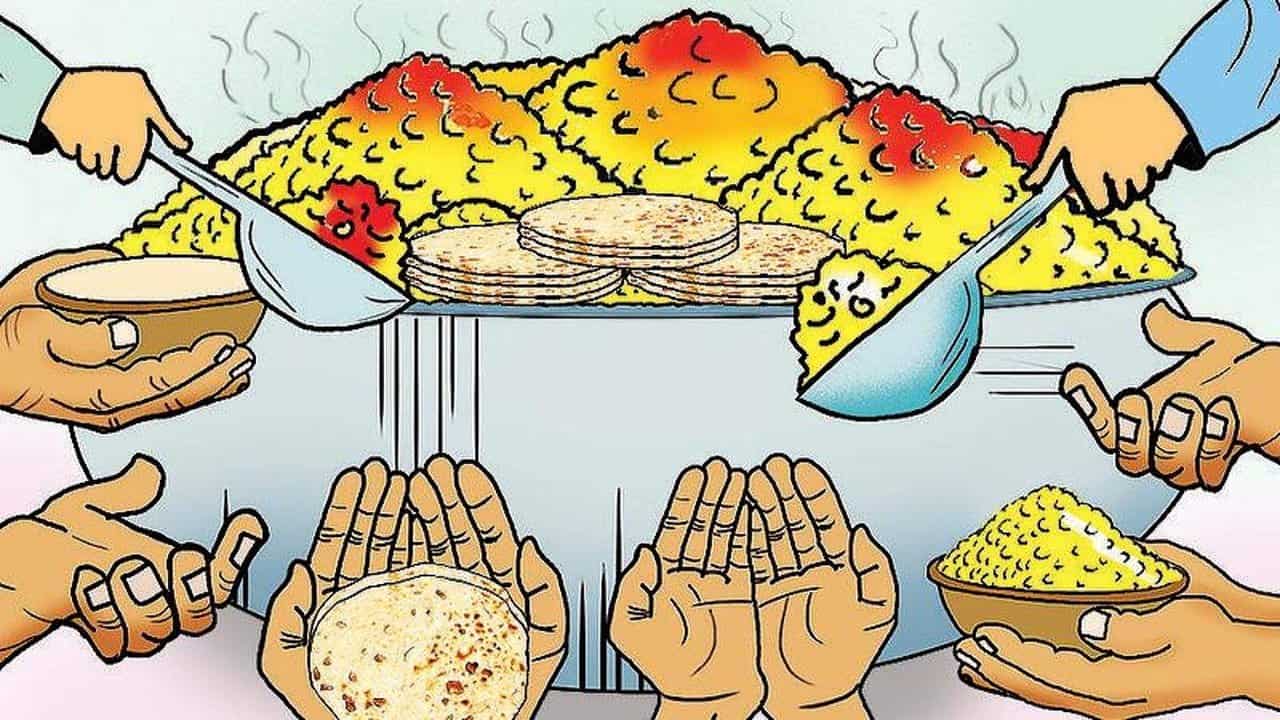
  • Centre to give 5 kg foodgrains free to poor

    The Central Government announced that 5kg of free wheat or rice per monthwill be provided to around 80 crore people for the next two months, May and June.

    Major Highlights:

    • This will be extended to beneficiaries under the National Food Security Act(NFSA).
    • Nearly 8 million tonnes of food grains will be distributed under this scheme.
    • The scheme is expected to bring relief to NFSA beneficiaries as it will be in addition to the regular entitlement of 5kg highly subsidised foodgrains to each beneficiary at Rs 3, 2 and 1 per kg of rice, wheat and coarse grains.

    Pradhan Mantri Garib Kalyan Anna Yojana (PMGKAY):

    • Pradhan Mantri Garib Kalyan Anna Yojana is a food security welfare schemeannounced by the Government of India in March 2020.
    • PM-GKAY is a part of Atma Nirbhar Bharat to supply free food grains to migrants and poor.
    • The program is operated by the Department of Food and Public Distributionunder the Ministry of Consumer Affairs, Food and Public Distribution.

    Aim:

    • To feed the poorest citizens of India by providing grain through the Public Distribution System to all the priority households (ration card holders and those identified by the Antyodaya Anna Yojana scheme).
    • PMGKAY provides 5 kg of rice or wheat (according to regional dietary preferences) per person/month and 1 kg of dal to each family holding a ration card.

    Eligibility/ Beneficiaries:

    • Families belonging to the Below Poverty Line – Antyodaya Anna Yojana (AAY) and Priority Households (PHH) categories will be eligible for the scheme.
    • PHH are to be identified by State Governments/Union Territory Administrations as per criteria evolved by them.
    • AAY families are to be identified by States/UTs as per the criteria prescribed by the Central Government:
      • Households headed by widows or terminally ill persons or disabled persons or persons aged 60 years or more with no assured means of subsistence or societal support.
      • Widows or terminally ill persons or disabled persons or persons aged 60 years or more or single women or single men with no family or societal support or assured means of subsistence.
      • All primitive tribal households.
      • Landless agriculture labourers, marginal farmers, rural artisans/craftsmen such as potters, tanners, weavers, blacksmiths, carpenters, slum dwellers, and persons earning their livelihood on daily basis in the informal sector like porters, coolies, rickshaw pullers, hand cart pullers, fruit and flower sellers, snake charmers, rag pickers, cobblers, destitute and other similar categories in both rural and urban areas.
      • All eligible Below Poverty Line families of HIV positive persons.
  • Fifth session of Codex Committee on Spices and Culinary Herbs

    Fifth session of Codex Committee on Spices and Culinary Herbs (CCSCH)established under Codex Alimentarius Commission (CAC) inaugurated virtually on 20th April with a series of virtual sessions.

    • The session will see nearly 300 experts from 50 countries taking part in the deliberations.

    About CCSCH:

    • Codex Committee on Spices and Culinary Herbs was formed in 2013 with support of more than a hundred countries with India as the host country and Spices Board India as the Secretariat for organising the sessions of the committee.
    • The objective was to develop and expand worldwide standards for spices and culinary herbs, and to consult with other international organisations in the standards development process.
    • Since its inception, the Codex Committee on Spices and Culinary Herbs has been successful in developing harmonised global Codex standards for spices and herbs.
    • In its past four sessions, the committee developed and finalized standards for four spices, viz. dried or dehydrated forms of black/white/green pepper, cumin, thyme, and garlic.

    About CAC:

    • The Codex Alimentarius Commission (CAC) is an intergovernmental body.
    • Set up in 1963.
    • It was established jointly by the UN’s Food and Agriculture Organisation (FAO) and the World Health Organisation (WHO), within the framework of the Joint Food Standards Programme to protect the health of consumers and ensure fair practices in the food trade.
  • Employee State Insurance Scheme and Employee Provident Fund

    The idea of welfare state

    • Covid reminds us that a modern state is a welfare state as governments worldwide launched 1,600 plus new social protection programmes in 2020.
    • Sustainable social security lies in raising India’s 138th ranking in country per-capita GDP.
    • However, on the social security schemes, there is a case for three reforms to our biggest health insurance and pension schemes:
    • These schemes are the Employee State Insurance Scheme (ESIS) and Employee Provident Fund (EPF).

    Issues with ESIS

    • The Employee State Insurance Scheme (ESIS) is India’s richest and biggest health insurance scheme with 13 crore people covered and Rs 80,000 crore in cash.
    • Employers with more than 10 employees make a mandatory 4 per cent payroll deduction for employees earning up to Rs 21,000 per month.
    • Despite covering roughly 10 per cent of India’s population, a recent working paper from Dvara Research suggests high dissatisfaction.
    • The constraint is hardly resources: ESIC’s unspent reserves are larger than the Central government’s healthcare budgetary allocation.

    Issues with EPF

    • EPF is India’s biggest pension scheme with a Rs 12 lakh crore corpus and 6.5 crore contributors.
    • Employers with more than 20 employees make mandatory 24 per cent payroll deductions for employees earning up to Rs 15,000 per month.
    • It only covers 10 per cent of India’s labour force and 60 per cent of accounts and 50 per cent of registered employers are inactive.
    • EPF offers poor service and pathetic technology despite employer-funded administrative costs that make it the world’s most expensive government securities mutual fund.

    Updating the risk-sharing frameworks in society

    • In a book titled What We Owe Each Other: A New Social Contract, Nemat Shafik suggests updating the risk-sharing framework in societies.
    • This is because current structures are breaking up under the weight of changes in the role of women, longer careers, technology, globalisation, and much else.
    • She suggests a more nuanced social security redistribution across time (the piggy bank function), incomes (the Robin Hood function), and financial burden-bearing (the state, individuals, or employers).
    • In India, the answer lies in fixing the problems of EPF and ESIS.

    Solution to the EPF and ESIS problems

    • Both suffer from poor coverage, high costs, unsatisfied customers, metrics confused with goals, jail provisions, excessive corruption, low expertise, rude and unaccountable staff with no fear of falling or hope of rising, and no competition.

    Let’s look at possible solutions.

    1) Structure

    • EPF and ESIS combine the roles of policymaker, regulator, and service provider.
    • Splitting roles is a precondition for performance because goals, strategy, and skills are different.
    • An independent policymaker horrified with only 6 lakh of India’s 6.3 crore enterprises covered would create competition.
    • An independent regulator terrified by ESIS overcharging would frown on a claims ratio of less than 75 per cent.
    • An independent service provider would invest heavily in technology, customer service, and human capital.
    • Splitting roles would lead to the following benefits:
    • 1) Competition from NPS for EPF.
    • 2) Ending VIP opt-out by merging CGHS with ESIS,
    • 3) Raising enforceability by making employee provident fund contribution voluntary.
    • 4) Improving portability by de-linking accounts from employers.
    • 5) Targeting universalisation by simultaneously ending minimum employer head-count and employee salary contribution thresholds while introducing absolute contribution caps.
    • The Health and Finance Ministry would be logical homes for ESIS and EPF policy roles.

    2) Governance

    • The governing board of ESIS and EPFO have 59 and 33 members respectively.
    • Such a large group can’t have meaningful discussions, make decisions, and exercise oversight.
    • This governance deficit needs smaller boards (not more than 15), age limits, term limits, expertise, active sub-committees (HR, Investments, and technology) and real powers.

    3) Leadership

    • Health and pensions need complex skills developed over time.
    • Yet, ESIS and EPF are led by generalist bureaucrats.
    • Both organisations need professional chief executives.
    • Philosopher Isaiah Berlin’s framing of the generalist vs specialist debate as hedgehogs (who know one thing) and foxes (who know many things) is important.
    • A less generalist, non-transitory, and non-cadred chief executive would create a new tone-from-the-top around performance management, technology, and service outcomes.

    Conclusion

    Social security — not a borrowing binge that steals from our grandchildren — can blunt structural and COVID inequality when combined with complementary policies like formalisation, financialisation, urbanisation, and better government schools. But a great place to start is three flick-of-pen, non-fiscal reforms at EPF and ESIS.

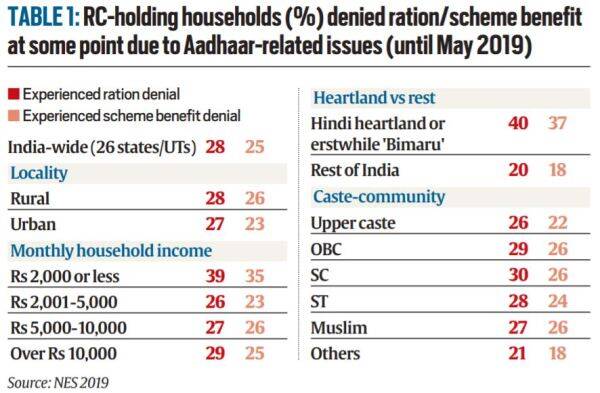
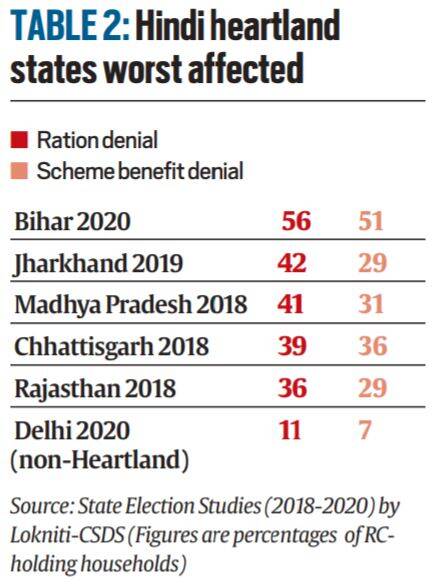
  • When Aadhaar-related problems lead to denial of rations and benefits: what the data show

    The Supreme Court recently asked the Centre to respond to allegations made in a Public Interest Litigation with respect to 3 crore ration cards being cancelled in the country because of the insistence on Aadhaar linkage and biometric authentication.

    Key Points

    About Aadhar Card:

    • Aadhar Card is basically a biographic and biometric data of Indian citizens that includes name, date of birth, gender, address, a photograph, and ten fingerprint and two iris scans.
    • It includes a unique 12-digit Aadhaar number.
    • The Aadhar Card is a residential proof and not a citizenship card.
  • National Pension System (NPS)

    The National Pension System (NPS) will no longer compel investors to convert 40% of their accumulated retirement corpus into an annuity.

    An annuity is a long-term investment that is issued by an insurance company and is designed to help protect you from the risk of outliving your income. Through annuitisation, your purchase payments (what you contribute) are converted into periodic payments that can last for life.

    Why such a move?

    • Poor yields on annuities and high inflation are translating into negative returns.
    • Since annuities are taxable, deducting the tax and factoring in inflation means annuities are yielding negative returns.

    Try this PYQ:

    Q.Who among the following can join the National Pension System (NPS)?

    (a) Resident Indian citizens only

    (b) Persons of age from 21 to 55 only

    (c) All-State Government employees joining the services after the date of notification by the respective State Governments

    (d) All Central Governments Employees including those of Armed Forces joining the services on or after 1st April 2004

    National Pension Scheme (NPS)

    • NPS is a government-sponsored pension scheme. It was launched in January 2004 for government employees.
    • It was extended to all citizens of Indian on a voluntary basis from May 2009 and to corporates in December 2011 and to Non-Resident Indians in October 2015.
    • PFRDA is the statutory authority established by an enactment of the Parliament, to regulate, promote and ensure orderly growth of the NPS and pension schemes to which this Act applies.
    • The scheme allows subscribers to contribute regularly in a pension account during their working life.
    • On retirement, subscribers can withdraw a part of the corpus in a lump sum and use the remaining corpus to buy an annuity to secure a regular income after retirement.

    Who can join NPS?

    • Any Indian citizen between 18 and 60 years can join NPS.
    • The only condition is that the person must comply with know your customer (KYC) norms.
    • An NRI can join NPS. However, the account will be closed if there is a change in the citizenship status of the NRI.
    • Now, any Indian citizen, resident or non-resident and OCIs are eligible to join NPS till the age of 65 years.