GS Paper: GS1-02.Modern Indian History- Mid-18th century – Present (significant events, personalities, issues);

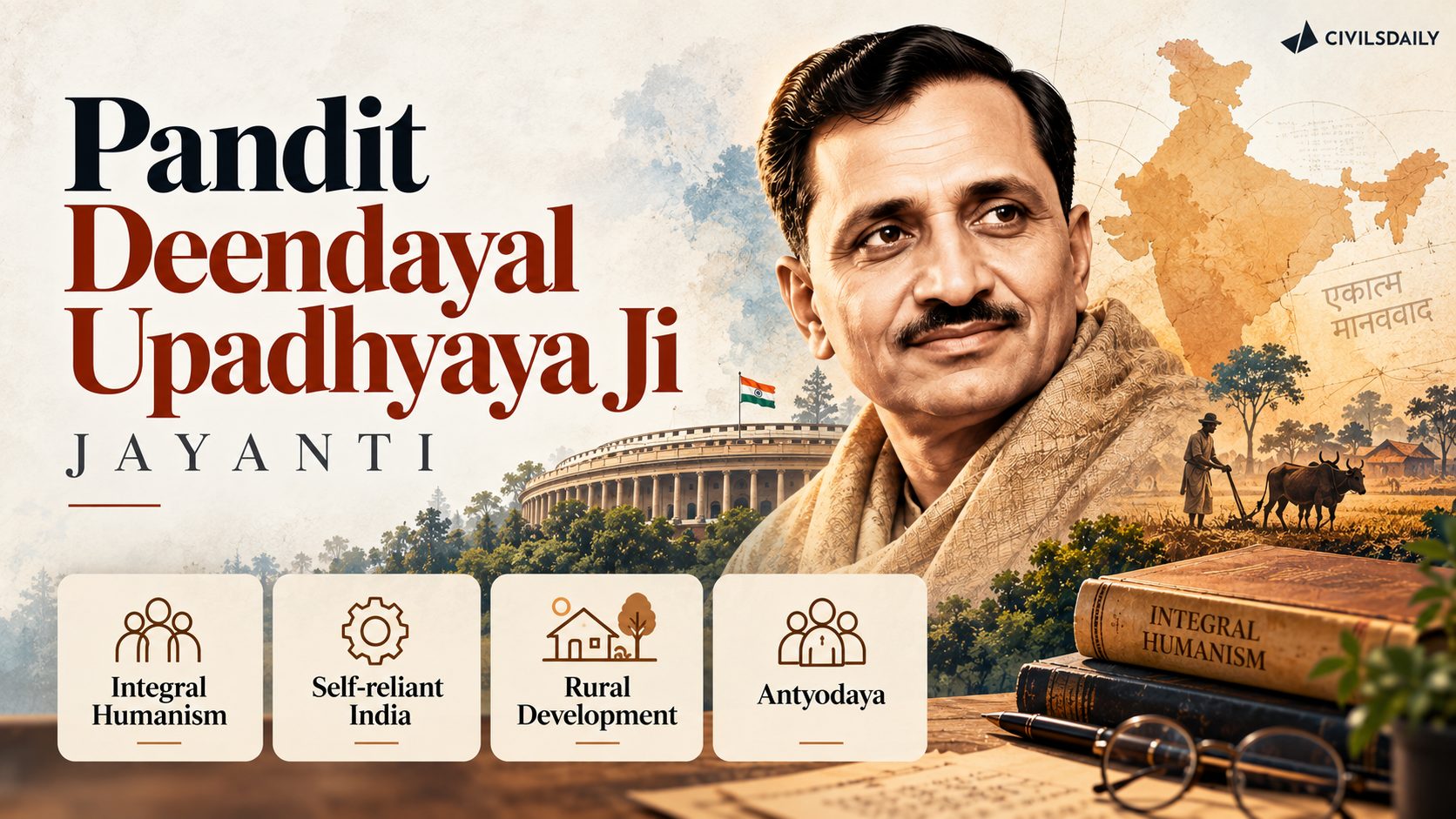
  • Pandit Deendayal Upadhyaya Ji – Jayanti

    Pandit Deendayal Upadhyaya Ji – Jayanti

    Why in the News?

    • Prime Minister Narendra Modi paid tributes to Pandit Deendayal Upadhyaya on his Jayanti on 25 September 2026.
    • The PM highlighted his vision of Antyodaya and the upliftment of the marginalized as a foundation of nation-building.

    Key Highlights

    • Date: 25 September 2026
    • Person: Pandit Deendayal Upadhyaya
    • Core idea: Antyodaya – upliftment of the person standing in the last line of society.
    • Nation-building: Social welfare and upliftment of marginalized sections were highlighted as central to nation-building.
    • PM urged citizens to imbibe his ideals and fulfil their social and national responsibilities.
    • Sanskrit Subhashitam emphasised:
      • Continuous effort and perseverance lead to success.
      • Dedicated action, courage and resolve are important for innovation.
      • Success and innovation were presented as outcomes of sustained effort rather than luck.

    Antyodaya

    • Means focusing on the upliftment of the person at the last end of society.
    • In the article, it is presented as a central idea associated with Pandit Deendayal Upadhyaya.
    • Linked with social welfare and inclusive nation-building.

    Sanskrit Subhashitam

    • “यथा यथा प्रयत्नः स्याद्भवेदाशु फलं तथा।”
    • Emphasises that greater effort and perseverance can lead to quicker achievement of results.
    • The article connects the idea with innovation, stressing continuous effort and dedicated action.

    Prelims Quick Revision

    • 25 September – Jayanti of Pandit Deendayal Upadhyaya.
    • Antyodaya – upliftment of the person at the last line of society.
    • Deendayal Upadhyaya’s vision was associated with nation-building through upliftment of marginalized sections.
    • The PM highlighted social and national responsibility.
    • Sanskrit Subhashitam emphasised effort, perseverance and dedicated action.
    • The article links continuous effort with both success and innovation.
    • The message contrasts dedicated action and courage with reliance on luck.

    UPSC Prelims Trap

    • Antyodaya should not be confused with a specific scheme in this article; it is presented as a vision/ideology associated with Deendayal Upadhyaya.
    • The article does not provide details of any specific government scheme under Antyodaya.
    • The Sanskrit Subhashitam emphasises effort and perseverance, not merely luck, as drivers of success.
    • 25 September is the date highlighted for Pandit Deendayal Upadhyaya’s Jayanti.
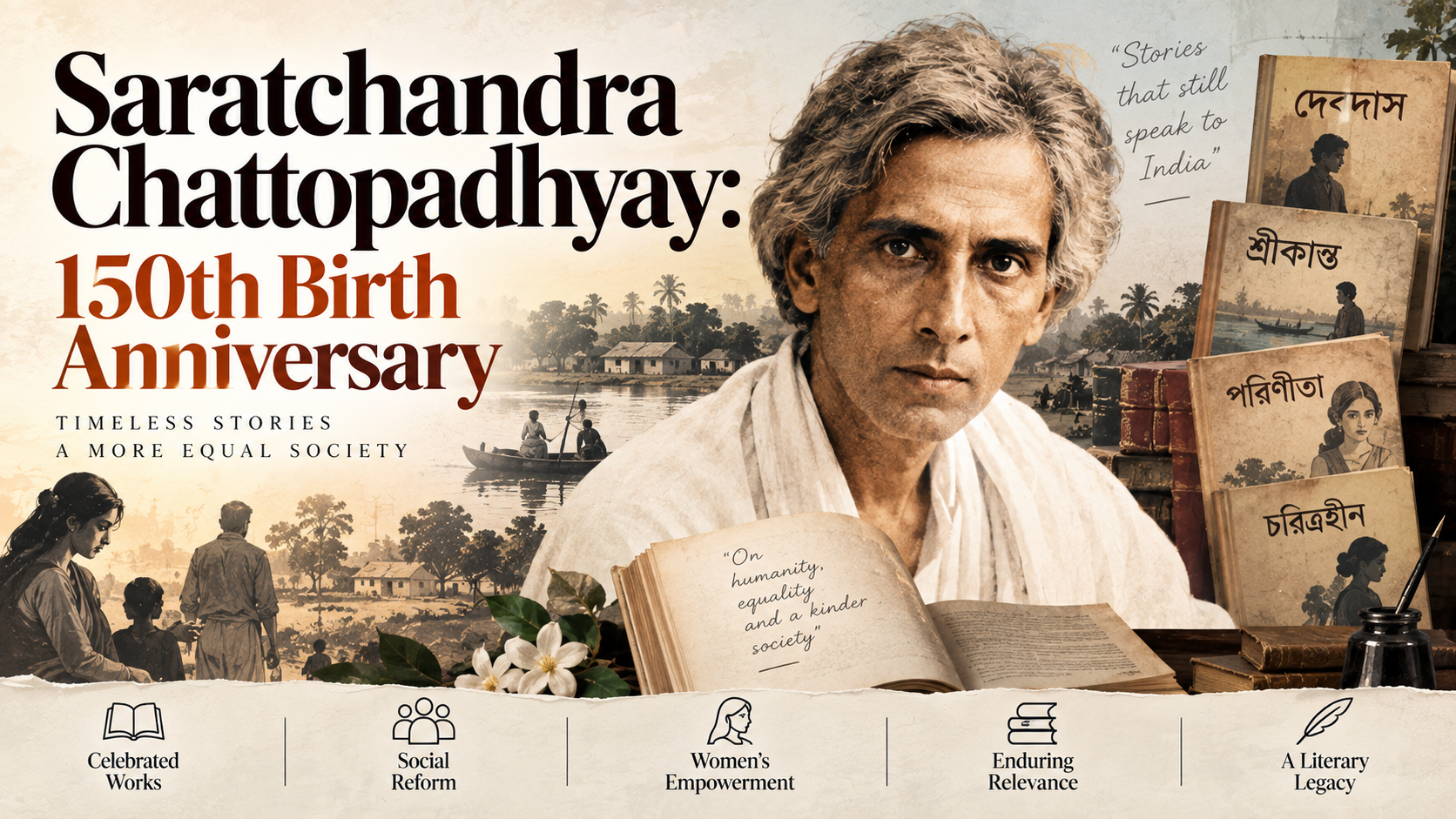
  • Saratchandra Chattopadhyay: 150th Birth Anniversary

    Saratchandra Chattopadhyay: 150th Birth Anniversary

    Why in the News?

    Prime Minister Narendra Modi paid tribute to Saratchandra Chattopadhyay on his 150th birth anniversary, highlighting his enduring contribution to Bengali literature and social consciousness.

    Who was Saratchandra Chattopadhyay?

    • Born: 15 September 1876, Debanandapur, Bengal Presidency
    • Died: 16 January 1938
    • One of the most widely read Bengali novelists and short-story writers.
    • His simple, emotionally powerful writing brought the lives of ordinary people, women and socially marginalised groups into mainstream literature.
    • His works have been translated into Indian and foreign languages, giving him a wider literary influence.

    Literary & Social Significance

    1. Social realism

    • Portrayed social inequalities, caste and class distinctions, poverty and conservative social practices.
    • Particularly captured the complexities of Bengal’s rural and semi-urban society.

    2. Women’s emancipation

    • Female characters often challenge restrictive social norms.
    • Explored issues such as widowhood, child marriage, patriarchy, education and women’s autonomy.
    • Women are not merely passive characters but often represent moral agency and resistance to social conventions.

    3. Nationalism

    • His writings reflected the intellectual and emotional atmosphere of the Indian nationalist movement.
    • Pather Dabi is particularly associated with anti-colonial nationalism and revolutionary politics.

    4. Language and accessibility

    • Used relatively simple, colloquial Bengali, making literature accessible to a broad readership.
    • Helped bridge the gap between elite literary culture and ordinary readers.
    WorkUPSC Relevance
    DevdasSocial conventions, class and emotional conflict
    ParineetaGender, marriage and social hierarchy
    Biraj BauWomen’s condition and patriarchy
    SrikantaSocial conventions, individual freedom and society
    CharitraheenGender morality and social hypocrisy
    Pather DabiNationalism, colonialism and revolutionary politics
    GrihadahaMarriage, relationships and social norms

    [2020] With reference to the book ‘Desher Katha’ (1904) written during the freedom struggle, consider the following statements:
    1.It warned against the Colonial State’s “hypnotic conquest of the mind,” explaining how the British successfully colonized the Indian psyche.
    2.It inspired the performance of swadeshi street plays, folk songs, and the “Yatras” in Bengal.
    3.The use of the word ‘desh’ by Deuskar was specifically meant to refer only to the region of Bengal and its linguistic identity.
    Which of the statements given above are correct?

    [A] 1 and 2 only

    [B] 2 and 3 only

    [C] 1 and 3 only

    [D] 1, 2, and 3

  • The 1946 Naval Mutiny That Shook British Rule in India

    Why in News

    The Royal Indian Navy (RIN) uprising began in Bombay on 18 February 1946 and spread to about 78 ships and 20 shore establishments, involving nearly 20,000 personnel. It demonstrated that British India’s armed forces could no longer be relied upon to suppress nationalist resistance.

    Causes

    • Poor food, living conditions and service grievances
    • Racial discrimination by British officers
    • Post-war demobilisation and loss of status
    • Anger over the INA trials
    • Abuse of sailors by Commander Arthur Frederick King.

    Demands

    • Action against Commander King
    • Better pay, food and service conditions
    • Withdrawal of Indian troops from Indonesia
    • Free trials for INA detainees.

    Spread & Suppression

    • Involved 78 ships + 20 shore establishments
    • Spread to Mumbai and Karachi, with civilian support
    • Strikers seized Butcher Island and removed British flags
    • Police firing in Bombay on 22 February killed at least 400 people, with estimates ranging higher.

    Significance

    • Air Force and Army units also showed mutinous conduct
    • British realised Indian forces might not obey orders to suppress Indians
    • Thus, the uprising hastened the transfer of power
    • Often described by naval historians as the “last war of independence.”

    Key Facts

    • 18-23 February 1946: Uprising
    • M.S. Khan: Naval Central Strike Committee president
    • Madan Singh: Vice-president
    • 23 February: Strikers surrendered
    • 2001: Memorial unveiled at Colaba, Mumbai
    • Butcher Island: Now Jawahar Dweep.

    “[2014, GS1, 10 marks] In what ways did the naval mutiny prove to be the last nail in the coffin of British colonial aspirations in India?”

    [2017] With reference to Indian freedom struggle, consider the following events :
    1. Mutiny in Royal Indian Navy
    2. Quit India Movement launched
    3. Second Round Table Conference

    What is the correct chronological sequence of the above events ?

    (a) 1-2-3

    (b) 2-1-3

    (c) 3-2-1

    (d) 3-1-2