National Sports Day is celebrated on August 29 in India to honor the memory of “Major Dhyan Chand”, widely regarded as the first superstar of Indian hockey and arguably India’s first sporting superstar.
About MajorDhyan Chand:
Details
Birth
Born on August 29, 1905, in Allahabad, India
Olympic Achievements
Led India to three Olympic gold medals in 1928 (Amsterdam), 1932 (Los Angeles), and 1936 (Berlin).
Career Goals
Scored 33 goals in 12 Olympic matches, nearly averaging a hat-trick per game.
Signature Skill
Renowned for his exceptional dribbling and ball control.
Anecdotes
Famous for his stick work so effective that his hockey stick was checked for magnets;
Declined an offer from Adolf Hitler to change nationality after the 1936 Olympics.
National Recognition
In honour of his contributions, August 29 is celebrated as National Sports Day in India.
Rajiv Gandhi Khel Ratna Award was renamed the Major Dhyan Chand Khel RatnaAward in 2021.
It is the highest sporting award given by the Ministry of Youth Affairs and Sports for the spectacular and most outstanding performance in the field of sports by a sportsperson over four years.
The award comes with a cash prize of Rs 25 lakh.
The Khel Ratna Award was instituted in 1991-1992 and the first recipient was Chess legend Viswanathan Anand.
Winners: Leander Paes, Sachin Tendulkar, Dhanraj Pillay, Pullela Gopichand, Abhinav Bindra, Anju Bobby George, Mary Kom and Rani Rampal in 2020.
Legacy
Major Dhyan Chand National Stadium in New Delhi is named after him, underscoring his impact on Indian sports infrastructure.
PYQ Relevance: Mains: Q.1 Bring out the constructive programmes of Mahatma Gandhi during the Non-Cooperation Movement and Civil Disobedience Movement. (UPSC IAS/2021) Q.2 Can the strategy of regional-resource-based manufacturing help in promoting employment in India? (UPSC IAS/2019)
Note4Students:
Prelims: Khadi and Village Industries Commission (KVIC);
Mains:Challenges related to khadi industry;
Mentor comments: The khadi industry in India is a vital segment of the textile sector, known for its hand-spun and hand-woven fabrics made from cotton, silk, and wool. It plays a crucial role in generating employment, particularly in rural areas, with millions of artisans involved in its production. The industry has seen significant growth, with khadi production valued at ₹1,904.5 crore (USD 255.8 million) in FY21, up from ₹1,520.8 crore (USD 204.3 million) in FY17. Promoted by the Khadi and Village Industries Commission (KVIC), khadi symbolizes India’s heritage and commitment to sustainable practices.
Let’s learn —
Why in the News?
The Prime Minister’s ‘Har Ghar Tiranga’ campaign highlights moral contradiction, as machine-made polyester flags, often imported, overshadow the significance of our national flag.
The Flag Code of India has historically required the national flag to be made of “hand spun and hand-woven wool/cotton/silk khadi bunting”
Significance of Khadi Industries:
Second Largest Employer: After agriculture, the khadi industry is the second largest industry to provide employment opportunities to the unemployed and rural people
Preserving Heritage: Khadi is a national heritage fabric of India with a unique identity and a rich tradition dating back to ancient times.
Symbol of Freedom Struggle: Khadi was the fabric of the freedom struggle, with Mahatma Gandhi launching the movement of ‘spin your own cloth and buy hand-spun cloth’ in 1921
Eco-friendly Production: The production of khadi focuses on the environment right from the beginning, using locally manufactured raw materials without chemicals and energy resources.
The reason behind the Khadi procurement has fallen:
Neglect of Mandates: Government departments are reportedly ignoring or overruling mandates requiring them to procure khadi. For instance, many departments shifted to other materials, resulting in a drop in khadi purchases from ₹50-60 crore per year to ₹32 crore over a decade.
Amendment to the Flag Code: In 2022, the Government amended the Flag Code of India to allow for the use of machine-made polyester bunting for the national flag, which historically required khadi.
Tax Exemption for Polyester Flags: The government exempted polyester flags from the Goods and Services Tax (GST), placing them on the same tax footing as khadi flags.
Indefinite Strike by Khadi Producers: The Karnataka Khadi Gramodyoga Samyukta Sangha (KKGSS), the sole national flag manufacturing unit accredited by the Bureau of Indian Standards, resorted to an indefinite strike to protest the government’s actions, which they view as detrimental to the khadi industry.
Market Regulation Failures: The khadi market lacks effective regulation, leading to the sale of khadi produced from semi-mechanized charkhas alongside traditional hand-spun khadi. This situation creates confusion among consumers and undermines the authenticity of traditional khadi.
Lack of Global Promotion: The government has failed to establish a global audience for Indian handlooms, particularly khadi. For instance, khadi’s share remains very low, accounting for less than 0.22% of the total textile sector exports.
Economic Pressures on Workers: Khadi spinners and weavers are facing economic hardships, with wages remaining low at ₹200-₹250 per day despite their labour-intensive work.
Impact of Policy Changes: Recent policy changes, such as the introduction of the Goods and Services Tax (GST), have placed additional burdens on handloom workers. The GST applies to both finished khadi products and raw materials, increasing costs for producers.
Khadi and Village Industries Commission (KVIC)
•Establishment: The KVIC was established in April 1957 by the Government of India under the Khadi and Village Industries Commission Act. It is a statutory body aimed at promoting and regulating the khadi and village industries in India. •Objectives: The KVIC has three main objectives: 1. Social Objective: To provide employment in rural areas. Economic Objective: To produce saleable articles. 2. Wider Objective: To create self-reliance among people and build a strong rural community spirit.
•Affiliation and Oversight: The KVIC oversees approximately 5,600 registered khadi institutions and 30,138 cooperative societies across India. It collaborates with 30 State Khadi and •Village Industry Boards (KVIBs) to implement its programs at the state level.
•Trademark Protection: KVIC holds exclusive rights to the “Khadi” and “Khadi India” trademarks, ensuring that the term is used correctly and protecting the integrity of khadi products in the market.
Way forward:
Revitalize Government Mandates & Incentivize Khadi Procurement: Reinforce mandates requiring government departments to prioritize khadi procurement and introduce subsidies or tax incentives for using traditional hand-spun khadi, ensuring fair competition against synthetic alternatives.
Global Promotion & Fair Wages: Launch targeted campaigns to promote khadi internationally, increasing its market share while ensuring that khadi spinners and weavers receive fair wages through direct government support and better pricing mechanisms.
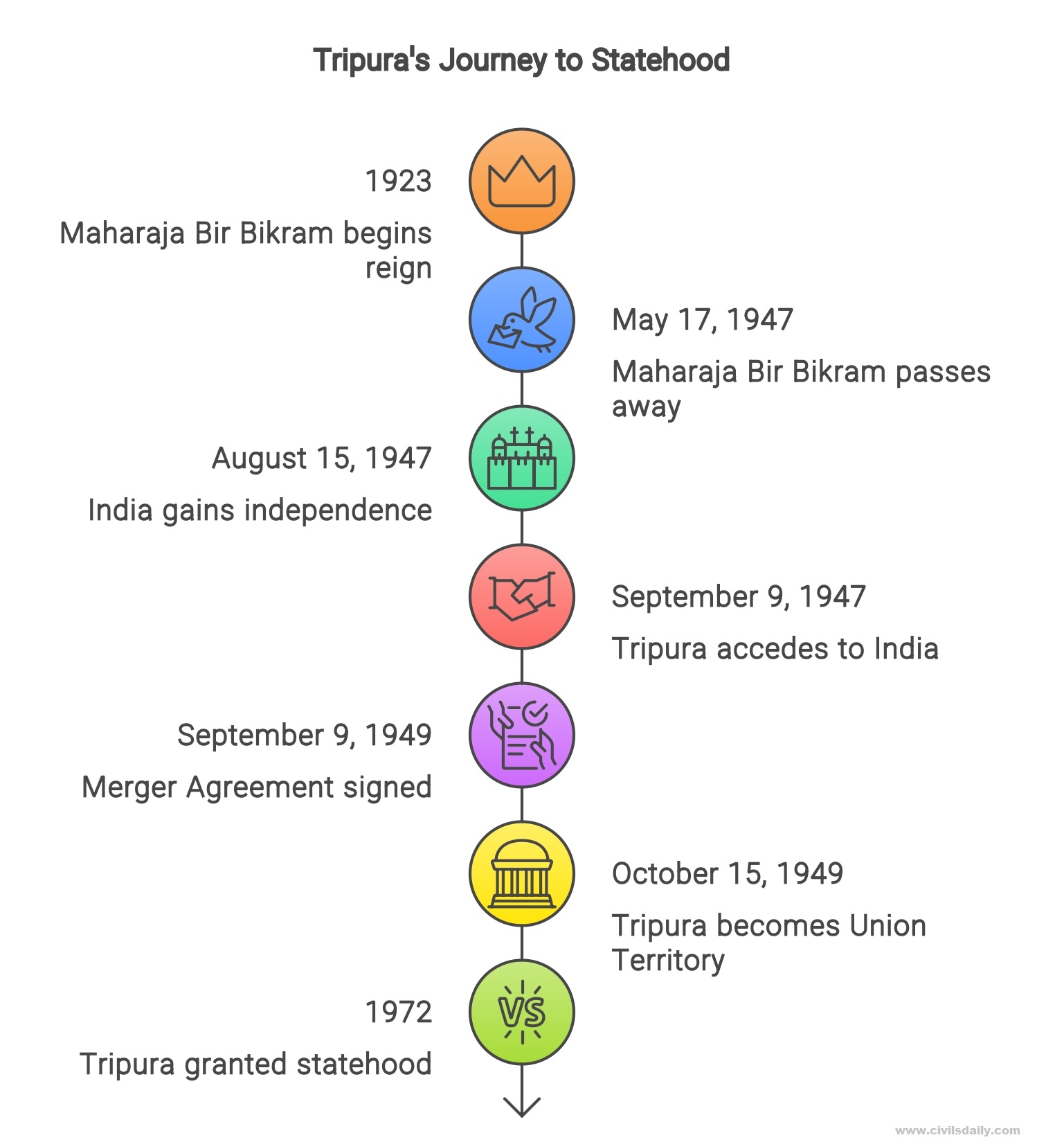
The Prime Minister has paid homage to the great Maharaja of Tripura Bir Bikram Kishore Manikya Bahadur on his birth anniversary.
Who wasMaharaja Bir Bikram Kishore Manikya Bahadur?
Details
Reign
1923 – 1947
Birth
August 19, 1908
Contributions to Tripura
– Modernized Tripura with infrastructure and educational reforms.
– Planned and designed the city of Agartala, earning the title “Architect of Modern Tripura.”-He took initiatives to explore tea cultivation and established several tea estates in Tripura.
Education and Infrastructure
– Established schools, colleges, and hospitals.
– He was instrumental in establishing the first airport in Tripura, the Maharaja Bir Bikram Airport, which greatly improved connectivity and facilitated economic growth
Social Reforms
Introduced land reforms, granted land rights to indigenous people, and worked to abolish untouchability.
Maharaja Bir Bikram was a patron of the arts and culture, supporting various cultural activities and institutions.
Military Role
Supported the British during World War II.
Legacy
Died on May 17, 1947
Remembered as a visionary ruler who played a crucial role in shaping modern Tripura.
PYQ:
[2022] The political and administrative reorganization of states and territories has been a continuous ongoing process since the mid-nineteenth century. Discuss with examples. (250 words, 15 marks)
[2007] Which one of the following is the correct chronological order of the formation of the following states as full states of the Indian Union?
PYQ Relevance: Mains: Q Highlight the importance of the new objectives that got added to the vision of Indian Independence since the twenties of the last century. (UPSC IAS/2017) Q Why did the armies of the British East India Company – mostly comprising of Indian Soldiers – win consistently against the more numerous and better-equipped armies of the then-Indian rulers? Give reasons. (UPSC IAS/2022)
Note4Students:
Subject: GS I (Modern India)
Mains: Significance of Red Fort Trial
Mentor comments: The Red Fort trials, held in 1945-46, were a significant event in India’s struggle for independence. The British colonial government prosecuted key members of the Indian National Army (INA), including Shah Nawaz Khan, Prem Sahgal, and Gurbaksh Singh Dhillon, charging them with waging war against the King. Despite the government’s expectation of public disdain, the trials ignited widespread support for the INA, leading to national demonstrations. The defendants were ultimately found guilty but received lenient sentences, which further fueled the independence movement and contributed to the eventual end of British rule in India.
Why in the news?
Decades after the Red Fort trial, it is hoped that India’s leaders will once again find the wisdom to commit themselves to what unites us as a people.
About the Red Fort Trial:
The Red Fort Trial, also known as the Indian National Army (INA) trials, was a series of court-martials held by the British colonial government in India between November 1945 and May 1946. The trials were held at the Red Fort in Delhi, and they are among the most significant events in the final years leading up to India’s independence.
Background:
Indian National Army (INA): The INA was formed by Indian nationalists during World War II under the leadership of Subhas Chandra Bose. It was composed primarily of Indian prisoners of war who had been captured by the Japanese in Southeast Asia and was aligned with the Axis powers to fight against British rule in India.
The objective of the INA: The INA aimed to overthrow British rule in India through military means, and it played a key role in the campaigns in Burma and the Indian Northeast during the war.
British Reaction: After World War II ended, the British captured several INA soldiers and officers. The British decided to make an example of the INA by trying its officers for treason, murder, and other charges.
Protests that spread across India
Widespread National Support: Protests erupted in multiple cities, including Delhi, Calcutta, Madras, Lahore, Bombay, Patna, and Lucknow, with people from all religious and social backgrounds uniting to demand justice for the INA officers.
Role of Congress and Muslim League: Both the Indian National Congress and the Muslim League supported the INA officers, with leaders from both parties actively participating in and encouraging the protests, showcasing rare political unity against British colonial rule.
Slogans and Symbols of Unity: Protesters chanted slogans like “Laal Quila se aayi aawaaz, Sahgal, Dhillon, Shahnawaaz!” and “Hindu-Muslim Unity Zindabad!”, while the flags of both Congress and the Muslim League were prominently displayed, emphasizing the nationalistic fervour and unity.
Violent Clashes and Sacrifices: The protests were met with brutal police repression in several cities, particularly in Madras and Calcutta, where police firing led to significant casualties—five in Madras and 97 in Calcutta—highlighting the intense opposition to British rule and the high cost of the struggle for independence.
Why is it so significant?
National Unity Across Religious Lines: The trial involved three officers of the Indian National Army (INA)—a Hindu (Prem Kumar Sahgal), a Muslim (Shah Nawaz Khan), and a Sikh (Gurbaksh Singh Dhillon). This symbolized the inclusive and secular nature of India’s struggle for independence.
Mobilization of Public Sentiment: The INA officers were seen as heroes who had fought for India’s freedom, despite the controversial alliance with the Axis powers. Their prosecution by the British was widely perceived as unjust, leading to mass protests, strikes, and demonstrations.
Challenge to British Moral Authority: The trial highlighted the declining legitimacy of British rule in India. The British attempted to portray the INA officers as traitors, but the Indian public saw them as patriots fighting for their country’s freedom.
Catalyst for Independence Movement: The trial also demonstrated the effectiveness of public mobilization and protest in challenging colonial authority, inspiring further actions that ultimately led to India’s independence in 1947.
Conclusion: The Red Fort Trials, featuring INA officers, ignited widespread protests and highlighted national unity, challenging British legitimacy. They symbolized India’s resolve for independence, accelerating the end of colonial rule.
Former CM of West Bengal and leader Buddhadeb Bhattacharya passed away at 80.
Who was Buddhadeb Bhattacharya?
Bhattacharya was a politician who served as CM of West Bengal from 2000 to 2011.
He was known for his attempts to modernize and industrialize West Bengal while navigating the challenges of maintaining communist ideology.
In 2022, Bhattacharya was awarded Padma Bhushan by the Indian government, which he declined, citing his political principles.
Key Contributions:
Category
Details
Political Reforms
Attempted to reduce the influence of powerful trade unions in the state, particularly in the industrial sector, to attract investments and improve work culture.
Social-Cultural Reforms
Played a key role in establishing the Kolkata International Film Festival and promoted Bengali literature.
Authored several books and translated works of Gabriel Garcia Marquez and Vladimir Mayakovsky into Bengali, enriching the state’s cultural heritage.
Introduced measures to eliminate corruption in school recruitments by ensuring all hiring was conducted through transparent exams.
Initiated reforms to integrate mainstream subjects into madrassa education.
Economic Reforms
Led efforts to industrialize West Bengal by attracting investments in IT, steel, and special economic zones (SEZs), including the Tata Nano project in Singur.
Faced significant opposition and protests in Singur and Nandigram over land acquisition, which ultimately contributed to the political decline of the Left Front.
PYQ:
[2011] Karl Marx explained the process of class struggle with the help of which one of the following theories?
On July 31, 1940, Indian revolutionary leader Udham Singh was executed at the Pentonville prison in London for killing Michael O’Dwyer, the former lieutenant governor of Punjab.
Singh was born in Sunam in Punjab’s Sangrur district in 1899.
Political Activism
Became associated with the Ghadar Party while in the US, which was founded by Sohan Singh Bhakna in 1913 and headquartered in California.
Purpose and Actions
In 1934, Singh travelled to London to assassinate Michael O’Dwyer, the former Lieutenant Governor of Punjab during the 1919 Jallianwala Bagh massacre.
Reason for Targeting O’Dwyer
O’Dwyer had ordered Brigadier Reginald Dyer to Amritsar before the massacre, fearing a second Indian mutiny due to Hindu-Muslim unity and demonstrations.
Assassination of O’Dwyer
On March 13, 1940, Singh shot O’Dwyer at a meeting in Caxton Hall, London.
Arrest and Execution
Arrested immediately, held in Brixton prison, sentenced to death, and hanged on July 31, 1940, at Pentonville Prison.
Legacy and Recognition
Regarded as a hero for avenging the Jallianwala Bagh massacre.
Gandhi termed it an “act of insanity”.
He symbolized Hindu-Sikh-Muslim unity by adopting the name ‘RamMohamed Singh Azad’ during his trial.
Posthumous Honors
His remains were returned to India in 1974 and cremated in his village in Sunam.
His statue was installed at Jallianwala Bagh in 2018;
Udham Singh Nagar district in Uttarakhand is named after him.
PYQ:
[2014] The Ghadr (Ghadar) was a:
(a) Revolutionary association of Indians with headquarters at San Francisco.
(b) Nationalist organization operating from Singapore
(c) Militant organization with headquarters at Berlin
(d) Communist movement for India’s freedom with head-quarters at Tashkent
On 22nd July in 1947, the Constituent Assembly of India adopted the National Flag.
PC: The Better India
About the National Flag Day
The Constituent Assembly met in New Delhi at 10 o’clock, chaired by Dr. Rajendra Prasad.
The Assembly had been meeting since December 9, 1946, discussing various subjects.
The Chair announced the first agenda item: “aMotion by Pandit Jawaharlal Nehru about the Flag.”
Jawaharlal Nehru’s Resolution on National Flag
India’s first Prime Minister, Jawaharlal Nehru, moved the Resolution:
The National Flag of India shall be a horizontal tricolour of deep Saffron (Kesari), white, and dark green in equal proportion.
In the centre of the white band, there shall be a navy blue Wheel representing the Charkha.
The design of the Wheel is based on the Chakra from the Sarnath LionCapital of Ashoka.
The diameter of the Wheel approximates the width of the white band.
The ratio of the width to the length of the Flag shall be 2:3.
The motion was adopted unanimously by the Assembly.
Adoption by Popular Acclaim:
Nehru mentioned that the Flag was adopted by popular acclaim and sacrifice over the past decades.
Nehru clarified that the Flag was not meant to be seen in communal terms.
The design was intended to represent the spirit and tradition of India, grown over thousands of years.
Reactions and Support
There were no significant objections to Nehru’s Resolution.
Several members, including Seth Govind Das, V I Muniswami Pillai, Chaudhri Khaliquzzaman, S Radhakrishnan, Saiyid Mohammad Saadulla, Frank R Anthony, and Sarojini Naidu, paid tributes to the Flag and supported the Resolution.
H V Kamath suggested adding a Swastika inside the Chakra to symbolize peace but withdrew the amendment after seeing the Flag’s design.
Dr. P S Deshmukh preferred retaining the original tricolour with the Charkha but did not push his amendment, respecting the House’s preference.
Back2Basics: History of Our National Flag
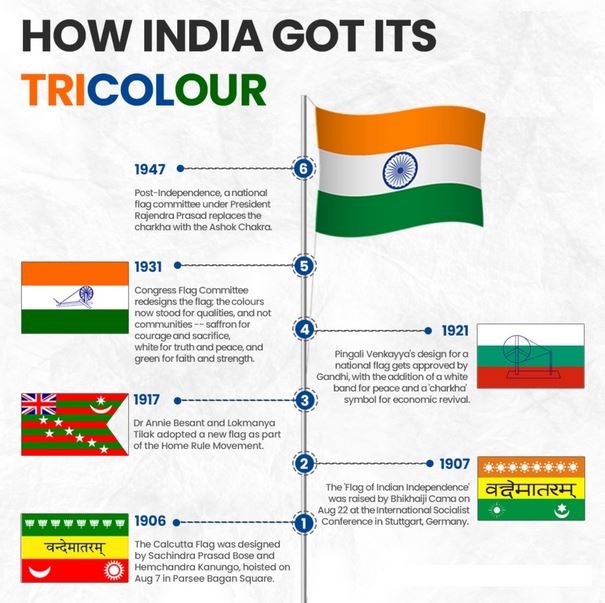
First Public Display in Kolkata (1906):
The first national flag of India was hoisted on August 7, 1906, in Kolkata at Parsee Bagan Square (Green Park).
The flag had three horizontal stripes of red, yellow, and green, with “Vande Mataram” inscribed in the center.
Symbolism: The red stripe included symbols of the sun and a crescent moon, while the green stripe featured eight half-open lotuses.
The flag is believed to have been designed by freedom activists Sachindra Prasad Bose and Hemchandra Kanungo.
Indian Flag in Germany:
In 1907, Madame Cama and her group of exiled revolutionaries hoisted an Indian flag in Germany.
This event marked the first time the Indian flag was hoisted in a foreign country.
Home Rule Movement Flag:
Dr. Annie Besant and Lokmanya Tilak introduced a new flag in 1917 as part of the Home Rule Movement.
The flag featured alternate red and green horizontal stripes, with seven stars in the Saptarishi configuration.
It included a white crescent and star in one top corner, and the Union Jack in the other.
Version by Pingali Venkayya:
Pingali Venkayya, an Indian freedom fighter, is credited with the design of the modern Indian tricolour.
Venkayya first met Mahatma Gandhi in South Africa during the second Anglo-Boer War (1899-1902).
He conducted extensive research and published a book in 1916 that included possible designs for the Indian flag.
At the All India Congress Committee in Bezwada in 1921, Venkayya proposed a basic flag design to Gandhi, featuring two bands of red and green to represent Hindus and Muslims.
PYQ:
[2014] The national motto of India, ‘Satyameva Jayate’ inscribed below the Emblem of India is taken from
Prithipal Singh Randhawa, leader of the Punjab Students Union (PSU), was murdered in Ludhiana on July 18, 1979.
At the time of his death, he was 27 years old and among the most prominent leaders of the student union movement in Punjab during the 1970s.
Who was Prithipal Singh Randhawa?
Randhawa hailed from Hoshiarpur in Punjab and joined Punjab Agricultural University (PAU), Ludhiana, in 1972.
On October 5, 1972, students protested outside Regal Cinema in Moga district against black marketing of tickets.
The police opened fire, killing four people, including student leaders Swarn Singh and Harjeet Singh.
In response, Randhawa launched a mass movement, leading to the arrest of the responsible police officers.
On October 26, 1974, he organized the massive Moga Sangram rally, addressing issues like student fee hikes and the United States’ imperial war in Vietnam.
He was assassinated on July 18, 1979, after abduction.
His rising popularity and anti-establishment stance led to his arrest and 19-month imprisonment under the Maintenance of Internal Security Act (MISA) during the Emergency.
His death led to massive protests in Punjab, Haryana, and Delhi.
Back2Basics:Maintenance of Internal Security Act (MISA): Overview
The MISA was a controversial law enacted by the Indian government in 1971.
It was primarily aimed at ensuring internal security and public order during times of political unrest and emergencies.
MISA was heavily used during the Emergency period (1975-1977) declared by Prime Minister Indira Gandhi.
Key Provisions:
Preventive Detention: MISA allows for the preventive detention of individuals without trial for a maximum period of two years. This was intended to pre-emptively address threats to national security.
Detention without Charges: Individuals could be detained without being charged with a specific offense, based on the suspicion of being a threat to national security or public order.
No Right to Legal Representation: Detainees under MISA did not have the right to legal representation or a fair trial.
Limited Judicial Review: The act severely restricted the scope of judicial review, making it difficult for courts to intervene in cases of detention under MISA.
Controversy and Criticism:
Human Rights Violations: MISA was widely criticized for its draconian measures and violation of fundamental human rights, including the right to liberty, freedom of speech, and due process.
Political Repression: The act was seen as a tool for political repression, used by the government to silence opposition and dissent.
Abuse of Power: There were numerous instances of abuse of power under MISA, with individuals being detained on vague or politically motivated grounds.
Repeal:
After the end of the Emergency in 1977, the newly elected Janata Party government repealed MISA in 1978 as part of its efforts to restore democratic norms and civil liberties.
The legacy of MISA remains a stark reminder of the potential for misuse of power and the importance of safeguarding democratic principles and human rights.
PYQ:
[2022] Which of the following is/are the exclusive power(s) of Lok Sabha?
To ratify the declaration of Emergency
To pass a motion of no-confidence against the Council of Ministers
To impeach the President of India
Select the correct answer using the code given below:
The Santhal Revolt of 1855 was a revolt against imperialism led by four brothers, Sidho, Kanho, Chand, and Bhairav Murmu, along with sisters Phulo and Jhano.
June 30 marks the 169th anniversary of the beginning of the revolt.
About Santhal Hul
The Santhal people revolted against the British East India Company and the Zamindari system, also known as the Santhal Rebellion or Santhal Hul.
The rebellion began on June 30, 1855.
Martial Law was imposed on November 10, 1855, by the East India Company, lasting until January 3, 1856, when the rebellion was suppressed.
Who are the Santhals?
Santhals were agricultural people living in the Rajmahal Hills of Bihar.
Ol Chiki(Ol Chemet) is the writing script of Santhals.
The British asked them to clear forests for agriculture to increase revenue.
Damin-i-Koh (1832) was created as a designated area for Santhals, now known as Santhal Pargana.
Over time, the British began exploiting the Santhals, leading to the Santhal Rebellion.
What makes the revolt so unique?
Marginalized Indigenous Community: Led by the Santhal tribe, a marginalized indigenous community in mid-19th century India.
Agrarian Uprising: Primarily a fight against exploitative land laws, high taxes, and forced labor rather than political or religious issues.
Tribal Unity and Guerrilla Tactics: Characterized by a strong sense of tribal unity and guerrilla warfare tactics, making it unique and significant.
Causes of the Santhal Revolt:
Permanent Settlement System (1793): Introduced by the British East India Company, giving Zamindars long-lasting property rights.
Oppression by Zamindars: Zamindars misused their power to oppress and enslave peasants, leading to resentment.
Exploitation and Debt: Santhals faced exploitation through high-interest loans and lost their land and freedom.
Violent Suppressions: British police supported Zamindars and moneylenders in evicting Santhals violently.
Disruption of Traditional Structures: Traditional social and political structures of the Santhals were disrupted, pushing them into debt and poverty.
Economic Hardship: Led to the Santhals revolting against the British and Zamindars to escape their predicament.
About the Santhal Pargana Tenancy Act (1876) and Chhotanagpur Tenancy Act (1908)
Santhal Pargana Tenancy Act (1876): Enacted by the British as a result of the Hul.
Land Inheritance: Prohibits the transfer of Adivasi lands to non-Adivasis and allows land to be inherited only as per the Act.
Self-Governance: Retains the rights of Santhals to self-govern their land.
Chhotanagpur Tenancy Act (1908): Result of the Birsa Movement.
Land Transfer Restrictions: Allows land transfers within the same caste and geographical areas with District Collector’s approval.
Protection of Adivasi and Dalit Land: Restricts the sale of Adivasi and Dalit land but allows transfers within the same community.
PYQ:
[2018] After the Santhal Uprising subsided, what was/were the measure/measures taken by the colonial government?
The territories called `Santhal Parganas’ were created.
It became illegal for a Santhal to transfer land to a non-Santhal.
Select the correct answer using the code given below:
![[20th August 2024] The Hindu Op-ed: The ‘livery of India’s freedom’ is under threat](https://www.civilsdaily.com/wp-content/uploads/2024/08/20-Aug-1568x882.jpg)
![[15th August 2024] The Hindu Op-ed: The trial that progressed rapidly towards Independence](https://www.civilsdaily.com/wp-content/uploads/2024/08/15-Aug-1568x882.jpg)