💥Join UPSC 2027,2028 Mentorship (July Batch) + XFactor Notes & Microthemes PDF

GS Paper: Indian Economy

  • RBI Report on Currency and Finance (RCF), 2023-24

    Why in the News?

    The Reserve Bank of India (RBI) released the “Report on Currency and Finance (RCF)” for the year 2023-24 with the theme – India’s Digital Revolution.

    What is the Report on Currency and Finance (RCF)? 

    • The RCF is an annual publication by the Reserve Bank of India (RBI).
    • It covers various aspects of the Indian economy and financial system, providing insights and analysis on current economic conditions, financial stability, and policy issues.
    • The theme for the 2023-24 report is “India’s Digital Revolution.”
    • Focus: It focuses on the transformative impact of digitalization across various sectors in India, especially in the financial sector.
    • Highlights: The report highlights how digital technologies are reshaping economic growth, financial inclusion, public infrastructure, and the regulatory landscape. It also addresses the opportunities and challenges associated with digitalization.

    Key Highlights of the RCF:

    [1] Digital Revolution

    • The RCF emphasizes India’s leading role in the global digital revolution.
    • With robust digital public infrastructure (DPI), evolving institutional frameworks, and a tech-savvy population, India has emerged as a frontrunner in this arena.
    • Key initiatives such as Aadhaar, the world’s largest biometric-based identification system, and the UPI, a real-time, low-cost transaction platform, have revolutionized service delivery and financial inclusion.

    [2] Digitalization in Finance

    • The above-discussed initiatives have made retail payments faster and more convenient, while the RBI’s pilot runs of the E-Rupee position India at the forefront of digital currency initiatives.
    • The digital lending ecosystem is also vibrant, with the Open Credit Enablement Network and the Open Network for Digital Commerce (ONDC) driving growth.

    [3] Remittance Inflows in India

    • India continues to lead as the highest remittance recipient globally, with US$ 115.3 billion in 2023, accounting for 13.5% of the world’s total remittances.
    • The RCF highlights that more than half of India’s inward remittances in 2021 came from the Gulf countries, with North America contributing 22%.
    • The remittance-to-GDP ratio for India has risen from 2.8% in 2000 to 3.2% in 2023, surpassing the gross FDI inflows to GDP ratio of 1.9% in 2023.
    • Looking forward, India is poised to remain a leading supplier of labor, with its working-age population expected to rise until 2048, potentially propelling remittances to around $160 billion by 2029.

    [4] Smartphones Penetration

    • India’s mobile penetration has seen remarkable growth, with internet penetration reaching 55% in 2023 and an increase of 199 million internet users over the past three years.
    • The cost per gigabyte of data in India is the lowest globally, at an average of Rs. 13.32 per GB.
    • India has one of the highest mobile data consumption rates worldwide, with an average per-user per-month consumption of 24.1 GB in 2023.
    • The number of smartphone users in India was about 750 million in 2023, expected to reach 1 billion by 2026. 
    • The RCF projects that India will become the second-largest smartphone manufacturer within the next 5 years.

    PYQ:

    [2017] Which of the following is the most likely consequence of implementing the ‘Unified Payments Interface (UPI)’?

    (a) Mobile wallets will not be necessary for online payments.
    (b) Digital currency will replace physical currency in about two decades.
    (c) FDI inflows will drastically increase.
    (d) Direct transfer of subsidies to poor people will become very effective.

  • GST on Health and Life Insurance Premiums

    Why in the News?

    • Insurance premiums on health and life policies have increased this year, and the 18% Goods and Services Tax (GST) has made insurance less affordable for many people.
      • Medical inflation, estimated at 14% towards the end of last year, along with increased premiums, has made buying medical insurance difficult for many.

    What is the GST on Health and Life Insurance Premiums?

    • GST replaced all indirect taxes like service tax and cess from July 1, 2017.
    • Currently, GST on health and life insurance policies is fixed at 18%.
    • According to the formula, the Centre collects 9% GST with a matching collection by states.
      • Before GST, life insurance premiums were subject to 15% service taxes, including Basic Service Tax, Swachh Bharat cess, and Krishi Kalyan cess.

    Rational behind the Tax

    • GST Council Recommendations:
      • GST rates and exemptions on all services, including insurance, are prescribed on the recommendations of the GST Council, which includes the Union Finance Minister and ministers nominated by state governments.
      • Insurance is considered a service, and policyholders pay tax on their premiums, generating significant revenue for the government.
    • Tax Deductions:
      • Insurance policies allow certain deductions while computing income tax under Sections 80C and 80D of the Income Tax Act, 1961. Customers can avail deductions on the premium, including the GST applicable.

    Arguments for Withdrawing the GST on Premiums

    • High Premium Increases:
      • Significant increases in premiums on health insurance policies this year have been observed, with some public sector insurers hiking premiums by 50%.
      • The renewal rate of policies is declining due to frequent premium hikes and medical inflation.
    • Comparative GST Rates:
      • The Confederation of General Insurance Agents’ Associations of India points out that GST on insurance in India is the highest in the world.
      • The high GST rate is seen as a deterrent to insurance penetration, which conflicts with the goal of “Insurance for All by 2047”.
    • Recommendations for Rationalisation:
      • The Standing Committee on Finance recommended rationalising the GST rate on insurance products to make them more affordable.
      • Suggestions include reducing GST rates for health insurance, especially for senior citizens, micro-insurance policies, and term policies.

    Insurance Penetration in India:

    • According to a Swiss Re Sigma report, insurance penetration in India’s life insurance sector reduced from 3.2% in 2021-22 to 3% in 2022-23, while the non-life insurance sector remained stagnant at 1%.
    • Overall insurance penetration reduced to 4% in 2022-23 from 4.2% in 2021-22.


    PYQ:

    [2018] Consider the following items:

    1. Cereal grains hulled

    2. Chicken eggs cooked

    3. Fish processed and canned

    4. Newspapers containing advertising material

    Which of the above items is/are exempted under GST (Goods and Services Tax)?

    (a) 1 only

    (b) 2 and 3 only

    (c) 1, 2 and 4 only

    (d) 1, 2, 3 and 4

  • The relevance of pumped storage projects      

    Why in the news?

    The Union Budget for 2024-25 announced that “a policy will be introduced to promote pumped storage projects aimed at electricity storage and ensuring the seamless integration of the increasing share of renewable energy.

    Why is renewable power generation subject to variations and weather changes?

    • Due to Intermittent nature: Renewable energy sources, particularly solar and wind, are inherently intermittent. Solar energy is only available during daylight hours and is affected by weather conditions such as cloud cover, while wind energy varies with wind speed and direction. This variability leads to fluctuations in power generation, making it challenging to match supply with demand consistently.
    • Daily and Seasonal Variations: The generation capacity of renewable sources can change significantly over short periods (hours to days) and longer periods (seasonal). For instance, solar power generation peaks during sunny days and drops to zero at night, while wind power can vary greatly depending on seasonal weather patterns.

    Significance of Pumped Storage Projects

    • Grid Stabilization: Pumped storage projects are critical for stabilizing the power grid by addressing the variability and intermittency of renewable energy sources like solar and wind.
    • Energy Storage Capacity: PSPs account for over 94% of the installed global energy storage capacity, making them the most widely used technology for large-scale energy storage.
    • Flexible Energy Generation: These projects can provide both base load and peaking power, offering flexibility in energy generation.  
    • Environmental Benefits: Pumped storage is a clean and environmentally friendly technology.
    • Economic Viability: The cost of energy from pumped storage is competitive compared to other energy storage technologies.

    How do Power Managers decide which energy source to use?

    • Use of forecasting Techniques: Power managers utilize advanced forecasting techniques to predict renewable energy generation based on expected weather conditions. This allows them to plan the operation of different power plants in advance, ensuring a steady supply of electricity.
    • Demand and Supply Management: Decisions on which energy source to use are based on real-time demand and the availability of renewable energy. When there is a surplus of renewable energy (e.g., during sunny or windy periods), it may be used to pump water in pumped storage systems. Conversely, when renewable generation is low, power managers may rely on more stable sources like hydro, coal, or nuclear power to meet demand.

    Where are some of the Pumped Storage Projects of India situated?

    • Kadamparai: Located in Tamil Nadu, this facility has a capacity of 400 MW and operates by pumping water to a higher reservoir during periods of surplus power generation.
    • Other Notable Projects: India has several other pumped storage projects, including those at Nagarjunasagar, Kadana, and Panchet. These facilities contribute to managing the variability of renewable energy generation in the country.

    How do the reservoirs in Kadamparai, Tamil Nadu operate?

    • The Kadamparai pumped storage plant consists of two reservoirs at different elevations. Water is pumped from the lower reservoir to the upper reservoir when there is surplus power available, typically from solar or wind sources.
    • When demand rises, especially during peak evening hours, water flows from the upper reservoir to the lower reservoir, turning turbines to generate electricity. This operation allows the plant to provide power for three to four hours during peak demand periods, effectively stabilizing the grid.
    • The plant can switch between pumping and generating modes, allowing it to respond quickly to changes in power demand. This flexibility is crucial for integrating variable renewable energy sources into the grid.

    Conclusion: The need to Develop a robust and flexible grid infrastructure that can efficiently handle the integration of renewable energy sources is crucial. Implementing smart grid technologies, including real-time monitoring, advanced forecasting techniques, and automated demand-response systems, can optimize the balance between supply and demand.

  • What is the Sovereign Gold Bond Scheme?

    Why in the News?

    Recent reports suggest that the government might reduce or discontinue the Sovereign Gold Bond (SGB) scheme due to its high cost.

    Decline in Popularity of SGB:

    • This speculation follows the Union budget’s decision to slash customs duties on gold and silver from 15% to 6%.
    • The reduction in customs duties is expected to decrease demand for SGBs, which has already led to a 2-5% drop in their prices on the National Stock Exchange (NSE).

    About Sovereign Gold Bonds (SGBs)

    Details
    Launch 2015
    Nature
    • Government securities denominated in grams of gold.
    • Issued by RBI.
    Objective Reduce dependence on gold imports and shift savings from physical gold to paper form.
    Eligibility Resident in India, including individuals, HUFs, trusts, universities, and charitable institutions.
    Denomination and Tenor
    • Denominated in multiples of grams of gold, with a basic unit of 1 gram.
    • Tenor of 8 years with an exit option from the 5th year on interest payment dates.
    Investment Limits
    • Minimum: 1 gram of gold.
    • Maximum: 4 kg for individuals and HUFs,
      • 20 kg for trusts and similar entities per fiscal year.
    Benefits
    • Quantity of gold protected, receiving market price at redemption.
    • Eliminates storage risks and costs.
    • Assured market value at maturity and periodic interest.
    • Free from making charges and purity issues.
    • Held in RBI books or demat form, eliminating scrip loss risk.
    Add-ons
    • Can be used as collateral for loans.
    • Loan-to-value (LTV) ratio set equal to ordinary gold loans.


    PYQ: 

    [2016] What is/are the purpose/purposes of Government’s ‘Sovereign Gold Bond Scheme’ and ‘Gold Monetization Scheme’?

    1. To bring the idle gold lying with Indian households into the economy
    2. To promote FDI in the gold and jewellery sector
    3. To reduce India’s dependence on gold imports

    Select the correct answer using the codes given below:

    (a) 1 only

    (b) 2 and 3 only

    (c) 1 and 3 only

    (d) 1, 2 and 3


    https://indianexpress.com/article/business/commodities/gold-customs-duty-may-take-some-shine-off-sovereign-gold-bonds-9485686/

  • On discarding indexation for LTCG    

    Why in the news?

    Finance Minister Nirmala Sitharaman’s decision to eliminate indexation for calculating long-term capital gains (LTCG) tax in the Union Budget has received a lukewarm response from stakeholders.

    Changes in the LTCG Regime

    • The new LTCG regime removes the indexation benefit for property, gold, and other unlisted assets.
    • The LTCG tax rate is reduced from 20% to 12.5%.
    • For assets purchased before 2001, the fair market value as of April 1, 2001, is considered the cost of acquisition.

    What is long-term capital gains (LTCG) tax? 

    • LTCG refers to the profit realized from the sale of an asset that has been held for more than one year. This includes various types of assets such as stocks, bonds, real estate, and mutual funds. 
    • If an asset is sold before this holding period, the gains are classified as short-term capital gains (STCG) and are taxed at different rates.

    Why has the Union Finance Minister done away with indexation for computing long-term capital gains (LTCG) tax?

    • Simplification of Tax Computation: The Finance Minister proposed the change to “ease computation of capital gains for the taxpayer and tax administration.” The intention is to simplify the tax process.
    • Uniform Tax Rate: Long-term gains on all financial and non-financial assets would now be taxed at a flat rate of 12.5%, replacing the previous tiered structure.
    • High real estate return: The Income Tax department believes that the real estate returns (12-16% per annum) are higher than indexation for inflation (4-5%). Thus, it predicts “substantial tax savings” for a “vast majority” of taxpayers under the new system.

    What is indexation?

    • Indexation is a mechanism used to adjust the original purchase price of an asset to account for inflation. It helps in calculating the real gains and prevents inflation from inflating the tax liability. The adjusted purchase price is called the indexed cost of acquisition.

    How does Indexation help in Tax Savings?

    • Adjusts the purchase price for inflation: Indexation increases the original purchase price of an asset to account for inflation between the time of purchase and sale. This results in a lower taxable capital gain.
    • Reduces the taxable capital gains: By revising the purchase price upwards using the Cost Inflation Index, indexation reduces the difference between the sale price and purchase price. This lowers the taxable capital gains amount.
    • Leads to lower tax liability: With a reduced taxable capital gain, the tax payable on it also decreases. For example, on a ₹48 lakh gain from selling a house, indexation can bring down the taxable gain to ₹28.6 lakh, saving ₹4,264 in tax (assuming 20% LTCG rate).

    What has been the feedback from corporates and industry regarding the move?

    • Concerns Over Increased Tax Liability: Many stakeholders expressed apprehension that the removal of indexation would lead to higher tax obligations for ordinary investors, particularly in the real estate sector.
      • There are fears that this might encourage the undervaluation of properties to reduce capital gains tax and potentially increase black money transactions in real estate.
    • Mixed Reactions from Realty Players: While some real estate developers and consultants indicated that the removal of indexation might not significantly impact demand and prices, especially for primary home buyers, they noted that high-end properties could see a drop in demand.
      • Some developers viewed the changes positively and said that the lowered tax rate (from 20% to 12.5%) could make real estate a more attractive long-term investment.
    • Government Justifications and Clarifications: The government has argued that the new tax regime simplifies the capital gains tax structure and is beneficial for most taxpayers.

    Way forward: 

    • Transitional Provisions: Govt. should implement transitional provisions for existing investments to ease the shift from the old system to the new one.
    • Strengthen the monitoring system: Need to strengthen monitoring mechanisms to prevent the undervaluation of properties and reduce black money transactions.

    Mains PYQ: 

    Q Comment on the important changes introduced in respect of the Long-term Capital Gains Tax (LCGT) and Dividend Distribution Tax (DDT) in the Union Budget for 2018-2019. (UPSC IAS/2018)

  • SEBI’s proposed measures to curb F&O speculation    

    Why in the news?

    SEBI has proposed a series of measures to curb speculative trading in the index derivatives segment due to concerns over the exponential increase in trading volumes in futures and options, especially among individual investors.

    What are the different types of derivatives?  

    Note: Derivatives are financial contracts deriving their value from an underlying asset such as stocks, commodities, or currencies.
    • Futures: 
        • Futures are standardized contracts obligating the buyer to purchase an underlying asset (such as stocks, commodities, or currencies) at a predetermined price on a specified future date. They are traded on exchanges, with daily settlements based on market price changes.
        • Futures contracts have margin requirements and are marked to market daily, ensuring liquidity and reducing credit risk.
    • Options: 
        • Options give the buyer the right, but not the obligation, to buy (call option) or sell (put option) an underlying asset at a predetermined price within a specified time frame. Unlike futures, options are not obligatory; the buyer can choose whether to exercise the option.
        • Options can be traded on exchanges or over-the-counter (OTC) and require the payment of a premium by the buyer.
    • Forwards: 
        • Forward contracts are similar to futures but are privately negotiated agreements between two parties to buy or sell an asset at a future date and price. They are customizable and traded over the counter, which allows for flexibility but introduces counterparty risk.
        • Settlement occurs at the maturity date, and forward contracts do not have standardization like futures.
    • Swaps: 
      • Swaps involve the exchange of cash flows or financial instruments between two parties, often based on interest rates or currencies. Common types include interest rate swaps and currency swaps, which allow participants to manage exposure to interest rate fluctuations or gain access to different currencies.
      • Swaps are typically traded over the counter and can be tailored to meet the specific needs of the parties involved.

    What measures have the SEBI proposed?

    • Increase in minimum contract size for index derivatives from Rs 5-10 lakh to Rs 15-20 lakh, which can be further increased to Rs 20-30 lakh after six months.
    • Upfront collection of option premiums by brokers from clients.
    • Intraday monitoring of position limits for index derivative contracts by Market Infrastructure Institutions (MIIs).
    • Providing only one weekly options contract on a single benchmark index of an exchange.
    • Removal of calendar spread benefits on the expiry day for positions involving any of the contracts expiring on the same day.
    • Rationalisation of options strikes, with a uniform interval up to a fixed coverage of 4% near the prevailing index price and an increased interval as the strikes move away from the prevailing price.
    • Increasing margins on the expiry day and the previous day to address the issue of high implicit leverage in options contracts near expiry.

    Why have these measures been proposed?

    • The measures aim to enhance investor protection and promote market stability in the derivative markets, amidst concerns about an exponential rise in the volume of trade in the futures and options (F&O) segment, particularly by individual investors.
    • In the Union Budget 2024-25, the Securities Transaction Tax (STT) on F&O of securities was doubled to 0.02% and 0.1%, respectively, effective October 1, 2024.
    • Data shows that in FY 2023-24, 92.50 lakh unique individuals and proprietorship firms traded in the NSE index derivatives segment and cumulatively incurred a trading loss of Rs 51,689 crore, with only 14.22 lakh investors (about 15%) making a net profit.

    Way forward: 

    • Enhancing Investor Education and Awareness: To mitigate the risks associated with speculative trading in index derivatives, it is essential to implement comprehensive investor education programs.
    • Strengthening Regulatory Oversight and Compliance: SEBI should enhance its regulatory framework by implementing robust monitoring systems that ensure compliance with the proposed measures.
  • What is Indexation in calculating LTCG tax?

    Why in the News?

    The withdrawal of the indexation benefit from the long-term capital gains (LTCG) tax regime has emerged as a contentious decision in the Union Budget for 2024-25.

    What is Indexation?

    • Indexation is a method used to adjust the purchase price of an asset to account for inflation over the period it was held.
    • This reduces the taxable capital gain, as it reflects the increase in the asset’s value due to inflation.
    • Purpose: To ensure that the taxpayers are taxed only on the real gains and not on the inflationary increase in the value of the asset.

    Changes in the LTCG Regime

    • The new LTCG regime removes the indexation benefit for property, gold, and other unlisted assets.
    • The LTCG tax rate is reduced from 20% to 12.5%.
    • For assets purchased before 2001, the fair market value as of April 1, 2001, is considered the cost of acquisition.

    Implications of the Changes

    • The government claims the changes simplify the capital gains tax structure without causing a loss to most taxpayers.
    • The uniform tax rate for various asset classes is intended to benefit both taxpayers and tax authorities.

    Concerns for Taxpayers

    • There was significant concern, particularly in the residential real estate sector, about increased LTCG tax liabilities.
    • The government clarified that the new regime would be beneficial in most cases, as real estate returns typically outpace inflation.
    • The Income Tax Department explained that:
    1. For properties held for 5 years, the new regime is beneficial if the value has appreciated 1.7 times or more, and
    2. For 10 years, if the value has increased to 2.4 times or more.

    Back2Basics: Capital Gains Tax Overview

    Details
    Definition Tax on profit from the sale of a capital asset.
    Launch Introduced in 1956, as part of the Income Tax Act, 1961.
    Types Short-Term Capital Gains (STCG): Held for ≤36 months (≤12 months for specified assets).

    Long-Term Capital Gains (LTCG): Held for >36 months (>12 months for specified assets).

    Tax Rates (STCG) With STT: 15%

    Without STT: Applicable income tax slab rates.

    Tax Rates (LTCG) Listed Equity Shares & Equity-Oriented Funds: 10% on gains >₹1 lakh without indexation.

    Other Assets: 20% with indexation (proposed 12.5% without indexation from FY 24-25).

    Indexation Adjusts purchase price for inflation using Cost Inflation Index (CII).
    Purpose of Indexation To tax only the real gains, accounting for inflation.
    Formula (Indexation) Indexed Cost of Acquisition: (Cost of Acquisition × CII of sale year) / CII of purchase year

    Indexed Cost of Improvement: (Cost of Improvement × CII of sale year) / CII of improvement year


    PYQ:

    [2012] Under which of the following circumstances may ‘capital gains’ arise?

    1. When there is an increase in the sales of a product

    2. When there is a natural increase in the value of the property owned

    3. When you purchase a painting and there is a growth in its value due to increase in its popularity

    Select the correct answer using the codes given below:

    (a) 1 only

    (b) 2 and 3 only

    (c) 2 only

    (d) 1, 2 and 3

  • A big step towards the transformation of various sectors  

    Why in the news?

    The 2024-25 Budget is a progressive proposal featuring several commendable initiatives aimed at boosting India’s economic growth and advancing social progress.

    Prioritized areas in the recent Budget 2024-25

    • Job Creation and Skilling: The budget allocates ₹1.48 lakh crore towards job creation, employment, and skilling, emphasizing the importance of developing a skilled workforce to support India’s service sector. This shift from a focus on manufacturing to skilling reflects a strategic move towards building a service-oriented economy.
    • Energy Transformation: There is significant investments are directed towards energy transformation initiatives, including solar panel manufacturing and nuclear energy development. The budget allocates ₹89,287 crore to crucial sectors, indicating a commitment to sustainable energy solutions.
    • Healthcare Initiatives: The budget includes measures to enhance healthcare access, such as customs duty exemptions on life-saving cancer medications and components for advanced medical equipment.
    • Technology and Innovation: A framework with nine priorities is introduced to leverage advanced technology and foster collaboration between the government and private sector, promoting growth and innovation across various sectors.
      • For example: The budget allocates ₹1 lakh crore specifically for research and innovation, accompanied by a 50-year interest-free loan.

    What does the budget say on Accessibility and Affordability?    

    • Customs Duty Exemptions on drugs: The budget exempts customs duties on three essential cancer medications, making them more affordable and accessible to patients. This move addresses the high costs associated with cancer treatments, which often pose significant barriers to access.
    • Support for Medical Equipment: Customs duties are also waived for components of X-ray tubes and digital detectors, which are crucial for advanced medical technologies.
    • Alignment with Domestic Capacity: The budget emphasizes aligning customs duties with domestic capacity under the phased manufacturing program, fostering a conducive environment for startups and encouraging local manufacturing.

    On Prioritizing Inclusivity and Fiscal Prudence

    • Women’s Workforce Participation: The budget focuses on boosting women’s participation in the economy through targeted initiatives such as hostels, creches, and skilling programs.
      • According to a report by McKinsey, India can increase its 2025 GDP, estimated at $4.83 trillion, by 16%-60% simply by enabling women to participate in the economy on par with men
    • Research and Development: With India spending only 0.7% of its GDP on research, the budget encourages private sector collaboration with the government to increase investments in R&D. This collaboration is vital for fostering innovation and ensuring sustainable economic growth.
    • Public-Private Partnerships: The budget promotes public-private partnerships to enhance healthcare delivery and infrastructure, reflecting a commitment to inclusivity and collaboration in achieving economic and social goals.

    Conclusion: The government should expand the scope of skilling programs to cover a wider range of sectors and skill levels while ensuring the workforce is equipped to meet the evolving demands of the service-oriented economy.

  • Key takeaways from the 2023-24 Economic Survey   

    Why in the News?

    The 2023-24 Economic Survey highlights realistic challenges for India’s growth, projecting GDP growth at 6.5%-7% for FY 2024-25 despite 8% growth in FY 2023-24.

    What are the major five issues with the Indian Economy?  

    • Weak Demand: In India, an unfavourable environment for FDI growth is due to high interest rates in developed countries, which increases the cost and opportunity cost of investment in India.
    • Dependence on China: Due to over-reliance on China for imports, particularly in key sectors like renewable energy, limits India’s manufacturing capabilities and increases vulnerability to geopolitical tensions.
    • Tepid Private Investment: Despite tax cuts aimed at stimulating capital formation, the corporate sector has not significantly increased investment, leading to a lack of job creation and economic dynamism.
    • Employment Challenges: The need to generate approximately 78.5 lakh jobs annually in the non-farm sector until 2030 to accommodate the growing workforce, coupled with insufficient data on job creation, complicates labour market analysis.
    • Infrastructure Deficiencies: Inadequate infrastructure, such as roads, railways, and sanitation, continues to hinder economic development and efficiency, requiring substantial investment and reform to improve productivity.

    What are the suggestions given in the Economic Survey? 

    • Private Sector’s Role in Job Creation: The corporate sector should take responsibility for creating jobs, as it is in their enlightened self-interest.
    • Embracing Healthy Lifestyle: Indian businesses should learn from India’s traditional lifestyle, food, and recipes to live healthily and in harmony with nature.
    • Focusing on Agriculture: The farm sector can generate higher value addition, boost farmers’ income, create opportunities for food processing and exports, and make the sector attractive to urban youth.
    • Removing Regulatory Bottlenecks: Licensing, inspection, and compliance requirements imposed by various levels of government are an onerous burden on businesses, especially MSMEs.
    • Improving Data Quality: The lack of availability of timely data on the absolute number of jobs created in various sectors precludes an objective analysis of the labour market situation.

    Way forward: 

    • Enhance Infrastructure Development: Need to prioritize investments in essential infrastructure such as roads, railways, and sanitation to boost economic efficiency and productivity.
    • Strengthen Data Collection and Analysis: The government should develop robust mechanisms for timely and accurate data collection on employment and other key economic indicators.

    Mains PYQ: 

    Q Do you agree with the view that steady GDP growth and low inflation have left the Indian economy in good shape? Give reasons in support of your arguments. (2019)

  • What is Angel Tax that was scrapped in Budget 2024?

    Why in the News?

    Finance Minister announced the abolition of the angel tax, aiming to strengthen the startup ecosystem and support innovation in India.

    What is Angel Investment?

    • An angel investor is an individual who provides financial backing to early-stage startups or entrepreneurs, typically in exchange for equity in the company.
    • Angel investors are typically high-net-worth individuals who invest their own personal funds, rather than investing on behalf of a firm or institution.
    • Features of Angel Investing: Early-stage funding, equity investment, high-risk, high-reward, active involvement,personal investment,f lexible terms and shorter investment horizon.

    What is Angel Tax? 

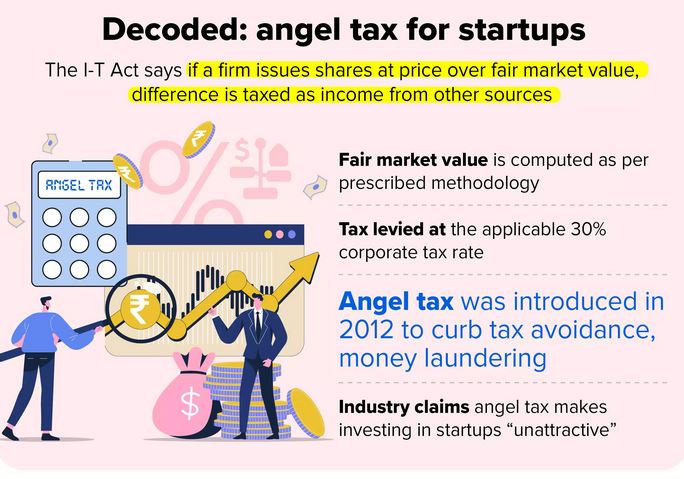
    • Referred to as Angel Tax, this rule is described in Section 56(2)(vii)(b) of the Income Tax Act, 1961.
    • Essentially it’s a tax on capital receipts, unique to India in the global context.
    • This clause was inserted by the Finance Act in 2012 to prevent laundering of black money, round-tripping via investments with a large premium into unlisted companies.
    • The tax covers investment in any private business entity, but only in 2016 was it applied to startups.

    Why was angel tax introduced?

    • The complicated nature of VC fundraising with offshore entities, multiple limited partners and blind pools is contentious.
    • There has been some element of money laundering or round-tripping under guise.

    Details of its levy

    • The Angel Tax is being levied on startups at 9% on net investments in excess of the fair market value.
    • For angel investors, the amount of investment that exceeds the fair market value can be claimed for a 100% tax exemption.
    • However, the investor must have a net worth of ₹2 crores or an income of more than ₹25 Lakh in the past 3 fiscal years.

    Key Issues with Angel Tax

    • Share Valuation: The tax impacted the valuation of shares, causing complications for startups in raising funds.
    • Discounted Cash Flow (DCF) Method: Issues arose with the treatment of estimated figures in the DCF method, leading to disputes.
    • Scrutiny of Funding Sources: The scrutiny of funding sources and investor credibility added another layer of complexity for startups.
    • Retrospective Application: The retrospective application of the tax and its effect on the conversion of convertible instruments into equity were also significant points of dispute.

    Significance for the Startup Community

    • Startups has long advocated for a more supportive and less restrictive environment for fundraising.
    • With this change, the government aims to create a more favourable atmosphere for innovation and investment in India.
    PYQ:

    [2014] What does venture capital mean?

    (a) A short-term capital provided to industries.

    (b) A long-term start-up capital provided to new entrepreneurs.

    (c) Funds provided to industries at times of incurring losses.

    (d) Funds provided for replacement and renovation of industries.