💥Join UPSC 2027,2028 Mentorship (July Batch) + XFactor Notes & Microthemes PDF

GS Paper: Indian Economy

  • India’s Exports Grow Despite West Asia Crisis

    Why in the News?

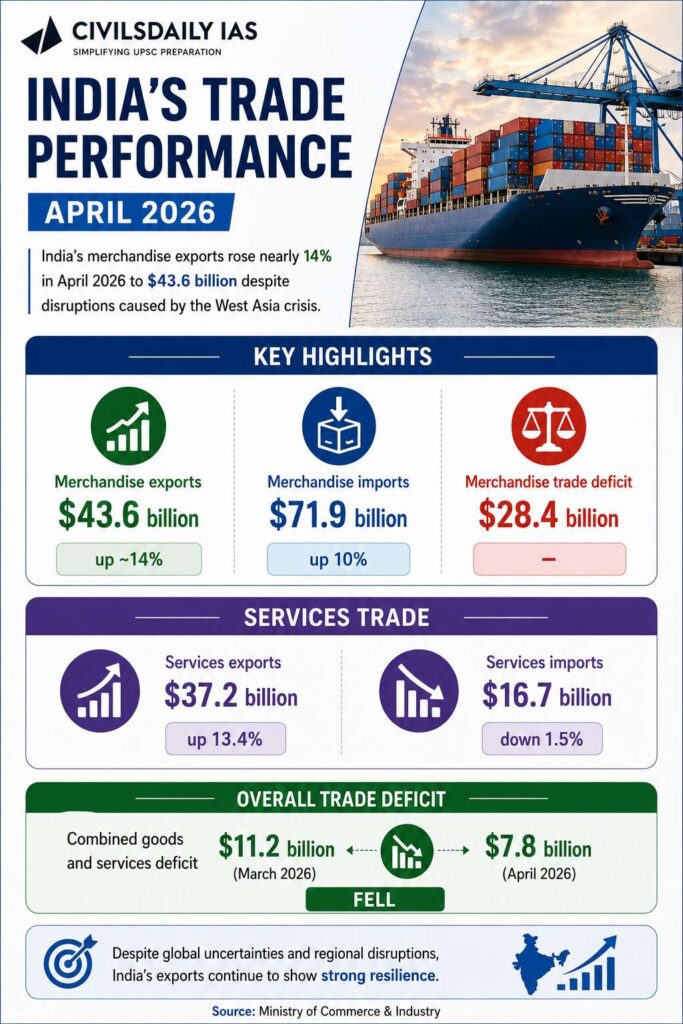
    India’s merchandise exports rose nearly 14% in April 2026 to $43.6 billion despite disruptions caused by the West Asia crisis.

    Key Highlights

    • Merchandise exports: $43.6 billion (up ~14%)
    • Merchandise imports: $71.9 billion (up 10%)
    • Merchandise trade deficit: $28.4 billion
    • Services Trade
      • Services exports: $37.2 billion (up 13.4%)
      • Services imports: $16.7 billion (down 1.5%)

    Overall Trade Deficit: The combined goods and services deficit fell from $11.2 billion to $7.8 billion.

    Reasons for Export Growth

    1. Diversification of export markets
    2. Higher global commodity prices
    3. Strong supply chain resilience

    Strong Export Growth To

    • Tanzania
    • Sri Lanka
    • Singapore
    • Bangladesh
    • Vietnam

    Impact of the West Asia Crisis

    • Exports to West Asia fell by ~28%.
    • Imports from West Asia fell by ~31.6%.
    • Reasons:
      • War-related disruptions
      • Shipping concerns
      • Energy market instability

    UAE and U.S. Trade

    • Exports to United Arab Emirates declined sharply.
    • Exports to the United States grew modestly.

    Important Concepts

    • Merchandise Trade: Trade in physical goods like petroleum, machinery, textiles, and electronics.
    • Services Trade: Trade in IT, banking, consulting, tourism, etc.
    • India usually runs:
      • Trade deficit in merchandise
      • Trade surplus in services
    [2020] With reference to the international trade of India at present, which of the following statements is/are correct? 
    1.India’s merchandise exports are less than its merchandise imports. 2.India’s imports of iron and steel, chemicals, fertilisers and machinery have decreased in recent years.
    3.India’s exports of services are more than its imports of services.
    4.India suffers from an overall trade/current account deficit.
    Select the correct answer using the code given below:
    a) 1 and 2 only b) 2 and 4 only c) 3 only d) 1, 3 and 4 only
  • Capital flight and pressure on the rupee

    Why in the News?

    The Indian Rupee is under intense depreciatory pressure. This is driven by significant capital outflows and surging global oil prices. This situation is particularly critical because, unlike previous cycles, capital flight is occurring based on the mere expectation of future interest rate hikes in developed economies, rather than actual hikes. This “pre-emptive” exit by foreign investors, coupled with a sharp rise in LPG and petrol prices, has triggered domestic hardships and a reverse migration of workers. The scale of the problem is highlighted by the fact that even without a formal change in U.S. Federal Reserve or Bank of England rates (currently held at 3.75% since December 2025), the Indian external account is facing a “taper tantrum” style exodus. This threatens the stability of India’s post-pandemic recovery and widening the Current Account Deficit to unsustainable levels.

    How do global geopolitical shifts trigger domestic capital flight?

    1. Geopolitical Hostilities: Promotes risk-aversion among foreign investors due to conflict in the Persian Gulf and the closure of the Strait of Hormuz.
    2. Capital Outflows: Leads to the liquidation of Indian assets as investors seek “safe haven” currencies, primarily the U.S. Dollar.
    3. Currency Weakening: Results in the depreciation of the Rupee relative to major currencies, increasing the cost of imports.

    Why is the current pressure on the rupee different from previous episodes of depreciation?

    1. Pre-emptive Capital Flight: Reflects investor withdrawal before actual foreign interest rate hikes, unlike earlier periods where monetary tightening had already occurred.
    2. Geopolitical Trigger: Emerges from uncertainty generated by hostilities in the Persian Gulf and fears regarding the closure of the Strait of Hormuz, a critical oil transit route.
    3. Double Vulnerability: Combines rising oil prices and capital outflows, placing simultaneous pressure on India’s currency and external account.
    4. Sharp Contrast with Earlier Trends: Occurs despite the U.S. Federal Reserve and Bank of England not raising rates, signalling a shift toward expectation-driven financial behaviour.
    5. Domestic Spillover: Rising LPG and petrol prices have increased hardship among working households and reportedly triggered reverse migration of workers back to villages.

    Can we compare the present situation with the 2013 ‘Taper Tantrum’?

    1. Taper Tantrum Parallel: Mirrors the 2013 episode, when expectations of reduced quantitative easing by the U.S. Federal Reserve caused sharp capital withdrawals from emerging markets.
    2. Expectation-Driven Exit: Demonstrates how the mere anticipation of tighter monetary policy, rather than actual policy implementation, can trigger capital outflows.
    3. Historical Similarity: Repeats a pattern where global financial sentiment rapidly alters investor behaviour in emerging economies.
    4. Critical Difference: Current outflows appear to be happening even earlier, before any formal signal of rate hikes has materialised.
    5. External Account Risk: Suggests India may face stronger pressure if future rate increases actually occur.

    Why does capital flight create pressure on the rupee?

    1. Capital Outflows: Foreign investors reduce holdings in Indian financial assets during periods of uncertainty. This reduces demand for the rupee and increases demand for foreign currencies.
    2. Exchange Rate Depreciation: Reduced foreign capital inflows weaken the rupee because investors convert rupee-denominated assets into dollars and other reserve currencies.
    3. Interest Rate Differential: Investment decisions depend on comparative returns between India and advanced economies. Higher expected returns abroad reduce the attractiveness of emerging markets.
    4. External Vulnerability: India remains vulnerable due to dependence on foreign capital to finance its current account deficit.

    How does capital flight occur through interest rate differentials?

    1. Interest Rate Differential: Determines investor preference based on comparative returns between Indian assets and foreign financial markets.
    2. Return Calculation: Requires Indian investments to compensate investors for inflation risk and currency depreciation risk in addition to nominal returns.
    3. Foreign Monetary Tightening: Encourages investors to reduce holdings of Indian assets if foreign rates rise and returns abroad become relatively attractive.
    4. Currency Depreciation: Occurs when foreign investors liquidate rupee-denominated assets and convert holdings into stronger reserve currencies such as the U.S. Dollar.
    5. Emerging Market Vulnerability: Exposes economies like India because dependence on external capital increases sensitivity to global financial conditions.

    How are geopolitical tensions in West Asia aggravating India’s external vulnerabilities?

    1. Strait of Hormuz Risk: Closure concerns regarding the Strait of Hormuz have heightened uncertainty because nearly one-third of global seaborne crude oil passes through the route.
    2. Crude Oil Prices: Rising oil prices increase India’s import bill because India imports nearly 85% of its crude oil requirement.
    3. Current Account Deficit (CAD): Higher oil imports widen the CAD by increasing expenditure on imports relative to exports.
    4. Inflationary Pressure: Expensive crude increases fuel and transport costs, thereby raising inflation across sectors.
    5. Investor Sentiment: Global uncertainty encourages investors to shift capital toward safer assets such as U.S. treasury securities.

    How does monetary policy uncertainty complicate exchange rate management?

    1. Inflation Persistence: Prolonged geopolitical conflict increases energy prices, thereby sustaining inflation.
    2. Central Bank Dilemma: Monetary authorities face a trade-off between controlling inflation and supporting growth.
    3. Interest Rate Transmission: Higher interest rates strengthen currency attractiveness but may slow economic growth.
    4. Policy Signalling: Ambiguity regarding future global monetary policy creates volatility in exchange rate markets.
    5. Example:  U.S. Federal Reserve: Delayed response to inflation after the pandemic contributed to uncertainty regarding future tightening.

    Why are current policy responses insufficient to address structural vulnerabilities?

    1. Moral Suasion: Appeals to reduce gold and petroleum consumption may temporarily reduce import demand but do not resolve structural imbalances.
    2. Import Duties: Increase in import duties on gold seeks to reduce non-essential imports and conserve foreign exchange.
    3. RBI Intervention: Restrictions on certain foreign exchange derivative contracts aim to reduce excessive currency speculation.
    4. Structural Limitation: Temporary measures cannot fully offset persistent vulnerabilities arising from oil dependence and foreign capital reliance.
    5. External Dependence: Rising foreign interest rates may intensify pressure on India despite domestic interventions.

    What are the long-term implications for India’s macroeconomic stability?

    1. Exchange Rate Volatility: Persistent rupee depreciation increases import costs and external debt burden.
    2. Inflation Risk: Imported inflation weakens household purchasing power and increases cost of living.
    3. Growth Concerns: High interest rates to stabilize the rupee may reduce investment and economic expansion.
    4. External Sector Stress: Wider current account deficits may weaken investor confidence.
    5. Financial Stability: Sudden capital outflows increase volatility in equity and bond markets.

    Conclusion

    India’s current external sector stress reflects more than routine rupee depreciation. The combination of geopolitical uncertainty, rising oil prices, and expectation-driven capital flight has exposed underlying vulnerabilities in the economy. Temporary measures such as derivative restrictions and gold import duties may moderate immediate pressures, but sustained stability requires reducing structural dependence on imported energy and volatile foreign capital.

    PYQ Relevance

    [UPSC 2018] How would the recent phenomena of protectionism and currency manipulations in world trade affect macroeconomic stability of India?

    Linkage: The PYQ tests understanding of how global trade distortions (protectionism, currency depreciation/manipulation) affect India’s macroeconomic stability, capital flows, inflation, exports, and exchange rate management. It is directly linked because the article discusses how global uncertainty and anticipated foreign monetary tightening are weakening the rupee through capital flight

  • Wholesale Inflation Rises to 3.5-Year High

    Why in the News

    India’s wholesale inflation, measured by the Wholesale Price Index (WPI), rose to 8.3% in April 2026, the highest level in nearly 3.5 years, mainly due to rising crude oil and natural gas prices amid the West Asia crisis.

    What is Wholesale Inflation?

    • Wholesale inflation measures changes in prices of goods at the wholesale or producer level before they reach consumers.
    • In India, it is measured through the Wholesale Price Index (WPI).
    • Released by the Ministry of Commerce and Industry.

    Key Data Highlights

    • WPI inflation:
      • March 2026: 3.9%
      • April 2026: 8.3%
    • Highest since October 2022.

    Major Drivers of Inflation

    Crude Oil and Natural Gas Prices

    • Inflation in crude oil and natural gas reached 67.2% in April 2026.
    • Highest level in 46 months.
    • Reasons:
      • West Asia geopolitical tensions
      • Supply uncertainty
      • Rising global energy prices
    • Fuel and Power Inflation: Fuel and power inflation rose to 24.7% in April 2026.
    • Driven by:
      • Rise in mineral oil prices
      • Higher transportation and logistics costs
    • Imported Inflation: Rising global commodity prices increased India’s import costs.

    What is Base Effect?

    • Base effect means current inflation appears higher because prices were unusually low in the previous year.
    • Since crude oil and natural gas witnessed deflation last year, current price increases appear statistically sharper.

    Core Difference between WPI and CPI

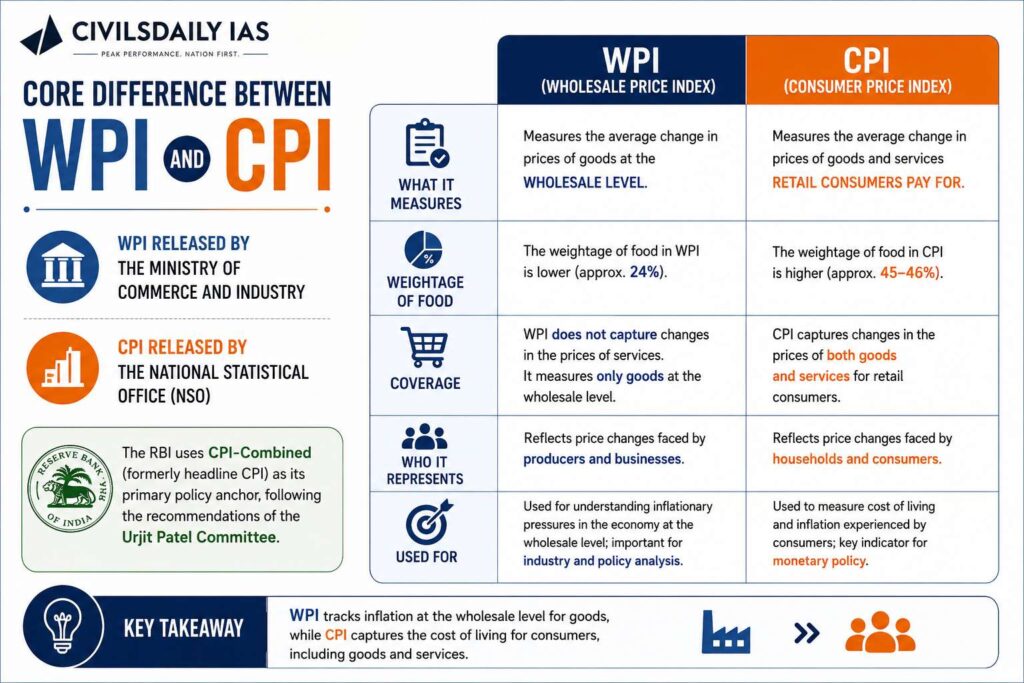
    • WPI Released by the Ministry of Commerce and Industry 
    • CPI Released by the National Statistical Office (NSO)
    • The weightage of food in Consumer Price Index (CPI) is higher than that in Wholesale Price Index (WPI). CPI has a significantly higher weightage for food (approx. 45-46%) compared to WPI (approx. 24%).
    • The WPI does not capture changes in the prices of services, which CPI does. WPI measures only goods at the wholesale level, while CPI includes both goods and services for retail consumers.
    • The RBI uses CPI-Combined (formerly headline CPI) as its primary policy anchor, following the recommendations of the Urjit Patel Committee.
    [2020] Consider the following statements: 
    1.The weightage of food in the Consumer Price Index (CPI) is higher than that in the Wholesale Price Index (WPI). 
    2.The WPI does not capture changes in the prices of services, which the CPI does. 
    3.The Reserve Bank of India uses WPI as its key measure of inflation to decide changes in policy rates. 
    Which of the statements given above is/are correct? 
    [A] 1 and 2 only [B] 2 and 3 only [C] 1 and 3 only [D] 1, 2 and 3
  • Centre doubles import duty on gold, silver; move is criticised as retrograde

    Why in the News?

    India has doubled the effective import duty on gold and silver from nearly 9.2% to 18.4%. The decision came amid concerns over the impact of the West Asia crisis on India’s external sector and soon after the Prime Minister urged citizens to reduce gold purchases to conserve foreign exchange.

    How has the government changed the import duty structure on gold and silver?

    1. Customs Duty Revision: The government increased basic customs duty on gold and silver from 5% to 10%.
    2. AIDC Increase: The Agriculture Infrastructure and Development Cess (AIDC) increased from 1% to 5%.
    3. IGST Continuity: The Integrated Goods and Services Tax (IGST) remains 3% on the assessable value.
    4. Effective Tax Burden: The cumulative effective tax burden increased from around 9.2% to 18.4%, including customs duty, cess, insurance, freight cost, and IGST.
    5. Immediate Implementation: The revised rates came into force through official notifications issued on 13 May, without prior consultation.

    Why did the government increase import duty on precious metals?

    The government increased the import duty on gold and silver to defend India’s macroeconomic balance against external shocks by prioritizing non-discretionary resource allocations.

    1. Current Account Deficit (CAD): Reducing import volumes directly curbs the widening Current Account Deficit to keep the trade balance within sustainable limits.
    2. Foreign Exchange Conservation: India aims to preserve forex reserves and rupee stability, especially amid geopolitical uncertainty.
    3. West Asia Crisis: Regional instability threatens oil prices, logistics chains, and shipping routes, increasing vulnerability for a crude oil-import dependent economy.
    4. Import Prioritisation: The government appears to prioritise foreign exchange for essential imports such as:
      1. Crude Oil
      2. Fertilisers
      3. Industrial Raw Materials
      4. Defence Requirements
      5. Critical Technologies
      6. Capital Goods
    5. Demand Management: Gold is treated as a consumption and investment good, unlike strategic imports necessary for production.

    Why are the gems and jewellery industry opposing the decision?

    1. Export Cost Escalation: Exporters argue that expensive imported gold raises production costs, reducing competitiveness in international markets.
    2. Working Capital Blockage: Exporters now face bank guarantees of ₹28-30 lakh per kg of duty-free gold, creating liquidity stress.
    3. MSME Vulnerability: MSMEs constitute nearly 80% of Gems and Jewellery Export Promotion Council (GJEPC) membership, making the sector particularly vulnerable.
    4. Employment Risks: Higher costs could reduce export orders and employment in a labour-intensive sector.
    5. Export Disruption: Industry stakeholders warn of lower shipments during a period already marked by trade disruption due to the West Asia crisis.

    Can higher import duties reduce gold imports effectively?

    1. Historical Experience: India’s past experience indicates that higher gold tariffs often fail to proportionately reduce imports.
    2. Persistent Demand: Cultural demand for gold in India remains high due to:
      1. Marriage Expenditure
      2. Household Savings
      3. Investment Demand
      4. Inflation Hedge
    3. Price Transmission: Higher tariffs often increase domestic gold prices rather than reduce demand.
    4. Import Resilience: Despite global gold prices doubling in recent years, imports have not fallen proportionately.
    5. Limited Elasticity: Demand for gold in India demonstrates low price elasticity, limiting tariff effectiveness.

    Does a higher duty increase smuggling and informal trade?

    1. Smuggling Incentives: Large differences between domestic and international prices create incentives for illegal gold inflows.
    2. Historical Precedent: India witnessed higher gold smuggling during earlier phases of elevated import duties.
    3. Revenue Leakage: Smuggling reduces formal tax collection and weakens customs enforcement.
    4. Informal Economy Expansion: Illegal channels strengthen hawala networks and black-market transactions.
    5. Policy Trade-off: Excessively high tariffs may undermine the original objective of reducing imports.

    How important is West Asia for India’s gems and jewellery trade?

    1. Diamond Export Share: West Asia accounts for nearly 18% of India’s diamond exports during the first nine months of FY 2025-26.
    2. Import Dependence: Around 68% of India’s rough diamond imports originate from the UAE and Israel.
    3. Trade Vulnerability: Regional instability directly affects supply chains, shipping, insurance costs, and export demand.
    4. Strategic Dependence: The sector remains deeply linked to West Asian trade networks.

    What concerns have been raised regarding policy transparency?

    1. Complex Taxation Structure: Multiple amendments and notifications complicate duty calculations.
    2. Ease of Doing Business Issues: Frequent tariff changes increase compliance burdens for traders and exporters.
    3. Predictability Deficit: Sudden duty revisions reduce policy certainty for investment planning.
    4. Administrative Complexity: Multi-layered taxation may weaken transparency in customs administration.

    What are the Policy Alternatives to Import Duty Hike?

    1. Gold Monetisation Scheme (GMS): Mobilises idle household gold through bank deposits, reducing dependence on fresh imports.
    2. Sovereign Gold Bonds (SGBs): Provides gold-linked returns without physical purchase, lowering demand for imported gold.
    3. Financial Savings Alternatives: Encourages investment in mutual funds, fixed deposits, equities, and pension schemes, reducing gold dependence as a savings tool.
    4. Recycling of Domestic Gold: Strengthens refining and reuse of existing gold stock, reducing import needs.
    5. Formalisation of Gold Trade: Improves hallmarking, digital tracking, and compliance, reducing smuggling and increasing tax collection.

    Conclusion

    The increase in gold and silver import duties shows India’s effort to protect foreign exchange reserves and manage external economic pressures during global uncertainty. However, past experience suggests that very high duties on gold may increase smuggling, disrupt markets, and hurt exports. A balanced approach, combining moderate tariffs with alternatives like digital or financial gold investments, may work better in the long run.

    PYQ Relevance

    [UPSC 2017] Account for the failure of the manufacturing sector in achieving the goal of labour-intensive exports rather than capital-intensive exports. Suggest measures for more labour-intensive rather than capital-intensive exports

    Linkage: The article links directly to this PYQ because the gems and jewellery sector is a labour-intensive export industry, and higher gold import duties can reduce its global competitiveness. It also highlights the challenge of balancing trade policy with export growth and MSME employment.

  • Bharat Maritime Insurance Pool (BMIP)

    Why in the News

    The Department of Financial Services under the Ministry of Finance launched the Bharat Maritime Insurance Pool (BMIP) worth USD 1.5 billion amid rising geopolitical tensions in West Asia.

    About Bharat Maritime Insurance Pool (BMIP)

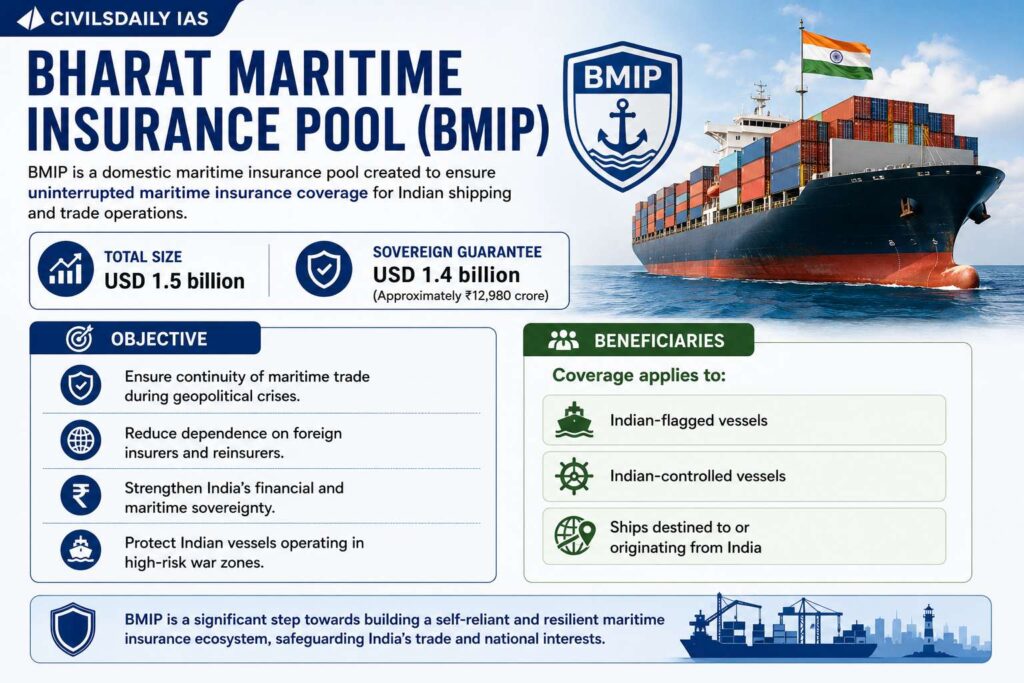
    • BMIP is a domestic maritime insurance pool created to ensure uninterrupted maritime insurance coverage for Indian shipping and trade operations.
    • Total Size: USD 1.5 billion
    • Sovereign Guarantee: USD 1.4 billion
    • Approximately ₹12,980 crore

    Objective

    • Ensure continuity of maritime trade during geopolitical crises.
    • Reduce dependence on foreign insurers and reinsurers.
    • Strengthen India’s financial and maritime sovereignty.
    • Protect Indian vessels operating in high-risk war zones.

    Beneficiaries

    • Coverage applies to:
      • Indian-flagged vessels
      • Indian-controlled vessels
      • Ships destined to or originating from India
    [2024] Consider the following statements: 
    Statement-I Sumed pipeline is a strategic route for Persian Gulf oil and Natural gas shipments to Europe. 
    Statement-II: Sumed pipeline connects the Red Sea with the Mediterranean Sea. 
    Which one of the following is correct in respect of the above statements? 
    [A] Both Statement-I and Statement-II are correct and Statement-II explains Statement-I 
    [B] Both Statement-I and Statement-II are correct, but Statement-II does not explain Statement-I 
    [C] Statement-I is correct, but Statement-II is incorrect 
    [D] Statement-I is incorrect, but Statement-II is correct
  • Why saving forex could hamper India’s growth

    Why in the News?

    The Prime Minister of India recently asked Indians to use fewer imports, like oil and fertilizers, to save the country’s foreign exchange (forex). While India has a huge “safety net” of over $640 billion in reserves, some experts are worried. They argue that cutting imports too much might actually hurt our industrial growth, since many factories depend on imported parts. The big question now is: should India focus on hoarding cash or boosting production?

    How are forex reserves linked to India’s economic growth?

    Foreign exchange (forex) reserves act as a high-speed engine and a safety net for India’s economic growth. Their link to growth is both protective (preventing crashes) and productive (enabling industrial expansion).

    1. Sustaining Industrial Output (Import Financing)
      1. Energy & Raw Materials: India imports roughly 85% of its crude oil and large quantities of fertilizers and electronics.
      2. Growth Link: Healthy reserves ensure that factories never stop running due to a lack of dollars to pay for these essential inputs. As of May 2026, India’s reserves provide an import cover of approximately 11 to 12 months, keeping industrial production stable despite global supply shocks
    2. Balance of Payments (BoP): Reflects all economic transactions between India and the rest of the world. Forex reserves increase when inflows exceed outflows through the current account and capital account.
      1. Current Account Deficit (CAD): Occurs when imports exceed exports. India generally runs a CAD because of dependence on crude oil, gold, electronics and industrial inputs.
      2. Capital Account Surplus: Compensates for CAD through Foreign Direct Investment (FDI), Foreign Portfolio Investment (FPI), external borrowings and remittances, helping maintain reserve adequacy.
    3. Stabilizing the “Price of Growth” (Rupee Stability)
      1. Controlling Inflation: When the rupee weakens, imports like oil become expensive, causing “imported inflation.”
      2. Growth Link: The RBI uses reserves to intervene in the market, selling dollars when the rupee falls too fast (as it did when the rupee crossed ₹95/$ in May 2026). This stability keeps costs predictable for businesses and protects the purchasing power of citizens.
    4. Example: India’s reserves provide an import cover of several months, unlike the 1991 Balance of Payments crisis, when reserves had fallen to levels sufficient for only weeks of imports.

    Why has conserving forex become a policy concern?

    1. Import Dependence: India imports nearly 80-85% of crude oil requirements, making oil the largest source of forex outflow.
    2. Commodity Vulnerability: Global disruptions such as the Russia-Ukraine conflict increased energy and fertilizer prices, worsening import bills.
    3. Edible Oil Imports: India depends significantly on imports of palm, soybean and sunflower oils, creating recurring pressure on forex.
    4. Fertilizer Dependence: Though food grain production is self-sufficient, agriculture remains dependent on imported fertilizer inputs.
    5. Trade Deficit Pressure: Persistent trade deficits increase vulnerability to global shocks and currency depreciation.

    Why could excessive forex conservation slow India’s growth?

    1. Consumption Compression: Reducing spending on imported goods lowers aggregate demand, affecting production and employment.
    2. Industrial Dependence on Imports: Indian manufacturing depends heavily on imported machinery, components, chemicals and intermediate goods.
    3. Multiplier Effects: Lower demand reduces business expansion, private investment and job creation.
    4. Growth Slowdown: Reduced imports of productive inputs may weaken sectors dependent on global value chains.
    5. Investment Sentiment: Weak domestic demand discourages domestic and foreign investors from expanding production.
    6. Example: Cutting imports indiscriminately may reduce economic dynamism rather than merely reducing forex outflows.

    Can India realistically replace imported goods in the short term?

    1. Crude Oil Constraint: India cannot quickly substitute imported crude because domestic energy production remains limited.
    2. Fertilizer Dependence: Natural resources required for fertilizer production, such as potash and phosphates, remain import-dependent.
    3. Intermediate Goods Dependence: Electronics, semiconductors and industrial machinery require imported components.
    4. Cost Consideration: Domestic substitutes often remain costlier or technologically inferior in the short run.
    5. Time Lag: Import substitution requires industrial capacity, technology transfer and infrastructure expansion.
    6. Example: India is food self-sufficient but still relies heavily on imported fertilizers to sustain agricultural productivity.

    What explains the relationship between the rupee and forex reserves?

    1. Currency Intervention: RBI sells dollars to stabilise the rupee during depreciation pressures.
    2. Exchange Rate Impact: Higher imports increase dollar demand, weakening the rupee.
    3. Inflation Transmission: A weaker rupee raises import costs, especially for oil, increasing inflation.
    4. Reserve Buffer: Forex reserves function as insurance against global financial shocks and capital flight.
    5. Example: RBI interventions during global volatility periods help moderate sharp exchange-rate movements.

    What should be India’s long-term strategy to manage forex sustainably?

    1. Production Enhancement: Strengthens manufacturing competitiveness through Make in India and industrial reforms.
    2. Export Diversification: Expands high-value exports in electronics, pharmaceuticals and services.
    3. Productivity Growth: Increases efficiency through technology adoption and logistics improvements.
    4. Import Rationalisation: Reduces avoidable imports while preserving productive imports.
    5. Energy Transition: Expands renewable energy and biofuel production to reduce crude oil dependence.
    6. Domestic Capability: Strengthens fertilizer, semiconductor and critical mineral ecosystems.
      1. Example: Production-linked incentive (PLI) schemes seek to reduce import dependence in sectors like electronics and solar manufacturing.

    Conclusion

    India’s forex reserves remain a critical macroeconomic buffer, but external strength cannot substitute for domestic growth momentum. Excessive emphasis on conserving forex through reduced consumption risks weakening demand, investment and productivity. A sustainable solution lies not merely in spending less foreign exchange, but in earning more through exports, higher productivity and stronger domestic production capacity.

    PYQ Relevance

    [UPSC 2017] Among several factors for India’s potential growth, savings rate is the most effective one. Do you agree? What are the other factors available for growth potential?

    Linkage: The PYQ examines whether higher savings alone can drive economic growth. This is similar to the debate on conserving foreign exchange versus expanding production and investment. The article extends this logic by arguing that growth depends not only on saving forex, but also on productivity, manufacturing and demand creation

  • Gold Monetisation Scheme (GMS)

    Why in the News

    The jewellery industry, led by the All India Gem and Jewellery Domestic Council, has called for revitalising the Gold Monetisation Scheme (GMS) to reduce gold imports and ease pressure on India’s foreign exchange reserves.

    About Gold Monetisation Scheme (GMS)

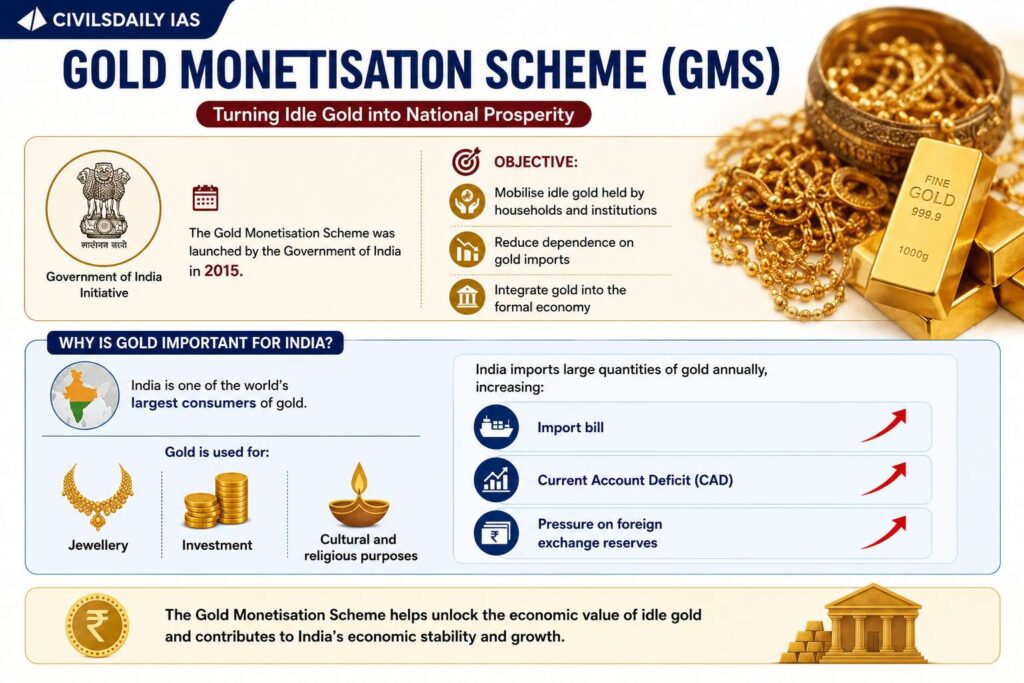
    • The Gold Monetisation Scheme was launched by the Government of India in 2015
    • Objective:
      • Mobilise idle gold held by households and institutions
      • Reduce dependence on gold imports
      • Integrate gold into the formal economy

    Why is Gold Important for India?

    • India is one of the world’s largest consumers of gold.
    • Gold is used for:
      • Jewellery
      • Investment
      • Cultural and religious purposes
    • India imports large quantities of gold annually, increasing:
      • Import bill
      • Current Account Deficit (CAD)
      • Pressure on foreign exchange reserves
    [2016] Which of the following is/are the purpose/purposes of Government’s ‘Sovereign Gold Bond Scheme’ and ‘Gold Monetization Scheme’?:
    1. To bring the idle gold lying with Indian households into the economy.
    2. To promote FDI in the gold and jewellery sector. 3.To reduce India’s dependence on gold imports.
    Select the correct answer using the code given below:
    [A] 1 only [B] 2 and 3 only [C] 1 and 3 only [D] 1, 2 and 3
  • Prevalence of fake currency till a reality post-demonetisation

    Why in the News?

    Nearly a decade after demonetisation was projected as a major strike against black money and fake currency, new NCRB and Parliamentary data show that counterfeit currency continues to circulate in India. The issue has become significant because fake ₹500 notes have sharply increased, Gujarat alone accounted for more than half of counterfeit currency seizures between 2017 and 2024, and counterfeit ₹2,000 notes rose despite being introduced after demonetisation.

    Why was demonetisation expected to curb fake currency?

    1. Currency Replacement: Demonetisation invalidated old ₹500 and ₹1,000 notes and introduced redesigned currency with enhanced security features.
    2. Financial Disruption: Intended to eliminate counterfeit stock accumulated by criminal and terror networks.
    3. Formalisation of Economy: Encouraged banking transactions and digital payments to reduce cash dependency.
    4. Security Objective: Sought to weaken terror financing channels dependent on fake Indian currency notes (FICN).
    5. Governance Goal: Intended to reduce black money circulation and illicit cash transactions.

    What do recent data reveal about counterfeit currency trends?

    1. Persistent Counterfeit Circulation: NCRB data show counterfeit currency seizures worth more than ₹54.61 crore across States.
    2. Peak Seizures in 2022: Fake currency seizures reached ₹382.6 crore, the highest level in recent years and over 85% linked to Gujarat.
    3. Sharp Rise After Demonetisation: Counterfeit ₹2,000 notes nearly doubled compared to 2017 despite being newly introduced after demonetisation.
    4. Continued Fake ₹500 Notes: Fake ₹500 notes seized in 2024 were nearly four times the level recorded in 2016.
    5. Pandemic Disruption: Currency seizures fell temporarily in 2020 (₹92 crore) during COVID-19 restrictions but later surged.
    6. Banking Detection: Banks detected counterfeit notes worth nearly ₹40.26 crore between 2020-21 and 2024-25, averaging roughly 2 lakh fake notes annually.

    Why does the rise in fake ₹500 and ₹2,000 notes matter?

    1. Security Failure: Indicates criminal networks adapted rapidly even after redesigned currency introduction.
    2. Post-Demonetisation Counterfeiting: Fake ₹2,000 notes, introduced after 2016, emerged in large numbers, questioning technological safeguards.
    3. ₹500 Dominance: Fake ₹500 notes formed a major share of seizures because the denomination remained widely used even after the withdrawal of ₹2,000 notes from circulation in May 2023.
    4. Banking Penetration: Counterfeit notes entering banks indicate that fake currency penetrated formal financial channels
    5. Economic Trust Deficit: Sustained counterfeiting weakens public confidence in cash transactions.

    Why has Gujarat emerged as the major hub of counterfeit currency seizures?

    1. High Seizure Concentration: Gujarat accounted for ₹355.72 crore, more than half of India’s total counterfeit currency seizures (2017-2024).
    2. Geographical Significance: Coastal access and trade routes may increase vulnerabilities to smuggling and organised criminal activity.
    3. Extraordinary Spike in 2022: Gujarat alone contributed to more than 85% of counterfeit currency seized nationally.
    4. Inter-State Pattern: Maharashtra and Karnataka followed Gujarat with seizures worth approximately ₹100 crore and ₹50 crore, respectively.
    5. Enforcement Question: Raises concerns regarding whether high seizures indicate stronger policing or higher counterfeit circulation.

    Has demonetisation achieved its objectives regarding fake currency?

    1. Partial Success: Immediate withdrawal disrupted counterfeit stock based on old ₹500 and ₹1,000 notes.
    2. Limited Long-Term Impact: Rising fake currency in new denominations suggests only temporary gains.
    3. Digitalisation Outcome: India witnessed growth in digital transactions, reducing some dependence on cash.
    4. Black Money Limitation: Cash-based black money adapted through alternative channels.
    5. Institutional Challenge: Persistent counterfeiting suggests the need for continuous currency security upgrades.

    What are the broader economic and security implications of counterfeit currency?

    1. Terror Financing: Fake currency supports unlawful activities and cross-border terror financing.
    2. Inflationary Distortion: Counterfeit money artificially increases cash circulation.
    3. Monetary Credibility: Reduces trust in sovereign currency and payment systems.
    4. Banking Burden: Increases costs of verification and counterfeit detection.
    5. Internal Security Threat: Strengthens organised crime and hawala networks.

    What measures can strengthen India’s anti-counterfeit framework?

    1. Currency Security Enhancement: Ensures frequent upgrades in watermarking, microprinting, and security threads.
    2. AI-Based Detection: Facilitates real-time identification of counterfeit notes in ATMs and banks.
    3. Border Surveillance: Strengthens monitoring of smuggling routes and cross-border criminal networks.
    4. Financial Intelligence Coordination: Supports coordination among RBI, NCRB, FIU-IND, DRI, NIA, and State police.
    5. Digital Payments Expansion: Reduces excessive cash dependence and counterfeit vulnerability.
    6. Public Awareness: Ensures citizen awareness regarding security features of currency notes.

    Conclusion

    The persistence of counterfeit currency despite demonetisation indicates that currency replacement alone cannot eliminate the challenge of fake money. While the 2016 exercise disrupted old counterfeit networks temporarily and accelerated digital transactions, rising seizures of fake new-series notes reveal institutional and technological gaps. A sustained strategy based on advanced currency security features, stronger inter-agency coordination, border vigilance, financial intelligence, and reduced cash dependency is necessary to protect monetary credibility and internal security.

    PYQ Relevance

    [UPSC2022] Give out the major sources of terror funding in India and the efforts being made to curtail these sources. In the light of this, also discuss the aim and objective of the ‘No Money for Terror (NMFT)’ Conference recently held at New Delhi in November 2022.

    Linkage: Counterfeit currency is a major source of terror financing, often linked with hawala, organised crime, and cross-border networks. The article directly relates to illicit financial flows and internal security.

  • [7th May 2026] The Hindu OpED: Understanding inequality in India’s growth story  

    PYQ Relevance[UPSC 2017] What are the salient features of ‘inclusive growth’? Has India been experiencing such a growth process? Analyze and suggest measures for inclusive growth.Linkage: The article directly examines whether India’s post-reform growth has remained inclusive, especially amid widening urban-rural and class-based consumption inequality. It links strongly with GS-III themes of inclusive growth, welfare distribution, labour reforms, poverty, inequality measurement, and human development disparities.

    Mentor’s Comment

    India’s growth story is increasingly being questioned for its uneven distribution of gains. The assumption that inequality in India is moderate when compared globally is being challenged now. The Household Consumer Expenditure Survey (HCES) 2023-24 data states that inequality, especially in urban India and in non-food consumption, is far deeper than commonly estimated. While India has emerged as one of the fastest-growing economies, consumption patterns reveal widening disparities between rural and urban India, between rich and poor, and within social classes themselves. The top 10% in urban India account for 27% of total non-food expenditure, while the richest urban households spend nearly nine times more than the poorest rural households. 

    Why does measuring inequality in India remain methodologically complex?

    1. Multiple Dimensions: Inequality exists across income, wealth, consumption expenditure, and access to opportunities.
    2. Data Limitations: India lacks reliable and frequent income and wealth datasets. Consumption expenditure therefore becomes the primary proxy for measuring inequality.
    3. Methodological Changes: HCES 2023-24 introduced methodological modifications, making comparison with previous NSSO rounds difficult.
    4. Measurement Variations: World Bank estimates place India’s Gini coefficient at 0.25, while HCES-based estimates suggest a higher overall consumption inequality of 0.29.
    5. Sectoral Disaggregation: Urban inequality appears significantly higher once rural-urban and food-non-food distinctions are separately examined.
    6. Consumption Bias: Food expenditure shows lower inequality because food remains a basic necessity across classes.

    How does food and non-food expenditure reveal hidden inequality?

    1. Food Equality Effect: Food expenditure inequality remains relatively lower due to survival-driven consumption patterns.
    2. Non-Food Polarisation: Non-food expenditure shows significantly higher inequality in both urban and rural India.
    3. Urban Concentration: Urban non-food expenditure inequality is the highest among all categories.
    4. HCES Findings:
      1. Food expenditure Gini coefficient: approximately 0.25
      2. Non-food expenditure Gini coefficient: approximately 0.35-0.36
      3. Overall expenditure inequality: approximately 0.29
    5. Consumption Diversification: Richer households spend disproportionately on healthcare, education, digital services, transport, luxury goods, and recreation.
    6. Structural Indicator: Rising non-food inequality reflects unequal access to quality human development indicators.

    Why is urban India emerging as the epicentre of inequality?

    1. Growth Concentration: Most high-growth sectors are urban-centric, including finance, IT, services, logistics, and professional sectors.
    2. Urban Advantage: Mean urban expenditure exceeds the all-India average, while rural expenditure remains below it.
    3. Consumption Gap: Urban non-food Monthly Per Capita Expenditure (MPCE) stands at nearly 1.51 times the all-India average.
    4. Rural Lag: Rural non-food MPCE remains significantly lower at nearly 0.78 of the all-India average.
    5. Top-Decile Dominance: The richest 10% in urban India contribute nearly 27% of total non-food expenditure.
    6. Bottom-Decile Marginalisation: The same metric remains only around 4.5 times lower in rural India, indicating sharper urban inequality.
    7. Extreme Contrast: Mean MPCE of the richest urban decile is nearly nine times that of the poorest rural decile.
    8. Spatial Disparity: Urban prosperity increasingly coexists with informal labour vulnerability and rising living costs.

    How does class-based inequality deepen India’s growth paradox?

    1. Consumption-Based Class Divide: Inequality increasingly reflects divergence between spending classes rather than only interpersonal differences.
    2. Urban Professional Gains: Since the 1980s, urban owners, managers, and professionals have disproportionately benefited from economic growth.
    3. Stagnation of Informal Labour: Informal workers, agricultural labourers, and small farmers experienced comparatively limited gains.
    4. Class Inequality Persistence: Welfare expansion has not substantially reversed within-class inequality in urban India.
    5. Growth-Inequality Nexus: Economic liberalisation accelerated aggregate growth but also intensified concentration of gains.
    6. Non-Food Expenditure Concentration: Around 67% of non-food expenditure inequality arises from within-decile disparities.
    7. Food Expenditure Contribution: Nearly 33% of food expenditure inequality arises from within-decile disparities.
    8. Structural Dualism: India simultaneously experiences high-growth enclaves and low-income consumption traps.

    Why can lower inequality estimates produce misleading policy outcomes?

    1. Underestimation Risk: Consumption-based estimates may underestimate actual inequality because the richest households are often underrepresented in surveys.
    2. Policy Misalignment: Lower inequality estimates may weaken welfare urgency and social protection interventions.
    3. Welfare Retrenchment Concerns: Reduction in employment guarantees and labour protections could disproportionately affect informal workers.
    4. Poverty-Inequality Overlap:
      1. Around one-fourth of the richest 10% benefited from PMGKAY.
      2. Around 13% of them reportedly accessed BPL cards.
    5. Targeting Errors: Welfare leakages reveal institutional weaknesses in beneficiary identification.
    6. Social Stability Risks: Persistent inequality may intensify social fragmentation, urban distress, and political dissatisfaction.

    How does rural-urban disparity shape India’s development trajectory?

    1. Rural Consumption Constraint: Rural expenditure remains heavily food-oriented with limited discretionary spending.
    2. Urban Service Expansion: Urban economies benefit from greater access to finance, technology, education, and infrastructure.
    3. Human Capital Divide: Access to quality healthcare and education remains highly unequal across regions.
    4. Migration Pressures: Rural distress fuels migration toward cities without proportional employment generation.
    5. Regional Imbalance: Growth remains concentrated in select urban clusters and metropolitan regions.
    6. Development Asymmetry: Economic expansion has not ensured balanced regional transformation.

    Conclusion

    India’s growth story reflects a structural paradox where rapid economic expansion coexists with widening consumption inequality, especially in urban India and non-food expenditure. The findings from HCES 2023-24 indicate that economic gains remain concentrated among higher-income groups, while informal workers, rural households, and vulnerable classes continue to face limited upward mobility.

  • Das Adam Smith Problem: rethinking Smith’s moral and economic worlds

    Why in the News?

    The debate has resurfaced due to the 250th anniversary of The Wealth of Nations (1776-2026). This milestone has triggered a re-evaluation of Adam Smith’s ideas. Earlier views saw a contradiction between self-interest and morality. Recent scholarship rejects this. It argues Smith presented a unified moral-economic framework.

    The issue is significant in today’s context of rising inequality and market failures. It challenges the idea of purely self-regulating markets. The debate marks a shift from a long-standing misinterpretation. It highlights the need to integrate ethics with economic policy.

    What constitutes the “Das Adam Smith Problem”?

    “Das Adam Smith Problem” refers to a long-standing scholarly debate concerning a perceived, fundamental contradiction between the moral philosophy in Adam Smith’s The Theory of Moral Sentiments (1759) and the economic principles in The Wealth of Nations (1776).

    Formulated by late-19th-century German Historical School scholars, the “problem” posits that Smith abandoned the ethics of “sympathy” (compassion/impartial spectator) for a, or a solely, self-interested model of human nature in his later economic work

    1. Conceptual Dichotomy: Suggests a contradiction between sympathy in Theory of Moral Sentiments and self-interest in Wealth of Nations.
    2. Historical Origin: Formulated by German Historical School scholars like Wilhelm Hasbach and August Oncken in the late 19th century.
    3. Perceived Conflict: Interprets Smith’s later work as abandoning moral philosophy for economic individualism.
    4. Temporal Gap: Highlights the 17-year gap between the two works, raising questions about intellectual evolution.
    5. Core Issue: Questions whether markets are morally neutral or embedded within ethical frameworks.

    Is the problem a misinterpretation of Adam Smith’s philosophy?

    1. Unified Framework: Argues Smith’s works form a coherent system integrating ethics and economics.
    2. Moral Foundations: Emphasizes that markets operate within moral norms and institutions.
    3. Scholarly Reassessment: Amartya Sen (2010) highlights Smith’s concern with broader social motivations beyond self-interest.
    4. Institutional Role: Recognizes the importance of laws and norms in enabling economic activity.
    5. Key Insight: Markets are extensions of moral behavior, not replacements for it.

    How does Smith reconcile morality and market mechanisms?

    1. Misinterpreted: Unified FrameworkThe Problem: Many view Smith purely as a technical economist who advocated for “cowboy capitalism” and unchecked self-interest.
      1. The Reality: Smith did not view his works as separate. He viewed his economic analysis (Wealth of Nations) as deeply connected to his moral philosophy (Theory of Moral Sentiments). Together, they represent a system where commercial activities are intended to function within a structure of moral norms
    2. Invisible Hand Reinterpretation: Functions as a mechanism where individual actions benefit society when guided by moral constraints.
    3. Empathy Framework: Theory of Moral Sentiments provides the ethical lens through which economic actions are judged.
    4. Complementarity: Both works address different dimensions, moral psychology and economic organization.
    5. Behavioral Insight: Recognizes humans as motivated by both self-interest and empathy.
    6. Outcome: Establishes that economic efficiency and moral responsibility are not mutually exclusive.

    What are the intellectual debates surrounding the problem?

    The intellectual debate surrounding “Das Adam Smith Problem” has shifted from trying to “fix” a contradiction to critiquing the very way we categorize human behavior.

    1. Binary Thinking Critique: Scholars like Leonidas Montes argue that the perceived conflict between Smith’s works is a modern “myth” born from oversimplification. By forcing human behavior into a binary of “selfish” (economics) vs. “selfless” (ethics), 19th-century commentators created a problem that Smith, who saw these as overlapping, didn’t actually have.
    2. Spectrum Approach: Suggests human motivations lie along a continuum between self-interest and altruism.
      1. It isn’t a choice between pure egoism and pure altruism; rather, Smith’s “sympathy” acts as a bridge. 
      2. We act out of self-interest, but that interest is moderated by our desire for social approval and our internal “impartial spectator.”
    3. Economic Thought Evolution: Links Smith’s ideas to welfare economics and behavioral economics.
    4. Arrow’s Contribution: In the 1950s, Kenneth Arrow provided a mathematical backbone to this debate.
      1. His “Impossibility Theorem” demonstrated that individual preferences cannot always be merged into a fair social choice through simple market or voting mechanisms. 
      2. This formalized what Smith hinted at: pure market logic has inherent limits when it comes to collective welfare and social justice.
    5. Unresolved Debate: No single consensus exists on the precise linkage between Smith’s works.

    What is the relevance of this debate in contemporary economics?

    The modern reinterpretation of Adam Smith isn’t just an academic exercise; it provides a framework for addressing the limitations of “pure” market models. It aligns with findings that humans are not purely rational or self-interested.

    By bridging the gap between ethics and economics, this debate directly informs several contemporary movements:

    1. The Rise of Behavioral Economics: The debate validates the idea that the “Economic Man” (Homo economicus), the perfectly rational, purely selfish actor, is a myth.
      1. Beyond Self-Interest: Aligning with Smith’s “moral sentiments,” behavioral economics shows that people value fairness, reciprocity, and altruism.
      2. Nudge Theory: Understanding human psychology allows for policies that “nudge” people toward better outcomes without removing their freedom of choice.
    2. Redefining Corporate Responsibility (ESG): The “integrated” Smith supports the modern shift toward Environmental, Social, and Governance (ESG) criteria.
      1. Stakeholder vs. Shareholder: If Smith believed markets rely on a moral foundation, then businesses have a responsibility to the community, not just to profit.
      2. Sustainable Development: The debate encourages a long-term view of economic growth that considers environmental and social stability as necessary conditions for a healthy market.
    3. Ethical Capitalism: In a world facing a “crisis of trust” in institutions, the debate reinforces that capitalism cannot survive on greed alone.
      1. Trust as Infrastructure: Modern economists argue that trust is a “social capital” that lowers transaction costs.
    4. Policy Implications: Supports welfare policies, redistribution, and regulation.
    5. Market Failures: Highlights the need for institutional intervention in addressing inequality and externalities.
    6. Modern Relevance: Connects to debates on corporate responsibility and sustainable development.

    How has modern scholarship reshaped the interpretation?

    1. Expanded Scope:  Recent scholarship rejects the view that Smith’s The Theory of Moral Sentiments (1759) and The Wealth of Nations (1776) are contradictory.
      1. Integration over Separation: Rather than separating economic behavior from morality, scholars now emphasize that Smith viewed sympathy and ethical motivations as essential elements of human interaction and economic exchange.
    2. Evidence-Based Approach:
      1. Pro-social Motivations: Natalie Gold (2020) and other scholars argue that while Smith recognized self-interest, he also understood that pro-social motivations and moral sentiments are active in economic life.
    3. Interdisciplinary Analysis:
      1. Philosophy, Economics, and Psychology: Scholars now blend perspectives from the history of political economy, moral philosophy, and psychology to interpret Smith.
      2. The “Impartial Spectator”: Research in moral cognition uses Smith’s concept of an “impartial spectator” as a vital tool for understanding modern ethics and decision-making, as highlighted in studies on Adam Smith’s moral cognition .
    4. Continuing Debate: Acknowledges lack of a definitive resolution.
      1. Reconciling Motives: The new debate focuses on how to reconcile self-regarding motives with pro-social motivations within a single, integrated, and fair system.
    5. Key Outcome: Positions Smith as a thinker of integrated social science rather than fragmented disciplines.

    Conclusion

    The “Das Adam Smith Problem” reflects more about interpretative frameworks than about Smith’s actual philosophy. Modern scholarship establishes that Smith envisioned a system where markets function within moral boundaries. The debate underscores the necessity of integrating ethics into economic governance, making it highly relevant for contemporary policymaking.

    PYQ Relevance

    [UPSC 2022] Is inclusive growth possible under market economy? State the significance of financial inclusion in achieving economic growth in India.

    Linkage: The PYQ tests the tension between market-led self-interest and social welfare, central to Adam Smith debate. It provides scope to argue for ethical regulation and moral foundations of markets in ensuring inclusive growth.