Why in the News
India’s wholesale inflation, measured by the Wholesale Price Index (WPI), rose to 8.3% in April 2026, the highest level in nearly 3.5 years, mainly due to rising crude oil and natural gas prices amid the West Asia crisis.
What is Wholesale Inflation?
- Wholesale inflation measures changes in prices of goods at the wholesale or producer level before they reach consumers.
- In India, it is measured through the Wholesale Price Index (WPI).
- Released by the Ministry of Commerce and Industry.
Key Data Highlights
- WPI inflation:
- March 2026: 3.9%
- April 2026: 8.3%
- Highest since October 2022.
Major Drivers of Inflation
Crude Oil and Natural Gas Prices
- Inflation in crude oil and natural gas reached 67.2% in April 2026.
- Highest level in 46 months.
- Reasons:
- West Asia geopolitical tensions
- Supply uncertainty
- Rising global energy prices
- Fuel and Power Inflation: Fuel and power inflation rose to 24.7% in April 2026.
- Driven by:
- Rise in mineral oil prices
- Higher transportation and logistics costs
- Imported Inflation: Rising global commodity prices increased India’s import costs.
What is Base Effect?
- Base effect means current inflation appears higher because prices were unusually low in the previous year.
- Since crude oil and natural gas witnessed deflation last year, current price increases appear statistically sharper.
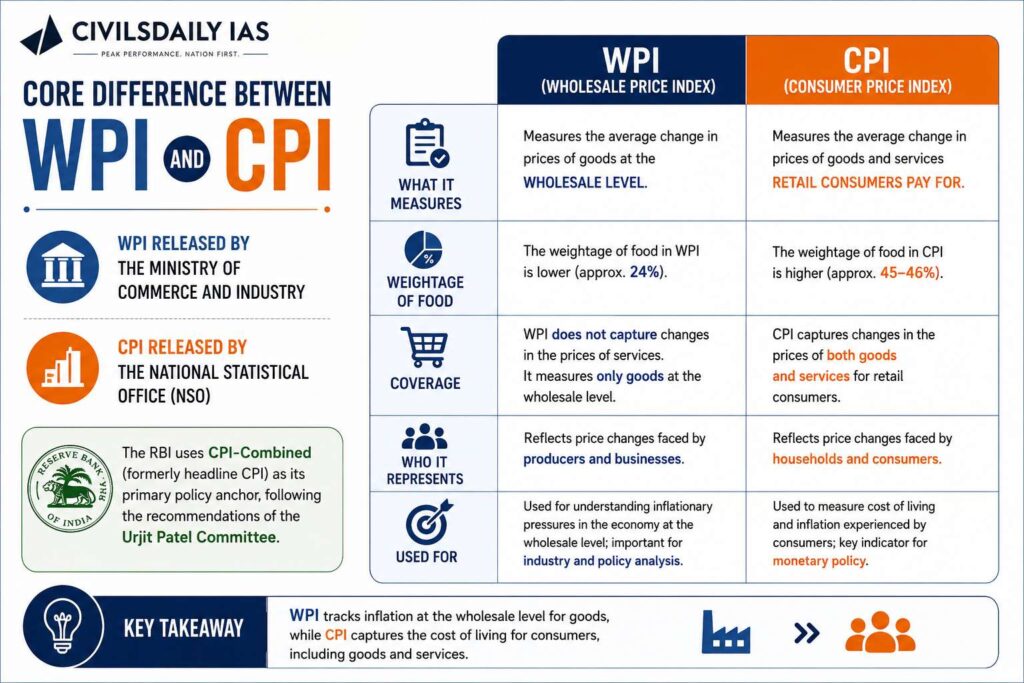
Core Difference between WPI and CPI
- WPI Released by the Ministry of Commerce and Industry
- CPI Released by the National Statistical Office (NSO)
- The weightage of food in Consumer Price Index (CPI) is higher than that in Wholesale Price Index (WPI). CPI has a significantly higher weightage for food (approx. 45-46%) compared to WPI (approx. 24%).
- The WPI does not capture changes in the prices of services, which CPI does. WPI measures only goods at the wholesale level, while CPI includes both goods and services for retail consumers.
- The RBI uses CPI-Combined (formerly headline CPI) as its primary policy anchor, following the recommendations of the Urjit Patel Committee.
| [2020] Consider the following statements: 1.The weightage of food in the Consumer Price Index (CPI) is higher than that in the Wholesale Price Index (WPI). 2.The WPI does not capture changes in the prices of services, which the CPI does. 3.The Reserve Bank of India uses WPI as its key measure of inflation to decide changes in policy rates. Which of the statements given above is/are correct? [A] 1 and 2 only [B] 2 and 3 only [C] 1 and 3 only [D] 1, 2 and 3 |
