Mains Ready By December. Smash Mains & Smash PYQ Admissions Open

GS Paper: GS3

  • Species in news: Henneguya Salminicola


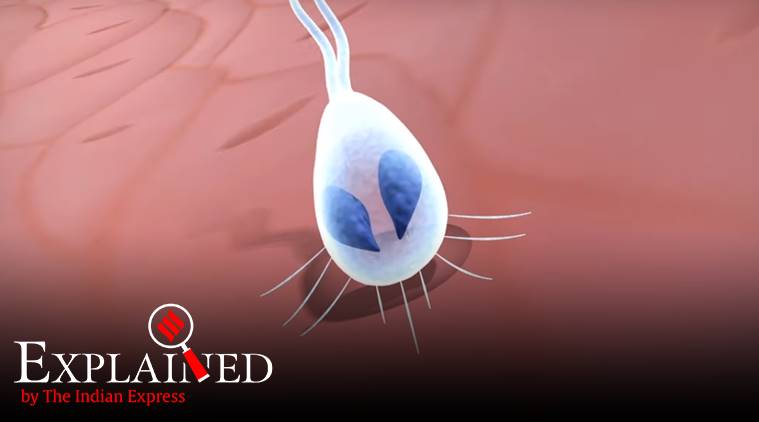
    Researchers at Tel Aviv University have discovered a non-oxygen breathing animal, which significantly changes one of science’s assumptions about the animal world — that all animals use aerobic respiration and therefore, oxygen.

    Henneguya Salminicola

    • The organism is Henneguya salminicola, a fewer-than-10-celled microscopic parasite that lives in salmon muscle.
    • It relies on anaerobic respiration (through which cells extract energy without using oxygen).
    • In the case of this non-oxygen breathing organism, evolution turned it into a simpler organism that shed “unnecessary genes” responsible for aerobic respiration.
    • Other organisms such as fungi and amoebas that are found in anaerobic environments lost the ability to breathe over time.
    • The new study shows that the same can happen in the case of animals, too.

    What is Aerobic respiration?

    • Animals, including humans, need energy to perform the various tasks that are essential for survival.
    • Aerobic respiration is one such chemical reaction through which organisms take in oxygen and release carbon dioxide into the atmosphere.
    • Through this mechanism, energy is transferred to cells, which can use it for multiple purposes — for instance, to burn food.
    • Mitochondria is the “powerhouse” of the cell, which captures oxygen to make energy — its absence in the H. salminicola genome indicates that the parasite does not breathe oxygen.
  • NASA’s InSight Mission


    It’s now more than a year since NASA’s InSight lander mission touched down on Mars on November 26, 2018. This week, NASA published a report regarding findings on the Mars.

    About InSight Mission

    • The Interior Exploration using Seismic Investigations, Geodesy and Heat Transport mission is a robotic lander designed to study the deep interior of the planet Mars.
    • It is the first mission dedicated to looking deep beneath the Martian surface.
    • Among its science tools are a seismometer for detecting quakes, sensors for gauging wind and air pressure, a magnetometer, and a heat flow probe designed to take the planet’s temperature.
    • The InSight mission is part of NASA’s Discovery Program.
    • It is being supported by a number of European partners, which include France’s Centre National d’Études Spatiales (CNES), the German Aerospace Center (DLR) and the United Kingdom Space Agency (UKSA).

    Key findings of the Mission

    Underground: rumbles

    • Mars trembles more often than expected, but also more mildly.
    • This emerged from readings of the ultra-sensitive seismometer, called the Seismic Experiment for Interior Structure (SEIS).
    • The instrument enables scientists to “hear” multiple trembling events from hundreds to thousands of miles away.
    • Mars doesn’t have tectonic plates like Earth, but it does have volcanically active regions that can cause rumbles.

    The surface: Magnetism

    • Billions of years ago, Mars had a magnetic field.
    • Although it is no longer present, it left behind what NASA describes as “ghosts” – magnetized rocks that are now between 61 m to several km below ground.
    • InSight is equipped with a magnetometer, which has detected magnetic signals.
    • At a Martian site called Homestead hollow, the magnetic signals are 10 times stronger than what was predicted earlier (based on data from orbiting spacecraft).

    In the wind: dust devils

    • InSight measures wind speed, direction and air pressure nearly continuously.
    • Weather sensors have detected thousands of passing whirlwinds, which are called dust devils when they pick up grit and become visible.
    • The site has more whirlwinds than any other place where a landing has been made on Mars while carrying weather sensors.
    • Despite all that activity in the wind and frequent imaging, InSight’s cameras have yet to see dust devils. But SEIS can feel these whirlwinds pulling on the surface.

    The core: still to come

    • InSight has two radios. One is for regularly sending and receiving data. The other radio, which is more powerful, is designed to measure the “wobble” of Mars as it spins.
    • This X-band radio, also known as the Rotation and Interior Structure Experiment (RISE), can eventually reveal whether the planet’s core is solid or liquid.
    • A solid core would cause Mars to wobble less than a liquid one would.
    • This first year of data is just a start, NASA said in the statement. When it is two years on Earth, Mars will have completed one year.
  • ‘MH-60R and AH-64E Apache’ Choppers


    During his speech in Ahmedabad, Mr. Trump announced: deals to sell over $3 billion state-of-the-art military helicopters and other equipment to the Indian Armed Forces.

    MH-60 Romeo helicopters

    • The incoming 24 multirole MH-60 Romeo helicopters are expected to boost the Indian Navy’s efforts to expand its role in the Indian Ocean Region.
    • The MH-60 Romeo Seahawk, made by defence giant Lockheed Martin, is one of the most advanced naval helicopters in the world, used by the US Navy among others.
    • It is the most capable and mature Anti-Submarine Warfare (ASW) Anti-Surface Warfare (ASuW) multi-mission helicopter available in the world today, the makers say.
    • MH-60 Romeo Seahawks have equipped with anti-submarine Mark 54 torpedoes and Hellfire air-to-surface missiles, along with precision-kill rockets.
    • It also has an advanced system for passive detection, location, and identification of emitters. It can not only track and hunt ships but is also used by the US Navy as an anti-submarine weapon.

    Apache helicopters

    • Indian Army will receive six more Apache helicopters in addition to the 22.
    • The Apaches can operate at high altitudes and will be deployed along the Pakistan border. The Army is likely to get the helicopters armed with Stinger air-to-air missiles and Hellfire Longbow air-to-ground missiles.
    • Among the Apache’s modern capabilities are the ability to shoot fire-and-forget anti-tank missiles, air-to-air missiles, rockets, and other munitions.
    • It also has modern electronic warfare capabilities to provide versatility in network-centric aerial warfare.
    • The choppers are all-weather capable and have high agility and survivability against battle damage.
    • They can be easily maintained in field conditions as well as during operations in the tropical and desert regions.
  • National Technical Textiles Mission

    The Cabinet Committee on Economic Affairs has given its approval to set up a National Technical Textiles Mission with a view to position the country as a global leader in Technical Textiles.

    What are Technical Textiles?

    • Technical textile is a textile product manufactured for non-aesthetic purposes, where the function is primary criterion.
    • They are functional fabrics that have applications across various industries including automobiles, civil engineering and construction, agriculture, healthcare, industrial safety, personal protection etc.
    • Technical Textiles is a high technology sunrise sector which is steadily gaining ground in. India.

    National Technical Textiles Mission

    • The Mission would have a four year implementation period from FY 2020-21 to 2023-24.
    • It will move into sunset phase after four years period.
    • A Mission Directorate in the Min. of Textiles headed by an eminent expert in the related field will be made operational.
    • The Directorate will not have any permanent employment and there will be no creation of building infrastructure for the Mission purpose.

    Components of the mission

    Component-I:  Promoting both (i) fundamental research at fibre level and (ii) application-based research in geo-textiles, agro-textiles, medical textiles, mobile textiles and sports textiles and development of bio­degradable technical textiles.

    Component-II: Promotion and Market Development.

    Component-III: Export promotion of technical textiles and ensuring 10% average growth in exports per year upto 2023-24. An Export Promotion Council for Technical Textiles will be set up for this purpose.

    Component-IV: Promoting technical education at higher engineering and technology levels related to technical textiles.

  • [pib] Exercise Indradhanush

    The Indian Air Force (IAF) and Royal Air Force (RAF) jointly commenced the fifth edition of Exercise Indradhanush at Air Force Station Hindan.

    Ex. Indradhanush

    • It is a joint air force exercise conducted by the Royal Air Force (RAF) of United Kingdom and the Indian Air Force (IAF) being held since 2006.
    • The exercise is tasked to enhance mutual operational understanding between the two air forces via close interaction.
    • The focus of this edition of the exercise is ‘Base Defence and Force Protection’.
    • This theme is of significance considering the recent threats to military establishments from terror elements.
  • [pib] ICoSDiTAUS-2020

    ICoSDiTAUS-2020 a two-day International Conference on Standardisation of Diagnosis and Terminologies in Ayurveda, Unani and Siddha systems of Medicine was concluded in New Delhi.

    ICoSDiTAUS-2020

    • The conference was jointly organized by the Ministry of AYUSH and the WHO at New Delhi
    • It adopted the “New Delhi Declaration on Collection and Classification of Traditional Medicine (TM) Diagnostic Data”.
    • The New Delhi declaration emphasised the commitment of the countries to Traditional Medicine (TM) as a significant area of health care.
    • It further sought the opportunity for including traditional systems of medicine like Ayurveda, Unani and Siddha in the International Classification of Diseases (ICD) of WHO which is the standard diagnostic tool for health management across the world.
  • World Air Quality Report, 2019


    The 2019 World Air Quality Report was recently released

    World Air Quality Report

    • The World Air Quality Report is released by the pollution tracker IQAir and Greenpeace.
    • The report focuses on PM2.5 as a representative measure of air pollution.

    Highlights of the report

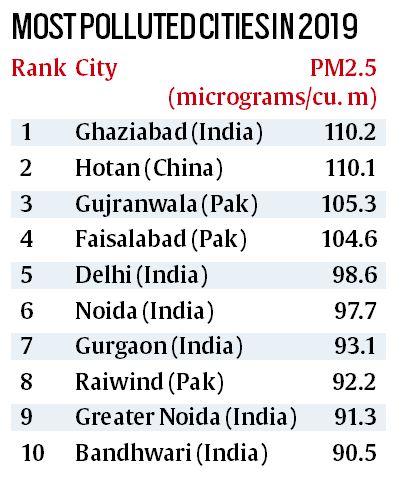
    • India accounts for two-thirds of the world’s most polluted cities — 21 of the most polluted 30 cities; 14 of the highest 20; and 6 of the highest 10 — in the report.
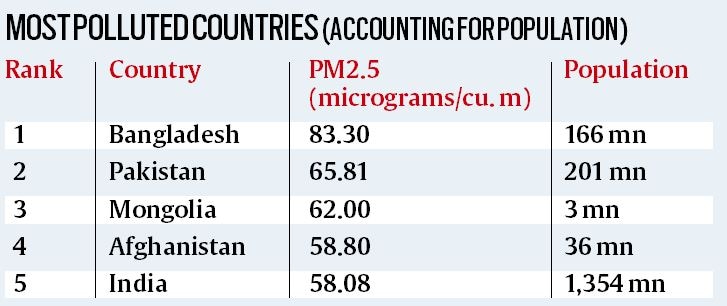
    • Among countries, when population is taken into account, average PM2.5 pollution is highest in Bangladesh, followed by Pakistan, while India is at number 5.
    • China is at number 11 in the list of countries affected by population, with population factored in. Chinese cities achieved a 9% average decrease in PM2.5 levels in 2019.
    • While cities in India, on average, exceed the WHO target for annual PM2.5 exposure by 500%, national air pollution decreased by 20% from 2018 to 2019, with 98% of cities experiencing improvements.
    • It said 90% of the global population breathing unsafe air.

    Top polluted Indian Cities


    Back2Basics

    PM 2.5

    • PM 2.5 refers to particulate matter (ambient airborne particles) which measure up to 2.5 microns in size and has a range of chemical makeups and sources.
    • It is widely regarded as the pollutant with the most health impact of all commonly measured air pollutants.
    • Due to its small size PM2.5 is able to penetrate deep into the human respiratory system and from there to the entire body, causing a wide range of short- and long-term health effects.
    • Particulate matter is also the pollutant group which affects the most people globally. It can come from a range of natural as well as man-made sources.
    • Common sources of PM include combustion (from vehicle engines, industry, wood and coal burning), as well as through other pollutants reacting in the atmosphere.
  • Pakke Tiger Reserve


    The government in Arunachal Pradesh is planning to build a 692.7 km highway through the 862 sq km Pakke Tiger Reserve (PTR). Named the East-West Industrial Corridor, the highway aims to connect Bhairabhunda in West Kameng district and Manmao in Changlang district along Arunachal Pradesh’s border with Assam.

    About Pakke Tiger Reserve (PTR)

    • Pakke Tiger Reserve, also known as Pakhui Tiger Reserve, is a Project Tiger reserve in the East Kameng district of Arunachal Pradesh.
    • The 862 km2 reserve is protected by the Department of Environment and Forest of Arunachal Pradesh.
    • This Tiger Reserve has won India Biodiversity Award 2016 in the category of ‘Conservation of threatened species’ for its Hornbill Nest Adoption Programme.
    • It falls within the Eastern Himalaya Biodiversity Hotspot.
  • [pib] SPICe+ web form


    The Ministry of Corporate Affairs has launched SPICe+ web form.

    SPICe+

    • It would offer 10 services by 3 Central Govt Ministries & Departments (Ministry of Corporate Affairs, Ministry of Labour & Department of Revenue in the Ministry of Finance) and One State Government (Maharashtra).
    • It saves as many procedures, time and cost for Starting a Business in India and would be applicable for all new company incorporations.

    Following are the features of the new Spice+ web form:

    • SPICe+ would be an integrated Web Form.
    • SPICe+ would have two parts viz.: Part A-for Name reservation for new companies and Part B offering a bouquet of services viz.
    • Registration for Profession Tax shall also be mandatory for all new companies to be incorporated in the State of Maharashtra through SPICe+.
    • All new companies incorporated through SPICe+ would also be mandatorily required to apply for opening the company’s Bank account through the AGILE-PRO linked web form.
  • Making the super-rich pay their fair share

    Context

    It is now beyond obvious that India cannot revive its economy without increasing public spending, and so increasing its fiscal resources is essential. Among other measures, this requires urgent adoption of legislation and institutional reforms to end financial opacity.

    The opacity in the data

    • Unlikely Budget estimates: The Union Budget was presented, based on numbers for revised estimates for the current year and Budget estimates for the coming year that the Finance Ministry itself knows are
    • Where else the opacity in data extends: The opacity of data also extends to cross-border movement of funds generated through a range of activities, including tax evasion, misappropriation of state assets, laundering of the proceeds of crime, and bribery.
      • Even here, India still has a lot to do, as confirmed by the recent publication of the Financial Secrecy Index by the Tax Justice Network, a U.K.-based financial advocacy group.
    • Financial Secrecy Index rank: On the surface, India has managed to reduce its contribution to global financial secrecy, with its rank falling from 32 on the 2018 index to 47 in 2020.
      • But this is partly because the new edition of the index covers more countries than it did two years ago.

    Transparency Reforms by the government

    • Arrangement with Switzerland: It is true that the government has adopted and supported a few transparency reforms, such as the automatic exchange of tax and financial information with other jurisdictions, like Switzerland.
      • What the arrangement with Switzerland mean? If an Indian citizen has an account with a Swiss bank and has a balance over a certain threshold, this information will be sent to the Indian tax authorities automatically.
    • Beneficial ownership register: The government did create a beneficial ownership register- which would allow the identification of the beneficial owner of an asset regardless of whose name the title of the property is in.
      • Exemption making the law weak: The law is weak since it exempts a lot of people at the discretion of the authorities.
      • Also, this register is not accessible to the public.

    Making multinationals and the super-rich pay their fair share of taxes 

    • Need to do more: Stopping the financial haemorrhage and making multinationals and the super-rich pay their fair share of taxes requires much more.
    • Capital flight and consequence for the country’s development: Capital flight out of India by Indian elites and foreigners alike has been undermining our country’s development for decades.
      • Outdated international system: An important part of these flows is the result of artificial profit shifting by multinational companies taking advantage of an outdated international tax system.
    • How the multinationals shifts profits? These multinationals may be making profits in India but can easily declare those profits in a low tax jurisdiction like Hong Kong and justify that transaction as a payment for the use of a patent.
      • The magnitude of loss-$27.5 billion: According to one estimate, this strategy represented a loss of $27.5 billion in 2014 for the Indian government, up from $142 million in 2000.

    Onshore financial services and issues with it

    • Paradoxical decision: Three years ago, the government took the paradoxical decision to set up onshore international financial services in the country.
      • This is how the International Financial Services Centre in the Gujarat International Finance Tec-City (GIFT-City), Gandhinagar, emerged.
      • It was modelled after offshore financial centres such as Hong Kong, Singapore, the City of London and Dubai.
    • Increasing the possibility of regulatory arbitrage: While this has not created much employment, it has led to growing possibilities for regulatory arbitrage by financial firms, with potentially very problematic consequences.

    The issue with the policy of tax incentives

    • Little evidence of attracting investment: The government keeps granting tax incentives on a discretionary basis, even though there is little evidence that these incentives attract investment.
    • What factors matters for investment: Recent research by International Monetary Fund, factors such as-
      • Quality of infrastructure.
      • A healthy and skilled workforce.
      • Market access and-
      • Political stability matters much more.
    • Consequences of the policy-reduction in tax revenue: The massive reduction in corporate tax rates has thus far not led to any increase in private investment.
      • But it has meant a significant reduction in tax revenues, with devastating consequences.
      • Implications for health, educations etc.: Reduction in tax revenue translates into a lack of resources for education, healthcare, food and nutrition and infrastructure.
      • Low tax-GDP ratio: India is already an outlier among similarly placed developing countries with its low tax-GDP ratio of 18%.
      • Making the budget dependent on indirect taxes: The government budget is also highly dependent on indirect taxes like the Goods and Services Tax which are regressive and hit ordinary citizens harder.

    Way forward

    • Legislation to end financial opacity: Adoption of legislation and institutional reforms to end financial opacity- including, for example-
      • Opening the beneficial ownership register to the public and-
      • Stopping the creation of onshore tax havens is the need of the hour.
    • Opening the debate on how to make the multinationals pay their fair share: The Government of India must also assume a more vocal role in the international debate about how to make multinationals pay their fair share of taxes.
      • This means continuing to appeal for a United Nations tax body, which is much more legitimate than the Organisation for Economic Co-operation and Development (OECD).
      • The issue with the OECD’s proposal: The OECD’s proposals, published at the end of 2019, are neither ambitious nor fair enough.
    • Explore the possibility of going alone: If the organisation continues to remain deaf to the demands of developing countries, India must be prepared to go it alone, thinking unilaterally about how to make multinationals pay what they owe.