đŸ’„Join UPSC 2027,2028 Mentorship (August Batch) + XFactor Notes & Microthemes PDF

GS Paper: Poverty & Development Issues

  • Commonwealth Human Rights Initiative (CHRI)

    The CHRI has released a report on “Eradicating Modern Slavery: An assessment of Commonwealth government progress”.

    Try this PYQ from CSP 2012:

    Q.Consider the following statements:

    1. The Commonwealth has no charter, treaty or constitution
    2. All the territories/countries once under the British Empire (jurisdiction/rule/mandate) automatically joined the Commonwealth as its members

    Which of the statements given above is/are correct?

    (a) 1 only

    (b) 2 only

    (c) Both 1 and 2

    (d) Neither 1 nor 2

    About the report

    The report was released on the occasion of World Day Against Trafficking in Persons by the Commonwealth Human Rights Initiative (CHRI) and an international anti-slavery organisation Walk Free.

    Highlights of the report

    • The report assessed the progress made by Commonwealth countries on the promises made in 2018 to end modern slavery by 2030 and achieve the SDGs of ending forced labour, human trafficking and child labour.
    • The report found that one-third of the Commonwealth countries had criminalised forced marriage, while 23 had not criminalised commercial sexual exploitation of children.
    • Commonwealth countries have made little progress towards their commitment to eradicate modern slavery by 2030.
    • One in every 150 people in the Commonwealth is living in conditions of modern slavery.
    • Out of 54 countries, only four engage with business to investigate supply chains, and all countries report gaps in victim assistance programs
    • None of the Asian countries in the group had implemented laws against forced labour in supply chains.

    India is the worst performer

    • India had fared the worst in terms of coordination with no national coordinating body or National Action Plan in place.
    • India, like all other Commonwealth countries in Asia, had not ratified the International Labour Organization’s 2011 Domestic Workers Convention or the 2014 Forced Labour Protocol.
    • The report said India accounted for one-third of all child brides in the world.
    • Despite being the largest country in the region, India has the weakest response on national coordination, with no national coordinating body or National Action Plan in place.

    Back2Basics: Commonwealth of Nations

    • The Commonwealth of Nations is an intergovernmental organisation of 53 member states that are mostly former territories of the British Empire.
    • It dates back to the first half of the 20th century with the decolonization of the British Empire through increased self-governance of its territories.
    • It was originally created as the British Commonwealth of Nation through the Balfour Declaration at the 1926 Imperial Conference, and formalized by the UK through the Statute of Westminster in 1931.
    • The current body was formally constituted by the London Declaration in 1949, which modernized the community, and established the member states as “free and equal”.
    • The symbol of this free association is Queen Elizabeth II, who is the Head of the Commonwealth.
    • The Queen is head of state of 16 member states, known as the Commonwealth realms, while 32 other members are republics and five others have different monarchs.
    • Member has no legal obligations to one another. Instead, they are united by language, history, culture and their shared values of democracy, human rights and the rule of law.

    Commonwealth Human Rights Initiative (CHRI)

    • It is an independent, non-partisan & nonprofit international NGO which works towards the practical realization of human rights in the countries of the Commonwealth.
    • It was founded in 1987 and is headquartered at New Delhi.
    • CHRI’s objectives are to promote awareness and adherence to the Commonwealth’s Harare Declaration, to the Universal Declaration of Human Rights, to other internationally recognised human rights instruments.
    • The organisation specializes in transparency and accountability issues, with a focus on access to justice and access to information.
    • The organisation mainly works in South Asia, East Africa, and Ghana region.
  • ‘Time to Care’ Report


    The report ‘Time to Care’  was recently released ahead of the 50th Annual Meeting of the World Economic Forum (WEF).

    ‘Time to Care’ Report

    • It is published by Oxfam International.
    • Its calculations are based on the latest data sources available, including from the Credit Suisse Research Institute’s Global Wealth Databook 2019 and Forbes’ 2019 Billionaires List.

    Findings of the report

    • Although global inequality has declined over the past three decades, domestic income inequality has risen in many countries, particularly in advanced economies and reached historic highs.
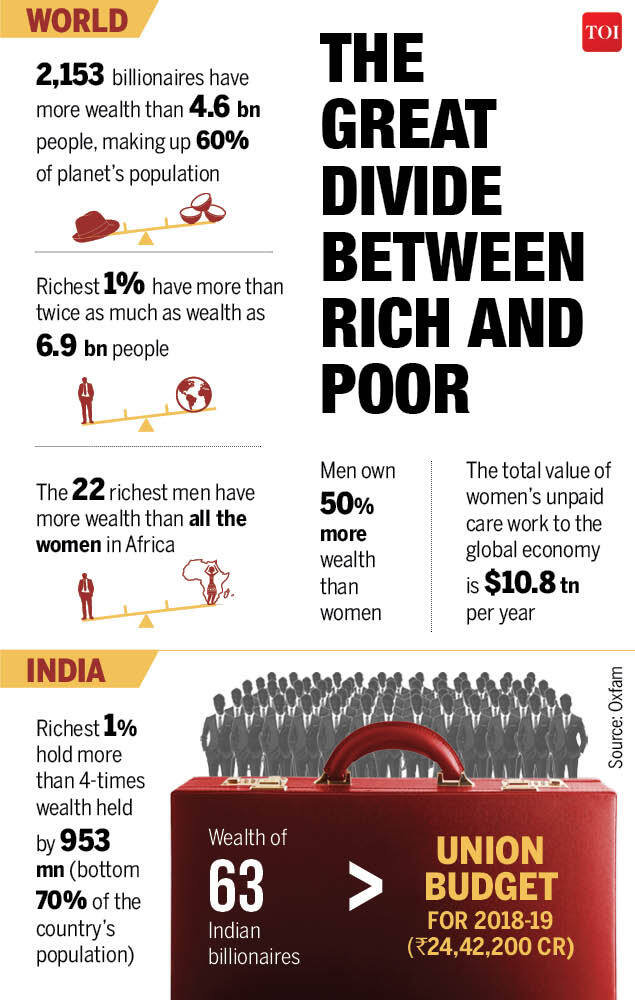
    • The report said that the world’s 2,153 billionaires have more wealth than the 4.6 billion people who make up 60 per cent of the planet’s population.
    • The report flagged that global inequality is shockingly entrenched and vast and the number of billionaires has doubled in the last decade, despite their combined wealth having declined in the last year.
    • The Oxfam report further said “sexist” economies are fuelling the inequality crisis by enabling a wealthy elite to accumulate vast fortunes at the expense of ordinary people and particularly poor women and girls.

    Income inequality in India

    • India’s richest 1 per cent hold more than four-times the wealth held by 953 million people who make up for the bottom 70 per cent of the country’s population.
    • The total wealth of all Indian billionaires is more than its full-year budget.
    • Regarding India, Oxfam said the combined total wealth of 63 Indian billionaires is higher than the total Union Budget of India for the fiscal year 2018-19 which was at Rs 24,42,200 crore.
    • It further said women and girls put in 3.26 billion hours of unpaid care work each and every day — a contribution to the Indian economy of at least Rs 19 lakh crore a year, which is 20 times the entire education budget of India in 2019 (Rs 93,000 crore).
    • He said women and girls are among those who benefit the least from today’s economic system.
    • They spend billions of hours cooking, cleaning and caring for children and the elderly. Unpaid care work is the ‘hidden engine’ that keeps the wheels of our economies, businesses and societies moving.

    Data on earnings

    • Oxfam said governments are massively under-taxing the wealthiest individuals and corporations and failing to collect revenues that could help lift the responsibility of care and tackle poverty and inequality.
    • As per the report, it would take a female domestic worker 22,277 years to earn what a top CEO of a technology company makes in one year.
    • With earnings pegged at Rs 106 per second, a tech CEO would make more in 10 minutes than what a domestic worker would make in one year.
    • Besides, direct public investments in the care economy of 2 per cent of GDP would potentially create 11 million new jobs and make up for the 11 million jobs lost in 2018, the report said.
  • NCRB Report on Farmers Suicide

    In 2017, 10,655 people involved in agriculture committed suicide in India, according to data released January 2, 2020 by the National Crime Record Bureau (NCRB).

    NCRB had released the 2017 crime data last October 2019, but held back information on suicides.

    Highlights of the report

    • NCRB highlighted that the toll was the lowest since 2013.
    • Among those who took their lives, 5,955 were farmers / cultivators and 4,700 agricultural labourers — both lower than in 2016.
    • They comprised 8.2 per cent of all suicide cases in the country in 2017.
    • In 2016, 6270 farmers killed themselves, down from 8,007 in 2015, while 5,109 farm hands committed suicide, up from 4,595.
    • The number of women farmers committing suicide, however, jumped to 480 in 2017 from 275 in ’16.

    Farm suicides over half a decade

    Years No. of farm sector suicides No. of farmers
    2017 10,655 5,955
    2016 11,379 6270
    2015 12,602 8007
    2014 12,360 5650

    Statewise data

    • In 2017, the most number of farm suicides were reportedly in Maharashtra (34.7 per cent), followed by Karnataka (20.3 per cent), Madhya Pradesh (9 per cent), Telangana (8 per cent) and Andhra Pradesh (7.7 per cent).
    • The trend was quite similar to previous year: In 2016, Maharashtra accounted for 32.2 per cent, Karnataka 18.3 per cent, MP 11.6 per cent, Andhra 7.1 per cent and Chhattisgarh 6 per cent.
    • In 2015 too Maharashtra tops in farmers suicides followed by Karnataka, Madhya Pradesh in 2016.
    • West Bengal, Odisha, Nagaland, Manipur, Mizoram, Uttarakhand, Chandigarh, Dadra and Nagar Haveli, Daman and Diu, Delhi, Lakshadweep and Puducherry reported zero suicides by farmers or agricultural labourers.

    Causes of Farmers Suicide

    • Major causes of farm suicides were reportedly bankruptcy / indebtedness, problems in the families, crop failure, illness and alcohol / substance abuse.

    Assist this newscard with:

    [Burning Issue] Annual Crime in India Report-2017