💥Join UPSC 2027,2028 Mentorship (August Batch) + XFactor Notes & Microthemes PDF

GS Paper: GS1-13.Factors responsible for the location of primary, secondary, and tertiary sector industries in various parts of the world (including India).

  • Describing the distribution of rubber producing countries, indicate the major environmental issues faced by them.

    Natural rubber is a tropical plantation crop that requires high temperature (25°-35°C), heavy rainfall (>200 cm), and well-drained lateritic soils. Its production is highly concentrated in the humid equatorial and tropical monsoon regions.
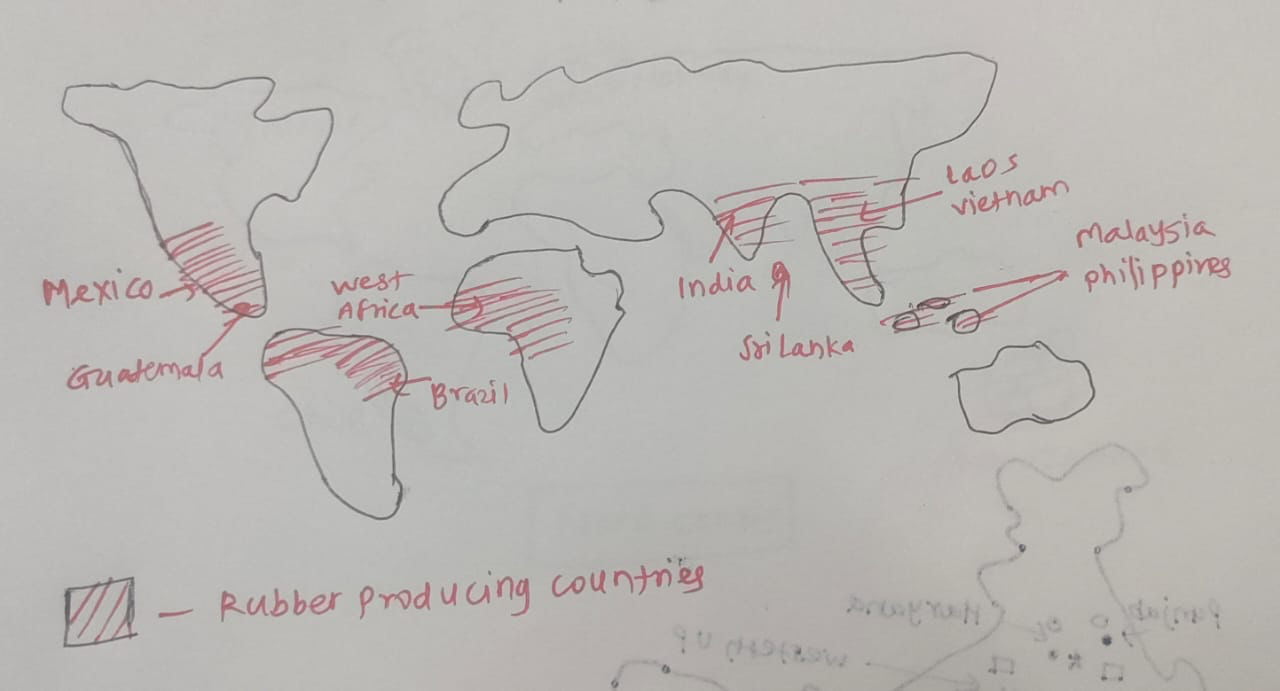
    Distribution of Rubber Producing Countries

    Approximately 85-90% of the world’s natural rubber is produced in Asia, primarily by smallholders (plantations under 4 hectares).

    Southeast Asia

    Thailand- The world’s leading producer with 32-36% of global supply.

    Indonesia- The second-largest producer (~22% share)

    Other countries – Vietnam and Malaysia

    West Africa

    Ivory Coast- 4th largest global producer (over 1.3 million tonnes)

    Others- Nigeria, Ghana, and Liberia etc

    India- production is centered in Kerala and the North-East.

    Other Producers

    China – Yunnan and Hainan Island.

    Latin America – Brazil (original home of Hevea brasiliensis).

    Major Environmental Issues

    Deforestation- Since 2000, over 4 million hectares of tropical forest in Southeast Asia have been cleared for rubber.

    Forest-to-plantation land-use change increase carbon emissions

    Loss of Biodiversity due to monoculture. Eg- Decline of wildlife habitats in Southeast Asia.

    Water Stress- Rubber trees have high evapotranspiration rates, leading to depletion of local aquifers.

    Soil Degradation – Continuous monocropping reduces soil fertility and increases erosion on slopes. Eg- Rubber plantations in hilly tracts of Kerala.

    Effluent Pollution- discharge from small-scale processing units leads to high Biological Oxygen Demand (BOD) and ammonia levels in nearby rivers.

    Habitat Fragmentation leading to human-wildlife Conflict. Eg- Elephant habitat loss in Kerala.

    Climate Change Vulnerability – Rising global temperatures (the “28°C threshold”) and erratic rainfall are making traditional regions less viable.

    Disease Proliferation – Monocultures are highly susceptible to pathogens like Circular Leaf Spot and White Root Rot

    Adoption of sustainable rubber agroforestry, intercropping, and landscape-level land-use planning is essential to reconcile economic benefits with ecological stability. Programs like the Global Platform for Sustainable Natural Rubber (GPSNR) are pushing for “Deforestation-Free” supply chains.

  • From being net food importer in 1960s, India has emerged as a net food exporter to the world. Provide reasons.

    At independence in 1947, India produced a mere 50 million tonnes (MT). By 2025-26, production has scaled to a record 330+ MT, catering to 1.4 billion people while maintaining a massive surplus for global trade.

    India as major importer in 1950s-1960s

    Low Productivity due to primitive farming methods.

    Monsoon Dependency and lack of irrigation.

    Colonial Legacy-The British prioritized cash crops (Indigo, Cotton) over food staples.

    Partition Impact-The most fertile, well-irrigated lands of the Indus basin went to Pakistan.

    Technological Gap-Absence of chemical fertilizers and high-yielding seed varieties.

    Neglect of Agriculture-Early Five-Year Plans focused heavily on rapid industrialization (Nehru-Mahalanobis model) at the expense of rural investment.

    Institutional Failures-Lack of formal credit led to debt traps.

    Reasons Behind India’s Emergence as a Net Food Exporter

    The Green Revolution (Phase I & II)-Adoption of HYV seeds, fertilisers, pesticides, and irrigation.

    Expansion of Irrigation-Total irrigated area rose from 22 million hectares (1950) to over 115 million hectares by 2026

    Institutional Support-The Minimum Support Price (MSP) provided price certainty, while the Food Corporation of India (FCI) ensured a guaranteed buyer for surpluses.

    The White & Blue Revolutions-India is now the world’s largest milk producer (~230 MT) and the 3rd largest fish producer, diversifying the export basket beyond grains.

    Through the National Horticulture Mission, India became the 2nd largest producer of fruits and vegetables globally.

    Agricultural Export Policy-identified 46 export hubs and the created Agri-Cells in Indian embassies abroad to find new markets.

    S&T and Digitalization-Tools like AgriStack (Farmer IDs) and e-NAM (National Market) have streamlined the supply chain, making Indian produce more competitive.

    Infrastructure & Logistics-Development of Mega Food Parks and the PM-Kisan SAMPADA Yojana have reduced post-harvest losses and increased shelf life for exports.

    GI Tagging-Branding products like Basmati Rice, Darjeeling Tea, and Alphonso Mangoes with Geographical Indication (GI) tags has fetched premium prices in EU and Middle Eastern markets.

    Resilience to Global Shocks-During the Russia-Ukraine conflict (2022-24), India stepped in as a critical supplier of wheat and rice to the Global South, cementing its status as a reliable partner.

    To reach the target of $100 billion in agricultural exports by 2030, India must shift from “Volume-driven” to “Value-driven” exports while ensuring the ecological sustainability of its farming practices.

  • How can Artificial Intelligence (AI) and drones be effectively used along with GIS and RS techniques in locational and areal planning?

    Locational and aerial planning involves selecting optimal sites for infrastructure and managing land use through spatial analysis. The integration of AI, drones, GIS, and Remote Sensing makes planning more efficient, accurate, and sustainable.

    Technological Synergy

    Drones & RS- Satellites provide the macro-view (regional scale), while Drones provide the micro-view (site scale) with high-resolution imagery and LiDAR.

    GIS acts as the central “brain” where all spatial data is layered, stored, and visualized.

    AI processes the massive data from drones/RS to automatically detect patterns, classify land, and predict future trends.

    Role of AI with GIS and RS in Planning

    Automated Land Use Classification- Eg- ISRO’s Bhuvan portal uses AI to automate the Land Use Land Cover (LULC) mapping across India.

    Infrastructure Corridor Optimization- Eg- The PM Gati Shakti platform integrates 200+ GIS layers to plan multi-modal connectivity projects across India.

    Predictive Urban Growth- AI analyzes historical RS data to predict future urban sprawl, helping in proactive zoning.

    Optimal Site Selection for Renewables- AI evaluates GIS layers like slope, solar radiation, and grid proximity to identify high-yield locations.

    Traffic and Mobility Planning- AI analyzes real-time GIS traffic data to optimize the location of new flyovers or metro stations.

    Environmental Risk Assessment- AI simulates flood or landslide scenarios based on RS topographical data to designate “no-build” zones.

    Precision Agriculture Planning- AI analyzes multispectral RS data to determine the best locations for warehouses based on crop yield forecasts. Eg- FASAL project uses AI to forecast district-level yields.

    Illegal Construction Detection- AI compares time-series satellite images to automatically flag unauthorized changes in land use.

    Retail and Logistics Locational Planning- Eg- Amazon and Flipkart use spatial AI to decide the location of “Dark Stores” for 10-minute deliveries.

    Role of Drones with GIS and RS in Planning

    High-Resolution Cadastral Mapping- Drones create centimeter-level accurate maps for property titling.

    3D Digital Twins of Cities- Drones use LiDAR to create 3D replicas of urban areas for detailed architectural planning.

    Real-Time Construction Monitoring- Eg- NHAI has mandated drone surveys for all highway projects to monitor progress.

    Disaster Damage Assessment- In areas inaccessible to RS due to cloud cover, drones provide immediate imagery for relief planning.

    Mining Area Surveillance- Wg- using drones to prevent illegal iron ore mining.

    Coastal Zone Management- Drones map shoreline erosion and mangrove health with high precision for environmental planning.

    Transmission Line Planning- Eg- PowerGrid Corporation of India uses drones for the inspection and locational planning of pylons in hilly terrains.

    Hydrological Planning- Eg- Under the Jal Shakti Abhiyan, drones map micro-watersheds for water conservation planning.

    Challenges

    High initial cost of technology and data processing infrastructure

    Shortage of skilled geospatial and AI professionals

    Data integration issues between multiple agencies due to different formats and standards delay implementation.

    Regulatory restrictions on drone operations

    Data privacy – High-resolution mapping of urban areas raises privacy issues.

    Inadequate real-time data sharing due to low inter-agency coordination

    Lack of decentralised planning capacity at local level – ULBs and PRIs lack funds and functionaries.

    Way Forward

    Implement National Geospatial Policy 2022 for open access and standardised datasets

    Capacity building at state and local levels – Establish district-level geospatial planning units

    Promote public-private partnerships for geospatial infrastructure

    Integrate Bhuvan, Digital India Land Records, and urban GIS databases

    Simplify drone regulations under Drone Rules 2021 for planning use


    These measures can improve evidence-based spatial planning and resource optimisation in India.

    Environmental Geography

  • What are non-farm primary activities? How are these activities related to physiographic features in India? Discuss with suitable examples.

    Non-farm primary activities are those primary sector activities that involve the direct extraction or harvesting of natural resources other than crop cultivation.

    Major non-farm primary activities in India

    Mining

    Fishing and aquaculture

    Forestry and logging

    Animal husbandry and pastoralism

    Collection of minor forest produce

    Relation with physiographic features

    Mining – Concentration in plateau and mountain regions due to ancient crystalline rocks and sedimentary basins. Eg- Iron ore in Odisha-Jharkhand belt, coal in Damodar valley, bauxite in Eastern Ghats.

    Forestry – Dense forests grow in high relief and high rainfall areas. Eg- Coniferous forests in Himachal & Uttarakhand, tropical evergreen forests in Western Ghats.

    Animal Husbandry – Arid, Semi-Arid and Grassland Regions. Eg- Sheep rearing in Rajasthan, cattle in Gujarat, transhumance in Himalayas.

    Fishing – Coastal Plains and Riverine Regions. Eg- Marine fishing in Kerala & Gujarat, inland fisheries in Ganga-Brahmaputra plains, brackish water aquaculture in Andhra Pradesh and Chilika lake

    Minor Forest Produce in Central Indian Highlands and North-East hills. Eg- Tendu leaves in Madhya Pradesh, lac in Jharkhand.

    Horticulture and Plantation – Grows in hill slopes and high rainfall areas. Eg- Tea in Assam & Darjeeling, spices in Kerala.

    This reflects the intimate relationship between natural resource endowment and livelihood patterns, and highlights the need for region-specific, sustainable development strategies.


  • [pib] First Commercial Coal Mine in Arunachal Pradesh at Namchik-Namphuk

    Why in the News?

    Arunachal Pradesh has launched its first commercial coal mine at the Namchik-Namphuk coal block in Changlang district.

    About the Namchik–Namphuk Coal Mine:

    • Overview: Located in Changlang district, Arunachal Pradesh, is the state’s first commercial coal mine, situated near the Indo-Myanmar border.
    • Reserves & Quality: Holds ~15 million tonnes of lignite/sub-bituminous coal, primarily for thermal power and industrial use.
    • Operator & Allocation: Operated by Coal Pulz Private Limited (CPPL), allotted through a transparent auction in 2022, project first allocated in 2003 but stalled due to environmental and administrative delays.
    • Production & Revenue: Initial capacity of 0.2 million tonnes per annum, expected to generate ₹100 crore annually for the state government.
    • National Context: Marks Arunachal Pradesh’s entry into India’s coal-producing map as the country crosses 1 billion tonnes output (FY 2024-25).
    • Policy Alignment: Supports the EAST Vision (Empower, Act, Strengthen, Transform) for North-Eastern development.

    Significance:

    • Legal Mining: Ends decades of illegal mining through regulated, community-driven extraction.
    • Sustainable Development: Part of Mission Green Coal Regions, targeting 73,000 ha of land reclamation by 2030, embedding ecological restoration into mining.
    [UPSC 2008] In which one of the following states are Namchik-Namphuk Coalfields located?

    Options: (a) Arunachal Pradesh* (b) Meghalaya (c) Manipur (d) Mizoram


  • More Women employed in agriculture, but half of them are unpaid

    Introduction

    Women-led development is increasingly recognised as a structural game-changer for India’s economic ambitions. Nowhere is this more urgent than in agriculture, which not only sustains livelihoods but also employs the largest share of India’s female workforce. However, while women’s participation in farming has risen sharply due to men shifting to non-farm jobs, their contributions remain largely invisible, unpaid, and undervalued. This contradiction calls for a deeper exploration of systemic inequities and emerging opportunities to turn agriculture into a vehicle for women’s empowerment and national growth.

    The Feminisation of Agriculture: Numbers Behind the Shift

    1. Surge in women workers: Women’s employment in agriculture rose by 135% in a decade, now accounting for 42% of the agricultural workforce.
    2. Unpaid work: The number of women as unpaid family workers increased 2.5 times, from 23.6 million in 2017–18 to 59.1 million in 2023–24 (PLFS).
    3. Regional inequities: In States like Bihar and Uttar Pradesh, over 80% of women workers are in agriculture, and more than half receive no wages.
    4. National picture: Today, one in three working women in India is unpaid.

    Why Women’s Work in Agriculture Remains Invisible

    1. Lack of recognition: Women are not officially recognised as farmers despite constituting a large share of labour.
    2. Skewed land ownership: Only 13–14% of land holdings are in women’s names, limiting access to credit, insurance, and government support.
    3. Wage gap: Women earn 20–30% less than men for equivalent agricultural tasks.
    4. Concentration in low-value work: Women are locked into subsistence farming and low-margin tasks without decision-making power.
    5. Macro impact: Despite higher participation, agriculture’s share in GVA fell from 15.3% (2017–18) to 14.4% (2024–25), reinforcing inequities instead of enabling empowerment.

    Global Trade Trends as an Opportunity

    1. India–U.K. FTA: Expected to boost agricultural exports by 20% within three years, covering 95% of agricultural and processed food products duty-free.
    2. Export-oriented crops: Women already have strong representation in spices, tea, millets, rice, dairy- sectors poised for expansion.
    3. From labourers to entrepreneurs: With training, credit access, and market linkages, women could transition to income-generating entrepreneurs in value-added exports.

    Technology as a Game-Changer

    1. Digital agriculture: Platforms like e-NAM, mobile advisory services, precision tools connect women to markets and pricing systems.
    2. Language and literacy gap: Women face low digital literacy, language barriers, and lack of devices, restricting adoption.
    3. Promising models:
      1. BHASHINI platform and Microsoft–AI4Bharat’s Jugalbandi provide multilingual, voice-first government access.
      2. L&T Finance’s Digital Sakhi programme has built digital and financial literacy among rural women in seven States.
      3. Odisha’s Swayam Sampurna FPOs and Jhalawari Mahila Kisan Producer Company (Rajasthan) leverage digital tools for branding and exports.

    Structural Reforms Needed

    1. Land reforms: Promote joint or individual land ownership to strengthen women’s eligibility for formal support.
    2. Labour reforms: Recognise women as independent farmers to ensure fair wages, rights, and credit.
    3. Value chain inclusion: Shift women into higher-margin activities like processing, branding, packaging, and exporting.
    4. Institutional support: Scale multi-stakeholder programs (government, NGOs, FPOs) to dismantle structural inequities.

    Conclusion

    The feminisation of agriculture in India highlights a double-edged reality: while women have become indispensable to the sector, their economic contributions remain unrecognised and unpaid. With global trade shifts, digital innovations, and land-labour reforms, India now stands at a crossroads. Whether women remain invisible labourers or emerge as empowered entrepreneurs will depend on how decisively policymakers, private actors, and civil society act to bridge systemic inequities. Women’s empowerment in agriculture is not just a gender issue, it is central to India’s economic transformation.

    PYQ Relevance

    [UPSC 2024] Distinguish between gender equality, gender equity and women’s empowerment. Why is it important to take gender concerns into account in programme design and implementation?

    Linkage: The question probes the conceptual clarity between equality, equity, and empowerment while testing their application in real policy frameworks. It aligns with the article as the feminisation of agriculture highlights how ignoring gender concerns in land, labour, and trade programmes perpetuates invisibility of women’s work, whereas equity-driven reforms can transform participation into genuine empowerment.

  • Realities behind the global experiment of ‘remote work’ 

    Why in the News?

    A new “Global Survey of Working Arrangements” (2024–25) by the Ifo Institute and Stanford University has spotlighted the growing mismatch between workers’ desire for remote work and its actual availability worldwide.

    Why does a gap remain between the preference for remote work and its adoption?

    • Employer Reluctance Due to Team Dynamics: Many managers believe that remote work reduces collaboration, innovation, and team bonding. Eg: In India’s tech sector, firms like TCS and Infosys have mandated office returns to maintain team culture.
    • Cultural Bias Toward Presenteeism: In several countries, especially in Asia, being physically present at work is linked to loyalty and productivity. Eg: Japanese companies often expect employees to stay late in office, even if not productive, as a show of commitment.
    •  Inadequate Home Infrastructure: Remote work demands reliable internet, quiet spaces, and ergonomic setups, which are lacking for many, especially in urban India or Southeast Asia. Eg: A Mumbai-based employee may live in a 1BHK flat with family, limiting concentration and comfort.
    • Health and Mental Well-being Concerns: Long-term remote work has led to increased backaches, eye strain, and mental stress due to isolation and blurred work-life boundaries. Eg: A Microsoft global report showed rising burnout levels among fully remote workers during the pandemic.

    How do culture and infrastructure hinder remote work in Asia?

    • Cultural Preference for Physical Presence: Many Asian workplaces equate being physically present with dedication and productivity. Eg: In Japan and South Korea, staying late in the office is considered a sign of commitment, discouraging remote setups.
    • Hierarchical Management Style: Traditional Asian work cultures rely on face-to-face supervision and top-down communication, making remote work less trusted. Eg: In India, many managers still believe in monitoring employee performance through in-person interactions.
    • Weak Digital and Housing Infrastructure: Many households lack reliable internet, private workspaces, or quiet environments, especially in urban slums or dense family homes. Eg: In Indonesia or the Philippines, remote employees often face disruptions due to unstable power or cramped living conditions.

    What is Remote work?

    Remote work (also known as work from home or telecommuting) is a work arrangement where employees perform their job duties outside of a traditional office environment, typically from their home or another location of their choice, using digital tools and internet connectivity.

    What are the gender implications of remote work trends?

    • Increased Unpaid Care Work for Women: Remote work has led to a disproportionate care burden on women, affecting their productivity and well-being. Eg: According to a 2022 UN Women report, women globally spent 3 times more hours on unpaid care work than men during the pandemic, even while working from home. In India, this gap was wider due to joint family setups and lack of domestic help.
    • Improved Flexibility, Aiding Workforce Re-entry: Remote work has provided flexible job opportunities for women who otherwise drop out due to childcare or household responsibilities. Eg: A 2021 LinkedIn report found that 60% of Indian women professionals preferred remote jobs to maintain work-life balance, and 30% rejoined the workforce post-pandemic due to such options.
    • Risk of Career Stagnation and Isolation: Remote women employees often face reduced visibility, leading to fewer promotions or leadership roles. Eg: A 2023 McKinsey study found that women working remotely were 1.5 times less likely to be promoted compared to their in-office peers, especially in mid-career roles.

    Why are employers reluctant to allow full remote work?

    • Concerns Over Productivity and Supervision: Employers fear a drop in productivity and difficulty in monitoring performance when employees work remotely full-time. They believe in-person settings enable better oversight, collaboration, and accountability.
    • Impact on Organisational Culture and Innovation: Physical workplaces are seen as essential for team bonding, mentorship, and creative brainstorming, which are harder to replicate virtually. Employers worry that remote work weakens organisational culture and slows innovation.

    What are the steps taken by the Indian Government?

    • Remote Work in SEZ Rules: The government amended the Special Economic Zones (SEZ) Rules (2006) by adding Rule 43A, allowing 100% of IT/ITeS employees in SEZs to work remotely for up to one year, extendable with permission.
    • Inclusion in New Labour Codes: The Occupational Safety, Health and Working Conditions Code, 2020 and the Social Security Code, 2020brought home-based workers under their ambit, addressing safety, health, and social protection for remote employees.

    What measures can ensure remote work is fair and sustainable? (Way forward)

    • Clear Legal and Social Protection Framework: Establish comprehensive labour regulations covering working hours, overtime, health and safety, and right to disconnect for remote workers. This helps prevent exploitation, burnout, and ensures work-life balance.
    • Inclusive Digital Infrastructure and Skill Development: Invest in pan-India broadband access, especially in rural and Tier-2/3 cities, and promote digital literacy programs. This ensures equal opportunities and reduces the urban-rural digital divide, making remote work accessible to all.

    Mains PYQ:

    [UPSC 2022] Explore and evaluate the impact of ‘Work From Home’ on family relationships.

    Linakge: The Unfinished Revolution of Remote Work,” delves into the complexities of remote work beyond just its flexibility and freedom. It highlights several key realities that make the “revolution of remote work” far more complicated than initially imagined.  This question directly addresses one of the significant “realities” and impacts of remote work, specifically focusing on “family relationships”.

  • The crisis in India’s cotton production, and what can help

    Why in the News?

    India’s cotton production has dropped by 25% over the last 10 years because of the pink bollworm. Some seed companies have created new genetically modified cotton varieties that can resist this pest, but government rules are delaying their approval and use.

    Why has cotton output fallen despite Bt cotton’s earlier success?

    • Resistance Development in Pests: The pink bollworm (PBW), a monophagous pest, developed resistance to Bt cotton toxins (cry1Ac and cry2Ab) over time. Eg: A study published in Nature showed PBW resistance by 2014, just 12 years after Bt cotton’s introduction.
    • Pest Adaptability and Short Life Cycle: PBW’s short life cycle (25–35 days) allows multiple generations in one crop season, accelerating resistance buildup. Eg: In central India, PBW reached economic threshold levels by 2014, impacting yields.
    • Yield Stagnation and Decline: The national average lint yield rose to 566 kg/ha in 2013–14 but has fallen to around 436–437 kg/ha in recent years. Eg: This drop mirrors increased pest pressure and reduced effectiveness of Bt technology.
    • Increased Import Dependence: Falling domestic production has led to India importing more cotton than it exports. Eg: In 2024–25, imports are projected at 30 lakh bales vs exports of 17 lakh bales.
    • Lack of New GM Approvals: Regulatory and political hurdles have stalled the approval of next-gen GM cotton hybrids resistant to PBW. Eg: No new GM cotton hybrid has been commercialised since Bollgard-II in 2006.

    How has the pink bollworm turned India into a net cotton importer?

    • Destruction of Cotton Bolls and Lint Quality: PBW larvae bore into cotton bolls, feeding on seeds and lint, reducing both yield and fibre quality. Eg: This led to a production drop from 398 lakh bales (2013–14) to just 294 lakh bales (2024–25 projected) — the lowest since 2008–09.
    • Resistance to Bt Cotton: PBW developed resistance to the Bt toxins (cry1Ac and cry2Ab) used in GM cotton, making current hybrids ineffective. Eg: Resistance was first noted in central India around 2014, eventually spreading to southern and northern zones.
    • Decline in Exports, Rise in Imports: As production fell and quality declined, exports dropped and imports surged. Eg: In 2024–25, India is expected to import 30 lakh bales but export only 17 lakh bales, reversing its earlier status as a net exporter.

    Which new genetic technologies are Indian seed companies using to combat PBW resistance in cotton crops?

    • Introduction of Novel Bt Genes: Companies are using Bt genes not previously deployed in India to overcome existing PBW resistance. Eg: Bioseed Research India is conducting trials with its ‘cry8Ea1’ gene-based hybrid under the proprietary BioCotX24A1 event.
    • Use of Synthetic Bt Genes: Synthetic versions of Bt genes are engineered to enhance toxicity and overcome pest resistance. Eg: Rasi Seeds has developed hybrids expressing a synthetic cry1c gene for improved resistance to PBW.
    • Deployment of Chimeric Bt Genes: Chimeric genes combine segments of multiple Bt genes to create a novel protein with broader insecticidal action.Eg: Ankur Seeds, in collaboration with NBRI, is trialing cotton hybrids using a chimeric Bt protein from Event 519.

    When did the pink bollworm start crossing the economic threshold level in various cotton-growing zones of India?

    • Central Zone (Maharashtra, Gujarat, Madhya Pradesh): PBW crossed the ETL around 2014, marking the beginning of widespread yield loss in the heartland of cotton production. Eg: Farmers in Maharashtra began reporting severe PBW damage post-2014 despite using Bt cotton.
    • Southern Zone (Telangana, Andhra Pradesh, Karnataka, Tamil Nadu): The pest breached the ETL by 2017, affecting the second major cotton belt in the country. Eg: Telangana experienced major crop losses during the 2017–18 season due to PBW infestation.
    • Northern Zone (Punjab, Haryana, Rajasthan): PBW reached ETL in the northern states by 2021, completing its spread across all major cotton-growing regions. Eg: In 2021, Haryana reported pink bollworm infestation even in previously unaffected areas.

    How are regulatory hurdles affecting the commercialisation of new GM cotton hybrids in India?

    • Lengthy Approval Process: Multi-stage field trials (event selection, BRL-1, BRL-2) take years before commercial approval is granted. Eg: Bioseed’s ‘cry8Ea1’ GM cotton is still in BRL-1 trial phase, needing further years of testing before release.
    • Lack of New GM Approvals Since 2006: No new GM cotton hybrid has been approved for commercial cultivation since Monsanto’s Bollgard-II in 2006. Eg: Despite several companies developing PBW-resistant varieties, commercialisation remains stalled.
    • Opposition from States and Activist Groups: State-level permissions and activist resistance delay or block field trials, affecting research and rollout. Eg: Rasi Seeds and Ankur Seeds await approvals for first-year trials amid regulatory scrutiny and local objections.

    What advantages does India have in cotton production and trade?

    • Favorable Climate and Large Cotton-Growing Area: India has a vast area suitable for cotton cultivation, with diverse agro-climatic zones supporting long growing seasons. Eg: India is the world’s largest cotton producer, with major states like Maharashtra, Gujarat, and Telangana contributing significantly.
    • Low Export Duties Compared to Other Countries: India faces lower tariffs on its textile exports in key markets like the US, making its products more competitive. Eg: Under the US’s “reciprocal tariff” policy, Indian textile exports face only 27% duty, while China’s face 54% and Bangladesh’s 37%.

    Way forward: 

    • Accelerate Regulatory Approvals for Next-Gen GM Cotton: The government should streamline and fast-track the approval process for new GM hybrids with novel, synthetic, or chimeric Bt genes to restore cotton productivity and pest control efficacy. Eg: Timely clearance of Bioseed’s cry8Ea1 and Rasi’s synthetic cry1c cotton hybrids can help tackle PBW resistance.
    • Promote Integrated Pest Management (IPM) and Farmer Awareness: Combine genetic solutions with IPM strategies—crop rotation, pheromone traps, and timely pesticide use—to delay resistance buildup. Launch nationwide farmer education programs on early detection and field hygiene. Eg: Maharashtra’s IPM pilot schemes have shown promise in reducing PBW infestations when practiced consistently.

    Mains PYQ:

    [UPSC 2021] What are the present challenges before crop diversification? How do emerging technologies provide an opportunity for crop diversification?

    Linkage:  Vulnerability of a monoculture system relying heavily on Bt cotton, crop diversification could be a strategy to reduce dependence on a single crop and potentially break pest cycles, although the article focuses on technological solutions within cotton itself.

  • [25th December 2024] The Hindu Op-ed: Myth of meritocracy, caste-based disparities in IT sector

    PYQ Relevance:

    Q) The caste system is assuming new identities and associational forms. Hence, caste system cannot be eradicated in India.” Comment. (UPSC CSE 2018)

    Mentor’s Comment: UPSC mains have always focused on the ‘Right to Equality’ (2021) and ‘Multi-cultural Indian Society’ (2020).

    Oxfam India Report (2022) indicates that 97% of surveyed Dalits reported experiencing discrimination in their workplaces, with 32.5% facing denied promotions and 19.4% being purposefully transferred due to caste-related biases.

    Today’s editorial critically examines the pervasive belief in meritocracy within the Indian IT industry and its implications for caste-based inequalities. This content can be used to present ‘Caste-based discrimination at workplaces’ and ‘Key highlights of NSSO Reports’ in your mains answers.

    _

    Let’s learn!

    Why in the News?

    The recent NSSO Report conducts extensive household surveys across India, highlighting the significant caste-based disparities in the IT sector. 

    What is Meritocracy?

    • Meritocracy is the belief that individuals should succeed based on their abilities and efforts rather than their social background. In theory, it promotes equality by providing everyone with an equal chance to succeed. 
    • However, this ideal is increasingly being challenged as a myth that fails to account for systemic inequalities, particularly in the context of caste in India.

    What does the NSSO data say about Caste Disparities in the IT Sector?
    The study draws from two NSSO survey rounds: the 78th (2020-21) and the 68th (2011-12):
    Caste-Based Employment Disparities: Analysis of NSSO data reveals significant caste-based disparities in employment probabilities and wage earnings within the IT sector, challenging the notion of inclusivity in this industry.
    Employment Probabilities: Scheduled Castes (SC) and Scheduled Tribes (ST) have only a 10% probability of being employed in the IT sector, compared to 27% for upper castes. This disparity persists even after controlling for educational attainment and other factors.From 2011-12 to 2020-21, the probability gap widened, with lower caste groups experiencing an increase in their disadvantage from an 11% deficit to a 17% deficit despite overall growth in IT employment.
    Wage Disparities: SC and Other Backward Classes (OBC) workers face wage differentials of 24.9% and 22.5%, respectively, compared to their upper caste counterparts, even when accounting for education and employment type.
    Labour Market Segmentation: The findings align with labour market segmentation theory, indicating that lower castes are relegated to lower segments of the job market with limited opportunities for upward mobility. This reflects ongoing social barriers that hinder marginalized groups from fully participating in the growing IT sector.
    Need for Addressing Inequalities: The study highlights that as the IT sector expands, it fails to recognize or mitigate social barriers that exclude marginalized communities, necessitating targeted reforms to promote inclusivity and equity.

    How do caste-based disparities affect opportunities for individuals in the IT sector?

    • Structural Inequalities: Despite the IT sector’s rapid growth and opportunities, caste-based disparities remain deeply entrenched. Individuals from marginalized communities often face barriers that prevent them from accessing the same opportunities as their upper-caste counterparts.
    • Hiring Practices: Many tech companies claim to hire based on merit; however, hiring practices often reflect existing societal biases. The recruitment process can inadvertently favor candidates from privileged backgrounds who have better access to resources such as quality education and networking opportunities.
    • Representation Issues: While there are initiatives aimed at increasing diversity, the representation of lower-caste individuals in senior positions remains disproportionately low. This lack of representation perpetuates a cycle where decision-making power is concentrated among a homogenous group.

    Is meritocracy a genuine principle for individuals in the Indian IT sector?

    • False Narratives: The belief in meritocracy creates a false narrative that ignores the socio-economic contexts from which individuals emerge. It allows those in privileged positions to believe their success is solely due to their abilities, dismissing the advantages they may have had over others.
    • Impact on Policy and Reform: This myth hinders meaningful policy reform aimed at addressing these disparities. When meritocracy is upheld as a guiding principle, it becomes challenging to advocate for affirmative action or other measures designed to level the playing field.

    What reforms are necessary to address these disparities?

    • Policy Reforms: Implementing policies that actively promote diversity and inclusion, ensuring equitable access to opportunities.
    • Awareness Campaigns: Raising awareness about the impact of caste on career advancement and the need for structural changes within organizations.
    • Support Systems: Establishing mentorship and support systems for individuals from marginalized communities to help them navigate barriers in their professional journeys.

    https://www.thehindu.com/opinion/op-ed/myth-of-meritocracy-caste-based-disparities-in-it-sector/article69023582.ece

  • Calling out exploitative labour dynamics on platforms 

    Why in the News?

    Amid the ongoing evolution of the “gig worker” concept, India recently witnessed a groundbreaking movement a nationwide digital strike organized by women gig workers this Deepavali.

    What are the specific exploitative practices faced by gig workers?

    • Wage Theft and High Commissions: Many gig workers receive only a fraction of their earnings after substantial deductions for company commissions, which can range from 10% to 35% of their total income. This often leaves them with minimal take-home pay, insufficient to meet basic living expenses.
    • Forced Purchases and Costs: Workers are often required to buy product kits at full retail prices from their employers, which further erodes their earnings. This practice restricts their ability to purchase necessary supplies at more affordable wholesale rates.
    • Job Insecurity and Rating Systems: Gig workers are subjected to biased rating systems that can lead to job insecurity. If they refuse “auto-assigned” jobs or fail to meet performance metrics, they risk being blocked from the platform or terminated without recourse.
    • Lack of Social Security: Gig workers are excluded from essential benefits such as minimum wages, health protections, and social security rights, leaving them vulnerable in times of need.

    How do platform dynamics contribute to labour exploitation?

    • Misclassification of Workers: Gig workers are often classified as independent contractors rather than employees, which denies them access to fundamental labour rights and protections. This legal loophole allows companies to evade responsibilities related to wages and benefits.
    • Algorithmic Control: Companies utilize complex algorithms to manage worker assignments and ratings, creating a system where workers are constantly monitored and evaluated based on performance metrics that may not accurately reflect their work quality.
    • Patriarchal Structures: The gig economy perpetuates existing patriarchal norms by relegating women to traditionally female roles such as beauticians and housekeepers, limiting their job options and negotiating power within the labour market.

    What measures can address and combat labour exploitation in this sector? (Way forward)

    • Legal Recognition as Employees: Governments should legislate the recognition of gig workers as employees rather than independent contractors, thereby extending labour rights such as minimum wage laws and social security benefits.
    • Regulatory Frameworks: Establishing comprehensive labour laws specific to the gig economy would help protect workers’ rights. This includes mechanisms for grievance redressal, ensuring fair treatment and accountability from platform companies.
    • Collective Bargaining Rights: Supporting unionization efforts like those of the Gig and Platform Services Workers Union (GIPSWU) can empower workers to negotiate better wages and working conditions collectively. This grassroots organizing is crucial for achieving meaningful change in labour practices within the sector

    Mains PYQ:

    Q Examine the role of ‘Gig Economy’ in the process of empowerment of women in India.  (UPSC IAS/2021)