Natural rubber is a tropical plantation crop that requires high temperature (25°-35°C), heavy rainfall (>200 cm), and well-drained lateritic soils. Its production is highly concentrated in the humid equatorial and tropical monsoon regions.
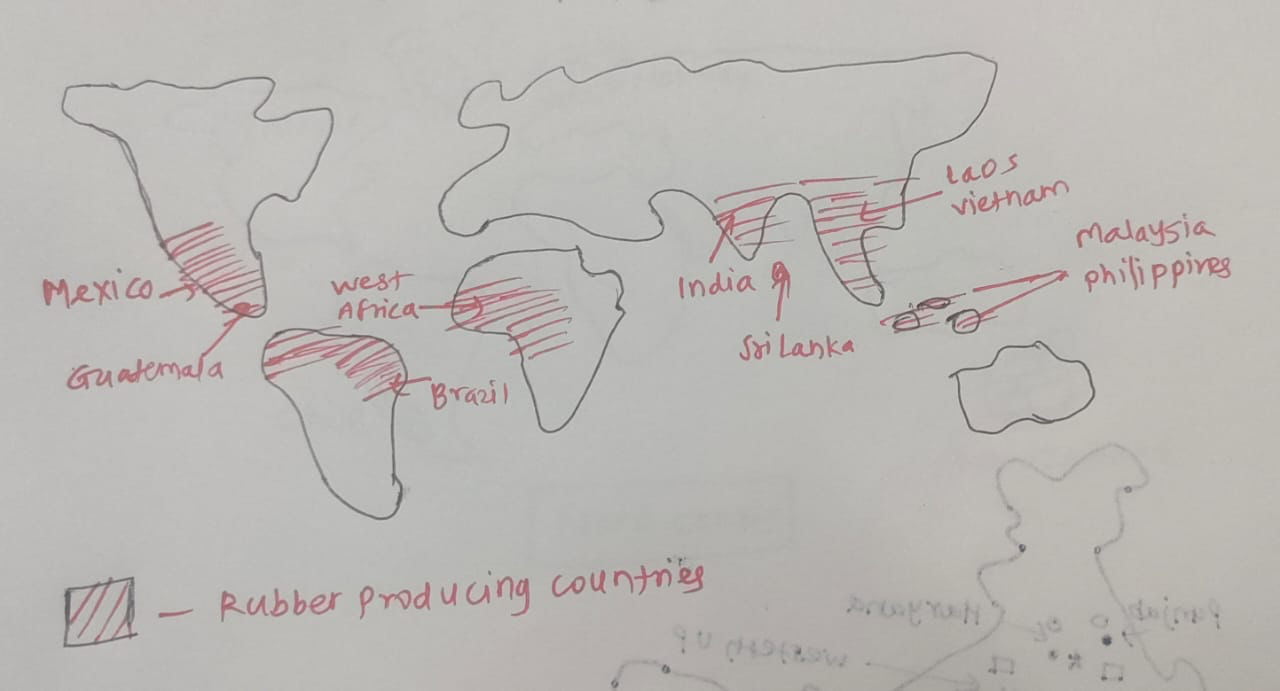
Distribution of Rubber Producing Countries
Approximately 85-90% of the world’s natural rubber is produced in Asia, primarily by smallholders (plantations under 4 hectares).
Southeast Asia
Thailand- The world’s leading producer with 32-36% of global supply.
Indonesia- The second-largest producer (~22% share)
Other countries – Vietnam and Malaysia
West Africa
Ivory Coast- 4th largest global producer (over 1.3 million tonnes)
Others- Nigeria, Ghana, and Liberia etc
India- production is centered in Kerala and the North-East.
Other Producers
China – Yunnan and Hainan Island.
Latin America – Brazil (original home of Hevea brasiliensis).
Major Environmental Issues
Deforestation- Since 2000, over 4 million hectares of tropical forest in Southeast Asia have been cleared for rubber.
Forest-to-plantation land-use change increase carbon emissions
Loss of Biodiversity due to monoculture. Eg- Decline of wildlife habitats in Southeast Asia.
Water Stress- Rubber trees have high evapotranspiration rates, leading to depletion of local aquifers.
Soil Degradation – Continuous monocropping reduces soil fertility and increases erosion on slopes. Eg- Rubber plantations in hilly tracts of Kerala.
Effluent Pollution- discharge from small-scale processing units leads to high Biological Oxygen Demand (BOD) and ammonia levels in nearby rivers.
Habitat Fragmentation leading to human-wildlife Conflict. Eg- Elephant habitat loss in Kerala.
Climate Change Vulnerability – Rising global temperatures (the “28°C threshold”) and erratic rainfall are making traditional regions less viable.
Disease Proliferation – Monocultures are highly susceptible to pathogens like Circular Leaf Spot and White Root Rot
Adoption of sustainable rubber agroforestry, intercropping, and landscape-level land-use planning is essential to reconcile economic benefits with ecological stability. Programs like the Global Platform for Sustainable Natural Rubber (GPSNR) are pushing for “Deforestation-Free” supply chains.