Contemporary development models
Neoliberal – privatization, and deregulation
Technocratic Model – Data driven governance
Donor-Driven Model
PPP Model
Participatory Development Model
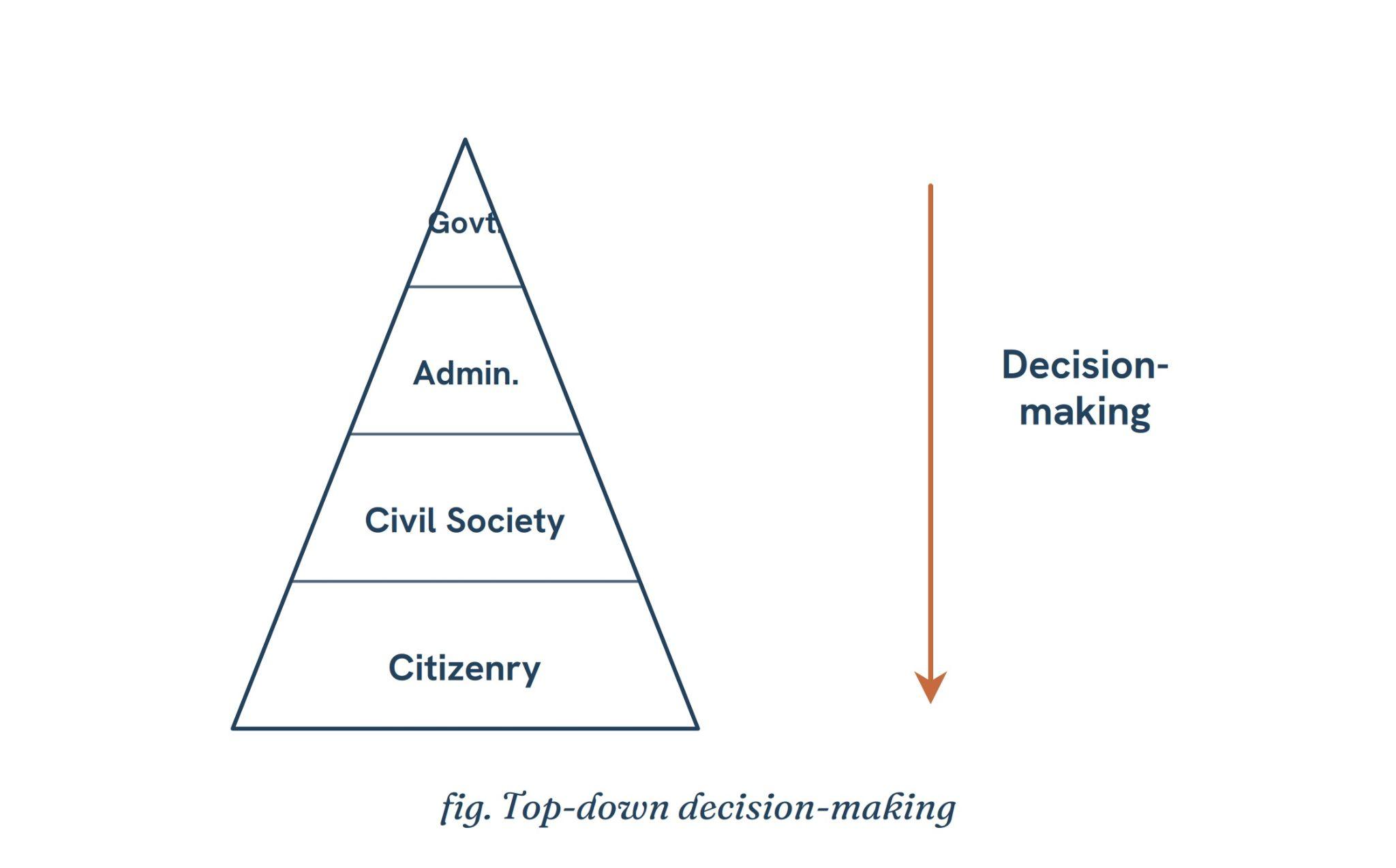
Decision-Making and Problem-Solving Not Close to Ground
Centralized Policy Design, with limited input from grassroots institutions. Eg- Uniform guidelines under PMAY-Gramin
Bureaucratic Hierarchies lead to delayed responses. Eg- delays in fund release under MGNREGA due to multi-tier approvals.
Technocratic and Data-Centric Planning leads to exclusion of indigenous knowledge.
Weak Decentralization – PRIs and ULBs lack fiscal and functional autonomy. Only 40% of states have functional District Planning Committees (NITI Aayog, 2022).
Lack of Coordination – ministries and departments work in silos. Eg- Smart Cities Mission: 60% projects delayed due to poor coordination.
Lack of Participatory democracy – Communities are treated as beneficiaries rather than partners in development.
Political and Fiscal Centralization through centrally sponsored schemes
Regulatory Capture – Eg- Nexus of Bureaucracy-Politicians-Corporate. (Vohra Committee)
Counter-Argument
73rd & 74th Constitutional Amendments empowered PRIs and ULBs for local governance and participatory planning.
Gram Panchayat Development Plans (GPDPs) institutionalized bottom-up planning in over 2.6 lakh Panchayats.
Aspirational Districts Programme (ADP) – Promotes data-driven local governance with district-level flexibility and real-time monitoring.
PM Gati Shakti National Master Plan – Integrates 16 ministries on a GIS-based platform to align planning and execution at ground level.
Mission Karmayogi – Builds capacity of field-level officials for local problem-solving and citizen-centric service delivery.
Cooperative Federalism via NITI Aayog – Governing Council enable state-specific and local feedback-based planning.
Community-Led Models – Swachh Bharat Mission and Jal Jeevan Mission emphasize village-level implementation and monitoring.
State Level Measures – Kerala’s People’s Plan Campaign
Way Forward
Capability Approach – increase spending on Health (2.5%of GDP) and Education (6% of GDP)
Adopt Best Practices – Participatory Budgeting in porto alegre brazil
Decentralized Governance based on principle of subsidiarity.
“Growth becomes meaningful only when it expands human freedom and capability.” – Amartya Sen
For this, decision-making authority and problem-solving responsibilities should be at the grassroots level.
Social Justice