The term demographic winter refers to a situation of persistently low fertility rates, leading to population ageing, workforce shrinkage and long-term economic and social challenges.
Features of ‘Demographic Winter’
Below Replacement Fertility (<2.1) for a prolonged period. Eg- Italy
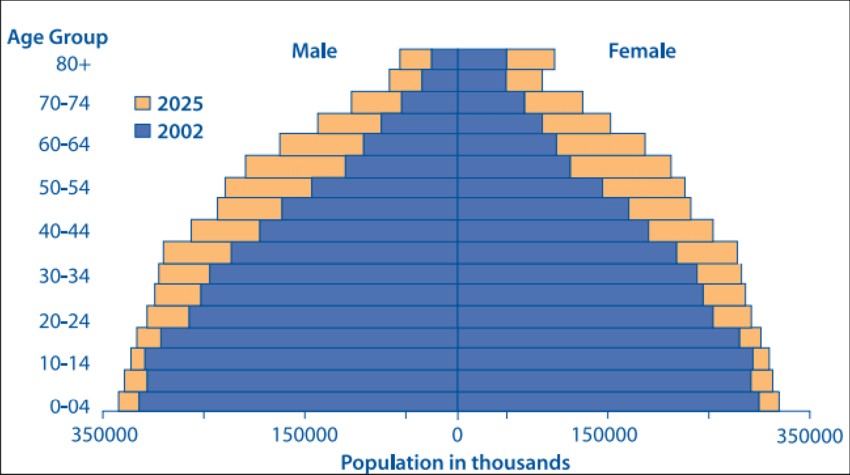
Decline in the working-age population.
Negative Population Growth in extreme cases. Eg- Japan, Ukraine, Russia, China
High Old-Age Dependency Ratio
Economic Slowdown Risks – Reduced consumption, innovation, and productivity.
Fiscal Stress on State – Pressure on pensions, healthcare, and social security systems.
World moving towards demographic winter
Arguments in favour
Falling Global Fertility Rates – declined from about 5 in 1950 to near 2.4 in 2025
Regions Already in Demographic Winter
East Asia
South Korea has the world’s lowest TFR (projected 0.65-0.68 for 2026).
Japan has seen its population shrink for over a decade
China recorded its fourth consecutive year of population decline in 2025.
Europe
Countries like Italy, Spain, and Greece have TFRs around 1.2-1.4.
Eastern European nations (Bulgaria, Latvia) are facing “double winters” due to low births combined with massive youth emigration.
Among developing countries
Brazil, Thailand, and Vietnam are seeing faster-than-expected fertility declines as they urbanize.
India’s TFR is 1.9 as per UNFPA
Changing Social Values – Eg- movements like “Tang Ping” (lying flat) in China and the “DINK” (Double Income, No Kids) lifestyle
Arguments against
Some regions still have high fertility. Eg- TFR for Africa is around 4%
Countries like India are still in a favourable age structure phase. Eg- median age of 28.
Nations like Canada, Australia, and the UAE use aggressive immigration policies to offset low domestic birth rates
Even with low fertility, the global population will not peak until the 2080s (at ~10.3 billion)
Thus, the way forward lies in managing demographic diversity through adaptive policies and balancing population stabilisation, economic sustainability, and social welfare