| PYQ Relevance [UPSC 2024] The West is fostering India as an alternative to reduce dependence on China’s supply chain and as a strategic ally to counter China’s political and economic dominance.’ Explain this statement with examples. Linkage: The PYQ examines India-China strategic competition and the scope for selective cooperation amid geopolitical rivalry. The article shows how climate resilience and disaster management can provide a limited, low-risk avenue for India–China engagement despite strategic distrust. |
Mentor’s Comment
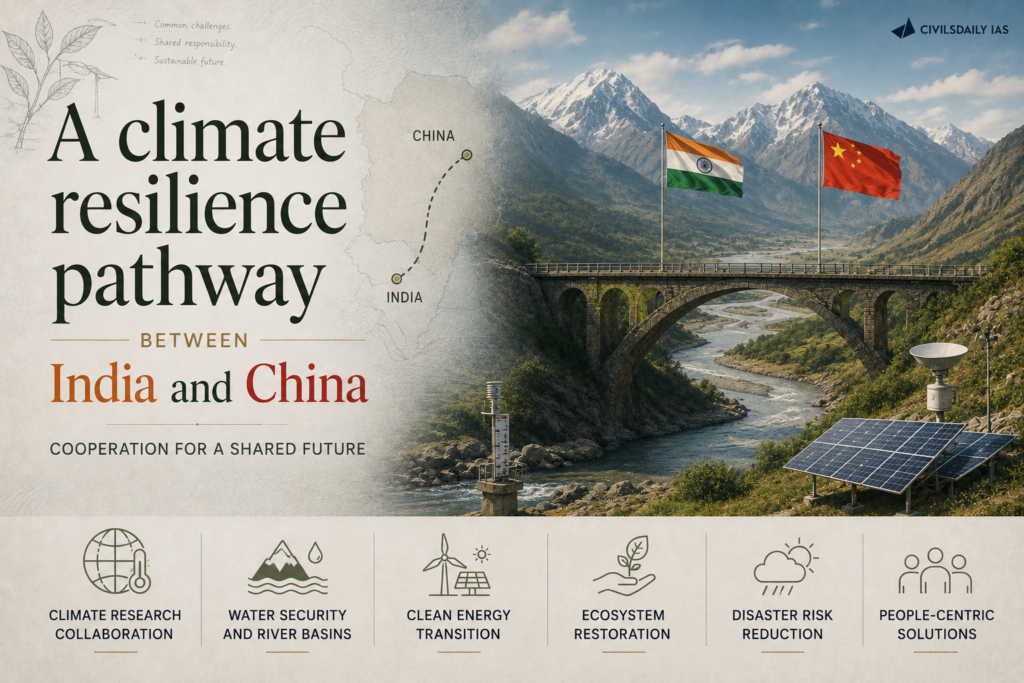
El Niño delayed India’s monsoon, followed by intense rainfall that caused severe flooding in Mumbai, Surat, Assam, and Odisha. Similar extreme weather also affected Guangxi, Shaanxi, and Gansu in China, highlighting the increasing frequency of climate-related disasters. Shared exposure to extreme climate events is proposed as a low risk avenue for India China cooperation. The tension is between deep strategic rivalry and a narrow band of mutual interest in disaster resilience.
How do India and China face similar climate challenges?
- Urbanisation: Wetlands, forests and permeable land are replaced by concrete, reducing natural water absorption.
- Drainage Deficit: Outdated drainage systems and poor waste management aggravate urban flooding.
- Loss of Green Spaces: Shrinking green cover increases runoff and weakens climate resilience.
- Coastal Risks: Coastal megacities face extreme rainfall, storm surges and sea-level rise.
- Inland Extremes: Inland cities experience recurring heatwaves, droughts and flash floods.
- Economic Costs: Climate disasters disrupt supply chains, reduce productivity and cause economic losses.
- Health Impacts: Frequent floods and heat events increase disease burden and public health risks.
Past Engagement: How have India and China cooperated on climate resilience?
- Climate Frameworks: Since the early 1990s, summit-level joint statements, MoUs and agreements have promoted practical climate cooperation.
- Disaster & Data Cooperation: Collaboration covered floods, earthquakes, droughts, extreme weather, along with hydrological, oceanic and seismic data sharing, joint R&D and governance exchange.
- Strategic Economic Dialogues: Six dialogues focused on sustainable urban planning, waste management, sewage treatment, water efficiency and capacity building.
- Sister City Agreements: Delhi-Beijing, Mumbai-Shanghai and Chennai-Chongqing were created to implement joint urban resilience projects, but diplomatic tensions limited execution.
- Mutual Learning: China offers data-driven planning (transport, housing, drainage), while India contributes early warning systems, Heat Action Plans, cool roofs, nature-based solutions and community-led adaptation.
- Future Cooperation: Scope exists for sponge cities, resilient agriculture, hydrological modelling, Himalayan glacier monitoring and revival of shared water agreements (which ceased in 2022).
What is the proposed cooperation pathway?
In April 2026, the visit by a Chinese delegation led by China’s Special Envoy for Climate Change to New Delhi suggests that climate cooperation remains a priority.
- Shared exposure: Both countries face recurring monsoon floods and urban flooding disasters.
- Low risk domain: Disaster mitigation and urban resilience avoid the sensitivities of border and trade disputes.
- Existing channels: An April 2026 visit by a Chinese Special Envoy and past sister city agreements offer a base.
What models could underpin it?
- Sponge cities: China’s urban water absorption model is cited as a resilience approach.
- Glacier concerns: Shared Himalayan glacier risks link both countries’ water security.
- City linkages: Past agreements between major cities offer a template for exchange.
Why is the pathway limited?
- Strategic distrust: Border tensions constrain deeper engagement.
- Asymmetry: Cooperation must manage a large power imbalance.
- Narrow scope: Resilience cooperation cannot resolve the core rivalry.
How can India and China bridge the climate finance gap?
- Public Funding Dependence: Climate adaptation is financed mainly through public funds in both countries.
- Private Capital: Expand blended finance, municipal bonds and credit enhancement to mobilise private investment.
- Ecosystem Gaps: Climate finance markets remain nascent, constrained by weak local capacity and regulatory gaps.
- Knowledge Exchange: Share evidence-based practices on innovative climate finance models.
- Global South Leadership: Develop common standards, metrics and fiscal frameworks for climate resilience financing.
- Win-Win Cooperation: Climate finance collaboration offers a low-risk pathway to strengthen India–China engagement and resilience.
Conclusion
Climate resilience offers a contained space for engagement without touching the strategic core. The unresolved question is whether either side will invest political capital in so narrow a domain.