Why in the News
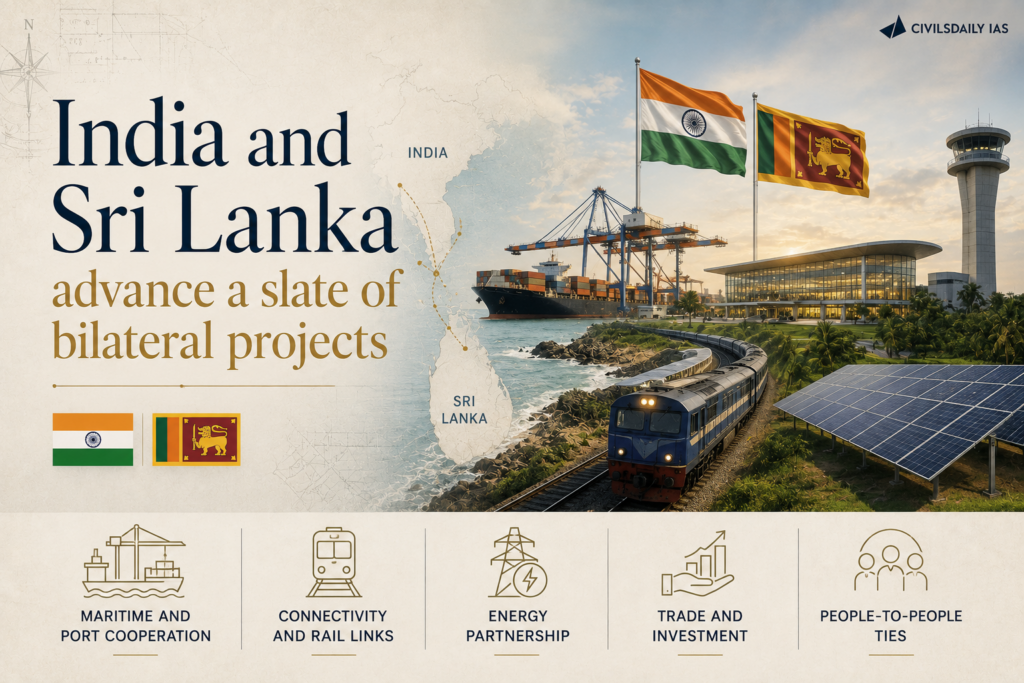
A high level visit produced concrete movement across trade, finance, energy, and connectivity between India and Sri Lanka. The development adds to the standing bilateral dossier rather than resolving a single dispute.
What is the 13th Amendment context?
- Devolution law: The 13th Amendment to Sri Lanka’s Constitution created Provincial Councils to devolve power, including to Tamil majority areas.
- India’s interest: India has consistently pressed for its full implementation and Provincial Council elections.
- Pending status: Implementation has remained incomplete for decades.
What was agreed on this visit?
- Trade and social security: Both sides agreed to advance the free trade agreement update and a social security pact.
- Rupee credit: Agreements were exchanged on Indian Rupee denominated Lines of Credit worth $350 million within a $450 million Cyclone Ditwah reconstruction package.
- Energy and connectivity: Talks covered grid interconnection, the Sampur solar project, the Trincomalee energy hub, and Kankesanthurai harbour.
- Digital identity: A Unique Digital Identity project modelled on India’s system was discussed.
Why does the relationship matter for India?
- Neighbourhood first: Sri Lanka is central to India’s regional policy.
- Strategic location: Its position astride Indian Ocean sea lanes shapes maritime security.
- China factor: Deeper Indian engagement counters competing external influence.
Conclusion
The visit deepens a multi sector partnership without a single headline pact. The next milestone is the finalisation of the free trade agreement update and the social security pact.
[2022, GS2, 10 marks] India is an age-old friend of Sri Lanka.’ Discuss India’s role in the recent crisis in Sri Lanka the light of the preceding statement.”