Why in the News
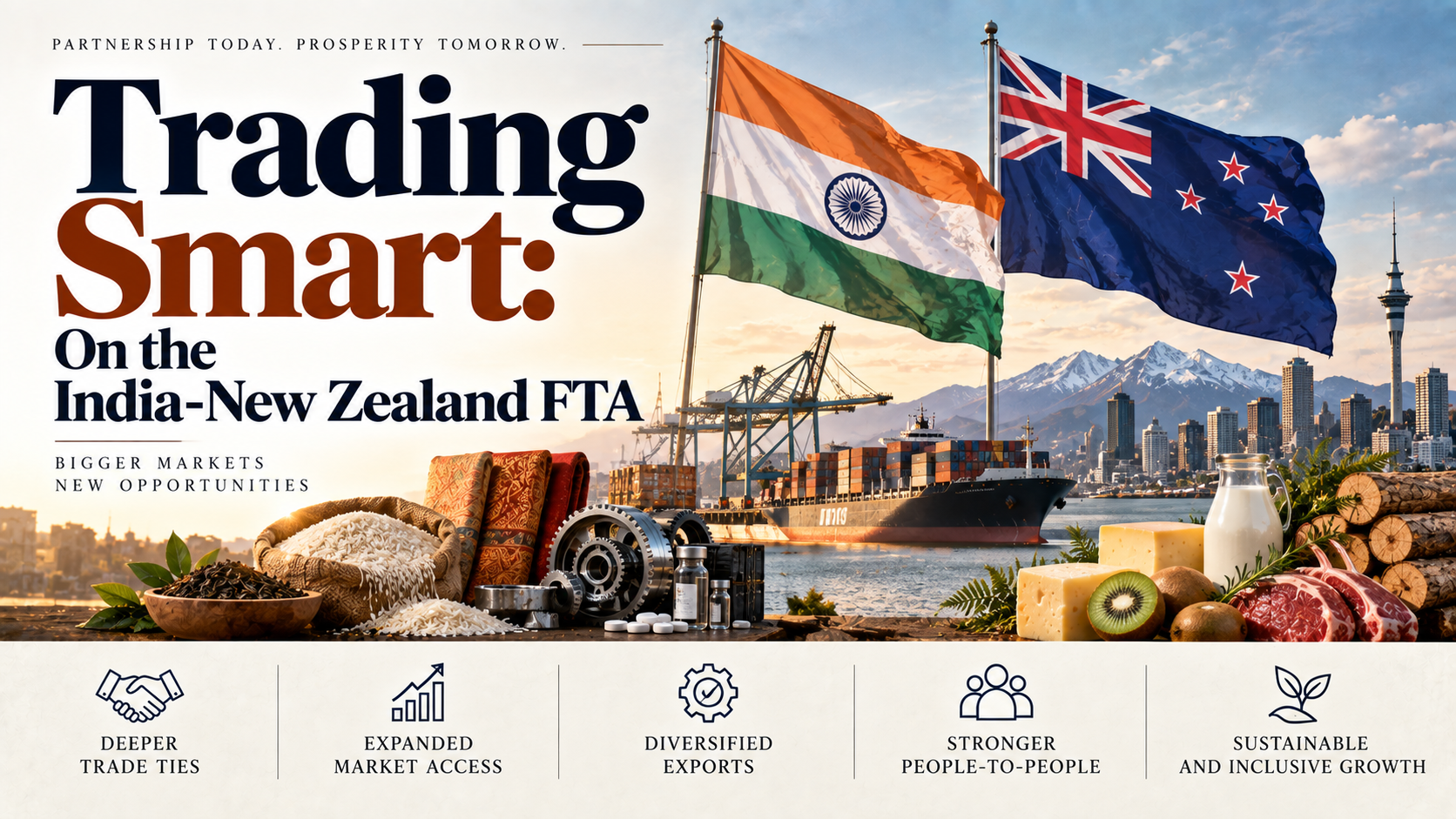
The India-New Zealand Free Trade Agreement (FTA) comes into force on 20 October. India has secured duty free access on 100 per cent of its exports to New Zealand, a historic concession. India held firm on dairy, an opening New Zealand’s negotiators had pressed for, and kept the sector out of the deal. The agreement lands while 100 per cent United States tariffs loom over Indian goods and a trade deal with Washington remains elusive. The contested point is whether the macroeconomic size of a trade relationship is the right test of whether an agreement was worth negotiating.
What is the India-New Zealand Free Trade Agreement?
- Trade volume covered: Bilateral goods trade between the two countries is $1.1 billion, which is less than 1 per cent of India’s total goods trade. The deal envisages a doubling by 2030.
- Tariff outcome on each side: New Zealand gives duty free access on 100 per cent of India’s exports to it. India has kept nearly 30 per cent of its own import lines outside the tariff concessions.
Why is macroeconomic size the wrong test of a trade deal?
- Trade as livelihood: Trade is a source of livelihood for lakhs of businesses, nearly half of which are micro, small and medium enterprises. A share of gross trade does not capture that.
- Rerouting as insurance: Adverse developments in tariffs or the closure of trade routes can be mitigated to an extent by a nimble rerouting of trade to countries where Indian exporters hold an advantage.
- The current trade environment: Indian exporters need every alternative channel that can be opened, because the largest single market for them is neither open nor settled.
Which Indian exports stand to gain?
- Labour intensive lines: Textiles make up about 14 per cent of India’s exports to New Zealand. Pearls and semi precious stones constitute another 5 per cent or so.
- Capital intensive lines: One third of India’s exports to New Zealand are pharmaceuticals, parts of nuclear reactors, vehicular parts, mineral fuels, electrical machinery, and iron and steel.
- The mix itself: India carries a good mix of capital intensive and labour intensive exports to New Zealand. Both halves of that mix stand to benefit from the duty free access.
What did India protect, and what did it extract?
- Dairy exclusion: Opening India’s dairy sector was a major demand of the New Zealand negotiators. India held firm and excluded it from the deal.
- Labour mobility: India has won valuable concessions on visas for workers and students. Several western countries are clamping down on foreign worker inflows, so an alternative route carries real relief.
- Investment commitment: New Zealand has committed to facilitate investments of $20 billion in India over 15 years. The commitment is smaller than, but along the same lines as, the one in India’s agreement with the European Free Trade Association (EFTA) bloc.
- Why the investment matters: India needs foreign investment for economic growth and to manage its balance of payments.
Challenges to the India-New Zealand Free Trade Agreement
- Duty free access does not clear non tariff requirements: A zero tariff is not market access where sanitary and phytosanitary standards and certification stop the consignment at the border. Eg. New Zealand operates one of the strictest biosecurity regimes in the world for plant and animal products.
The Fix: Negotiate mutual recognition of conformity assessment and pair the agreement with testing and certification support for exporters. - Small exporters cannot use preferences they do not know about: Preference utilisation stays low where a small firm does not know the tariff line, the origin rule or the certification procedure. Eg. Low preference utilisation has been a standing complaint about India’s earlier trade agreement with the Association of Southeast Asian Nations (ASEAN).
The Fix: Run a sector wise outreach programme through export promotion councils publishing the tariff line, the origin rule and the documentation for each covered product. - An excluded sector is a standing demand, not a settled question: A sector kept out of one agreement returns as a demand in the next round and in every other negotiation India is running. Eg. Agricultural and dairy access has been a contested demand in India’s negotiations with the United States.
The Fix: State the ground for the exclusion, which is the feed certification requirement and smallholder livelihoods, as a standing position rather than renegotiating it deal by deal. - Mobility concessions depend on domestic politics abroad: A visa concession sits in a treaty schedule, and the actual issuance sits with an immigration policy that changes with the government of the day. Eg. Several western countries have tightened foreign worker inflows within the past two years.
The Fix: Convert the concession into numerical quotas and processing timelines written into the agreement’s own schedule rather than a facilitation commitment. - Investment facilitation is not investment: A commitment to facilitate a sum over 15 years binds no firm to invest anything. Eg. The EFTA agreement carries a $100 billion facilitation commitment of the same design.
The Fix: Attach a periodic review with published investment data, so a shortfall is visible against the timeline rather than at the end of it.
Conclusion
The case for a small trade agreement does not rest on the trade it currently covers. It rests on giving exporters a channel that does not depend on one large market staying open, and on winning terms a bigger partner would not concede. India has done both here. What is not settled is whether the same approach survives a negotiation in which the partner holds the leverage, and the pending talks with Washington are where that will show.
Back2Basics: European Free Trade Association
- What it is: EFTA is an intergovernmental organisation and free trade area founded in 1960 by the Stockholm Convention.
- Members: It has four member states, Iceland, Liechtenstein, Norway and Switzerland. None of them is a member of the European Union.
- Relationship with the EU: Three of the four take part in the EU single market through the European Economic Area. Switzerland deals with the EU through separate bilateral agreements.
- Agreement with India: India and EFTA signed the Trade and Economic Partnership Agreement (TEPA) in March 2024.
