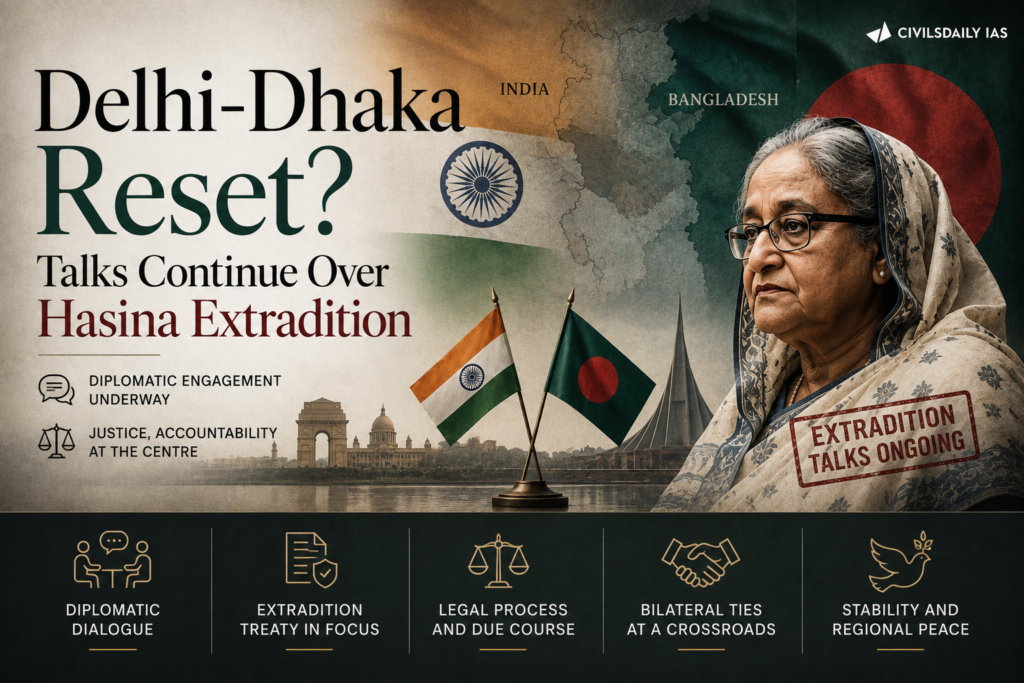
Why in the News
Dhaka has made the extradition of the former Bangladesh Prime Minister a precondition for a planned bilateral visit, and Indian officials state the request must go before Indian courts rather than being settled diplomatically. The route runs through the India Bangladesh Extradition Treaty, 2013 and the Extradition Act, 1962. The tension is between a treaty designed to remove the political offence defence for serious crimes and a request whose political character is contested.
What is the India Bangladesh Extradition Treaty, 2013?
- About: The treaty, signed in 2013, provides for extradition between India and Bangladesh for offences punishable by at least one year of imprisonment.
- Dual criminality: The conduct must constitute an offence in both countries for extradition to proceed.
- Political offence exception: Article 6 allows refusal where the offence is of a political character, subject to a list of carve outs.
- The carve outs: Twelve categories, including murder, terrorism related offences and kidnapping, are expressly excluded from the political offence defence.
- 2016 amendment: The evidentiary requirement was relaxed so that a warrant issued by a competent court of the requesting state suffices, without prima facie evidence.
How does an extradition request actually proceed in India?
- Request stage: The request is received through diplomatic channels and processed by the Consular, Passport and Visa Division of the Ministry of External Affairs.
- Magisterial inquiry: The central government may direct a magistrate to conduct an inquiry into the request.
- Judicial finding: The magistrate reports whether a prima facie case for surrender is made out.
- Executive decision: The final surrender decision rests with the central government, which may still refuse.
- Judicial review: The order is subject to challenge in the High Court and the Supreme Court, which is what makes the process a judicial one in practice.
Why is this request legally contested?
- Sentence in absentia: The International Crimes Tribunal in Bangladesh awarded a death sentence in November 2025 for crimes against humanity, delivered in absentia.
- Fair trial objection: In absentia trials and death sentences are challenged as inconsistent with international fair trial standards.
- Political character claim: The defence argues the prosecution arises from a change of government, engaging Article 6 of the treaty.
- Carve out counter: The offences charged fall within categories the treaty excludes from the political offence defence.
- Comparable precedent: The same fair trial objection was raised against the Syrian court’s in absentia death sentences delivered on 11 August 2026 for the Daraa crackdown.
What is the diplomatic cost of the dispute?
- Visit at risk: The planned bilateral visit on 21 August is in doubt because extradition has been made a precondition.
- Regional forum linkage: The Bangladesh leadership was invited to a multilateral summit as chair of the Bay of Bengal Initiative for Multi Sectoral Technical and Economic Cooperation, so the bilateral rift affects a regional grouping.
- Trigger event: A press conference held in Delhi by the former Prime Minister on 5 August hardened Dhaka’s position.
- Possible resolution: Officials note the question becomes moot if the former Prime Minister returns to Bangladesh voluntarily in December as she has said she will.
Challenges in India’s extradition practice
- Low success rate: India secures a small fraction of the fugitives it seeks. e.g. the prolonged proceedings in the United Kingdom over economic offenders sought by India.
- Prison conditions objection: Requested states refuse surrender citing Indian prison standards. e.g. the assurances India had to give on Barrack 12 of Arthur Road Jail in the Vijay Mallya proceedings.
- Human rights and death penalty bar: Many states will not extradite where the death penalty may be imposed. e.g. the assurances routinely sought by European states before surrender.
- Treaty coverage gaps: India has extradition treaties with a limited set of countries and arrangements with others. e.g. the absence of a treaty with several jurisdictions where fugitives relocate.
- Political offence litigation: The political character defence generates prolonged appellate litigation. e.g. the multi year appellate process in cases involving asylum claims.
- Reciprocity expectations: A refusal in one direction weakens the case for cooperation in the other. e.g. India’s own pending requests to Bangladesh for insurgent leaders sheltered across the border.
Conclusion
Routing the request to the courts converts a bilateral demand into a judicial question that the executive cannot concede quickly, which is itself the diplomatic outcome India has chosen. The treaty’s twelve carve outs make the political offence defence hard to sustain, while the in absentia death sentence supplies an independent ground for refusal. The next milestone is whether the 21 August visit proceeds, and whether a formal extradition request is filed for magisterial inquiry.
Back2Basics: Extradition Act, 1962
- Governs the extradition of fugitive criminals from India to foreign states and the receipt of fugitives into India.
- Applies to treaty states under Chapter II, and permits extradition to non treaty states through a notified arrangement.
- Requires that the offence be an extradition offence, defined as one punishable with imprisonment of at least one year under the laws of both countries.
- Provides for a magisterial inquiry, with the magistrate reporting to the central government on whether a prima facie case exists.
- Bars extradition for an offence of a political character, subject to the exclusions in the applicable treaty.
- The Ministry of External Affairs is the central authority for processing requests.
Way Forward
- Keep the process judicial: Insist on the statutory magisterial inquiry route, since a diplomatic surrender would set a precedent against India’s own pending requests.
- Seek assurances on sentence: Obtain an undertaking against execution before any surrender, consistent with international practice on capital cases.
- De link the bilateral agenda: Continue trade, connectivity and water cooperation tracks independently of the extradition question.
- Use the regional forum: Sustain engagement through the Bay of Bengal grouping so the bilateral rift does not stall regional cooperation.
- Press reciprocal requests: Pursue India’s own outstanding extradition requests to Bangladesh in the same process, establishing symmetry.
[2013, GS2, 10 marks] The protests in Shahbag Square in Dhaka in Bangladesh reveal a fundamental split in society between the nationalists and Islamic forces. What is its significance for India?”
