Why in the News
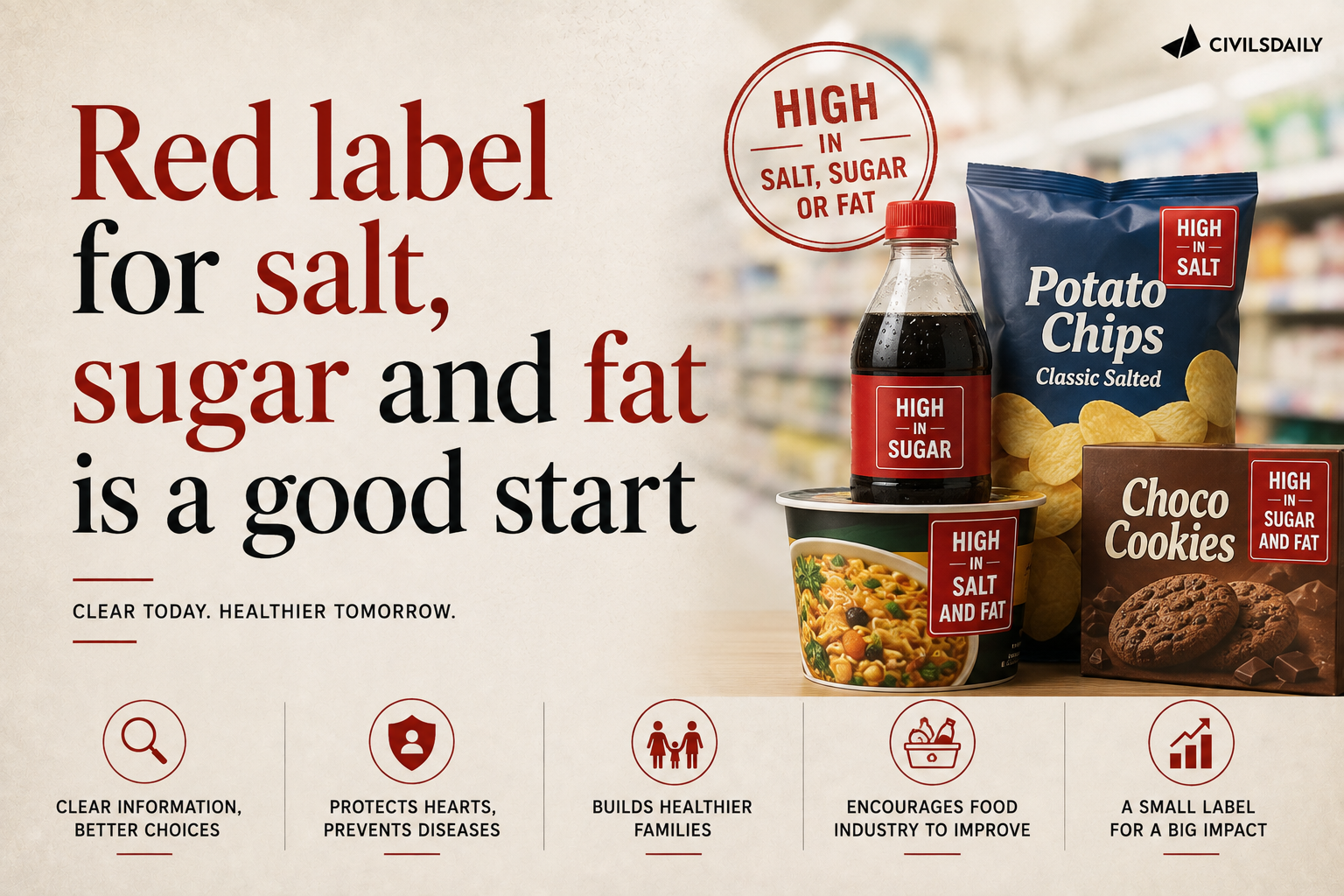
The Food Safety and Standards Authority of India (FSSAI) has proposed front-of-pack warnings (mandatory cautions printed on the front face of a packet, not in the nutrition table on the back) in the form of red hexagonal labels on packaged food high in sugar, refined carbohydrates, salt and unhealthy fats.
Can a warning label change what people actually eat?
- The case for scepticism: Eating behaviour is complex and shaped by gender, economic wherewithal, awareness and faith-based restrictions, so a label competes with several stronger determinants of choice.
- The evidence from Chile: Chile recorded a 24 per cent drop in sugary drink consumption after it introduced black octagonal warning labels on packages in 2016, which shows that a clear front-of-pack warning can shift consumption.
- Why the earlier star design failed: An earlier FSSAI proposal for a health star rating was criticised because stars are perceived as positive. Warning labels bearing stars have been associated with increased consumption of unhealthy foods, so clarity and legibility decide whether a label warns or advertises.
Why can a label be only one part of the response?
- A double burden: The obesity epidemic exists alongside malnutrition, so a policy that only discourages excess consumption addresses one half of India’s nutrition problem.
- The broader public-health response: The label must sit inside three further measures, raising nutritional awareness, stronger regulation of junk food, and nudges towards healthier lifestyles.
- What a label can honestly claim: A red label on a packet will not by itself make people eat better. Its value lies in making it easier to tell healthy choices from harmful ones at the point of purchase.
Challenges to the front-of-pack warning label proposal
- No notification or timeline yet: The proposal has not been notified and the implementation timeline is still awaited, so the regulator’s intent has no legal force. Eg. FSSAI’s 2022 draft for an Indian Nutrition Rating star label was never operationalised and has now been replaced by this proposal.
The Fix: Notify the regulation with dated phases so manufacturers and consumers have a fixed compliance calendar. - A threshold that misses single-nutrient products: The first of two intended phases applies the label only where a product is high in two or more unhealthy ingredients, which leaves out products high in just one. Eg. A sweetened biscuit that is high in sugar but within limits for salt and fat would carry no warning in phase one.
The Fix: Trigger the label on any single nutrient of concern crossing its limit, as Chile’s per-nutrient octagons do. - A font too small to warn: The proposed font size may be too small to be effective, so the label could exist on paper without being seen on the shelf. Eg. Chile fixes a minimum size for each octagon relative to the pack face so it cannot be shrunk into the design.
The Fix: Prescribe a minimum label area as a share of the front panel rather than a point size alone.
Conclusion
A warning label sorts products, it does not by itself change appetite. The Chilean result shows the sort is worth doing when the mark is unambiguous. What decides the outcome now is the notification: the date it is issued, whether phase one keeps the two-ingredient threshold, and whether the font is large enough to be read. Those three details are what to watch when FSSAI publishes the final regulation.
Back2Basics: Food Safety and Standards Authority of India
- Statutory basis: FSSAI is a statutory body established under the Food Safety and Standards Act, 2006, which consolidated earlier food laws into a single regulator.
- Ministry and location: It functions under the Ministry of Health and Family Welfare and is headquartered in New Delhi.
- Mandate: It lays down science-based standards for food articles and regulates their manufacture, storage, distribution, sale and import, including labelling and display rules.
[2024, GS2, 15 marks] In a crucial domain like the public healthcare system, the Indian State should play a vital role to contain the adverse impact of marketisation of the system. Suggest some measures through which the State can enhance the reach of public healthcare at the grassroots level.”
