Why in the News
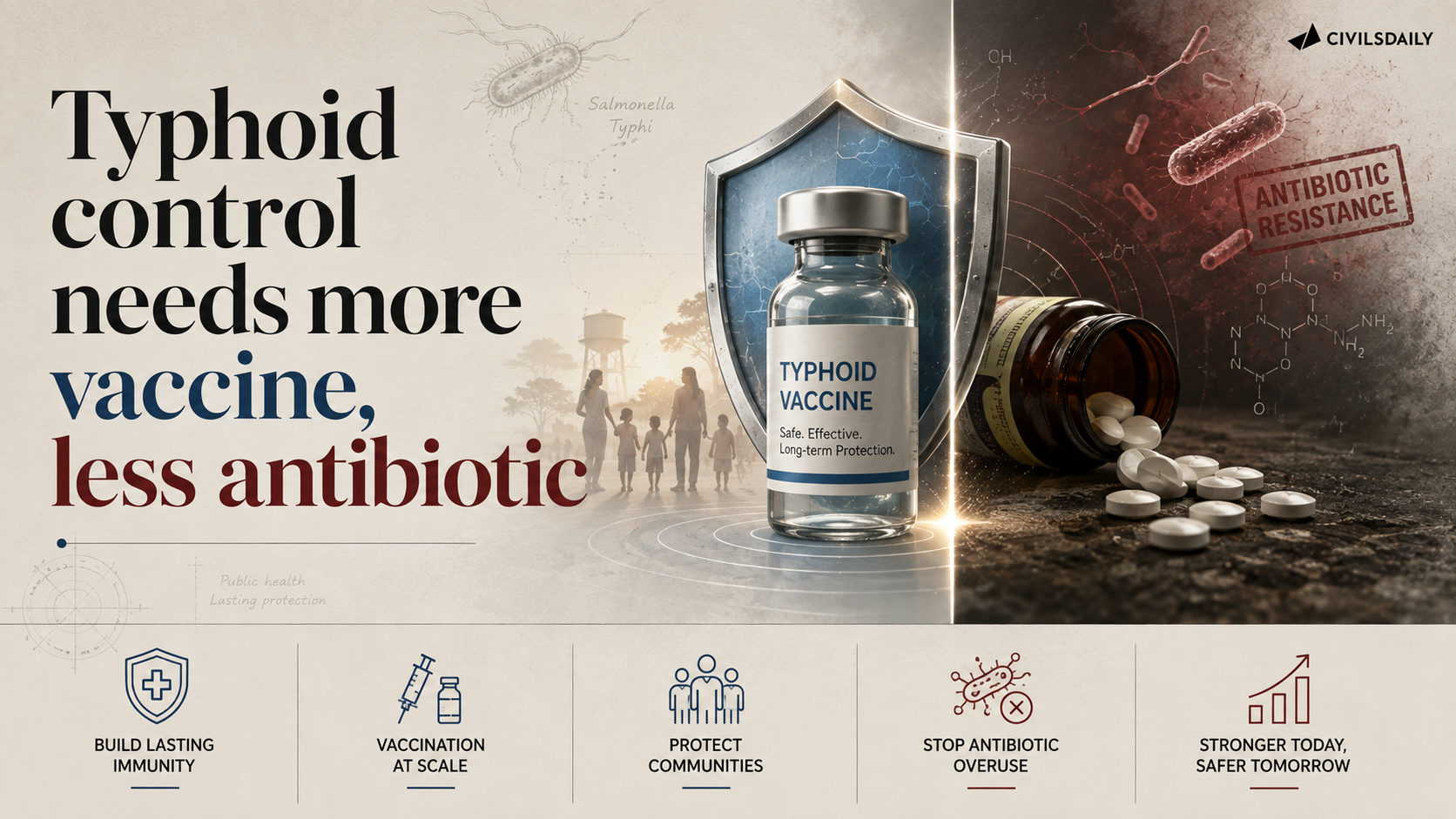
Typhoid cases in India are mounting without attracting the attention that influenza and swine flu currently draw, and every suspected case becomes a trigger for inappropriate or unnecessarily broad-spectrum antibiotic use. The disease is bacterial and vaccine preventable, yet it continues to be diagnosed imperfectly and treated empirically. The reason is the absence of a simple, reliable and accessible diagnostic test, which leaves the clinician with suspicion rather than confirmation. The tension is that the same empirical prescribing that substitutes for a diagnosis also generates the antimicrobial resistance in Salmonella typhi that makes future typhoid harder to treat, and it destroys the case data needed to see that resistance building.
What is the typhoid conjugate vaccine?
- What it is: The typhoid conjugate vaccine (TCV) links the Vi capsular sugar coat of Salmonella typhi to a carrier protein. The conjugation produces a durable immune response, including in children under two, which the older unconjugated vaccine did not.
- India’s manufacturing position: India produced the world’s first World Health Organization (WHO) prequalified typhoid conjugate vaccine, Typbar-TCV, in 2017. Additional Indian products have achieved WHO prequalification since then.
- Where WHO places it: The WHO has prioritised introduction of the vaccine in countries carrying a high typhoid burden or high levels of antimicrobial resistance.
Why does typhoid get treated without being diagnosed?
- A single Widal test settles nothing: The Widal test measures antibodies against Salmonella typhi, and one result is not sufficient to establish a diagnosis of acute typhoid.
- Endemicity corrupts the reading: In an endemic country such as India, background antibodies and previous exposure or vaccination make the result difficult to interpret. In routine practice a positive Widal result may still be treated as confirmation.
- The laboratory standard is only half sensitive: Blood culture remains the conventional laboratory standard. The latest WHO typhoid guidance puts the sensitivity of a single blood culture at only around 55 to 60 per cent.
- What the yield depends on: Sensitivity is influenced by the volume of blood collected and, critically, by prior exposure to antimicrobials.
- The vicious cycle this creates: A patient develops prolonged fever and takes an antibiotic before seeking care. The blood culture drawn afterwards returns negative, and the clinician responds to unresolved suspicion by escalating or changing the antibiotic.
What does empirical treatment cost beyond the individual patient?
- Every course adds selection pressure: India already faces increasing resistance in Salmonella typhi, and each unnecessary antibiotic course creates additional selection pressure on the organism.
- Every missed case blanks the record: A patient treated without microbiological confirmation never enters the resistance data, so the surveillance that should guide prescribing is undermined by the prescribing itself.
- Breadth compounds the damage: The response to diagnostic uncertainty is a broader spectrum agent, which acts on organisms far beyond the one suspected.
Why is a vaccine preventable disease being fought with antibiotics?
- The capability is not the constraint: The scientific and manufacturing capability exists and the vaccine exists. What remains inadequate is the scale and the rigour of its use.
- India is the case WHO describes: India is one of the countries where the combination of disease burden and resistance makes the case for typhoid vaccination compelling.
- Vaccination does not displace the basics: It cannot be treated as a substitute for clean water, sanitation, food safety or better diagnostics. It has to be one component of an integrated typhoid control strategy.
What would an integrated typhoid control strategy require?
- Surveillance triggered by the case rise: Reports of increasing typhoid should themselves trigger strengthened surveillance. Hospitals and laboratories should systematically document suspected and culture confirmed cases, antimicrobial susceptibility patterns and prior antibiotic exposure.
- Diagnostic stewardship inside antimicrobial stewardship: Blood cultures should ideally be obtained before antibiotics are started, with adequate blood volume and appropriate laboratory practices.
- A test that works at the point of care: India needs investment in a better point of care or rapid diagnostic test for typhoid.
- A settled place for the vaccine: The position of the typhoid conjugate vaccine in the public health strategy needs to be revisited rather than left to individual prescribing decisions.
Challenges to scaling the typhoid conjugate vaccine
- It sits outside the routine immunisation schedule: The vaccine is not part of the Universal Immunisation Programme, so uptake depends on the private market and on paying households. Eg. Coverage is concentrated in urban private paediatric practice rather than in the dense settlements where typhoid transmission is highest. Fix. Introduce it in a phased manner in high burden urban districts first, with the introduction decision anchored to culture confirmed case data.
- The vaccine does not cover the whole disease: Enteric fever is also caused by Salmonella paratyphi A, against which the conjugate vaccine gives no protection. Eg. A vaccinated patient presenting with prolonged fever still requires the same diagnostic workup. Fix. Fund development of a bivalent conjugate covering both organisms alongside scale up of the existing product.
- Introduction cannot be measured without a denominator: Without culture confirmed case counts there is no baseline against which to judge whether the vaccine reduced disease. Eg. Resistance data in India is heavily skewed towards tertiary hospitals rather than the community. Fix. Make enteric fever notifiable with mandatory laboratory reporting so introduction and impact are both measurable.
- Catch-up campaigns are the expensive part: A single dose given from six months of age is cheap, and a mass campaign across older cohorts is not. Eg. The cold chain and session load of a campaign compete directly with routine immunisation days. Fix. Attach the catch-up to existing school health programmes rather than running a parallel delivery system.
Conclusion
India has the vaccine and the manufacturing base to use it widely. What it does not have is a count of who actually has typhoid, because most cases are treated on symptoms and never confirmed in a laboratory. That missing count is exactly what would tell the government where to vaccinate first and whether it worked. The marker to watch is whether the typhoid conjugate vaccine enters the Universal Immunisation Programme, or stays held up waiting on data the country has not begun collecting.
What is Antimicrobial Resistance?
- About: Antimicrobial resistance (AMR) occurs when bacteria, viruses, fungi and parasites evolve and stop responding to medicines that once treated them. It is often termed the silent pandemic.
- The One Health scope: Human medicine, animal husbandry and the environment form one reservoir, since resistant organisms move between them through food, water and waste.
Laws and Rules Governing Antimicrobial Resistance
- Drugs and Cosmetics Act, 1940: The parent statute regulating manufacture and sale of medicines in India.
- Schedule H1: Requires a prescription and a sale register for listed antibiotics and second line drugs.
- Ban on irrational fixed dose combinations: The government banned 156 irrational fixed dose combinations in 2024, several being antibiotic cocktails with no scientific basis.
Government Initiatives for Antimicrobial Resistance
- National Action Plan on AMR 2.0 (2025 to 2029): Sets sectoral targets across human health, animal health and the environment.
- Red Line Campaign: Marks prescription-only antibiotic packs with a red vertical stripe for buyer identification.
- Indian Council of Medical Research (ICMR) AMR Surveillance Network: Collects susceptibility data from tertiary care hospitals.
Key Facts about Antimicrobial Resistance
- Consumption pattern: 59 per cent of antibiotics consumed in India in 2022 were in the WHO Watch category, meant to be used sparingly.
- Animal use ranking: India is the fourth largest consumer of antibiotics for animals, with an 82 per cent rise projected by 2030.
- Newborn burden: More than 50,000 newborn deaths a year in India are attributed to resistant sepsis.
Challenges in Antimicrobial Resistance
- Antibiotics still move over the counter: Retail enforcement of the prescription requirement is weak, so a course is bought like a painkiller. Eg. The pill popping habit widened after the COVID-19 pandemic, with antibiotics taken for viral illness. Fix. Make the Schedule H1 register a digital point of sale entry so it can be audited rather than inspected.
- Manufacturing effluent seeds resistance in rivers: Untreated effluent from drug production enters water bodies and selects for resistant organisms outside any clinic. Eg. The Musi river near Hyderabad shows antibiotic levels a thousand times above safe limits. Fix. Tie public procurement preference to plants certified for zero liquid discharge.
- Farm use is a growth strategy, not a treatment: Antibiotics are given routinely in poultry and aquaculture to accelerate weight gain, not to treat disease. Eg. Shrimp samples have shown up to 100 per cent ampicillin resistance. Fix. Subsidise animal vaccines and enforce farm to fork traceability so residue traces to a producer.
Matching Previous Year Question
“[2020] What is the importance of using Pneumococcal Conjugate Vaccines in India? (1) These vaccines are effective against pneumonia as well as meningitis and sepsis. (2) Dependence on antibiotics that are not effective against drug-resistant bacteria can be reduced. (3) These vaccines have no side effects and cause no allergic reactions. Select the correct answer using the code given below: (a) 1 only (b) 1 and 2 only (c) 1 and 3 only (d) 1, 2 and 3 ANSWER: (b)”
