Why in the News
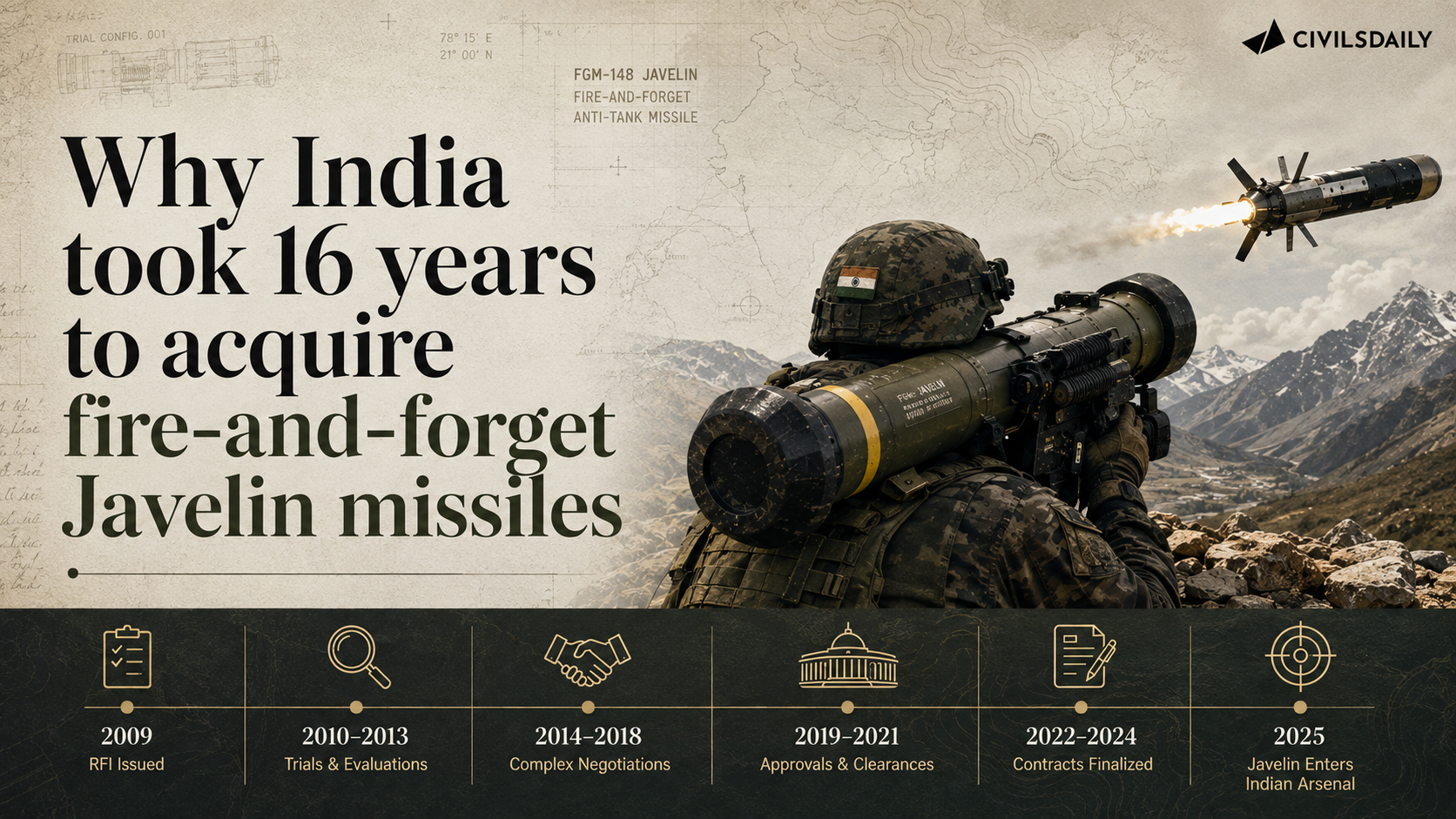
India has finalised a deal to purchase the Javelin anti-tank guided missile (ATGM) system from the United States through its Foreign Military Sales (FMS) process. The purchase closes a process that began in 2010 and was shelved and revived several times in between. The original attempt collapsed over the American refusal to release the missile’s core seeker technology, and the alternative India turned to in its place, Israel’s Spike system, also failed to convert into a contract. The tension is that the deal has now closed on terms India rejected sixteen years ago, since co-production of a finished round is a different thing from the full transfer of technology that was demanded the first time.
What is the Javelin anti-tank guided missile?
- What it is: A third generation, man portable anti-tank guided missile produced in the United States, designed to be carried and fired by a two person infantry team.
- Fire and forget guidance: The operator locks the missile onto the target before launch and the missile then guides itself to impact. The firing team can leave the position immediately, which a wire guided missile does not allow.
Why did India want the Javelin in 2010?
- The stated intent: In August 2010 the Defence Minister told Parliament that the government intended to procure third generation Javelin missiles through the FMS route, and that the procurement would include a transfer of technology.
- The inventory gap: The move was driven by a shortage of anti-tank guided missiles in the Indian Army’s inventory.
- The indigenous programme slipped: The original timelines for the indigenous systems being developed by the Defence Research and Development Organisation (DRDO) had been delayed.
- What it was meant to replace: The idea was to replace the ageing Milan-2T and Konkurs missile systems then in use with the Army.
- Where the preference came from: United States forces actively showcased the system during the 2009 bilateral exercise Yudh Abhyas, after which it was highlighted as the choice to immediately fill the gap.
Why did the first attempt collapse?
- The technology restriction: The acquisition was shelved because of stringent technology transfer restrictions imposed by Washington.
- The specific component withheld: The United States refused to share the missile’s core seeker technology, the imaging sensor that identifies and tracks the target, under a 100 per cent transfer of technology model.
- The consequence: The refusal caused India to pivot to Israel’s Spike missile system, manufactured by Rafael Advanced Defense Systems, in 2014.
What happened to the Spike alternative?
- Why Spike was chosen: In 2014 India went ahead with Spike over the Javelin, on the understanding that it could offer greater flexibility of technology transfer and local production.
- The order cleared: The Defence Acquisition Council cleared the purchase of over 8,000 Spike missiles.
- Why it was cancelled: Concerns over the system’s performance in trials, over technology transfer, and over progress in India’s own man portable missile programme led to cancellation of the $500 million order in 2017.
- Revived and shelved again: The deal was revived in 2018 following the Israeli Prime Minister’s visit, and was subsequently shelved again.
- The stopgap purchase: India undertook an emergency purchase of a limited quantity of the fourth generation Spike-LR missiles in 2019 to meet an immediate operational gap.
- What did get built: In August 2023 Kalyani Rafael Advanced Systems, a joint venture between the Kalyani Group and Rafael, said it had won a Rs 287.51 crore order from the Defence Ministry for the supply of the missile systems.
What changed to make the second attempt succeed?
- A different bilateral setting: The Javelin reappeared in India United States strategic discussions at a point when defence cooperation between the two countries had deepened.
- Co-production replaced technology transfer as the ask: A United States Congressional Research Service report updated in 2025 noted that co-production discussions involving the missile were ongoing.
- The industrial tie-up: In February 2025 the Javelin Joint Venture, a partnership between Lockheed Martin and Raytheon, said it was exploring co-assembly and co-production in India. It signed a memorandum of understanding with Bharat Dynamics Limited.
- The operational trigger: Discussions gained pace after Operation Sindoor in May 2025.
- The two track negotiation: By July 2025 India was negotiating for the systems both as an emergency procurement and through a long term contract, the latter likely involving co-production of the weapon systems.
- The clearance: Washington officially cleared the sale in November 2025.
Challenges to the Javelin acquisition
- A government to government sale surrenders schedule control: Under Foreign Military Sales the buyer contracts with the United States government rather than with the manufacturer, so delivery follows the seller’s production queue. Eg. GE Aerospace’s F404 engine deliveries for the Tejas Light Combat Aircraft programme ran late as European demand for American systems surged after 2024. Fix. Write dated delivery milestones with defined penalties into the Letter of Offer and Acceptance rather than relying on the standard schedule.
- Co-assembly is not the technology that was withheld: An arrangement to assemble finished rounds in India leaves the guidance package as an imported item, which is the precise gap that stalled the 2010 attempt. Eg. Indian co-production of imported systems has historically stopped at airframe and integration work. Fix. Tie offset credit to manufacture of the seeker and its imaging components rather than to assembly hours.
- Unit cost limits how deep the stock can go: A fire and forget round with an imaging seeker costs many times what a wire guided round costs, which restricts the number of rounds a formation can hold. Eg. The 2019 purchase of Spike-LR was a limited emergency buy rather than an inventory replacement. Fix. Pair the import with volume production of DRDO’s Man Portable Anti-Tank Guided Missile so the expensive round is reserved for the hardest targets.
- Four missile families in one role: The Army would operate legacy Milan and Konkurs stock, Spike, Javelin and the indigenous system together, multiplying training pipelines and spares chains. Eg. The Kalyani Rafael line and a Bharat Dynamics Limited line would produce competing rounds for the same infantry task. Fix. Fix a role split by range band and phase the legacy systems out on a published timetable.
Conclusion
India has been short of man portable fire and forget anti tank missiles for more than a decade. The purchase answers that operational gap rather than any shift in acquisition policy, and the indigenous programme’s repeated slippage is what left the gap open. The marker to watch is whether the domestic arrangement moves past final assembly into seeker manufacture, since that is the component the first attempt broke on. If it does not, the deal has bought rounds rather than capability, and a one time exception starts to look like the practice.
Back2Basics: Foreign Military Sales
- What it is: The United States government’s programme for selling defence articles, services and training to foreign governments and international organisations.
- How the transaction runs: The buyer contracts with the United States government, which then places the order with the manufacturer on the buyer’s behalf, so there is no direct commercial contract with the company.
- Who administers it: The Defense Security Cooperation Agency, under the Department of Defense, runs the programme under the Arms Export Control Act, 1976.
- The Congressional step: Sales above set value thresholds must be notified to the United States Congress before a Letter of Offer and Acceptance is issued to the buyer.
Matching Previous Year Question
“[2021, GS3, 10 marks] How is S-400 air defence system technically superior to any other system presently available in the world?”
