Why in News?
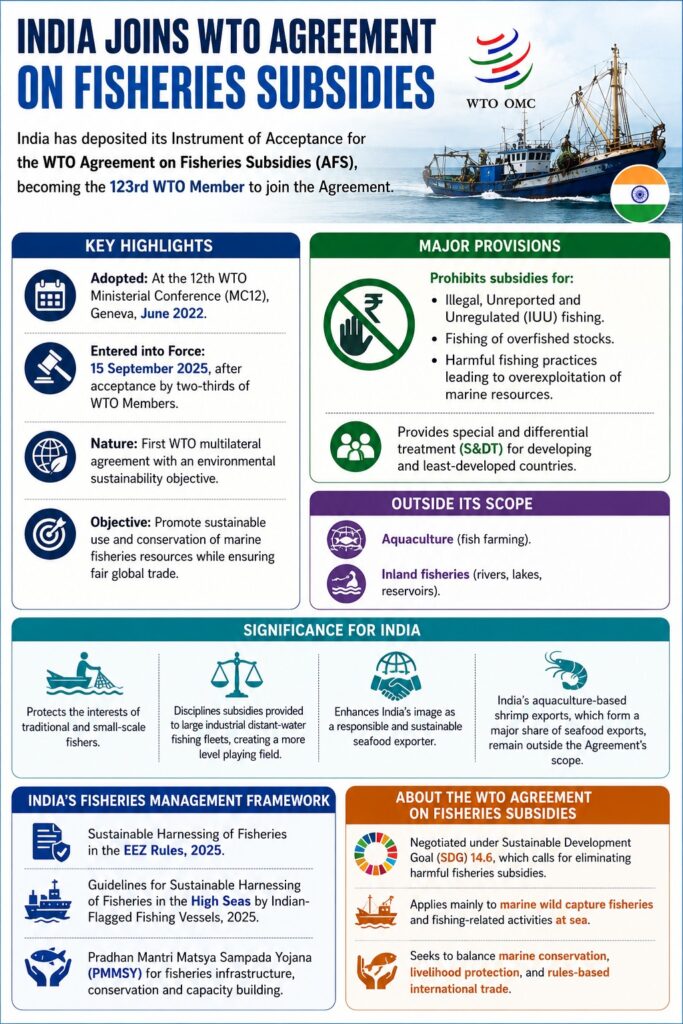
India has deposited its Instrument of Acceptance for the WTO Agreement on Fisheries Subsidies (AFS), becoming the 123rd WTO Member to join the Agreement.
Key Highlights
- Adopted: At the 12th WTO Ministerial Conference (MC12), Geneva, June 2022.
- Entered into Force: 15 September 2025, after acceptance by two-thirds of WTO Members.
- Nature: First WTO multilateral agreement with an environmental sustainability objective.
- Objective: Promote sustainable use and conservation of marine fisheries resources while ensuring fair global trade.
Major Provisions
- Prohibits subsidies for:
- Illegal, Unreported and Unregulated (IUU) fishing.
- Fishing of overfished stocks.
- Harmful fishing practices leading to overexploitation of marine resources.
- Provides special and differential treatment (S&DT) for developing and least-developed countries.
What is Outside its Scope?
- Aquaculture (fish farming).
- Inland fisheries (rivers, lakes, reservoirs).
Significance for India
- Protects the interests of traditional and small-scale fishers.
- Disciplines subsidies provided to large industrial distant-water fishing fleets, creating a more level playing field.
- Enhances India’s image as a responsible and sustainable seafood exporter.
- India’s aquaculture-based shrimp exports, which form a major share of seafood exports, remain outside the Agreement’s scope.
India’s Fisheries Management Framework
- Sustainable Harnessing of Fisheries in the EEZ Rules, 2025.
- Guidelines for Sustainable Harnessing of Fisheries in the High Seas by Indian-Flagged Fishing Vessels, 2025.
- Pradhan Mantri Matsya Sampada Yojana (PMMSY) for fisheries infrastructure, conservation and capacity building.
About the WTO Agreement on Fisheries Subsidies
- Negotiated under Sustainable Development Goal (SDG) 14.6, which calls for eliminating harmful fisheries subsidies.
- Applies mainly to marine wild capture fisheries and fishing-related activities at sea.
- Seeks to balance marine conservation, livelihood protection, and rules-based international trade.
[2017] Consider the following statements:
- India has ratified the Trade Facilitation Agreement (TFA) of WTO.
- TFA is a part of WTO’s Bali Ministerial Package of 2013.
- TFA came into force in January 2016.
Which of the statements given above is/are correct?
[A] 1 and 2 only
[B] 1 and 3 only
[C] 2 and 3 only
[D] 1, 2 and 3
