The Department of Atomic Energy released draft rules under the Sustainable Harnessing and Advancement of Nuclear Energy for Transforming India (SHANTI) Act on 14 August 2026, opening nuclear power generation to private and captive users. Comments are invited until 4 September 2026.
What is the SHANTI Act?
Replaces the earlier state monopoly framework with a licensing regime for non-government operators.
Provides a single composite licence for building, owning, operating and decommissioning a reactor.
Key Provisions
Captive nuclear power: Industries can generate nuclear electricity mainly for their own consumption.
In-principle approval: Allows land acquisition and vendor negotiations before final licensing.
Foreign technology: Imported designs must be certified by the regulator in the country of origin and already operational.
Nuclear liability: Operators must maintain insurance or financial security; a Nuclear Liability Fund is proposed.
Eligible users: Aluminium, cement, data centres, semiconductor fabs and Artificial Intelligence (AI) facilities.
Key Concern
The country-of-origin certification may speed up safety approval but restrict technology sourcing to a few countries. Requiring continued support and retaining Intellectual Property Rights (IPR) with foreign developers could also limit technology transfer and indigenous reactor design.
India’s Nuclear Programme
Stage 1: Pressurised Heavy Water Reactors (PHWRs) using natural uranium.
Stage 2: Fast Breeder Reactors (FBRs) using plutonium.
Stage 3: Thorium-based reactors using Uranium-233 (U-233).
Target:100 GW nuclear capacity by 2047.
Challenges
Supplier liability concerns
Limited regulatory independence
Land and public acceptance
Uranium and fuel constraints
Nuclear waste management
High project costs and long construction timelines
Prelims Pointers
DAE: Department of Atomic Energy
AERB: Atomic Energy Regulatory Board
NPCIL: Nuclear Power Corporation of India Limited
BHAVINI: Bharatiya Nabhikiya Vidyut Nigam Limited
NPT: Nuclear Non-Proliferation Treaty
NSG: Nuclear Suppliers Group
India is not a signatory to NPT and received an NSG waiver in 2008.
[2018, GS3, 15 marks] With growing energy needs should India keep on expanding its nuclear energy programme? Discuss the facts and fears associated with nuclear energy.”
[2020] In India, why are some nuclear reactors kept under “IAEA safeguards” while others are not ?
a) Some use uranium and others use thorium b) Some use imported uranium and others use domestic supplies c) Some are operated by foreign enterprises and others are operated by domestic enterprises d) Some are State-owned and others are privately-owned
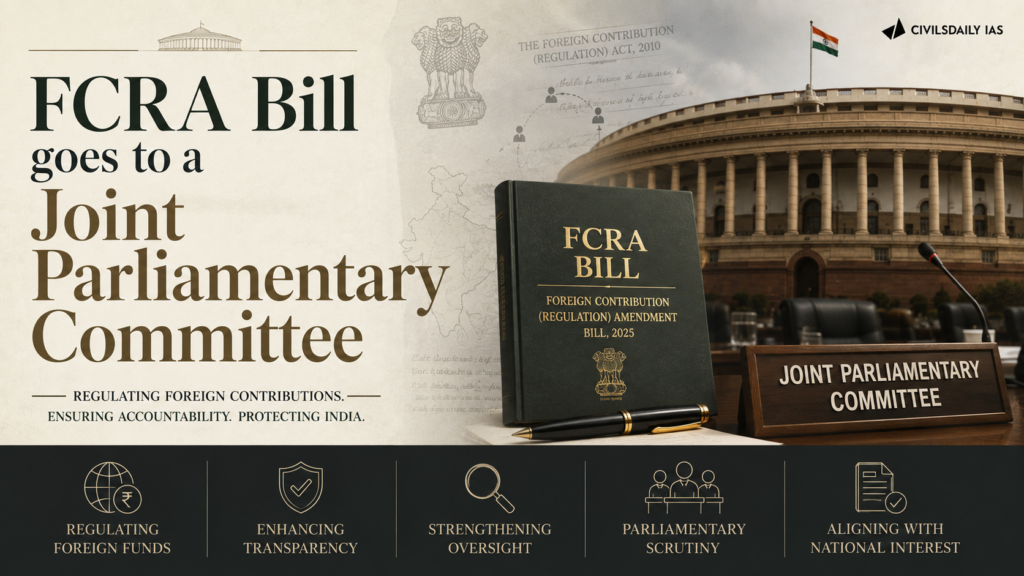
The Foreign Contribution (Regulation) Amendment Bill, 2026 was referred to a Joint Parliamentary Committee (JPC). The referral has renewed attention on how parliamentary committees shape legislation.
What is a Joint Parliamentary Committee?
Ad hoc committee: A JPC is set up for a specific bill or inquiry and dissolves after it reports.
Composition: Members are drawn from both Houses, in proportion to party strength.
Recommendations: Its recommendations are advisory, not binding on the government.
Why does the committee route matter?
Scrutiny space: Committees allow detailed, less partisan examination away from the floor.
Declining use: Bills referred to committees fell from about 71% in the 15th Lok Sabha to about 16% in the 17th.
Delay lever: Referral can also defer a contentious bill.
What is contested in the FCRA amendment?
Foreign funding control: The Foreign Contribution (Regulation) Act, 2010 governs foreign donations to NGOs and associations.
Civil society concern: Tighter rules are opposed as constraining non-governmental organisations and religious bodies.
Conclusion
The referral subjects a contested bill to committee scrutiny without settling it. The current status is examination by the JPC, with its report the next milestone.
Back2Basics: Parliamentary Committees
Standing committees: Permanent bodies such as the Public Accounts Committee and departmental committees.
Ad hoc committees: Temporary bodies such as a JPC or a Select Committee.
Financial committees: Public Accounts Committee, Estimates Committee, and Committee on Public Undertakings.
“[2023, GS2, 15] Explain the structure of the Parliamentary Committee system. How far have the financial committees helped in the institutionalization of Indian Parliament?”
[2018] With reference to the Parliament of India, which of the following Parliamentary Committees scrutinizes and reports to the House whether the powers to make regulations, rules, sub-rules, by-laws etc. conferred by the constitution of delegated by the Parliament are being properly exercised by the Executive within the scope of such delegation ?
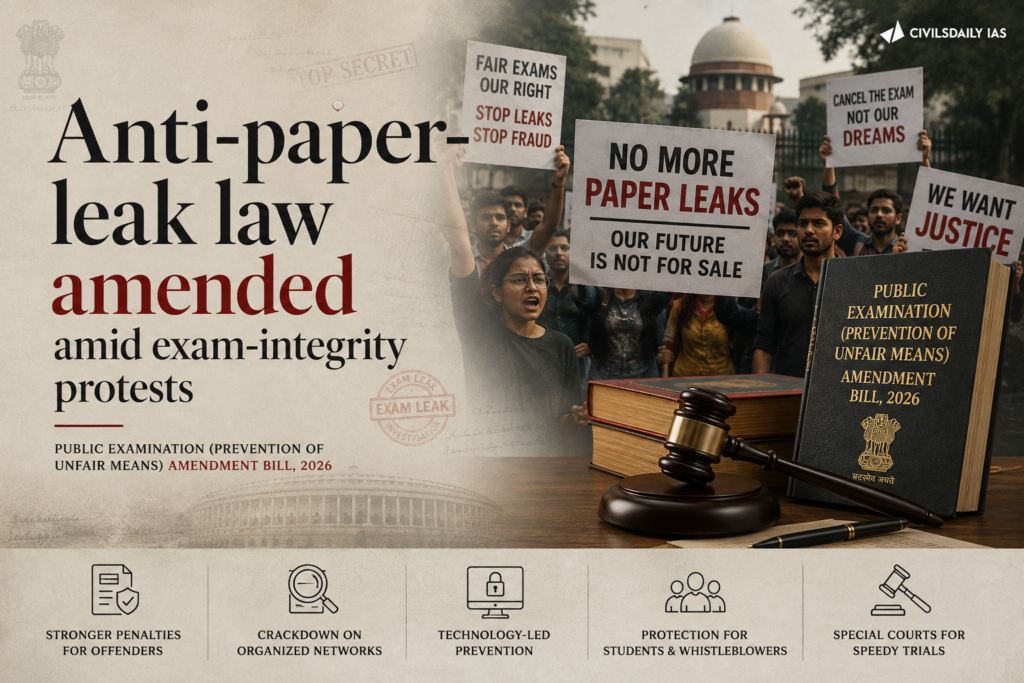
The Public Examination (Prevention of Unfair Means) Amendment Bill, 2026 seeks to strengthen the 2024 law against organised cheating and examination paper leaks amid concerns over NEET and recruitment examination irregularities.
What is the Public Examination Act, 2024?
Objective: Criminalises organised cheating, paper leaks, impersonation and other unfair means.
Coverage: Applies to major public examinations conducted by bodies such as UPSC, SSC and NTA.
Penalties: Provides imprisonment and heavy fines for organised examination malpractice.
Focus: Targets organised networks rather than genuine candidate errors.
Why was it amended?
Exam-leak crisis: Repeated paper leaks and irregularities exposed weaknesses in examination governance.
Enforcement gaps: Strengthening was considered necessary after experience with the 2024 framework.
Public trust: Fair examinations are essential for merit-based recruitment and equal opportunity.
What does the crisis reveal?
Aspiration-opportunity gap: Large numbers of candidates compete for limited government jobs.
Institutional trust deficit: Repeated leaks undermine confidence in recruitment institutions.
Governance challenge: Legal punishment alone cannot ensure examination integrity without secure technology, accountable agencies and speedy investigation.
Prelims Pointers
Act: Public Examinations (Prevention of Unfair Means) Act, 2024
Ministry/Department: Department of Personnel and Training
Targets: Organised cheating, paper leaks and impersonation
Important distinction: The Act does not automatically cover all university or State board examinations unless the concerned government adopts the framework.
“[2024, GS2, 15] What are the aims and objects of the recently passed and enforced, The Public Examination (Prevention of Unfair Means) Act, 2024? Whether University/State Education Board examinations, too, are covered under the Act?”
[2021] With reference to the Union Government, consider the following statements: 1. N. Gopalaswamy Iyengar Committee suggested that a minister and a secretary be designated solely for pursuing the subject of administrative reform and promoting it. 2. In 1970, the Department of Personnel was constituted on the recommendation of the Administrative Reforms Commission, 1966, and this was placed under the Prime Minister’s charge. Which of the statements given above is/are correct?
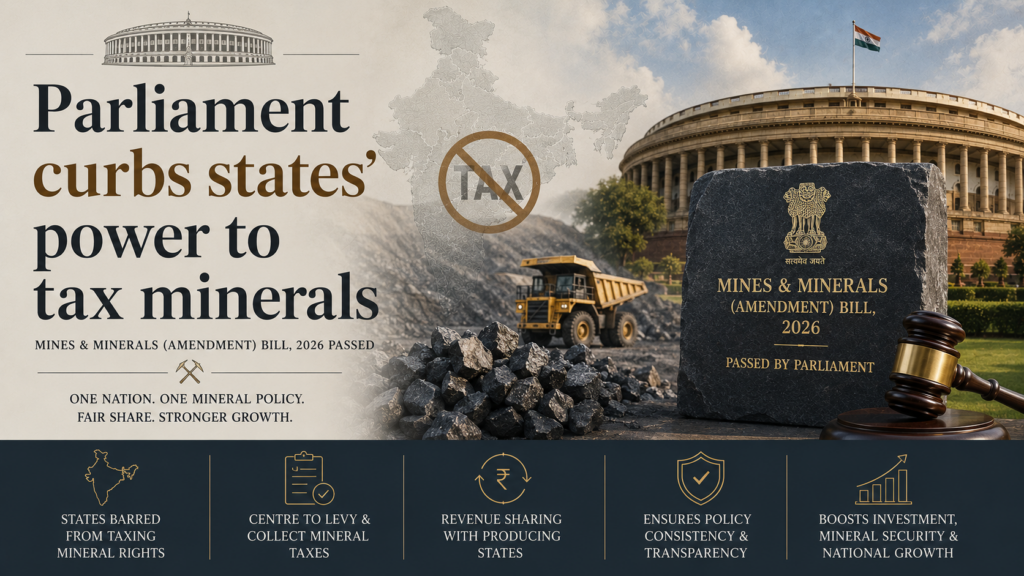
Parliament passed the Mines and Minerals (Development and Regulation) Amendment Bill, 2026. It bars states from imposing specified levies on mineral rights except on terms set by the Centre, reopening a fiscal federalism dispute.
What does the Mines and Minerals (Development and Regulation) Amendment Bill, 2026 do?
Levy restriction: States cannot impose specified taxes on mineral rights or mineral-bearing land except as the Centre prescribes.
Dues extinguished: Pre-amendment dues estimated near 2 lakh crore rupees stand extinguished.
Scope: The Bill applies to major minerals such as iron ore, coal, bauxite, manganese, and copper.
Why is this a fiscal federalism flashpoint?
2024 ruling reversed in effect: The Supreme Court in 2024 upheld states’ power to tax mineral rights, which the Bill now constrains.
Revenue dependence: Mining was 84.9% of Jharkhand’s non-tax revenue in 2024-25.
Mineral-rich states hit: States holding large mineral reserves lose an expected revenue stream.
What is the Centre’s justification?
Uniform rates: The government argues uniform mineral rates prevent a patchwork of state levies.
No revenue loss claim: The Centre states that states retain powers over minor minerals.
Investment climate: Predictable levies are framed as protecting mining-sector investment.
What are the major debates surrounding it?
Tax versus royalty: The dispute turns on whether a levy on minerals is a tax or a royalty, which the 2024 ruling addressed.
Tribal concerns: Mineral belts overlap with Scheduled Areas, raising questions of local benefit-sharing.
Divisible resource control: Centralising mineral levies shifts fiscal power toward the Union.
Conclusion
The amendment centralises control over mineral taxation soon after the Supreme Court affirmed states’ taxing power. The immediate stage is enactment, with a likely constitutional challenge the next development.
Back2Basics
Constitutional Framework Governing mineral taxation
Entry 50, State List: Taxes on mineral rights, subject to Parliament’s limitations relating to mineral development.
Entry 54, Union List: Regulation of mines and mineral development declared expedient in public interest.
Article 246: Distributes legislative power between Union and states via the Seventh Schedule.
What did the Supreme Court hold in 2024?
The Mineral Area Development Authority v. SAIL judgment is the constitutional backdrop to the 2026 amendment. The 9-judge Constitution Bench, by 8:1 majority, held that royalty is not a tax and that States have legislative competence to tax mineral rights under Entry 50, State List. It also recognised the States’ power to tax mineral-bearing land under Entry 49, State List.
Royalty ≠ Tax: Royalty paid under the MMDR Act is consideration for the right to extract minerals and is distinct from a tax.
State Taxing Power: States can impose taxes on mineral rights under Entry 50, List II, subject to limitations imposed by Parliament.
Mineral-Bearing Land: States can also levy taxes on land under Entry 49, List II.
MMDR Limitation: The Court held that the MMDR Act, as it then stood, did not impose a limitation on the States’ taxing power.
Why is the 2026 Amendment significant?
The 2026 amendment seeks to alter this position prospectively by restricting State taxation of mineral rights and mineral-bearing lands, except in accordance with conditions or restrictions prescribed by the Centre
PYQ Relevance
[UPSC 2025] Examine the evolving pattern of Centre-State financial relations in the context of planned development in India. How far have the recent reforms impacted the fiscal federalism in India?
Linkage: The 2025 PYQ examines the evolution of Centre–State financial relations and their impact on fiscal federalism. The Bill raises fresh concerns over the Union’s role in restricting States’ mineral revenue powers and fiscal autonomy.
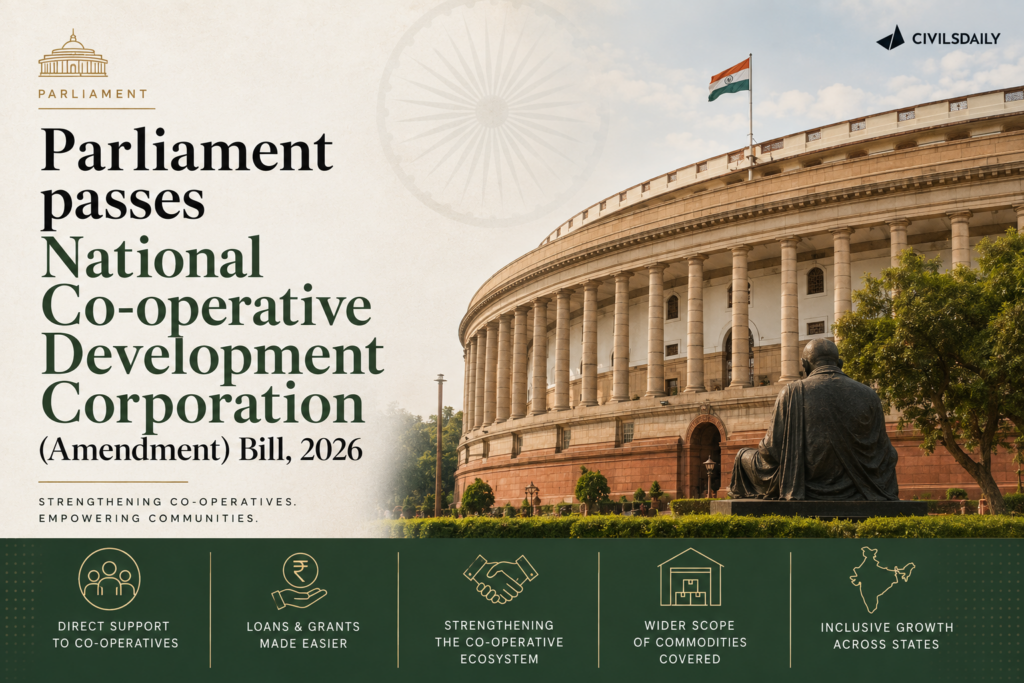
Parliament passed the National Cooperative Development Corporation (Amendment) Bill, 2026, enabling the NCDC to provide loans and grants directly to cooperative societies.
What is NCDC?
NCDC (National Cooperative Development Corporation) is a statutory corporation established under the National Cooperative Development Corporation Act, 1962.
Functions under the Ministry of Cooperation.
Promotes and finances cooperatives involved in production, processing, marketing, storage and trade of agricultural and allied produce.
What does the Amendment Change?
Direct lending: NCDC can directly provide loans and grants to cooperative societies.
Wider coverage: Definition of foodstuffs expanded to include processed food and other food items notified by the Centre.
No additional budgetary outlay: The Bill does not provide for additional government financial assistance.
Why is it Needed?
Faster flow of credit by removing intermediary delays.
Supports over 8 lakh cooperatives with more than 30 crore members.
Extends cooperative financing into value added food chains.
Why are States Concerned?
Cooperation is largely a State subject.
Direct central lending may bypass State governments and registrars.
Raises concerns about cooperative federalism and centralisation.
Key Challenges
Financial weakness and poor governance of PACS (Primary Agricultural Credit Societies).
Dual regulatory control.
Regional concentration of cooperatives.
Delayed elections and audits.
Limited professional management.
Centre State friction.
Constitutional Framework
Entry 32, State List: Incorporation and regulation of cooperative societies within a State.
Article 43B: Promotes voluntary formation and autonomous functioning of cooperatives.
Part IXB, Articles 243ZH to 243ZT: Constitutional provisions on cooperatives.
Multi State Cooperative Societies Act, 2002: Governs cooperatives operating across multiple States.
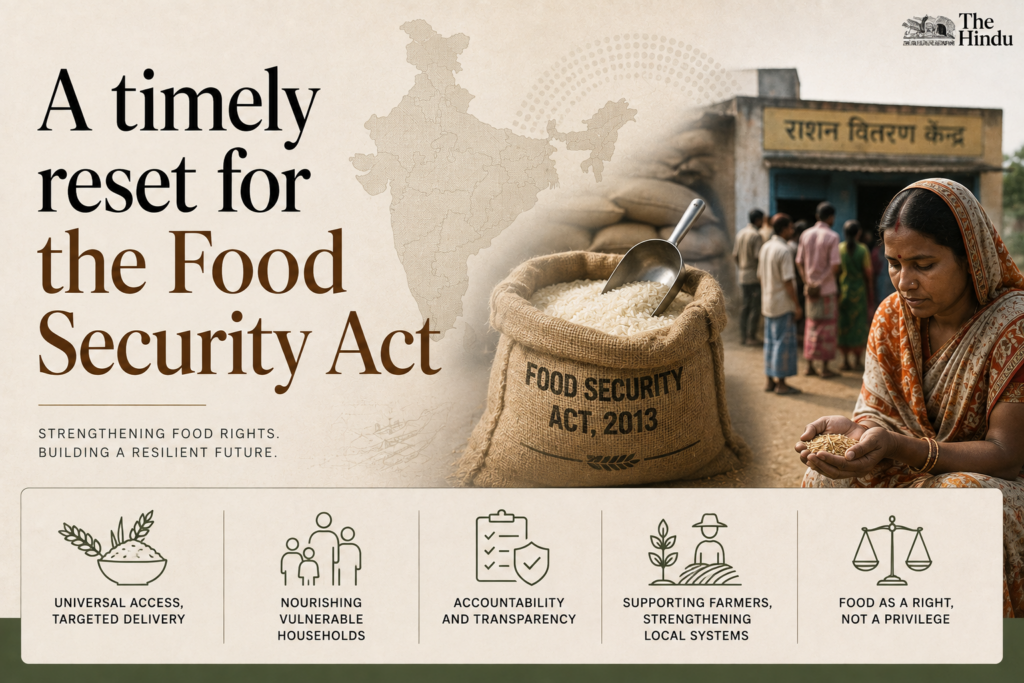
The draft National Food Security (Amendment) Bill, 2026 proposes to link Antyodaya Anna Yojana (AAY) entitlements to household size, opening a new phase in India’s food security debate. The reset exposes a triple tension: correcting the inequity of a flat household ration without reducing existing foodgrain access, while building a pathway from cereal security toward nutrition security amid a rising burden of diabetes and other non-communicable diseases.
What is the National Food Security Act, 2013?
Definition: The National Food Security Act, 2013 (NFSA) legally guarantees subsidised foodgrains to a large share of the population through the Public Distribution System, treating food as a legal entitlement rather than welfare.
Coverage design: It allows coverage of up to 75% of the rural and 50% of the urban population, split into Priority Households and Antyodaya Anna Yojana households.
What is the Antyodaya Anna Yojana (AAY) category?
Definition: AAY covers the poorest of the poor households and provides a flat 35 kg of foodgrains per household per month, regardless of household size.
Contrast: Priority Households instead receive 5 kg of foodgrains per person per month, a per-head rather than per-household entitlement.
Why does the flat AAY entitlement create inequity?
Small households protected: The flat 35 kg shields smaller and highly vulnerable families, such as a widow or an older person living alone.
Large households squeezed: A seven-member AAY household receives only 5 kg per person and an eight-member household about 4.4 kg, below the Priority Household entitlement.
The distortion: Support per person falls as household size rises, inverting the intended pro-poor design.
What does the draft amendment propose?
Per-person formula: The draft proposes 7 kg of foodgrains per person, capped at 35 kg per household.
Winners and losers: It would reduce support for households with one to four members by 20% to 80%, leave those with five or more members unchanged, and give no AAY household any additional foodgrain.
The design flaw: By reducing rather than raising any allocation, it corrects inequity by levelling down.
Why does the proposal risk reducing existing access?
Tamil Nadu illustration: The State reports that 15.75 lakh of its 18.64 lakh AAY households, or 84.5%, have fewer than five members.
Allocation cut: The proposal would reduce the State’s monthly AAY allocation from 65,261 tonnes to 42,040 tonnes, a fall of about 35.6%.
Composition matters: A smaller household may include a person with a disability, a widow or an older person living alone, so headcount alone is a poor proxy for need.
Why must coverage, not just the formula, be reformed?
Outdated ceiling: The NFSA’s 81.35-crore beneficiary ceiling remains based on Census 2011, though about 80 crore people currently receive free foodgrains.
Coverage erosion: Against an estimated population of 146.4 crore in 2025, the ceiling covers only 55.6% of people.
Recalculation needed: The ceiling should be recalculated when Census 2027 figures become available, with accessible inclusion and appeal mechanisms in the interim.
Why is grain alone not nutrition security?
Uneven child nutrition: NFHS-6 (2023-24) found stunting among under-fives fell from 35.5% to 29.3%, but wasting barely moved from 19.3% to 19.0% and underweight from 32.1% to 31.8%.
Diet inadequacy: Only about 15% of children aged six to 23 months receive a minimally adequate diet.
Double burden: The ICMR-India Diabetes study estimated 101 million Indians had diabetes and 136 million had prediabetes in 2021.
Life-course risk: Maternal undernutrition and low birth weight raise the risk of non-communicable diseases later in life.
Should the PDS cereal basket be blamed for diabetes risk?
Not a direct cause: Foodgrain entitlement should not itself be equated with diabetes risk.
The real concern: A predominantly cereal-based basket, combined with diets already high in carbohydrates and low in protein, can reinforce dietary imbalance.
Evidence: A 2025 ICMR-INDIAB study of 18,090 adults found carbohydrates supplied 62.3% of daily energy and protein 12%, with the highest carbohydrate intake carrying 30% higher odds of newly diagnosed type 2 diabetes.
Millets caution: Replacing refined cereals with whole-wheat or millet flour was not linked to lower risk when the carbohydrate share stayed high, so more grain or millets alone is not a complete nutrition policy.
How can diets be diversified without cutting cereals?
Balanced target: The ICMR-NIN 2024 guidelines recommend cereals and millets provide at most 45% of energy, with more from pulses, milk, nuts, vegetables and fruits.
What the PDS can do: The PDS can best supply affordable, shelf-stable foods, with States supported to offer pulses, local rice, wheat, millet choices and healthy edible oils.
Procurement link: Local production and consumption should guide supply chains and effective Minimum Support Price procurement for pulse, millet and oilseed growers.
Programme convergence: Sustained investment should link the PDS, Anganwadi services and Pradhan Mantri Poshan Shakti Nirman (PM POSHAN), providing eggs, milk or suitable alternatives where feasible.
Separate budgeting: Dietary diversification must be separately budgeted, not financed by reducing cereal entitlements, against a food subsidy allocation of Rs 2,27,629 crore in the 2026-27 Union Budget.
Phased pilots: Additions should be tested through State pilots assessing consumption, dietary diversity, anaemia, glycaemic risk, wastage and exclusion.
How does the delivery network enable this reform?
Digitised last mile: By the end of 2025, 5.50 lakh of 5.51 lakh fair price shops used electronic point-of-sale devices.
Portability: One Nation One Ration Card covered nearly all NFSA beneficiaries, supporting portability and monitoring.
Safeguards needed: Systems must include reliable offline alternatives, assisted or doorstep access for people with limited mobility, and a guarantee that authentication failure will not deny entitled foodgrains.
Nutrition referral: Fair price shops could carry multilingual receipts and messages and, where feasible, link willing adults to diabetes and hypertension services, with over 1.86 lakh Ayushman Arogya Mandirs and 41.3 crore diabetes screenings recorded by June 2026.
What three safeguards should anchor the reform?
No-loss guarantee: Any per-person formula should preserve the existing 35 kg monthly entitlement for every AAY household.
Periodic review: The adequacy of the 35 kg ceiling should be reviewed for larger and high-dependency households using consumption, nutritional and fiscal evidence.
Separately financed diversification: Dietary diversification must be separately financed and progressively implemented without reducing existing cereal entitlements.
Conclusion
The proposed amendment is an opportunity to correct the inequity of a flat AAY ration, but only if it preserves the 35 kg entitlement, assesses the needs of larger households, and finances a gradual transition toward more diverse and nutritious diets. India’s next food security reform must protect people from hunger while addressing the dietary drivers of diabetes, judged not by tonnes of grain moved but by whether vulnerable families can eat enough, eat healthier and obtain their entitlements with dignity.
Food Security in India (Foundational Context)
About: Food security means physical, economic and social access to sufficient, safe and nutritious food for an active, healthy life.
Scale: The NFSA covers about 80 crore people through the world’s largest food-based safety net.
Progress: The share of households unable to afford the ICMR-NIN recommended diet fell from about 52% in 2011-12 to about 25% in 2023-24, at 25% rural and 21% urban.
Back2Basics: National Food Security Act, 2013
Coverage: Up to 75% of rural and 50% of urban population.
Entitlement: 5 kg per person per month for Priority Households; 35 kg per household for AAY households.
Woman as head: The eldest woman aged 18 or above is the head of household for ration card issuance.
Maternity and child benefits: Entitlements for pregnant and lactating women and for children through supplementary nutrition programmes.
Grievance redress: State and district-level redress and vigilance mechanisms.
Statutory Framework Governing Food Security
Article 21: The right to life, read to include the right to food.
Article 47 (DPSP): Duty of the State to raise nutrition levels and the standard of living.
National Food Security Act, 2013: Legal entitlement to subsidised foodgrains.
Essential Commodities Act, 1955: Regulation of production, supply and distribution of essential commodities.
Government Initiatives for Food and Nutrition Security
Public Distribution System: Distribution of subsidised foodgrains through fair price shops.
PM POSHAN: Hot cooked meals for schoolchildren.
Anganwadi and ICDS: Supplementary nutrition for young children and pregnant or lactating women.
One Nation One Ration Card: Portable ration access across States.
Pradhan Mantri Garib Kalyan Anna Yojana: Free foodgrains scheme scaling the NFSA entitlement.
Key Facts about Food Security
PoS coverage: 5.50 lakh of 5.51 lakh fair price shops digitised by end 2025.
Diabetes burden: 101 million diabetics and 136 million prediabetics estimated in 2021.
Guideline: ICMR-NIN 2024 caps cereals and millets at 45% of dietary energy.
Challenges in Food and Nutrition Security
Cereal-heavy basket: High carbohydrate share crowding out protein and micronutrients.
Double burden: Coexistence of undernutrition and rising non-communicable diseases.
Outdated coverage: Beneficiary ceiling frozen at Census 2011.
Exclusion errors: Authentication failures and mobility barriers at the last mile.
Fiscal pressure: Large and rising food subsidy bill.
Procurement skew: MSP concentrated in rice and wheat over pulses and oilseeds.
Way Forward
No-loss safeguard: Legally protect the 35 kg AAY entitlement in any new formula.
Update coverage: Recalculate the ceiling on Census 2027 with accessible appeals.
Diversify diets: Separately fund pulses, millets and healthy oils in the PDS.
Converge programmes: Link PDS, Anganwadi and PM POSHAN for nutrition delivery.
Pilot before scale: Test additions through phased State pilots measuring nutrition and fiscal outcomes.
Previous Year Question
[2018] With reference to the provisions made under the National Food Security Act, 2013, consider the following statements:
1. The families coming under the category of ‘below poverty line (BPL)’ only are eligible to receive subsidised food grains.
2. The eldest woman in a household, of age 18 years or above, shall be the head of the household for the purpose of issuance of a ration card.
3. Pregnant women and lactating mothers are entitled to a ‘take-home ration’ of 1600 calories per day during pregnancy and for six months thereafter.
Which of the statements given above is/are correct?
(a) 1 and 2
(b) 2 only
(c) 1 and 3
(d) 3 only
[2021 GS3 15m] What are the salient features of the National Food Security Act, 2013? How has the Food Security Bill helped in eliminating hunger and malnutrition in India?”
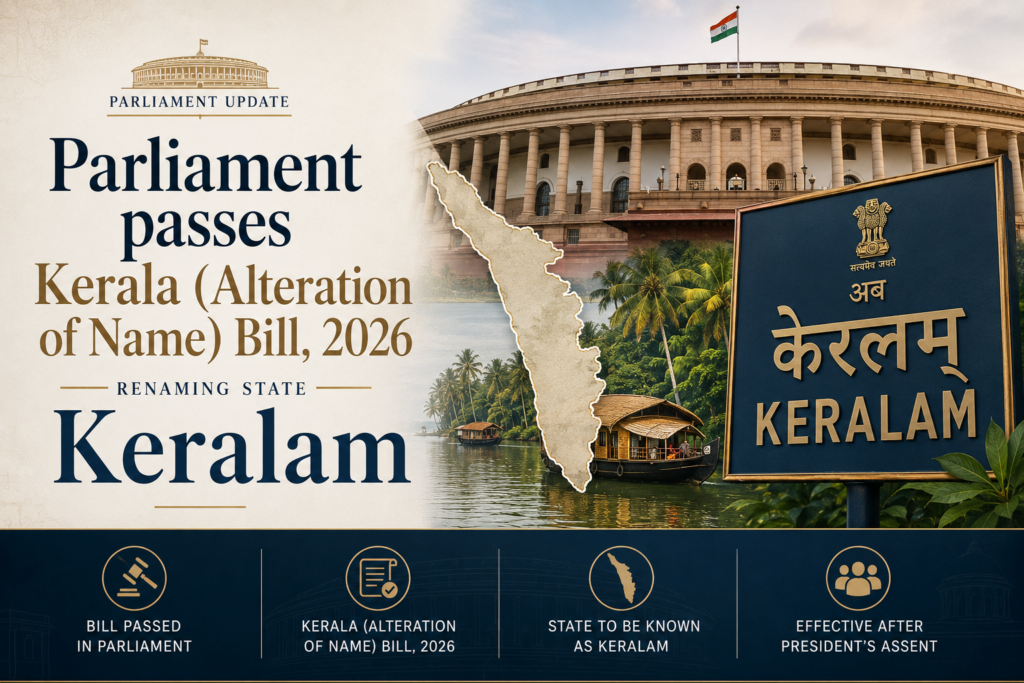
Parliament passed the Kerala (Alteration of Name) Bill, 2026, renaming the State Keralam and amending the First Schedule of the Constitution. The Rajya Sabha cleared the Bill by voice vote, over two years after the State Assembly unanimously resolved for the change. The measure has surfaced pending name change proposals from other States, including West Bengal’s request to become Bangla.
How is a State renamed under the Constitution?
Article 3 power: Parliament may by law alter the name of a State, and such a bill can be introduced only on the recommendation of the President.
State legislature reference: The President must refer the bill to the concerned State legislature for its views within a specified period, though those views are not binding.
First Schedule amendment: Renaming requires an amendment to the First Schedule, which lists the States and Union Territories, effected under Article 4 as an ordinary law.
What is the Kerala (Alteration of Name) Bill, 2026?
Core change: The Bill changes the name of the State from Kerala to Keralam and makes the consequential amendment to the First Schedule.
Origin: It continues the Kerala Assembly’s 2024 resolution urging the Union government to rename the State Keralam.
Passage: The Lok Sabha passed it on Tuesday and the Rajya Sabha by voice vote on Wednesday, with all MPs supporting the rename.
What is the current status of State name changes in India?
Precedents: Madras became Tamil Nadu, and several States and cities have been renamed over the decades.
Pending proposals: West Bengal’s proposal to become Bangla has been pending for eight years, and members sought renaming of other States, cities and railway stations.
Ordinary majority: A First Schedule amendment for renaming is passed as an ordinary law, not requiring the special majority reserved for other constitutional amendments.
Linguistic basis: Keralam is the Malayalam name of the State, and the change reflects respect for regional language identity.
Constitutional provisions related to State renaming:
Article 3: Empowers Parliament to form new States and to alter areas, boundaries or names of existing States.
Article 4: Provides that laws under Articles 2 and 3, including consequential First Schedule and Fourth Schedule amendments, are not deemed constitutional amendments under Article 368.
First Schedule: Lists the States and Union Territories and their territories, amended to record the new name.
Article 3 proviso: Requires presidential recommendation and reference to the State legislature before introduction.
What does the Bill do procedurally?
Amends the First Schedule: Substitutes Keralam for Kerala in the constitutional list of States.
Consequential amendments: Makes the necessary changes so that references in law read as Keralam.
Voice vote clearance: Passed in the Upper House by voice vote with cross party support during the Monsoon Session.
How does renaming differ from creating or altering a State?
Name only: Renaming changes only the label, leaving territory, boundaries and administrative structure intact.
Same Article, different effect: Article 3 covers both renaming and territorial reorganisation, but renaming carries no boundary or population change.
No special majority: Both are enacted by simple majority under Article 4, unlike amendments under Article 368.
What are the major debates surrounding State renaming?
Federal courtesy: Members urged that the Union work closely with States and respect regional languages, framing the change within cooperative federalism.
Pending parity: The eight year delay on West Bengal’s Bangla proposal raised the question of consistent and timely treatment of State requests.
Symbolic versus substantive: One member argued the Centre should change its behaviour on disaster funding, not just the name, contrasting symbolic recognition with substantive support.
Conclusion: Parliament has passed the Kerala (Alteration of Name) Bill, 2026, renaming the State Keralam and amending the First Schedule under Article 3. The change gives effect to the Kerala Assembly’s 2024 resolution and reflects the State’s Malayalam identity. The next step is presidential assent, after which the First Schedule stands amended.
Back2Basics: First Schedule and States reorganisation
First Schedule: Lists the 28 States and 8 Union Territories with their territorial extents.
States Reorganisation Act, 1956: Reorganised State boundaries largely on linguistic lines, the framework within which Kerala was formed.
Renaming precedents: Madras to Tamil Nadu (1969), Mysore to Karnataka (1973), Uttaranchal to Uttarakhand (2007), and Orissa to Odisha (2011).
Process anchor: Article 3 read with Article 4 governs formation, alteration and renaming of States.
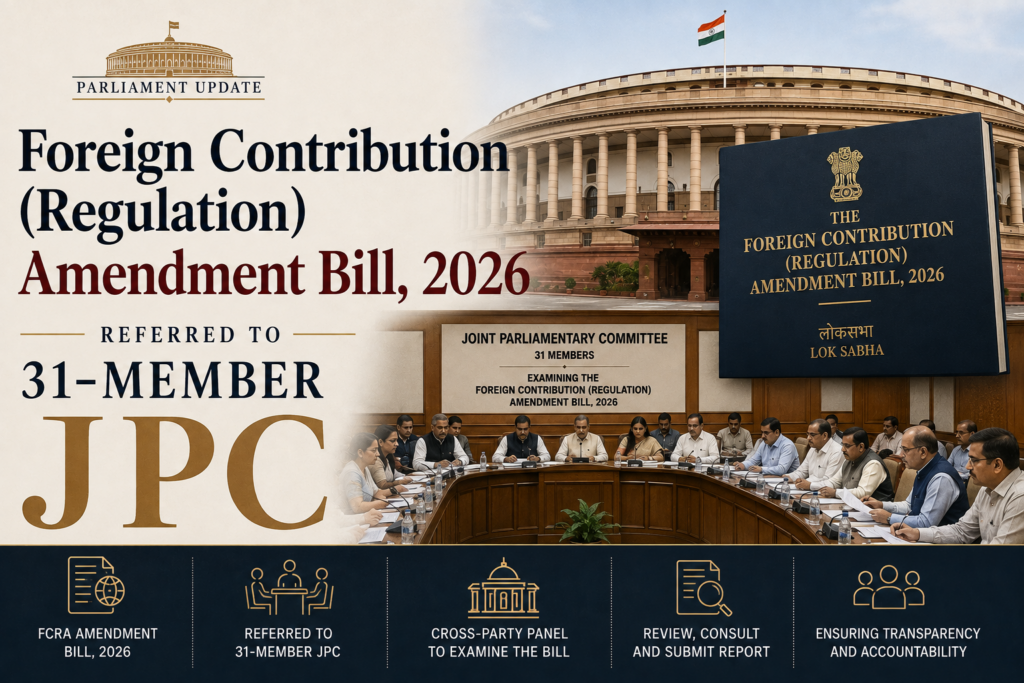
The Lok Sabha adopted a motion referring the Foreign Contribution (Regulation) Amendment Bill, 2026, to a Joint Parliamentary Committee (JPC) after sustained Opposition protest and coordinated appeals from Christian organisations. The referral has exposed a tension between the state’s claim to regulate foreign funded civil society and the property and hearing rights of the organisations that funding built. Minority run schools, colleges and hospitals sustained by money from abroad stand most exposed to the Bill’s asset takeover provisions.
What is the Foreign Contribution (Regulation) Act, 2010?
Governing statute: The Foreign Contribution (Regulation) Act, 2010 regulates the acceptance and use of foreign contributions and foreign hospitality by individuals and associations. It replaced the earlier Foreign Contribution (Regulation) Act, 1976.
Registration mechanism: An organisation receiving foreign funds must register with the Ministry of Home Affairs and renew that registration every five years. Funds may be used only for the declared cultural, economic, educational, religious or social programme.
What is a Joint Parliamentary Committee (JPC)?
Ad hoc committee: A JPC is a temporary committee of members drawn from both Houses to examine a specific bill or matter in detail and report back. This one has 21 Lok Sabha members nominated by the Speaker and 10 Rajya Sabha members nominated by the Chairman, a total of 31 members.
Reporting deadline: The committee must submit its report to the Lok Sabha by the last day of the first week of the coming Winter Session.
What is the current status of the right to receive foreign contributions in India?
Not a fundamental right: The Central government contends that the right to receive foreign contributions is not a fundamental right, and that access to foreign funds is a privilege the state may condition or withdraw.
Renewal regime: About every registered body operates on a five year certificate, renewable on application, with the Ministry of Home Affairs holding discretion to refuse renewal on security grounds.
Prior tightening: The 2020 amendments barred a registered body from transferring foreign funds to any other body, even one registered under the same Act, and cut the share of foreign funds usable for administrative expenses from one half to one fifth.
Judicial check: The Kerala High Court on Tuesday set aside the Centre’s refusal to renew certificates of two NGOs, Save A Family Plan and Kerala Social Service Forum, holding that reasons must be specified in every order and that peaceful protest funding is not a national security threat.
Constitutional provisions related to foreign funding regulation:
Article 19(1)(c): Guarantees the right to form associations, which the regulation of their funding directly affects.
Article 19(1)(a): Protects freedom of speech and expression, engaged where funding refusal follows an organisation’s support for protest.
Article 14: Requires that any classification and any exercise of discretion in refusing renewal be non arbitrary and reasoned.
Article 300A: Provides that no person shall be deprived of property save by authority of law, engaged by the automatic vesting of NGO assets in a designated authority.
Entry 10, Union List: Places foreign affairs and matters bringing the Union into relation with foreign countries within Parliament’s exclusive competence, the basis for central regulation of foreign funds.
What does the 2026 Bill change?
Designated authority: The Bill creates a government designated authority to take over, manage or dispose of assets built from foreign funds when an organisation’s FCRA registration is suspended, cancelled or not renewed.
Trigger on lapse: Registration can be lost not only by cancellation, but when renewal is refused, not applied for, or not granted before the old certificate expires.
Automatic vesting: On that event the organisation’s foreign funds and everything built with them pass to the authority automatically, returning only if the body re registers within a period the government has yet to specify.
Full takeover of part funded property: A building put up only partly with foreign money is taken over in full, and the organisation must separately apply to recover the share not paid for with foreign money.
Limited appeal: An appeal to a district judge lies only against what the authority later does with the property, not against the refusal to renew, and the organisation has no right to be heard before that refusal.
Why are minority religious institutions most alarmed?
Scale of dependence: Christian organisations run thousands of schools, colleges and hospitals built and sustained with money from churches and congregations abroad, which the takeover provisions place at risk.
Retrospective reach: A hospital built decades ago can be taken over today merely because a certificate has been allowed to lapse, contradicting the Home Minister’s assurance that the Bill will not apply retrospectively.
Geographic spread of protest: Hundreds marched in Aizawl under a newly formed council of churches, organisations in Kerala objected, the Nagaland Chief Minister sought a parliamentary review, and the Tamil Nadu Assembly unanimously resolved for withdrawal.
External pressure: A United States Congressman described the Bill as an attack on Christians and warned it could strain India United States relations, one trigger for the government’s rethink.
Institutional welcome for referral: The Catholic Bishops’ Conference of India and the National Council of Churches in India welcomed the referral while asking that major and minor offences be distinguished before assets are taken.
What are the major debates surrounding foreign funding regulation?
Regulation versus autonomy: Church bodies concede that regulation of foreign funds is necessary and that action must follow against anti national activity, while resisting a design that punishes lapse of a certificate as harshly as proven wrongdoing.
Discretion without reasons: Because the authority acts on the Centre’s instructions, the Centre can use opaque reasons to withdraw a licence, take over property, and then direct the body now holding it.
Hearing and appeal gap: The absence of a pre decisional hearing and of any appeal against refusal to renew is the core fairness objection the JPC is asked to cure.
Property proportionality: Full takeover of a building only partly financed by foreign money raises a proportionality question under the protection of property.
Challenges to fair FCRA regulation:
Reasoned order deficit: Refusals often rest on undisclosed intelligence inputs, leaving organisations unable to contest the specific ground, as the Kerala High Court flagged.
Chilling effect on civil society: Uncertainty over renewal deters legitimate service delivery in health and education that depends on predictable foreign inflows.
Asset valuation disputes: Separating the foreign funded share of a mixed asset invites prolonged litigation over apportionment and valuation.
Federal friction: State Assemblies have resolved against the Bill, exposing a centre state fault line over regulation of institutions operating within States.
Compliance burden on small NGOs: Frequent re registration and strict expense caps fall hardest on small organisations lacking dedicated legal and accounting capacity.
Selective enforcement risk: Broad discretion creates room for targeting organisations by community or by their political positions rather than by conduct.
Conclusion: The Bill’s central defect is that it lets the Centre seize the assets of a civil society body on the mere lapse of a certificate, without a hearing before refusal and without an appeal against it. The referral to a 31 member JPC defers passage rather than resolving the dispute. The committee must redraft the Bill to give organisations a hearing before renewal is refused and a right to appeal that refusal, with the report due by the first week of the Winter Session.
Statutory Framework Governing Foreign Funding of NGOs:
Foreign Contribution (Regulation) Act, 2010: The principal Act requiring registration and prior permission for receipt of foreign contributions.
Foreign Contribution (Regulation) Amendment Act, 2020: Barred sub granting of foreign funds, cut the administrative expense cap to one fifth, and mandated a designated FCRA account at a specified State Bank of India branch.
Foreign Contribution (Regulation) Rules, 2011: Prescribe the procedure for registration, renewal, reporting and use of foreign contributions.
Foreign Contribution (Regulation) Amendment Bill, 2026: The pending Bill introducing the designated authority and automatic vesting of assets, now before the JPC.
Back2Basics: FCRA registration
Administering ministry: Ministry of Home Affairs, Foreigners Division.
Eligibility: Associations with a definite cultural, economic, educational, religious or social programme, normally in existence for at least three years.
Prohibited recipients: Election candidates, judges, government servants, members of legislatures, political parties and media organisations are barred from accepting foreign contributions.
Validity and renewal: Registration is valid for five years and must be renewed through a fresh application before expiry.
Way Forward:
Pre decisional hearing: Mandate notice and an opportunity to be heard before any refusal to renew or cancellation.
Appeal against refusal: Provide a statutory appeal against the refusal itself, not only against later dealing with the property.
Proportionate asset treatment: Restrict any takeover to the demonstrably foreign funded share of an asset, with independent valuation.
Reasoned orders: Require every refusal to state specific, disclosable reasons, subject to security redaction reviewed by the appellate authority.
Distinguish offences: Separate technical lapses, such as delayed renewal, from substantive violations before invoking asset consequences.
“[2015 GS2 12.5m] Examine critically the recent changes in the rules governing foreign funding of NGOs under the Foreign Contribution (Regulation) Act (FCRA), 1976.”
The Lok Sabha passed the Mines and Minerals (Development and Regulation) Amendment Bill, 2026 without debate, barring State governments from imposing additional taxes, cesses or levies on mineral rights and giving the Centre greater control over regulating mineral-laden lands. The move exposes a fiscal federalism clash, since it curtails a State taxation power the Supreme Court had upheld in 2024 and shifts fiscal authority over a Concurrent-domain resource toward the Union.
What does the Mines and Minerals (Development and Regulation) Amendment Bill, 2026 do?
Bars State levies: It prevents State governments from imposing additional taxes, cesses or levies on mineral rights.
Central control: It gives the Centre greater control over regulating mineral-laden lands.
Stated rationale: The Coal and Mines Minister argued that divergent fiscal levies by States had created uncertainty in the mineral sector.
Feared effects cited: The government said such divergence could raise costs, encourage imports and undermine domestic supply chains.
What is the Mines and Minerals (Development and Regulation) Act, 1957?
Purpose: The MMDR Act, 1957 is the principal law regulating the mining sector, governing the grant of mineral concessions, leases and the development and regulation of mines.
Federal scheme: It empowers the Centre to frame rules for major minerals, while States frame rules for minor minerals and grant concessions for minerals in their territory.
Current Status of State taxation power over minerals in India
State entitlement: States levy royalty on extracted minerals and, since a 2024 Supreme Court ruling, hold constitutional competence to tax mineral rights and mineral-bearing lands.
The 2024 judgment: A nine-judge Bench held that royalty is not a tax and that States have legislative power to tax mineral rights, a power the present Bill now seeks to restrict.
Revenue stakes: Mineral-rich States such as Jharkhand, Odisha and Chhattisgarh rely on mining royalties and cesses as a significant own-revenue source.
Constitutional Provisions related to mineral regulation and fiscal federalism
Entry 54, Union List: Regulation of mines and mineral development to the extent Parliament declares expedient in the public interest.
Entry 23, State List: Regulation of mines and mineral development subject to the Union List entry.
Entry 50, State List: Taxes on mineral rights subject to any limitations imposed by Parliament relating to mineral development.
Entry 49, State List: Taxes on lands and buildings, the basis on which States tax mineral-bearing land.
Article 246 and Seventh Schedule: Distribute legislative competence between the Union and the States across the three Lists.
Article 265: No tax shall be levied or collected except by authority of law.
Why does the Centre want to bar State levies?
Uniformity: A single fiscal regime is intended to remove the uncertainty created by State-by-State levies.
Cost competitiveness: The government links divergent levies to higher input costs for downstream industry and greater import dependence.
Supply chain security: Uniform charges are framed as protection for domestic mineral supply chains, including critical minerals.
Why do States and the Opposition see this as an assault on federalism?
Overriding the Court: The Bill legislatively narrows a taxation power the Supreme Court affirmed for States in 2024.
Erosion of own-revenue: Barring cesses and levies removes a fiscal lever that mineral-rich States use to fund local development.
Centralising trend: Critics place it within a wider pattern of the Union tightening control over resources located in State territories.
Process objection: The Bill was passed without debate amid protests, which the Opposition cited as a denial of scrutiny on a federalism-sensitive measure.
Major debates surrounding mineral taxation federalism
Royalty versus tax: Whether royalty is a tax and where the line lies between Union regulation of mineral development and State taxation of mineral rights.
Parliamentary limitation: How far Parliament’s power under Entry 50 to limit State mineral taxation can extend before it hollows out the State entry.
Distributive justice: Whether mineral-bearing States should retain fiscal upside from resources extracted within their borders.
Investment climate: Whether uniform central levies genuinely lower costs or merely redistribute fiscal space from States to industry.
Challenges to a centralised mineral fiscal regime
Vertical fiscal imbalance: Reduced own-revenue deepens State dependence on central transfers.
Litigation risk: A statutory override of a constitutional ruling invites fresh challenges before the Supreme Court.
Regional equity: Resource-rich but income-poor States lose a development financing tool.
Cooperative federalism strain: Bypassing State consent on a shared-domain subject weakens negotiated federalism.
Compliance uncertainty: Transition from varied State levies to a single regime creates short-term ambiguity for operators.
Conclusion
The Lok Sabha has cleared a Bill that removes the States’ power to levy additional taxes on mineral rights and centralises regulatory control over mineral lands. The current status is passage in the Lower House amid Opposition protest; the next milestone is its consideration in the Rajya Sabha and likely constitutional scrutiny given its tension with the 2024 Supreme Court ruling on State taxation of minerals.
What is Fiscal Federalism? (Foundational Context)
About: Fiscal federalism is the division of taxation powers, expenditure responsibilities and transfers between the Union and the States.
Rationale: It exists to match revenue-raising capacity with spending needs across tiers of government.
Named typology: It addresses vertical imbalance between the Union and States, horizontal imbalance across States, and weak third-tier finances at the local level.
Key Concerns Regarding Fiscal Federalism
Shrinking divisible pool: Rising cesses and surcharges reduce the shareable tax pool with States.
Eroded State autonomy: GST and central levies have narrowed independent State taxation.
Resource control: Central assertion over minerals and land in State territories limits State fiscal levers.
Weak local finances: Third-tier bodies remain underfunded and dependent.
Constitutional Framework Governing Mineral Regulation
Entry 54 (List I): Union regulation of mines and mineral development in the public interest.
Entry 23 (List II): State regulation of mines subject to the Union entry.
Entry 50 (List II): State taxes on mineral rights subject to parliamentary limitation.
Article 246: Allocation of legislative competence across the three Lists.
Article 265: Taxation only by authority of law.
Way Forward
Consultative design: Frame mineral fiscal policy through the GST Council model of negotiated federalism.
Revenue neutrality: Compensate mineral-rich States for lost cesses through predictable transfers.
Legal clarity: Reconcile the amendment with the 2024 ruling to avoid protracted litigation.
District mineral funds: Strengthen use of mining revenues for affected local communities.
“[2025] Consider the following statements:
Statement I: In India, State Governments have no power for making rules for grant of concessions in respect of extraction of minor minerals even though such minerals are located in their territories.
Statement II: In India, the Central Government has the power to notify minor minerals under the relevant law.
Which one of the following is correct in respect of the above statements?
(a) Both Statement I and Statement II are correct and Statement II explains Statement I
(b) Both Statement I and Statement II are correct but Statement II does not explain Statement I
(c) Statement I is correct but Statement II is incorrect
(d) Statement I is incorrect but Statement II is correct
The President gave assent to the Prevention of Insults to National Honour (Amendment) Bill, 2026, making it law. The amendment criminalises intentional disruption or prevention of the singing of the National Song Vande Mataram, extending to it the legal protection currently accorded to the National Anthem.
What is the Prevention of Insults to National Honour (Amendment) Bill, 2026?
Core provision: The Prevention of Insults to National Honour (Amendment) Bill, 2026, criminalises intentional disruption or prevention of the singing of the National Song Vande Mataram.
Parent statute: It amends the Prevention of Insults to National Honour Act, 1971, which already penalises insults to the National Flag, the Constitution, and the National Anthem.
Equal status: The legislation grants Vande Mataram the same legal protection as the National Anthem, Jana Gana Mana.
Legislative passage: The Lok Sabha passed the Bill on 30 July and the Rajya Sabha cleared it a day earlier, with Presidential assent completing enactment.
What are the concerns raised on implementation?
Practicality of enforcement: A senior Opposition member questioned whether respect and patience for the song can be legislated.
Duration burden: A full rendition of Vande Mataram lasts about three minutes and ten seconds, against roughly 52 seconds for Jana Gana Mana.
Standing time: Where a State Song precedes both, audiences could be expected to stand for nearly six minutes before and after every official function.
Counterproductive risk: The stated concern is that mandating full rendition could reduce rather than promote respect for the National Song.
About National Symbols in India
National Anthem: Jana Gana Mana, adopted by the Constituent Assembly on 24 January 1950, protected under the Prevention of Insults to National Honour Act, 1971.
National Song: Vande Mataram, composed by Bankim Chandra Chatterjee, given equal status with the National Anthem by the Constituent Assembly on 24 January 1950.
National Flag: The Tiranga, governed by the Flag Code of India, 2002, and the Prevention of Insults to National Honour Act, 1971.
Legal duty: Article 51A(a) makes it a fundamental duty of every citizen to respect the Constitution, the National Flag, and the National Anthem.
Statutory Framework Governing National Honour
Prevention of Insults to National Honour Act, 1971: Penalises insults to the National Flag, the Constitution, and the National Anthem.
2026 Amendment: Extends protection to the National Song Vande Mataram against intentional disruption.
Flag Code of India, 2002: Consolidates conventions and instructions on display and use of the National Flag.
Emblems and Names (Prevention of Improper Use) Act, 1950: Restricts improper use of national emblems and names.
Back2Basics: Vande Mataram
Author: Bankim Chandra Chatterjee, who composed it and later included it in the novel Anandamath.
Historical role: It became a rallying song of the freedom movement, first sung at the 1896 session of the Indian National Congress.
Constitutional status: The Constituent Assembly resolved on 24 January 1950 that it shall have equal honour with the National Anthem, Jana Gana Mana.
Original language: Composed largely in Sanskritised Bengali.
Full rendition: A complete rendition runs about three minutes and ten seconds.