India has emerged as a global leader in solar energy with over 140 GW of installed solar capacity (Nov 2025) and ranks 3rd in the world in solar capacity and generation.
Ecological Benefits
Carbon Sequestration
By replacing coal-fired thermal power, which is the primary source of CO-2 emissions. Every 1 GW of solar power reduces CO2 emissions by approximately 1.5 million tonnes annually.
Supports India’s NDC targets – 500 GW non-fossil capacity by 2030 and net-zero by 2070.
Water Conservation – Use 95% less water than thermal power plants. Shifting to solar saves roughly 2.5 liters of water per kWh generated.
Preservation of Fragile Ecosystems – Installing panels on reservoirs reduces water evaporation and algae growth. Eg- Omkareshwar Floating Solar Park (Madhya Pradesh).
Agrivoltaic Biodiversity – “Solar farming” allows crops to grow beneath panels, creating a micro-climate that reduces soil moisture loss.
Reduction Air Pollution – Unlike fossil fuels, solar generation releases zero SOx, NOx, or particulate matter (PM 2.5).
Soil Reclamation – Solar parks built on saline or degraded “wastelands,” prevent further soil erosion. Eg- Khavda Hybrid Park in the Rann of Kutch
Transition to Circular Economy – Eg- Draft Solar Waste Management Rules mandate recycling of end-of-life panels.
Protection of Glacial Regions – Eg- Solar projects in Ladakh (13 GW planned) can reduce black carbon deposits on glaciers, which otherwise accelerate melting.
Economic Benefits
Cost Savings for Households – Solar tariffs are lower compared to coal based power.
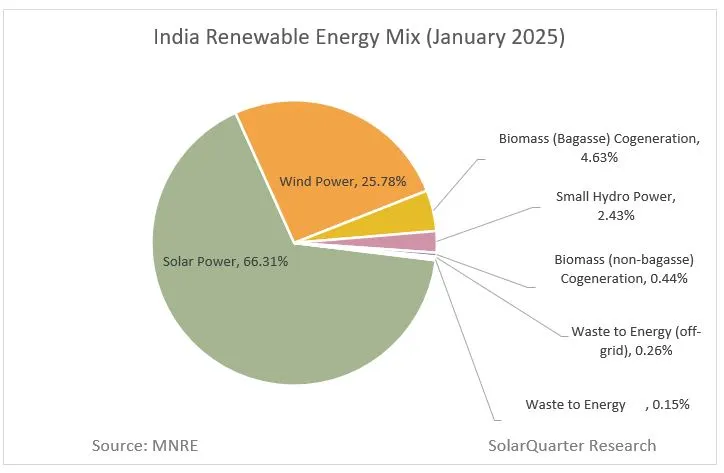
Reduction in Energy Import Bill – Solar energy helped India save roughly $4.2 billion in fuel costs in 2024-25, strengthening the Current Account Balance.
Boost to Domestic Manufacturing (PLI Scheme) – Solar manufacturing capacity jumped from 38 GW to 74 GW in 2025, attracting ₹52,900 crore in fresh private investment.
Agricultural Income Diversification- Under PM-KUSUM Component A, farmers can earn income by installing solar plants on unproductive land.
Attraction of Global FDI – 100% FDI under the automatic route has made India a top destination for ESG-focused global funds.
Rural Electrification – Solar micro-grids provide 24/7 power to remote villages where grid extension is expensive.
Infrastructure Development – Mega solar parks bring roads, water, and connectivity to previously isolated regions.
Export Potential– India exported $1.5 billion worth of solar equipment in 2025.
Challenges in Solar Energy Generation
Intermittency and Storage Gap- shortage of Battery Energy Storage Systems (BESS)
Land Acquisition Hurdles for Mega-parks
Lack of grid connectivity
Import dependency- India still imports over 90% of its wafers and ingots from China.
Limited recycling infrastructure creates a toxic waste risk (lead and cadmium).
Poor Financial Health of DISCOMs- delayed payments to solar developers and deterring investment.
Steps Taken by Governments
PM-Surya Ghar- Muft Bijli Yojana to solarize 1 crore households by 2027
Solar Park Scheme- A target of 40 GW across 50+ parks by March 2026.
PM-KUSUM- Solarizing over 30 million irrigation pumps.
PLI Scheme- to boost domestic manufacturing of high-efficiency solar modules
A balanced strategy focusing on decentralised solar, grid expansion, storage systems, and region-specific planning is essential to achieve Panchamrit Targets.