Mineral resources form the backbone of India’s industrial and economic growth, driving sectors such as energy, infrastructure, manufacturing, and defence. As Jawaharlal Nehru called them, minerals are the “basic raw materials of modern civilization.”
Importance of Mineral Resources for the Economy
Energy Security
Uranium and thorium reserves critical for India’s nuclear power program.
Industrial Development
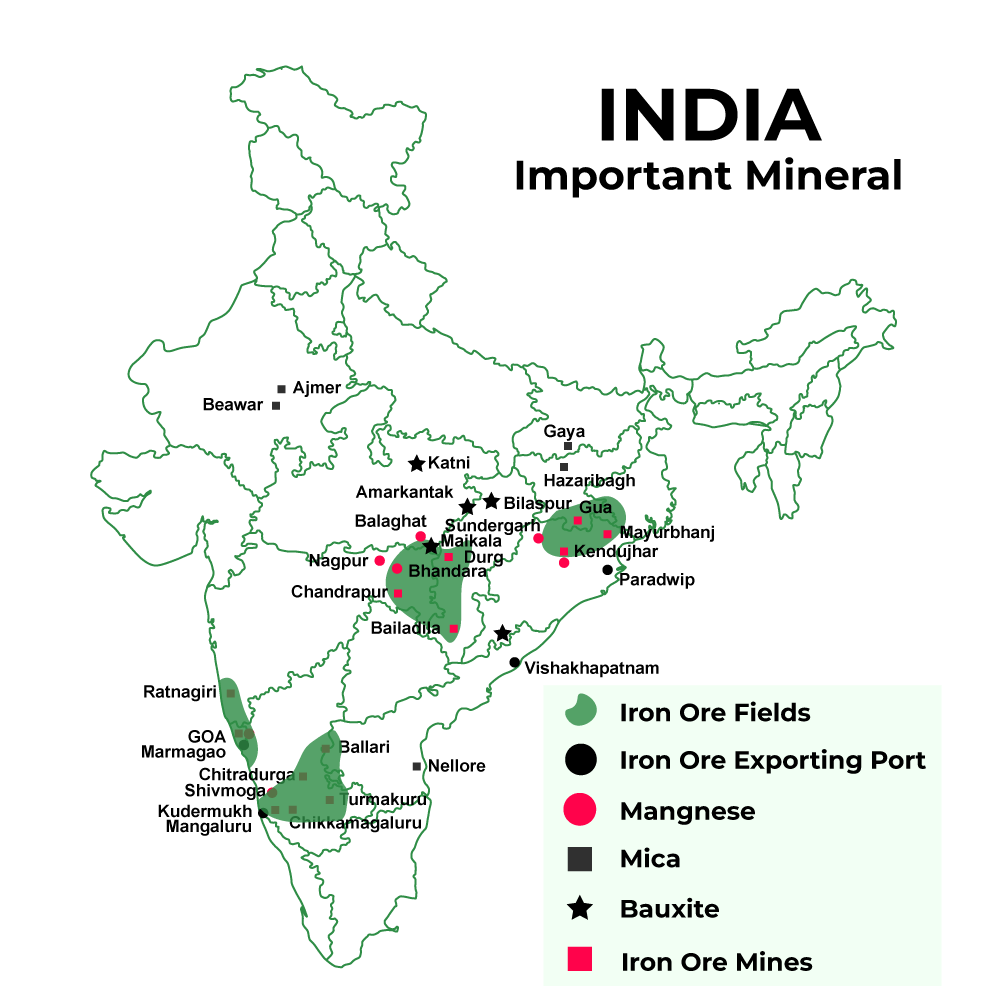
Iron ore and bauxite support steel and aluminium industries, pillars of infrastructure.
Limestone feeds cement industry, vital for housing and construction.
Manufacturing & Strategic Sectors
Rare Earth Elements (REEs), lithium, cobalt are essential for electronics, EV batteries, semiconductors, defence equipment.
India’s defence self-reliance depends on availability of titanium, tungsten, chromium.
Employment & Regional Development – Mining sector provides 2.3 million direct jobs in backward regions like Chhattisgarh, Odisha, Jharkhand.
Revenue & Fiscal Federalism – Royalty from minerals forms a major part of state revenues.
Strategic & Geopolitical Value – Critical minerals like lithium and cobalt are central to energy transition and Atmanirbhar Bharat.
Mining as an Environmental Hazard
Deforestation – Open-cast mining requires clearing of vast forests. Eg- Coal mining in Hasdeo (Chhattisgarh) leading to elephant habitat fragmentation
Soil Erosion and Land Degradation – Removal of topsoil and overburden dumping degrade agricultural lands.
Water Pollution – Acid Mine Drainage (AMD) contaminates rivers and groundwater with heavy metals. Eg- Sukinda Chromite Mines (Odisha).
Air Pollution – Dust, particulate matter, and gases from blasting and transport cause respiratory diseases. Coal mining regions like Singrauli have high PM2.5 levels
Noise and Vibrations – Blasting operations disturb wildlife and damage human settlements.
Climate Change Contribution – Coal mining emits methane, a greenhouse gas with high warming potential.
Loss of Ecosystem Services – Mining destroys wetlands, grazing lands, and forest resources, affecting agriculture, fisheries, and traditional livelihoods.
Improper disposal of mine tailings releases radioactive and toxic materials, leading to long-term soil and water contamination (Eg- Uranium mining in Jaduguda, Jharkhand).
Mining-induced displacement of tribal populations. Eg- Niyamgiri Hills bauxite project (Vedanta vs Dongria Kondh tribe).
Remedial Measures Required
Legislative & Regulatory – Enforce EPA 1986, MMDR Act 2015, and mandatory EIA with periodic audits.
Sustainable Practices – Adopt eco-friendly mining technologies like GIS monitoring, remote sensing, and controlled blasting.
Reclamation & Rehabilitation – Ensure progressive mine closure, land reclamation, backfilling, and afforestation of mined areas.
Pollution Control – Introduce dust suppression, acid mine drainage treatment, and soil stabilization measures.
Community-Centric Measures – Utilize District Mineral Foundation (DMF) funds for health, education, and livelihoods of affected people.
Institutional Monitoring – Strengthen Indian Bureau of Mines (IBM) oversight and use drones/AI for real-time compliance
Global Best Practices – Replicate Australia’s mine rehabilitation bonds and Canada’s TSM framework for accountability.
“We do not inherit the earth from our ancestors; we borrow it from our children.” Thus, development must be in harmony with the environment.