Semiconductors are the “oil of the 21st century.” With global chip shortages and geopolitical realignments, India aims to position itself as a semiconductor manufacturing hub through India Semiconductor Mission (ISM).
Challenges Faced by India’s Semiconductor Industry
High Capital Intensity – A state-of-the-art fab requires $8-12 billion.
Complex Supply Chains – Semiconductors involve 300+ inputs, ultra-pure chemicals, specialised gases, and precision tools.
Skill Gap – Eg-shortage of semiconductor engineers, chip designers, and clean-room technicians
Insufficient Ecosystem – Lack of component suppliers, semiconductor-grade wafers, lithography equipment, etc.
Infrastructure Deficits – Fabs require uninterrupted power, and nearly 10 million litres/day of ultra-pure water.
Global Competition – Taiwan, South Korea, USA, EU offer 40-70% capital subsidies
Long Gestation Periods (7-10 years) – deter private investment
Dependence on Imports – India imports 90-95% of its semiconductor needs.
Salient Features of the India Semiconductor Mission (ISM)
to build a complete semiconductor and display ecosystem.
Key Schemes under ISM:
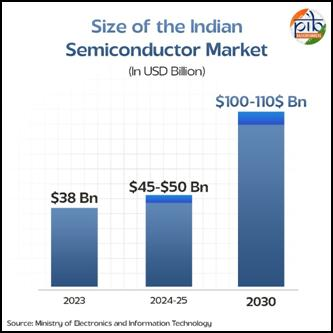
Display Fabs Scheme: Up to 50% financial assistance
Compound Semiconductors & ATMP/OSAT Scheme: Up to 50% support
Design Linked Incentive (DLI) Scheme – Incentives up to .
Creation of Semiconductor Research Centres – including advanced R&D, talent development, and industry-academia collaboration.
Development of semiconductor clusters in Gujarat (Dholera), Karnataka, Tamil Nadu, and Uttar Pradesh.
Single-window facilitation mechanism for all approvals, policy support, and coordination with global leaders.
Support for compound semiconductors (GaN, SiC), ATMP/OSAT units to build packaging capabilities.
Focus on trusted supply chains and strategic national security applications.
Way Forward
Establish specialised training programs to address projected 350,000 talent shortfall by 2027.
Boost R&D and Indigenous IP Creation – increase spending to 2.5% of GDP
Ensure timely incentive disbursal, ease of land acquisition, and high-quality utility infrastructure (power, water, logistics).
“chip diplomacy”—with partners like the US, Japan, Taiwan, EU, and South Korea.
Leverage global supply-chain realignments and US-China strategic tensions to attract firms seeking “China+1” diversification.
India’s ambition to become a semiconductor manufacturing hub is strategically significant for economic resilience, technology sovereignty and future readiness.