While India has emerged as “fastest growing economy” and 4th largest economy, its ranking in HDI, 2025 was 130th out of 193 countries.
Reasons behind low human development in india
Jobless growth due to shift from agriculture to service led growth instead of manufacturing led growth. Eg- service sector contributes 55% of GDP but employs only 30% of workforce
Economic Inequality – richest 1% control more than 40% of total wealth, while the bottom 50% own merely 3% (Oxfam Report)
Over 90% of the Indian workforce is in the informal sector – lacking social security and stable wages, leading to “working poverty.”
Social Stratification- Caste-based discrimination prevents upward mobility for the marginalized. Eg- 96% manual scavengers are Dalits
Population Pressure (1.35 billion) strains public infrastructure, housing, and the job market.
Poor Social Infrastructure
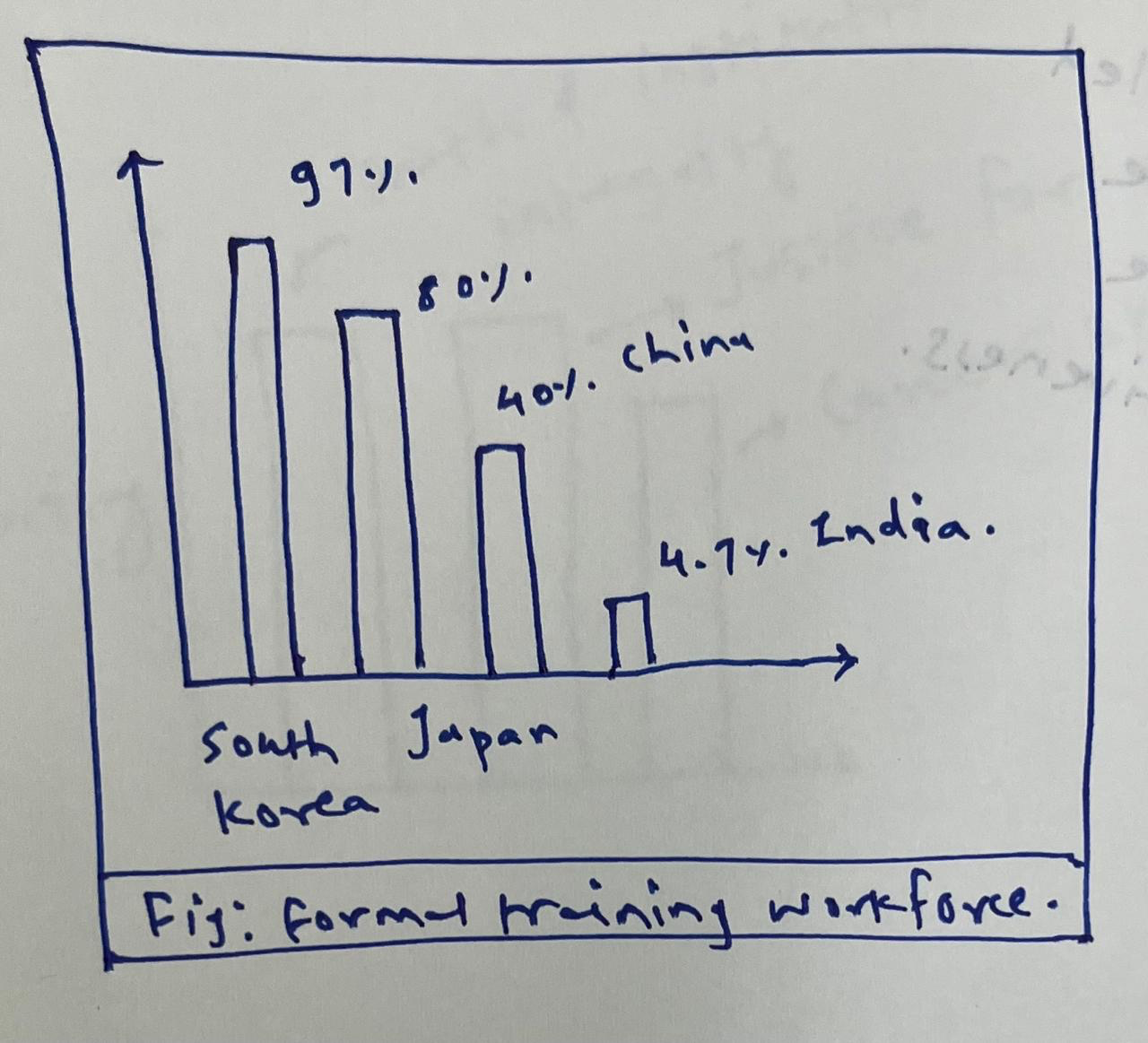
Education – low public investment (2.9% of GDP) lead to “quality crisis” and high dropout rates at secondary and higher levels
Skill Gap – only about 51.25% of youth are employable.
Gender Disparities
Low FLFPR – 41% in India vs 71% in China
Women own only 13% of land while forming 63% of agriculture workforce
Glass ceiling effect – discrimination and low representation at higher positions
India ranked 131st out of 148 countries in WEF’s Gender Gap Report
Regional disparity – Eg- BIMARU states lag behind southern states in human development indicators
“Climate Inequality” – women and poor are most vulnerable to climatic shocks like heatwaves or disasters. Eg- “climate induced migration” after floods in Assam
Measures taken for human development in India
Healthcare and Nutrition
Ayushman Bharat (PM-JAY)- over 40 crore Ayushman Cards have been issued.
Over 1.82 lakh primary health centers have been upgraded to “Arogya Mandirs”.
POSHAN Abhiyaan- targets stunting, wasting, and anemia.
Education and Skill Development
NEP 2020- 5+3+3+4 structure and the Academic Bank of Credits (ABC)
Skill India Mission- trained over 1.63 crore candidates.
Poverty and Living Standards
Over 40 crore people were lifted out of multidimensional poverty between 2005 and 2021
Kerala has been declared officially free from “extreme poverty” in 2025
Jal Jeevan Mission- Provided tap water to over 14.5 crore rural households
PM Awas Yojana (PMAY)- Over 4 crore pucca houses have been built
PM Ujjwala Yojana- Over 10.3 crore LPG connections have been provided
Financial Inclusion – Over 52 crore bank accounts have been opened
Way Forward
Capability Approach- increase expenditure on Health (2.5% of GDP) and Education (6% of GDP)
Bottom-up Planning – Porto Alegre Brazil Model
Expand MGNREGA and link with climate-resilient livelihoods (water conservation, afforestation).
Women Empowerment by adopting best practices like Kerala’s Kudumbshree Model
Focus on labour intensive sectors like textiles for job creation (Economic survey)
This can ensure whole of government and life-cycle approach to realise the vision of Viksit Bharat@2047