The Monsoon is a seasonal reversal of winds accompanied by corresponding changes in precipitation. In India, it brings nearly 75% of annual rainfall, shaping agrarian, ecological, and cultural life.
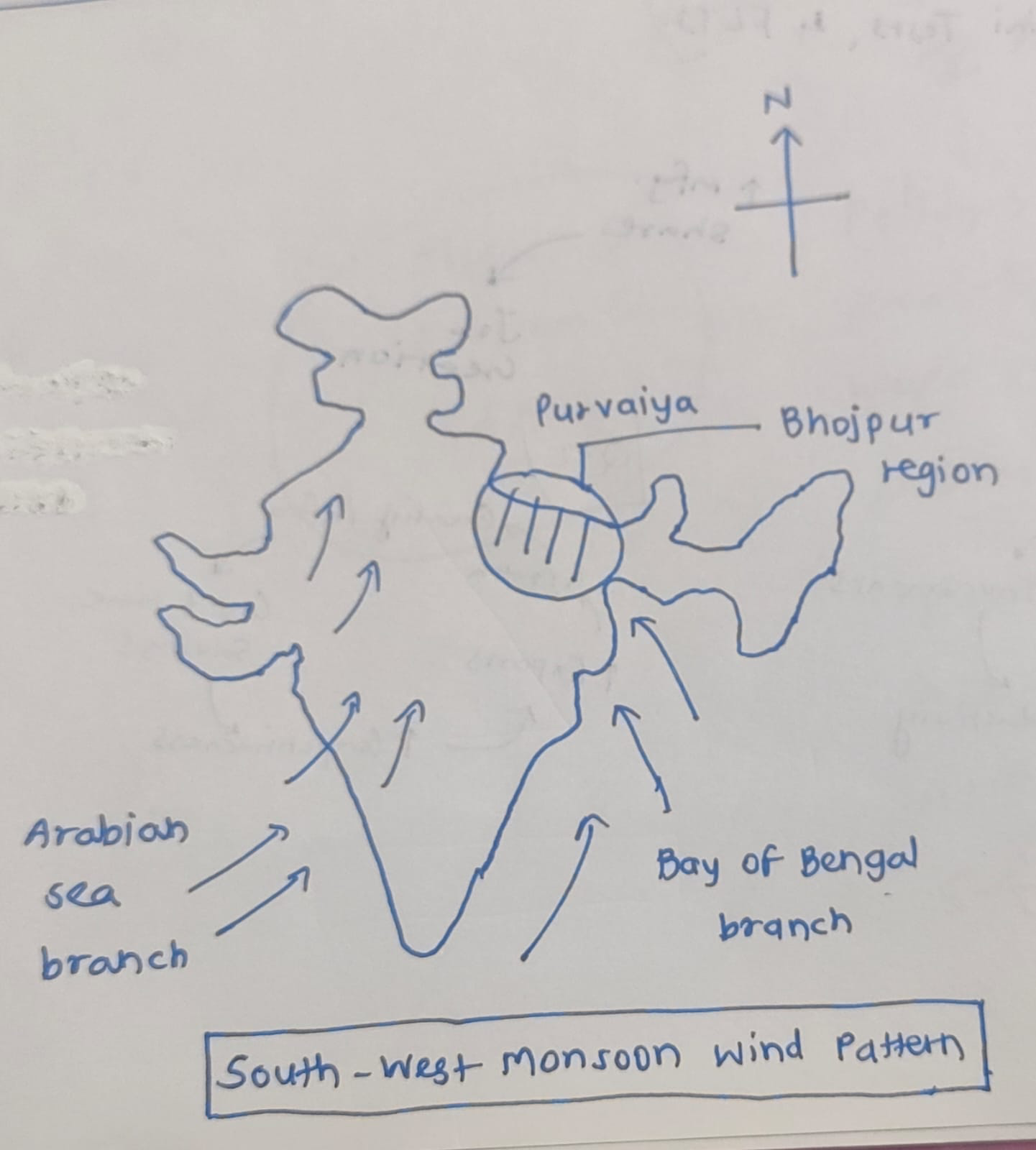
Bay of Bengal Branch branch monsoon winds hit the Purvanchal Himalayas and are deflected westward into the Ganga Plains.
Coriolis Effect and Meghalaya Plateau help “turn” the southwestern winds into a westward-flowing stream before they reach Bhojpur.
For the Bhojpur region, the moisture-laden winds arrive from the East/South-East.
In Bhojpuri, the suffix ‘-aiya’ denotes “originating from”. Thus, winds from the East are called Purvaiya
Influence of ‘Purvaiya’ on cultural ethos of Bhojpur Region
Agrarian calendar structuring – Sowing of paddy linked to arrival of Purvaiya.
Agrarian deities and rituals – Prayers for timely Purvaiya winds. Eg- Indra worship during drought conditions.
Folk songs and oral traditions – Eg- Purvaiya is personified in Kajri songs as a messenger of love and longing for women waiting for their husbands.
Emotional-cultural symbolism – Rain as metaphor for longing and reunion. Eg- Bhojpuri cinema and poetry portraying Purvaiya romantically.
Festivals of Fertility- Hariyali Teej and Nag Panchami celebrate the rejuvenation of the earth brought by the moisture-laden Purvaiya.
Architectural adaptation – Sloped roofs and raised plinths designed for heavy rainfall. Also, eastern-facing verandahs (Dalan) to catch the cooling breeze.
Culinary patterns – Seasonal foods linked to rainy months. Eg- Consumption of saag, pakoras, and millets during monsoon.
Traditional “Madhubani painting” also depicts purvailya frequently.
Thus, Purvaiya highlights the deep interlinkage between climate and culture in the Indo-Gangetic plains.