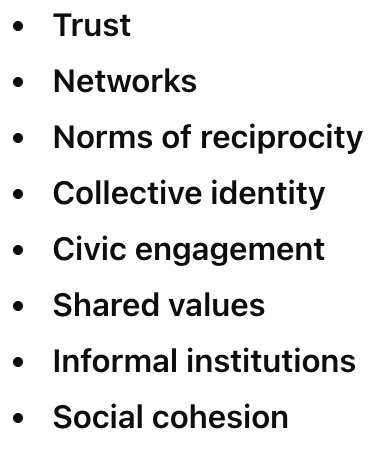
Social capital refers to the networks, norms, values and trust that enable individuals and groups to cooperate for mutual benefit and collective action.
“Social capital is the lubricant that makes the wheels of democracy turn.”
According to political scientist Robert Putnam, social capital consists of two main types-
Bonding Social Capital- Links between people of similar backgrounds (family, class).
Role of Social Capital in Enhancing Good Governance
Enhanced Accountability- High social capital empowers citizens to monitor the government. Eg- high public participation in local government in kerala
Reduction in Transaction Costs- When trust is high, the government spends less on policing and litigation.
Facilitating “Co-Production” of Services- Eg- The Bhagidari Scheme in Delhi involved RWAs in managing local water and electricity issues.
Effective Grievance Redressal- Strong social networks amplify the voice of the marginalized. Eg- Kudumbashree network in Kerala.
Promoting “Bottom-Up” Planning- Social capital makes the Gram Sabha a vibrant decision-making body. Eg- people’s plan campaign in kerala
Reducing Conflict and Promoting Peace- Eg- Peace Committees use inter-community trust to de-escalate tensions before they turn into riots.
Behavioral Change (Nudge Theory)- Social capital is the engine of “Jan Andolan” (People’s Movements). Eg- success of Pulse Polio immunization.
Improving Public Policy Compliance- Eg- Higher tax compliance rates in countries where citizens perceive the “social contract” to be strong and fair.
Inclusive Resource Management- It prevents the “Tragedy of the Commons.”
Humanizing the Bureaucracy- It bridges the gap between the “Ruler” and the “Ruled.” Eg- “Compassionate Kozhikode” initiative by IAS Prasant Nair
Ways to Build social capital
Strengthening Grassroots Decentralization with 4F’s
Education for “Civic Virtue”
Institutionalizing Community Policing
Strengthening civil society as a “bridge”
Implementing “Social Audits” as a Norm
For India to move toward “Minimum Government, Maximum Governance,” the state must act as a facilitator of social capital, transforming passive subjects into active, trusting, and responsible citizens.