The troposphere is the lowermost layer of the atmosphere, extending from the Earth’s surface to approximately 8 km at the poles and 18 km at the equator.
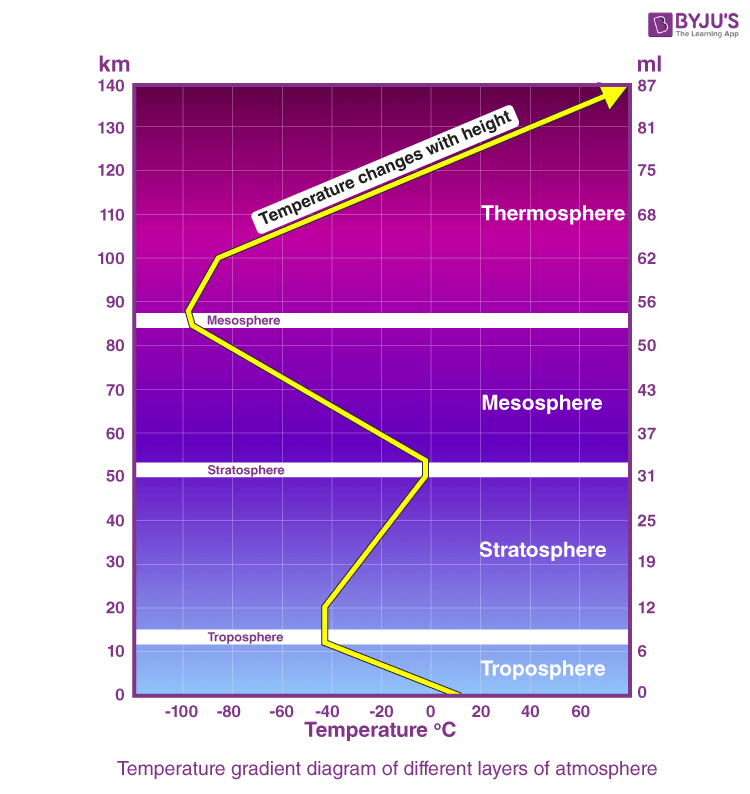
Troposphere- (0-18 km) Weather-active layer. Holds 75% of atmospheric mass.
Stratosphere- (18-50 km) Home to the ozone layer. Temperature increases with height.
Mesosphere- (50-85 km) Coldest layer. Meteors burn up here.
Thermosphere- (85-600 km) Ionosphere location. Facilitates satellite orbits.
Exosphere- (600 km+) Fades into outer space.
Significance of Troposphere
Hydrological Cycle Engine- Holds 99% of atmospheric water vapor, driving all rain and snow.
Aerosol Nucleation- Hosts dust and pollutants that act as “seeds” for raindrops.
Environmental Lapse Rate- Temperature drops 6.5°C per km, facilitating cloud-forming condensation.
Greenhouse Regulation- Contains most CO2 and Methane, maintaining Earth’s habitable temperature.
Zone of atmospheric convection – Vertical mixing redistributes heat and moisture. Eg- Cumulonimbus cloud development.
Mass Concentration- Contains 75% of the atmosphere’s mass, providing the pressure needed for winds.
Boundary Layer Dynamics- The lowest part (PBL) interacts with the surface, determining local microclimates.
Cyclogenesis Theatre- All tropical and extra-tropical cyclones originate and intensify within this layer.
Tropopause Lid- Acts as a thermal ceiling, trapping weather within the troposphere.
Jet streams at upper troposphere steer weather systems. Eg- Subtropical jet influencing Indian winter weather.
Major Challenges
Tropospheric Warming- Breach of the 1.5°C threshold has permanently altered weather baselines.
Increased frequency and intensity of La Niña-El Niño has destabilized global rainfall predictability.
Polar Vortex Instability- Stratospheric warming is pushing Arctic air into mid-latitudes. Eg- cold waves in Europe.
Height Expansion- As the troposphere warms, it is physically expanding upward.
Ground-Level Ozone- Increasing heat is turning tropospheric pollutants into toxic smog.
Understanding and protecting tropospheric processes is therefore critical for weather prediction, disaster management, and sustainable human survival.