Food processing refers to the transformation of raw agricultural commodities into value-added, marketable, and storable products through physical, chemical, or biological methods.
Challenges of the Food Processing Sector in India
Low Level of Processing – Only ~10% of total agricultural produce is processed (vs 60-70% in developed countries).
Post-harvest losses of 15-20% due to shortage of cold-storage, and transport infrastructure.
Fragmented Supply Chain – 86% of farmers are small/marginal – limits aggregation
High Logistics Cost of 13-14% of GDP (vs 8-9% in developed countries).
Delay in project implementation – Eg- only 25 out of 42 approved Mega Food Parks operational
Regulatory & Compliance Issues – Complex FSSAI norms and licensing delays discourage small processors.
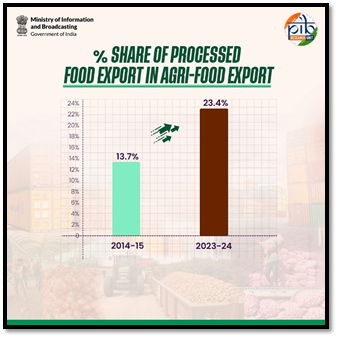
Low Exports – 16% of India’s agri-exports are processed products, compared to 25% in the US and 49% in China.
Micro and small units struggle to access formal credit, collateral, and working capital.
Skill gap – Only 3% of the food processing workforce is formally trained
Quality & Safety Gaps – Inconsistent adherence to food safety standards, and limited testing infrastructure. Eg- Rejection of Indian exports by EU.
Negligible R&D (<0.5% of sectoral GVA) – stall innovation in packaging and product design
Opportunities of Food Processing Industry in India
Large agricultural base
Second-largest producer of fruits and vegetables.
Wide product spectrum – Includes dairy, fruits & vegetables, meat, fisheries, beverages, ready-to-eat (RTE), and organic foods.
Lifestyle Shift – 65% of Indians under 35, rising incomes, urbanization & busy lifestyles have boosted demand for ready-to-eat & processed foods.
Rapid growth in Organised retail and “shopping mall culture”- better supply chain management. Eg- D-mart
Export potential – India exports processed foods to 200+ countries
Nearly 70% of food processing units operate in the unorganised MSME sector – generate rural employment and entrepreneurship.
Increasing Farmers’ Income through Food Processing
Encourages production of horticulture, millets, oilseeds, spices – create new income sources beyond cereals.
Strengthening FPOs – Processors procure directly from FPOs, giving assured prices and eliminating middlemen. Eg- Sahyadri FPO in Maharashtra
Employment generation – rural non-farm jobs in grading, sorting, packaging, logistics, and processing units.
Promotion of women entrepreneurship – Eg- Lijjat Papad
Zero-Waste Processing using circular economy models. Eg- converting fruit peels to bio-plastics
As India moves forward under the Make in India vision, the food processing industry will continue to be a key driver of economic growth, ensuring food security, quality, and global competitiveness.