LWE refers to violent insurgency driven by Maoist or Naxalite ideologies, with an objective of overthrowing the government and establishing a communist society.
Determinants of Left-Wing Extremism in Eastern India
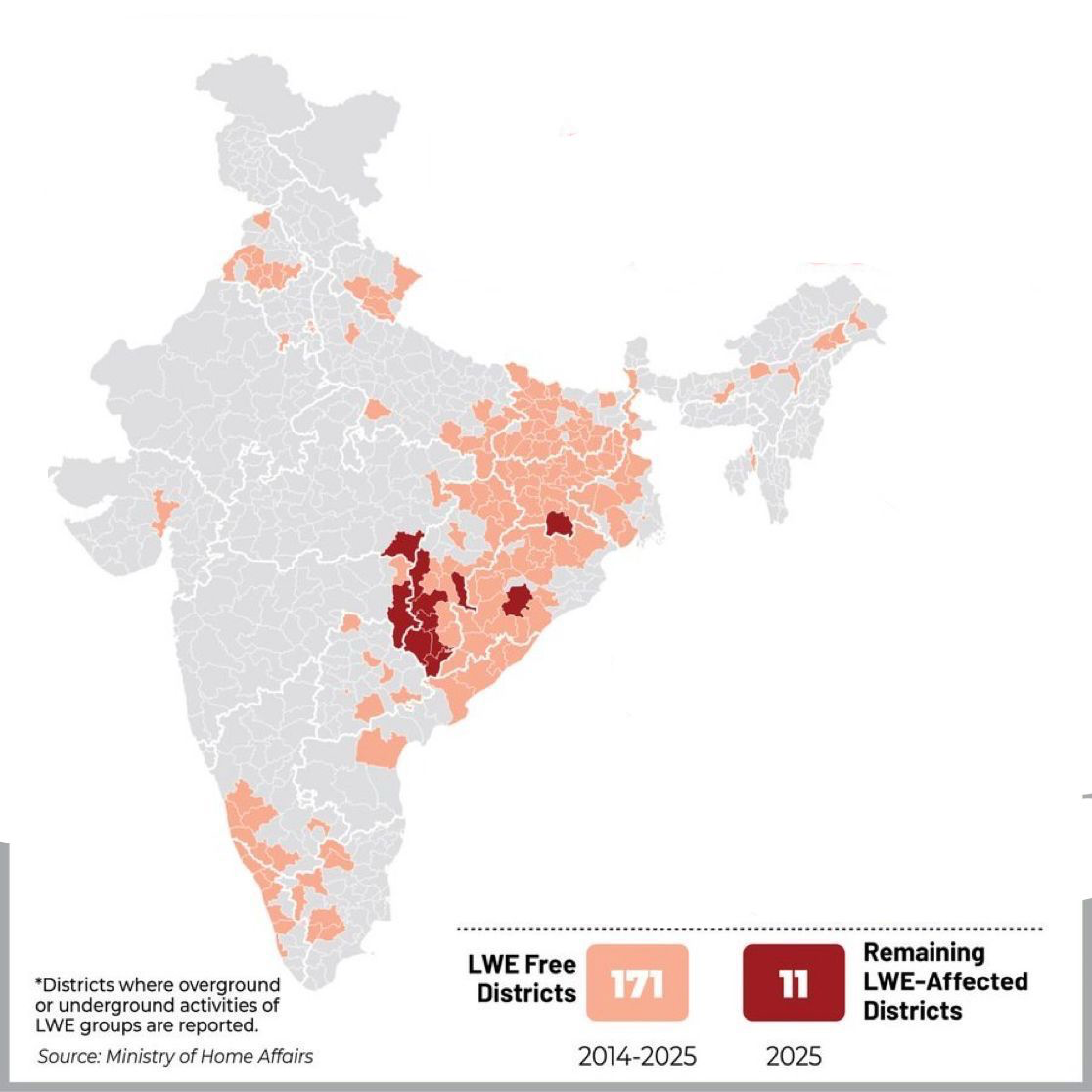
Maoist ideology of armed class struggle, anti-state revolution, and redistribution of resources appeals to sections alienated by inequality and exclusion. Eg- narrative of a “people’s war.”
Land Displacement – Eg- Mining-induced displacement in Jharkhand’s coal belt (Ramgarh, Hazaribagh).
Poor implementation of FRA, 2006, and PESA. Eg- Nearly 15% of forest and community land claims under the FRA are pending.
Historical Socio-Economic Deprivation– Eg- LWE districts like Malkangiri, Sukma have some of the lowest HDI indicators.
Unemployment & Lack of Livelihood Options- Eg- Jharkhand’s rural districts have among the highest youth unemployment in Eastern India.
Governance Deficit – Eg- Large parts of Southern Bastar lacked road connectivity until recent years.
Favourable Terrain – Eg- Dandakaranya region offers natural hideouts and logistical advantages for guerrilla warfare.
Porous and forested borders between Chhattisgarh-Jharkhand-Odisha-Maharashtra allow safe movement and sanctuary for cadres.
Ineffective Policing & Security Gaps – Poor training, lack of mobility, and limited intelligence in forest interiors.
Parallel Governance – Maoists run jan adalats, levy taxes, provide quick dispute resolution-gaining perceived legitimacy in ungoverned spaces.
Strategy to Counter LWE in Affected Regions
Government of India
Implement the “National Policy and Action Plan (2015)” in timely manner
Accelerate Development – Road Requirement Plan (RRP-I), mobile towers, banking, health centres, PDS reforms in LWE belts.
Strengthening PESA –
real-time digital dashboards for fund utilization to Gram Sabhas
“Bottom-Up” planning model – from “state imposition” to “participatory development”
Economic development
“Forest-to-Market” Value Chain development through Van Dhan Vikas Kendras (VDVKs)
Promotion of Tribal-Start-up Ecosystem in food processing – Eg- export of products like Mahua and wild honey
Civil Administration strategy
“The only way to end insurgency is to win the hearts and minds of people through inclusive governance.” – Rajnath Singh
Transparent and Participatory Mining & Resource Management- Eg- share of mineral royalties to local communities through the DMF Funds
Technology for Governance – Use GIS mapping, drones, and e-governance platforms for service delivery and monitoring.
Build Trust with Communities – Dialogue-based approach through “administration-public interface programmes”. Eg- Janta Darbars for grievance redressal
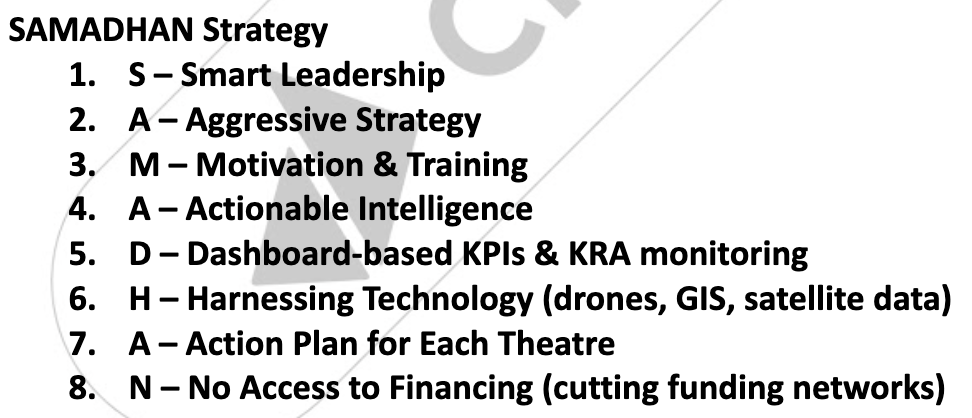
Security Forces Strategy
Strengthen Intelligence & Tech-Enabled Policing – Use of drones, satellite mapping, GPS-based tracking, communication intercept tools.
Capacity building – Eg- fortified police stations, all-terrain vehicles for deep forest movement.
Inter-State Coordination – Coordination between Chhattisgarh-Odisha-Jharkhand-Maharashtra in tri-junction zones.
Community Policing – Initiatives like Jan Maitri, sports outreach, and anti-propaganda programmes.