“There is no tool for development more effective than the empowerment of women.” – Kofi Annan
The 1994 Cairo International Conference on Population and Development (ICPD), moved the focus of population policy away from “target-driven” approach to “rights-based” empowerment.
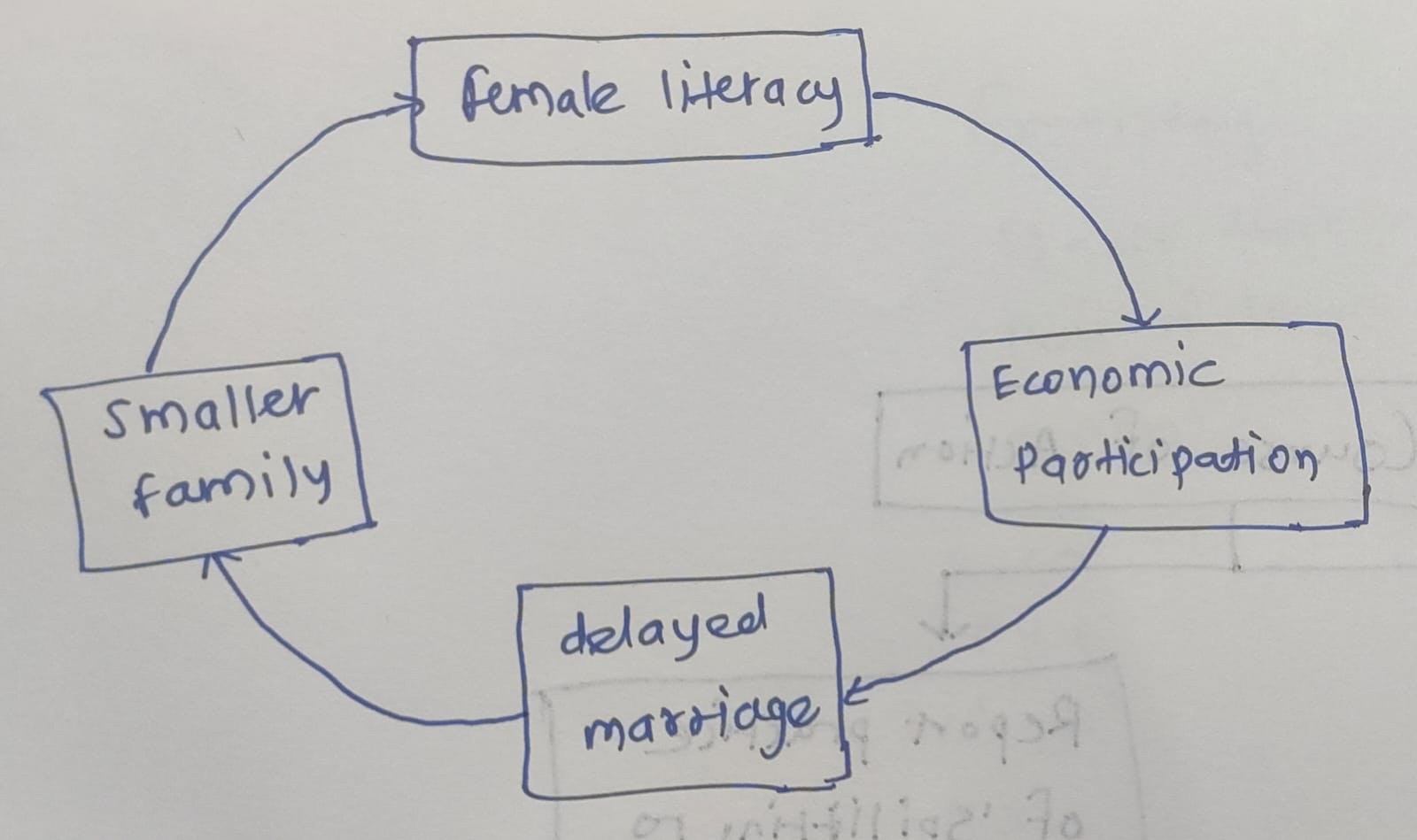
Inverse Correlation of Education and TFR – According to NFHS-5 (2021-23), women with no schooling have a TFR of 2.8, while those with 12+ years of schooling have a TFR of 1.8.
The “Kerala Model” shows that high female literacy leads to low Infant Mortality Rates (IMR), reducing the need for “extra” children as insurance.
Economic Independence – Working women prioritise quality of life over large families.
As women enter the formal workforce, the “Opportunity Cost” of child-rearing in terms of lost wages and career progression rises, leading to preference for smaller families.
Delay in Age of Marriage shortens the biological fertility window. Eg- average age of marriage for women with professional degrees is 27 years.
Greater Birth Spacing awareness among educated and employed women
Digital literacy allows women to access family planning information and tele-health services privately, bypassing social taboos.
Enhanced Reproductive Agency – Amartya Sen argues that “Women’s Agency” is more effective than any state-mandated policy, as it transforms women into active decision-makers.
Breakdown of Traditional Gender Roles – Empowerment challenges the notion that a woman’s primary value is reproductive and also reduces Son Preference
Global Precedence – Bangladesh’s success in dropping TFR from 6.7 in 1960 to 2.1 in 2017 was driven by micro-finance and female education.
Increase in Political Participation of Women – Women leaders prioritise health, education, and family welfare.
Challenges to this Approach
Persistent “Son Meta-Preference”
Prevalence of child marriage – 23.3% of women were married before age 18 years. (NFHS-5)
Stigmatization of male sterilization. Eg- 37.9% of women undergoing sterilization compared to only 0.3% of men. (NFHS-5)
Religious and Cultural Dogma – In certain conservative pockets, empowerment is viewed as an “attack on tradition,” leading to resistance against family planning.
Lack of Old-Age Social Security for informal sector workers – children are seen as “economic assets” for old age
Structural Barriers in Healthcare – Rural Health Statistics report shows a 75%% shortage of female gynecologists in Community Health Centers (CHCs).
Dual Burden – women spend 300% more time on unpaid care work than men (Time Use Survey).
Sustainable population control will emerge not from coercion, but from choice, dignity, and equality for women. This can be achieved through
Promoting Male Engagement
Universal old-age pension
Entrepreneurship under Stand-up India
Empowering ASHA workers