The Parliament of India is the temple of democracy and an MP would act as a national trustee. However, as per Former VP, Hamid Ansari, Parliament has turned into ‘chamber of anarchy’ due to declining role and productivity of members.
Functions of MPs
Legislative Function – Making, amending, and repealing laws.
Deliberative Function – Debating national policies and public issues.
Executive Oversight Function – Question Hour, motions, committees
Financial Function – Approving the Budget, Demands for Grants, and financial bills.
Representative Function – Voicing citizens’ concerns and constituency interests.
Indicators of Decline in Individual Parliamentarian’s Role
Legislative Function
Marginalization of Private Members’ Bills – Only 14 passed since 1952.
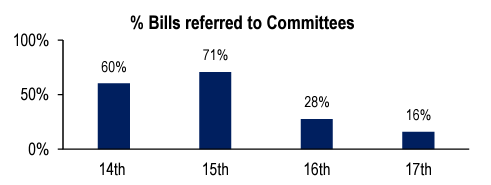
Lack of thorough scrutiny of bills- During the term of the 17th LS, 58% of the Bills introduced were passed within two weeks of their introduction. Eg- the J&K Reorganisation Bill, 2019
Weak research and knowledge support – Inadequate access to legislative data and expert analysis undermines quality of debates.
Deliberative Function
Decline in sitting days – From 120+ days (1950s) to around 55 days in 17th LS, curtailing deliberation
Declining attendance- In 2021, average attendance dropped to 71% in the Lok Sabha and 74% in the Rajya Sabha.
Frequent disruptions and adjournments – During the 17th Lok Sabha, MPs were suspended on 206 instances, across both Houses of Parliament. In Winter Session 2023, 146 MPs were suspended for serious misconduct in the House.
Party whip system – Strict control discourages independent viewpoints and policy reasoning.
Financial Function
Between 2019 and 2023, on average, about 80% of the budget has been voted on without discussion. In 2023, the entire budget was passed without discussion.
Decline in budget scrutiny – Detailed examination of Demands for Grants often guillotined without debate.
Weak engagement with financial committees – Falling participation in PAC, Estimates Committee, etc.
Executive Oversight Function
Question Hour functioned for 60% of scheduled time in LS and 52% in Rajya Sabha.
Underutilized parliamentary committees – Low attendance and poor follow-up dilute scrutiny of executive performance.
Resort to Money Bill route undermines RS. Eg- Aadhar Act
Consequences of the Decline in Individual Parliamentarian’s Role
Reduced Accountability – Rushing bills like the Women’s Reservation Bill, 2023 limits scrutiny and weakens executive oversight.
Criminalization of politics – as per ADR data, 46% of MPs elected in 2024 have criminal cases pending.
Poor Legislative Quality – Farm Laws (2020) passed with minimal debate led to backlash and repeal.
Legislative Stagnation – Delay in passage of important bills due to disruption
Judicial Intervention – Weak legislative performance prompts courts to step in (e.g., NGT, social justice rulings).
Ordinance Culture – Fewer sittings have led to rising ordinances (11 in 2020), bypassing Parliament.
Public Disillusionment – Citizens lose faith in Parliament’s deliberative and representative role.
Democratic Imbalance – Executive consolidation weakens checks and balances, harming deliberative democracy.
Diminishing role of opposition MPs – Reduced speaking time and political polarization undermine effective oversight.
Way Forward-
Increase Working Days- Eg- NCRWC (2002) recommended Parliament meet for at least 110 days a year; currently, it averages 60-70 days.
Enhancing Parliamentary Decorum- Encourage a culture of respect, professionalism, and active participation in debates.
Enhance Research Support for MPs- Eg- UK Parliament’s Research Service aids MPs in informed decision-making
Engaging Responsible Opposition– allowing opposition to set agenda on lines of UK House of Commons
Mandatory referral of Bills to Committee
As former Vice President M. Venkaiah Naidu aptly stated, “Disorder, disruption, and delay should not replace debate, discussion, and decision, which form the edifice of parliamentary democracy.”