Industrial corridors are integrated economic regions developed along high-capacity transport networks to promote manufacturing, urbanisation, and investment through node-based industrial development and world-class infrastructure.
Significance of Industrial Corridors in India
Manufacturing-led Growth – Helps move towards the target of 25% manufacturing share in GDP.
Employment Generation – NICDP projects are expected to generate approximately 1 million direct and up to 3 million indirect jobs.
Logistics Cost Reduction – Integrated with Dedicated Freight Corridors (DFC) → faster freight movement.
Balanced Regional Development – Growth of backward regions Eg- Amritsar-Kolkata Industrial Corridor (AKIC) covering eastern states.
Urbanisation – Planned greenfield smart cities with modern infrastructure. Eg- Dholera Special Investment Region (Gujarat).
Export Promotion – Port-linked corridors enable export-oriented industries. Eg- Visakhapatnam-Chennai Industrial Corridor (VCIC).
Ancillary industrial growth and MSME Cluster Development. Eg- Eg- Auto and electronics clusters along Chennai Bangalore Industrial Corridor.
Multi-modal connectivity – Power, roads, rail, logistics parks developed together. Eg- PM Gati Shakti integration.
High-tech manufacturing zones – Eg- Semiconductor cluster in Dholera
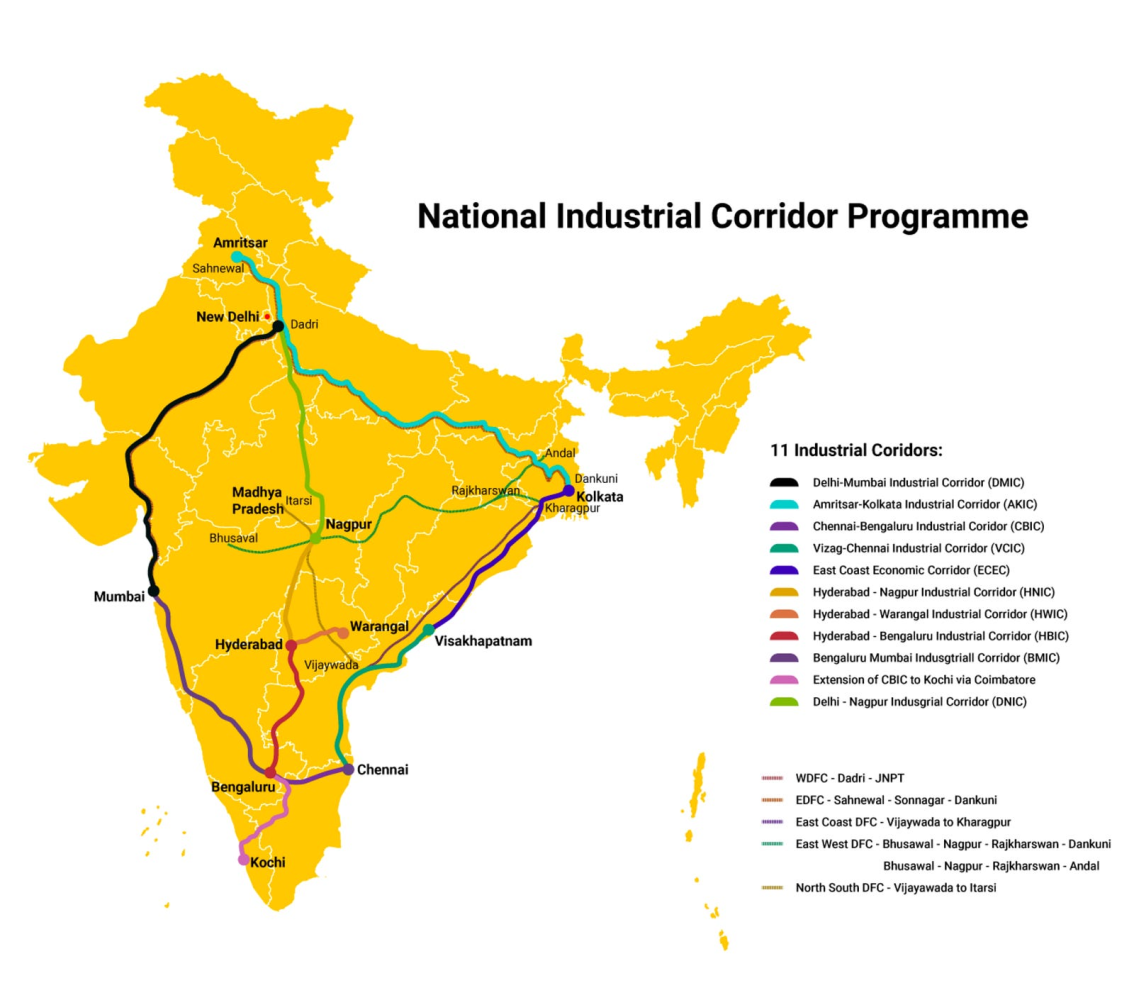
Major Industrial Corridors in India
Delhi-Mumbai Industrial Corridor (DMIC)
Chennai-Bengaluru Industrial Corridor (CBIC)
Bengaluru-Mumbai Industrial Corridor (BMIC)
Amritsar-Kolkata Industrial Corridor (AKIC)
Visakhapatnam-Chennai Industrial Corridor (VCIC)
Hyderabad-Bengaluru Industrial Corridor (HBIC)
Odisha Economic Corridor (OEC)
Delhi-Nagpur Industrial Corridor (DNIC)
Main Characteristics of Industrial Corridors
Multi-modal Connectivity- Seamless integration of High-speed Rail, 6-8 lane Expressways, and Deep-water Ports. Eg- Dighi Port in DMIC.
Plug-and-Play Infrastructure- Allotment of land with pre-cleared environmental permits and ready-to-use water, power, and gas connections.
Greenfield Smart Cities- Entirely new urban centers built from scratch with ICT-enabled utilities. Eg- Dholera SIR.
Walk-to-Work Culture- Residential zones are located within walking or cycling distance of industrial units to minimize commuting and pollution.
ICT Integration- Using “Unified Logistics Interface Platform” (ULIP) and PM Gati Shakti for real-time tracking of cargo and efficient project management.
Sector-Specific Clusters foster economies of scale. Eg- Pharma cluster in Zaheerabad or Agro-processing in Gaya
Sustainability- Adoption of green building standards, water recycling, and massive renewable energy parks
Single-Window Clearance- Streamlined regulatory processes through a digital interface
PPP Model – Private sector participation in infrastructure and industry.
Global Collaboration – Technology and finance support from international partners. Eg- Japan in DMIC, ADB in VCIC.
Sustainable and Green Development – Eg- Use of renewable energy, zero liquid discharge systems.
Industrial corridors are the pillars of Viksit Bharat @2047 and key to transition to a globally competitive manufacturing economy.