Why in the News
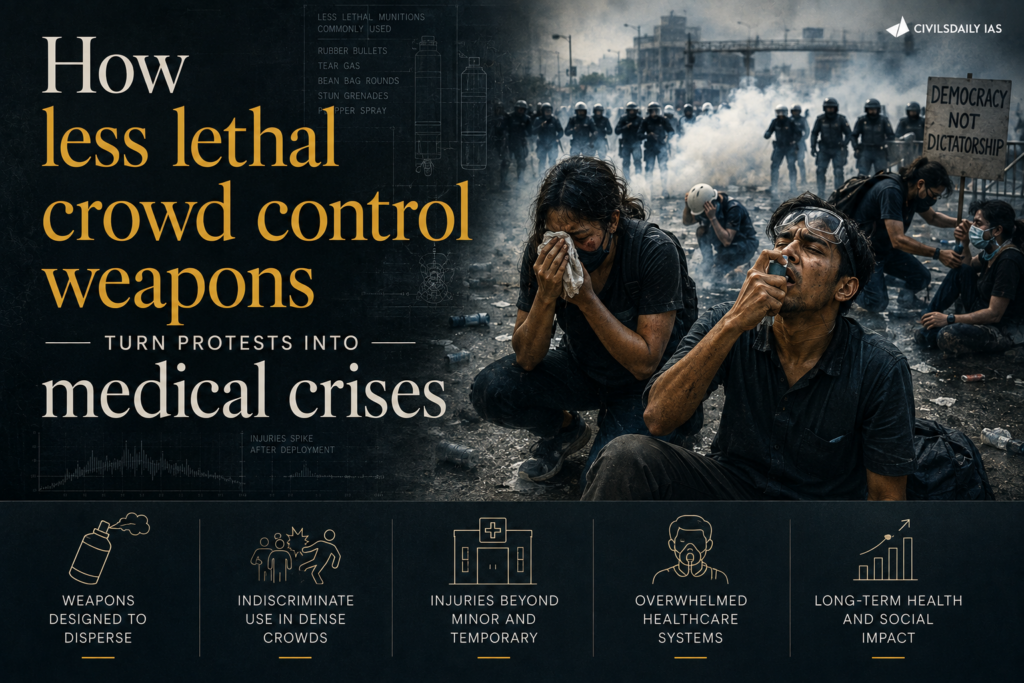
An analysis examines how crowd control weapons meant to be non lethal cause serious injury during protests. The tension is between the state’s duty to maintain order and its obligation to protect the right to protest safely.
What are less lethal weapons?
- Non lethal intent: Less lethal weapons are meant to disperse crowds without killing, but can cause serious harm.
- Common types: They include tear gas, pepper and PAVA spray, lathis, pellet guns, and shock batons.
- Chemical agents: Tear gas is a riot control agent that irritates the eyes and respiratory tract.
Which are the types of less lethal weapons?
- Tear Gas: A chemical riot-control agent that causes intense eye irritation, tearing, coughing, breathing difficulty, and temporary disorientation. Its main chemical compounds include CS Gas (2-chlorobenzalmalononitrile), CN Gas (Chloroacetophenone), OC Gas (Oleoresin Capsicum), CR Gas (Dibenzoxazepine) and Chloropicrin (PS).
- Pepper Spray: An oleoresin capsicum (OC)-based spray that causes severe burning of the eyes, skin, and respiratory tract, leading to temporary incapacitation.
- PAVA Spray: A synthetic pepper spray (Pelargonic Acid Vanillylamide) that causes intense eye irritation and pain with a more controlled and consistent effect than natural pepper spray.
- Lathi: A wooden or polycarbonate baton used by police for crowd control through physical force.
- Pellet Guns: Firearms that discharge multiple small pellets to disperse crowds; they can cause serious injuries, particularly to the eyes. They are loaded with cartridges containing hundreds of small metal sub-projectiles.
- Shock Batons (Stun Batons): Handheld electroshock devices that deliver a brief electric shock to temporarily immobilise a person through pain and muscle disruption.
Why do these weapons cause medical crises?
- Misuse at range: Pellet guns fired at close range or at the head cause blinding injuries.
- Enclosed spaces: Tear gas used in confined areas raises the risk of asphyxiation.
- Vulnerable groups: Children and people with respiratory illness face higher harm.
What do international and domestic norms say?
- Chemical Weapons Convention: Under the Organisation for the Prohibition of Chemical Weapons rules, the Chemical Weapons Convention bans tear gas in warfare while permitting it for domestic policing.
- UN guidance: The United Nations Guidance on Less Lethal Weapons sets limits on their use.
- Precedent: The 2016 pellet gun injuries in Jammu and Kashmir left many with permanent vision loss.
Conclusion
The weapons are lawful for policing yet routinely cause disproportionate harm in practice. The unresolved gap is enforceable standards on how and when they are deployed.
Back2Basics
The United Nations Guidance on Less Lethal Weapons
The United Nations Human Rights Guidance on the Use of Less-Lethal Weapons in Law Enforcement, released by the UN Human Rights Office (OHCHR), provides international standards for the lawful design, testing, training, and deployment of less-lethal equipment to prevent unnecessary harm, abuse, and human rights violations during policing and assemblies.
Core Principles
- Legality: Use must be strictly authorized by domestic and international law.
- Necessity: Force is applied only when strictly necessary to achieve a legitimate law enforcement objective.
- Proportionality: Harm caused must not outweigh the objective; excessive force is prohibited.
- Accountability: States and agencies must track, record, and review every deployment of less-lethal systems.
Scope and Covered Equipment
- Chemical Irritants: Regulations on tear gas and pepper spray deployment parameters.
- Kinetic Impact Projectiles: Standards for rubber bullets and beanbag rounds to avoid lethal head or torso strikes.
- Electric-Shock Weapons: Protocols for Tasers and other projectile stun systems.
- Area-Effect Tools: Oversight on water cannons and acoustic disruption gear.
PYQ Relevance
[UPSC 2021] Though the Human Rights Commissions have contributed immensely to the protection of human rights in India, yet they have failed to assert themselves against the mighty and powerful. Analyzing their structural and practical limitations, suggest remedial measures.
Linkage: The PYQ examines India’s human rights protection framework and institutional accountability. The article highlights excessive use of less-lethal weapons and the need for stronger human rights safeguards and accountability.