Why in the News
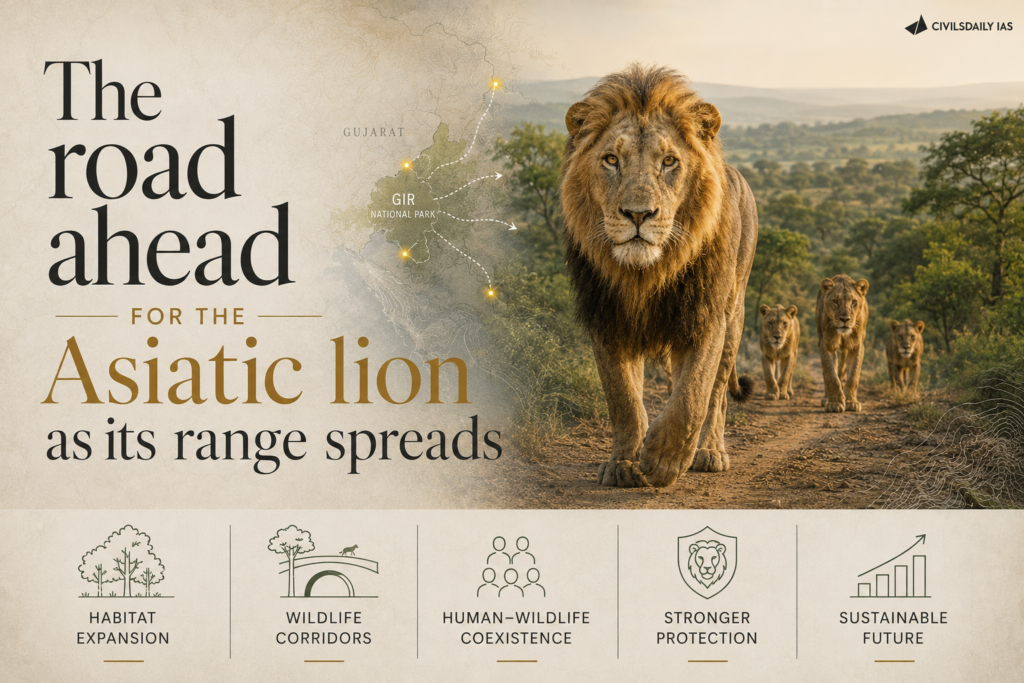
The Asiatic lion population has recovered strongly but is increasingly living outside protected areas. The tension is between a conservation success in numbers and the rising conflict and risk that dispersal brings.
What is the Asiatic lion?
- Endemic species: The Asiatic lion (Panthera leo persica) survives only in and around the Gir landscape of Gujarat.
- Status change: The International Union for Conservation of Nature (IUCN) moved it from Critically Endangered to Endangered.
- Single population: The entire wild population is concentrated in one region, making it vulnerable to a single event.
How has the population and range changed?
- Recovery: Numbers grew from about 100 to 150 six decades ago to over 1,000 today.
- Dispersal: Nearly half the lions now live outside protected areas.
- Satellite groups: For the first time, data shows that more than half—497 lions—now live outside the core Gir protected areas in nine distinct satellite populations spread across 11 districts, spanning a territory of 35,000 square kilometers.
Why does the spread create new risks?
- Habitat threat: A proposed limestone mine in the Babarkot corridor threatens a dispersal route.
- Disease risk: Past outbreaks of Canine Distemper Virus and babesiosis killed many lions.
- Green Status: The species remains assessed as “largely depleted” despite the numeric recovery.
Back2Basics: Asiatic Lion (Gir)
- IUCN status: Endangered.
- Legal protection: Listed in Schedule I of the Wild Life (Protection) Act, 1972.
- Habitat: Gir National Park and Wildlife Sanctuary and surrounding landscape in Gujarat.
- Significance: Gir is the only natural home of the wild Asiatic lion.
“[2024] Consider the following statements:
1. Lions do not have a particular breeding season.
2. Unlike most other big cats, cheetahs do not roar.
3. Unlike male lions, male leopards do not proclaim their territory by scent marking.
Which of the statements given above are correct?
(a) 1 and 2 only
(b) 2 and 3 only
(c) 1 and 3 only
(d) 1, 2 and 3