| PYQ Relevance [UPSC 2017] The question of India’s Energy Security constitutes the most important part of India’s economic progress. Analyze India’s energy policy cooperation with West Asian Countries Linkage: It connects the pact with India’s energy, strategic and security interests in West Asia. It helps analyse India’s response to emerging regional security alignments while safeguarding its strategic autonomy. |
Mentor’s Comment
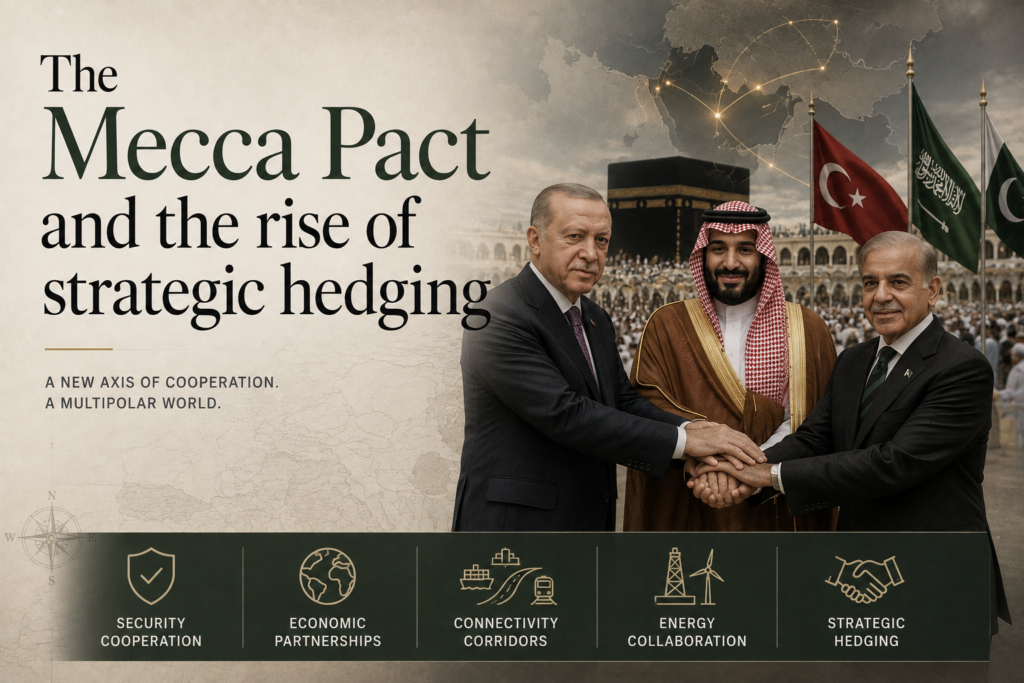
The Mecca Joint Defence Agreement signed on 7 August by Turkiye, Saudi Arabia and Pakistan commits the three states to treat an armed attack on any one of them as an attack on all. The pact exposes a shift in West Asian security away from sole reliance on external guarantors toward arrangements built by regional powers themselves. India, with large economic, energy and strategic stakes in the region, has said it is examining the implications and will safeguard its interests.
What is the Mecca Joint Defence Agreement?
- Signing and parties: The mutual defence agreement was signed on 7 August between Saudi Arabia, Turkiye and Pakistan in Mecca.
- Core provision: An armed attack against any one of the three states is to be regarded as an attack against all three, aimed at strengthening collective deterrence against aggression.
- What it does not do: It does not terminate the three states’ dependence on the United States, since Saudi Arabia remains militarily tied to Washington, Turkiye stays in the North Atlantic Treaty Organization (NATO), and Pakistan retains its own relationship with the United States.
What is strategic hedging?
- Definition: Strategic hedging is a policy of supplementing existing external security guarantees with independent arrangements, rather than replacing or breaking from those guarantees.
- Why states hedge: It lets a state demonstrate alternative options and reduce exposure to a single unreliable guarantor without provoking an open confrontation with that guarantor.
What complementary strengths do the three partners bring?
- Saudi Arabia: It provides financial resources, energy power and political influence across the Arab and Islamic worlds.
- Turkiye: It contributes the strongest conventional military among the Muslim states of West Asia and a rapidly expanding indigenous defence industry.
- Pakistan: It brings a large professional military and decades of cooperation with Saudi Arabia, and its nuclear weapons force any adversary to factor that capability into an attack on any member.
Why does each participant have distinct reasons to join?
- Saudi Arabia: The pact provides strategic insurance after the 2019 attacks on Saudi oil installations and the current confrontation with Iran exposed the risk of depending on a single external guarantor.
- Turkiye: It views the arrangement through strategic autonomy, expanding influence into the Gulf and South Asia and creating markets for its defence industry.
- Pakistan: The agreement widens its strategic horizons beyond the rivalry with India and converts its military capabilities into greater geopolitical influence.
Why have earlier Arab and pan-Islamic security groupings repeatedly failed?
- Baghdad Pact and CENTO: The Baghdad Pact lost Iraq in 1959, became the Central Treaty Organisation (CENTO) and expired in 1979.
- United Arab Republic: The Egypt and Syria federation founded in 1958 as the peak of pan Arabism dissolved in 1961.
- Regional Cooperation for Development: Launched in 1964 by Iran, Turkiye and Pakistan, it became the Economic Cooperation Organisation in 1985 and achieved little.
- Gulf Cooperation Council (GCC): Founded in 1981, it could not stop three members blockading a fourth in 2017 and remains divided on Iran.
- Arab League and OIC: The Arab League and the Organisation of Islamic Cooperation (OIC) function as forums for declarations, not instruments of action.
- The working alternative: United States led coalitions delivered results, reversing Iraq’s annexation of Kuwait in 1991, intercepting Iranian salvos, and anchoring the current 13 nation Red Sea shipping coalition on United States Central Command.
How should India read the pact?
- Not automatically anti Indian: India has cultivated close relations with Saudi Arabia over two decades, and Riyadh has strong economic incentives not to let the pact become an instrument in Pakistan’s disputes with New Delhi.
- Pakistan’s leverage: Inclusion in a mutual defense pact as a net security provider could embolden Islamabad, though direct military intervention by Saudi Arabia or Turkey in an India-Pakistan bilateral conflict remains unlikely.
- Intelligence and Industrial Sharing: Even without direct combat involvement, Pakistan could benefit from wider intelligence-sharing, diplomatic backing, or defense-industrial cooperation with Middle Eastern partners
- Turkiye as the complication: Ankara has repeatedly backed Pakistan on Kashmir and supplied weapons used against India, making it the harder partner to read.
- Suggested response: India should seek explicit reassurance from Riyadh that the pact does not apply to an India and Pakistan confrontation, and resist viewing the alignment only through the Pakistan lens.
- Official position: The government has said it is examining the pact from the standpoint of national security and regional stability and will take all necessary measures to safeguard national interests.
What are the implications for Iran, Israel and the United States?
- Iran: The effect is complicated, since Turkiye and Pakistan share borders with Iran and have reasons to avoid confrontation with Tehran, so it is not a clear anti Iranian coalition.
- Israel: The fragmentation of the Muslim world has been a standing Israeli advantage, and a combination of Saudi finance, Turkish conventional strength and Pakistani nuclear capability alters strategic calculations.
- United States: The pact presents a paradox, since Washington long sought greater burden sharing by regional partners, but greater responsibility also produces greater autonomy and diminishes American leverage.
Is the Mecca pact genuine security self reliance or another weak grouping?
- The sceptical reading:A seven-decade record of collapsed groupings shows that national interest often defeats supranational identity. This is captured in Suhrawardy’s formulation: “zero plus zero plus zero still amounts to zero.”(Suhrawardy’s formulation: It refers to a famous realist maxim coined by Huseyn Shaheed Suhrawardy, the Prime Minister of Pakistan during the 1956 Suez Crisis. He famously dismissed the idea of collective pan-Islamic or regional military alliances among weak developing states by stating that “zero plus zero plus zero still amounts to zero”)
- The hedge reading: The accord is best described not as Islamic security self reliance but as a hedge against American unreliability after erratic United States policy.
- The cumulative reading: When several major states begin hedging simultaneously, their combined actions can transform the regional order even without a formal realignment.
- Structural contradiction: Saudi Arabia and Turkiye both claim leadership of the Islamic world and diverge over the Muslim Brotherhood, so the accord does not dissolve the rivalry between Riyadh and Ankara.
Conclusion
The Mecca pact is an act of strategic hedging by regional powers seeking to supplement, not sever, their external guarantees, and its significance lies in the possibility of a more autonomous West Asian security architecture. Whether it becomes durable or joins the long list of weak groupings will turn on whether regional cooperation can outlast national interest. India cannot remain a spectator to this transformation, and the credible response is to expand its own military and security engagement in the region rather than react with alarm.
Back2Basics:
Foundational Context: India and West Asia
- About: West Asia, spanning the Gulf, the Levant and the wider region, is central to India’s energy security, remittances and diaspora, and maritime trade.
- Energy and diaspora: The region supplies a large share of India’s crude oil and hosts roughly nine million Indian workers, making stability there a direct national interest.
- Strategic posture: India follows a policy of de hyphenated engagement, maintaining ties simultaneously with the Gulf Arab states, Iran and Israel.
- Historical footnote: Undivided India was described as the anchor of Persian Gulf security, a role independent India stepped back from after 1947.
Organisation of Islamic Cooperation (OIC)
- Type: Intergovernmental organisation of Muslim majority states, the second largest such body after the United Nations.
- Formation: Established in 1969.
- Headquarters: Jeddah, Saudi Arabia.
- Membership: 57 member states across four continents.
- Mandate: Safeguards and protects the interests of the Muslim world and coordinates member positions, largely through declarations rather than enforcement.
- India context: India is not a member, though it was invited as a guest of honour to the OIC foreign ministers meeting in 2019.
Government Initiatives / Frameworks for India’s West Asia Engagement
- I2U2 Grouping: A grouping of India, Israel, the United Arab Emirates and the United States focused on water, energy, food security and technology cooperation.
- India Middle East Europe Economic Corridor (IMEC): A connectivity project linking India to Europe through the Gulf, announced on the sidelines of the G20 summit.
- Comprehensive Economic Partnership Agreement: India’s trade agreement with the United Arab Emirates deepening economic ties in the Gulf.
- Defence diplomacy: Growing military exercises and defence partnerships with Gulf states seeking to diversify their security partners.
Key Facts about India and West Asia
- Crude imports: West Asia remains among the largest sources of India’s crude oil imports.
- Remittances: The Gulf is a leading source of inward remittances to India.
- Strait of Hormuz: A large share of India’s oil imports transit this chokepoint.
- Suez crisis reference: The pact debate recalls the 1956 Suez crisis, when Pakistan faced pressure to abandon the Baghdad Pact.
Challenges to India’s West Asia Strategy
- Pakistan factor: Turkiye’s consistent support for Pakistan on Kashmir complicates India’s Gulf partnerships.
- Regional rivalries: Balancing ties with Saudi Arabia, Iran and Israel simultaneously constrains freedom of action.
- Energy exposure: Dependence on Gulf crude leaves India vulnerable to supply and price shocks from regional conflict.
- Capability gap: India lacks the power projection capacity to act as a security provider in the region despite being courted.
- Great power competition: Rising Chinese economic and diplomatic presence in the Gulf reduces India’s relative influence.
Way Forward
- Expand military diplomacy: Deepen exercises, training and defence exports with Gulf states seeking to diversify partners.
- Seek bilateral reassurances: Obtain clear assurances from Riyadh that the pact does not apply to an India and Pakistan conflict.
- Diversify energy sources: Broaden crude sourcing and strategic reserves to reduce chokepoint exposure.
- Build connectivity: Accelerate IMEC and Gulf economic corridors to lock in long term stakes in the region.
- Sustain de hyphenated engagement: Maintain simultaneous ties with all regional actors without being drawn into any single bloc.
