Why in the News
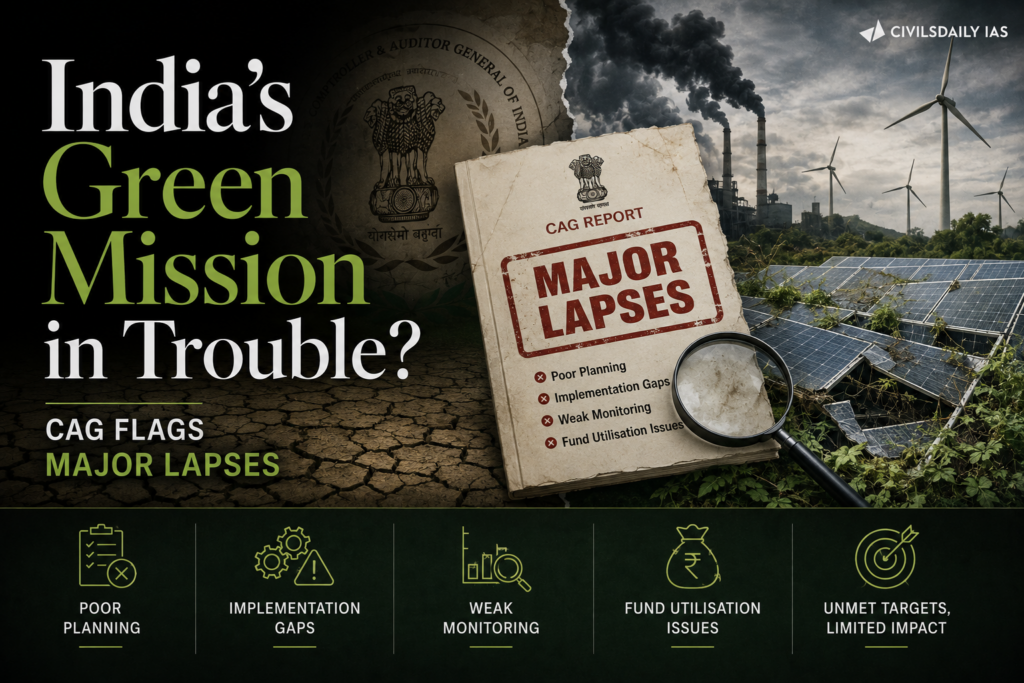
A Comptroller and Auditor General audit of the Green India Mission across 16 states and union territories found a 91.87 per cent shortfall against its forest quality improvement target and a 97.57 per cent shortfall against its forest cover target over ten years. The mission received Rs 1,149.14 crore, or 47.88 per cent, of the budgetary support it was to get. The tension is between a mission carrying India’s forest carbon sink commitment and a funding and convergence design that never materialised.
What is the Green India Mission?
- About: The Green India Mission is one of the eight missions under the National Action Plan on Climate Change, launched in 2014 by the Ministry of Environment, Forest and Climate Change.
- Twin targets: Increasing forest and tree cover on 5 million hectares, and improving the quality of forest cover on another 5 million hectares.
- Design principle: The mission was to work through convergence with existing schemes rather than through a large standalone budget.
- Climate function: It carries the forestry component of India’s Nationally Determined Contribution under the Paris Agreement.
What did the audit find on physical targets?
- Quality improvement: Forest cover quality improved on only 0.11384 million hectares against a 1.4 million hectare target, a shortfall of 91.87 per cent.
- Cover increase: Forest cover increased on only 0.03409 million hectares against a 1.4 million hectare target, a shortfall of 97.57 per cent.
- Audit period: The audit covered 2015-16 to 2024-25 across 16 states and union territories.
- Accounting failure: Eight states and union territories did not maintain annual accounts for the mission.
Why did the funding architecture fail?
- Proposed requirement: The mission’s proposed funding requirement was Rs 40,600 crore.
- What was approved: The Cabinet Committee on Economic Affairs approved Rs 2,000 crore for the first four years, alongside Rs 400 crore from Thirteenth Finance Commission grants.
- What was received: Only Rs 1,149.14 crore, or 47.88 per cent of even that reduced budgetary support, reached the mission over ten years.
- Structural consequence: A mission funded at under 3 per cent of its assessed requirement could not deliver targets set against the full requirement.
Why did convergence not happen?
- Intended partners: Convergence was planned with the Compensatory Afforestation Fund Management and Planning Authority, the Mahatma Gandhi National Rural Employment Guarantee Scheme, the Nagar Van Yojana and the School Nursery Yojana.
- What the audit found: These schemes operated in silos, and convergence was not achieved.
- Design dependence: The mission’s low budget was justified on the assumption that convergence would supply the resources, so the failure of convergence removed the funding basis entirely.
- Accountability gap: No single authority was answerable for delivering convergence across ministries.
What does this mean for India’s climate commitment?
- The commitment: India’s Nationally Determined Contribution includes creating an additional carbon sink of 2.5 to 3 billion tonnes of carbon dioxide equivalent by 2030 through additional forest and tree cover.
- Delivery vehicle: The Green India Mission is the principal instrument for the forestry component of that commitment.
- Arithmetic problem: Cover added on 0.03409 million hectares cannot support a sink target premised on 5 million hectares.
- Reporting risk: The gap between the reported forest cover figures and the audited mission achievement raises a measurement question about what counts as forest cover.
Challenges to India’s afforestation programmes
- Plantation survival rates: Trees planted are counted, trees surviving are not. e.g. audits repeatedly finding low survival in compensatory afforestation plantations.
- Monoculture plantation: Fast growing single species plantations raise canopy cover without restoring biodiversity. e.g. eucalyptus and acacia plantations counted as forest cover gains.
- Definition of forest cover: The forest survey definition counts any land above one hectare with over 10 per cent canopy, including plantations and orchards. e.g. commercial plantations appearing as forest cover increases.
- Compensatory afforestation land shortage: States lack non forest land of the required extent to compensate diversion. e.g. the accumulation of unspent Compensatory Afforestation Fund balances before the 2016 Act.
- Community rights friction: Plantation on land under claim conflicts with recognised forest rights. e.g. disputes over plantation drives on land claimed under the Forest Rights Act, 2006.
- Convergence without an owner: Cross ministry convergence has no accountable authority. e.g. the Green India Mission’s four named partner schemes operating in silos through the audit period.
Conclusion
The mission failed because its target was set against an assessed requirement of Rs 40,600 crore while its funding was built on a convergence assumption that no authority was made accountable for delivering. The shortfall is therefore a design failure rather than an implementation lapse. The next milestone is whether the government restructures the mission’s funding or restates the forestry component of the Nationally Determined Contribution.
Back2Basics: National Action Plan on Climate Change
- Launched in 2008 to outline India’s strategy on climate adaptation and mitigation.
- Comprises eight national missions: Solar, Enhanced Energy Efficiency, Sustainable Habitat, Water, Sustaining the Himalayan Ecosystem, Green India, Sustainable Agriculture, and Strategic Knowledge for Climate Change.
- Coordinated by the Prime Minister’s Council on Climate Change.
- States prepare State Action Plans on Climate Change aligned to the national missions.
- The Green India Mission was approved by the Cabinet Committee on Economic Affairs in 2014 with a mandate covering 10 million hectares in total.
Government Initiatives
- Compensatory Afforestation Fund Act, 2016: Governs the use of funds collected for forest land diversion, with a national authority and state authorities managing the corpus.
- Nagar Van Yojana: Supports the creation of urban forests on forest or other land within municipal limits, targeting city residents and local bodies.
- National Mission for a Green India: Targets 5 million hectares of new cover and 5 million hectares of quality improvement.
- Mission LiFE: Promotes individual and community behaviour change on sustainable consumption.
- School Nursery Yojana: Engages schools in raising seedlings to build a nursery base and environmental awareness.
Way Forward
- Fund the mission against its assessed requirement: Close the gap between the Rs 40,600 crore requirement and the Rs 1,149.14 crore released, or restate the targets.
- Appoint an accountable convergence authority: Name one authority answerable for delivering convergence across the four partner schemes.
- Report survival, not planting: Measure achievement through third party verified survival after three years, not through saplings planted.
- Separate plantation from natural forest in reporting: Report plantation area distinctly from natural forest cover so the carbon sink claim is verifiable.
- Enforce annual accounts: Make release of the next instalment conditional on maintained annual accounts, since eight states did not maintain them.
“[2016] Which of the following best describes/ describe the aim of ‘Green India Mission’ of the Government of India?
1. Incorporating environmental benefits and costs into the Union and State Budgets thereby implementing the ‘green accounting’
2. Launching the second green revolution to enhance agricultural output so as to ensure food security to one and all in the future
3. Restoring and enhancing forest cover and responding to climate change by a combination of adaptation and mitigation measures
Select the correct answer using the code given below.
(a) 1 only
(b) 2 and 3 only
(c) 3 only
(d) 1, 2 and 3
