💥Join UPSC 2027,2028 Mentorship (August Batch) + XFactor Notes & Microthemes PDF

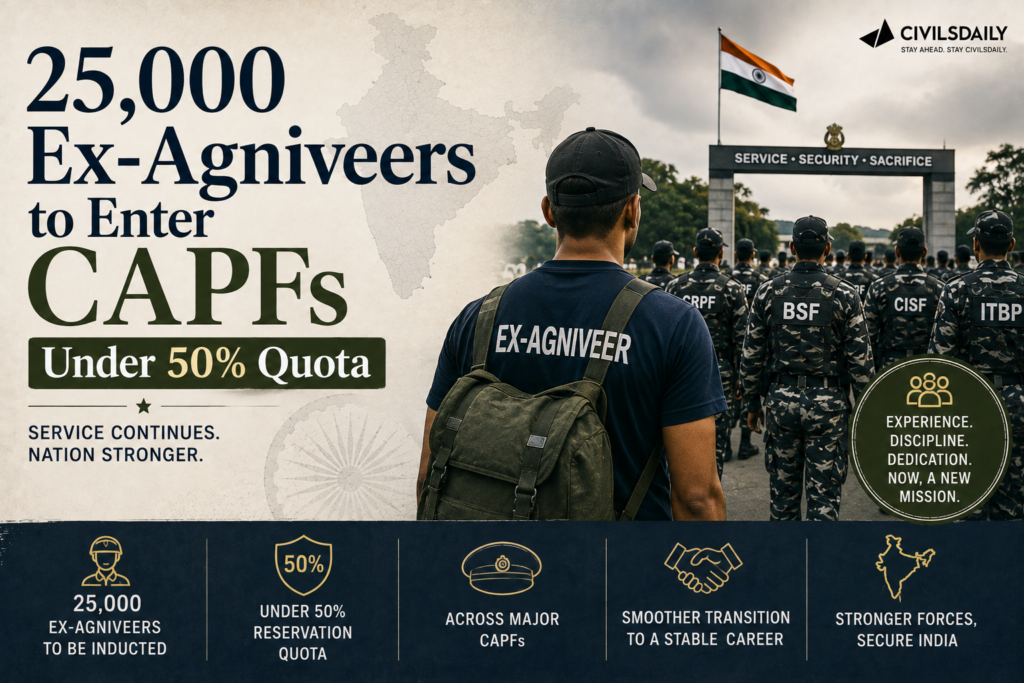
Armed forces to compile eligibility lists of ex Agniveers for CAPF recruitment as the first batch of about 25,000 retires by December against a 50 percent constable quota

Why in the News

The armed forces are to compile lists of Agniveers eligible for recruitment into the Central Armed Police Forces (CAPFs) under the reservation policy for these temporary recruits. The route shifts access to the reserved vacancies from an individual application to a list furnished by the parent service. The first batch of about 25,000 Agniveers retires from the Army by December.

What is the Agnipath scheme?

  1. About: Agnipath is the recruitment model under which soldiers, sailors and airmen are enrolled as Agniveers for a fixed short tenure instead of a full career.
  2. Tenure: Enrolment runs for four years, including the training period.
  3. Retention: Up to 25 percent of each batch is retained in the regular cadre for a further term, on merit and organisational requirement.
  4. Exit benefit: Those who leave receive a lump sum Seva Nidhi package, without pension or gratuity.
  5. The resettlement question: The remaining 75 percent leave in their mid twenties, which is what the CAPF quota was designed to answer.

What are the Central Armed Police Forces?

  1. About: The CAPFs are the armed police forces of the Union under the Ministry of Home Affairs, distinct from the armed forces under the Ministry of Defence.
  2. Composition: They comprise the Assam Rifles, Border Security Force, Central Industrial Security Force, Central Reserve Police Force, Indo-Tibetan Border Police, National Security Guard and Sashastra Seema Bal.

What changes in the recruitment route for former Agniveers?

  1. Lists replace applications: The Army, Navy and Air Force will furnish the CAPFs with details of eligible personnel.
  2. The consequence: Former Agniveers may not be able to apply directly for recruitment under the reserved quota.
  3. Sequencing: The change begins with the Army, at least initially, before extending to the other two services.
  4. Testing exemptions: Former Agniveers are exempted from written examinations, physical standard tests and physical efficiency tests.
  5. Recruitment mode: Constable (General Duty) posts are filled by direct recruitment, with 50 percent of vacancies in every recruitment year reserved for former Agniveers.

What do the individual force notifications provide?

  1. Who has notified: The Central Reserve Police Force (CRPF), Sashastra Seema Bal and Assam Rifles issued notifications over the past month specifying the 50 percent quota.
  2. Who was first: The Border Security Force was the first CAPF to issue such a notification.
  3. The CRPF numbers: Annual constable intake in the CRPF, the largest CAPF, is typically around 7,000, of which about 3,500 vacancies are now reserved.
  4. The CRPF notification date: It was issued on 27 July.
  5. Two phase recruitment: In the first phase the nodal force fills the earmarked vacancies, and in the second phase the remaining 50 percent are filled through an open examination.
  6. Carry forward rule: Reserved vacancies left unfilled in the first phase are carried forward and added to the vacancies filled through open recruitment.

Why would Agniveers prefer the CAPFs to the armed forces?

  1. Length of service: CAPF personnel serve up to the age of 60, while armed forces personnel retire much earlier.
  2. Job security: The deliberations recorded that many Agniveers, if given a choice, would prefer the CAPFs for the longer career span and greater security.
  3. The design implication: The preference means the CAPF quota functions less as a fallback and more as the intended destination for a large part of each batch.

Why does routing the quota through a service furnished list change the entitlement?

  1. Control shifts to the parent service: Eligibility is determined by the force that trained the Agniveer, not by the candidate’s own application.
  2. No independent route: A former Agniveer left off the list has no separate channel to the reserved vacancies.
  3. Criteria are not public: The basis on which the services will judge eligibility has not been notified alongside the CAPF quota notifications.
  4. Interaction with retention: The same services also decide the 25 percent retained in the regular cadre, so one authority now shapes both exits.
  5. Effect on open aspirants: Half of every constable recruitment year is closed to first time civilian candidates, and the reserved half is not open to competitive entry either.

How do caste based quotas interact with the ex Agniveer quota?

  1. In the armed forces: Recruitment into the armed forces is not based on caste reservations.
  2. In the CAPFs: Existing quotas for Scheduled Castes, Scheduled Tribes and Other Backward Classes continue to apply to CAPF recruitment.
  3. The overlay problem: A 50 percent horizontal reservation for former Agniveers has to be operated alongside vertical caste quotas within the same vacancy pool.

Challenges to the Ex Agniveer Absorption Framework

  1. Loss of the direct application right: Access to a reserved public post now depends on being named in a list prepared by another organisation. e.g. an Agniveer released on medical grounds but otherwise fit may not appear on the Army’s furnished list at all.
  2. Dilution of CAPF entry standards: Reserved candidates skip the written test and both physical tests that every other constable clears. e.g. CRPF Constable (General Duty) recruitment ordinarily requires a computer based examination followed by physical efficiency and standard tests.
  3. Compression of civilian opportunity: Half of all constable vacancies are closed to open competition each year. e.g. about 3,500 of roughly 7,000 annual CRPF constable posts are now earmarked.
  4. Timing mismatch: Batch releases and recruitment calendars are not synchronised. e.g. about 25,000 Agniveers retire by December while CAPF recruitment cycles run annually.
  5. Legal status gap: Agniveers are not classified as ex servicemen, so the separate ex servicemen quota in central civil posts does not reach them. e.g. the Ex-Servicemen (Re-employment in Central Civil Services and Posts) Rules, 1979 do not cover a four year Agniveer.
  6. No credit for prior service: A former Agniveer enters as a constable without seniority or pay protection for four years of military service. e.g. a soldier trained on infantry weapons restarts at the entry grade of a police organisation.
  7. Uneven state level absorption: State police reservations announced for Agniveers depend on each state’s own cadre rules. e.g. several states announced quotas and age relaxations with differing percentages and conditions.

Conclusion

The absorption of the first Agniveer batch will run through lists prepared by the armed forces rather than through applications by the individuals themselves, with 50 percent of CAPF constable vacancies reserved and the usual written and physical tests waived. The first cohort of about 25,000 leaves the Army by December, and the CRPF, Border Security Force, Sashastra Seema Bal and Assam Rifles have already notified the quota. The next milestone is the Army’s transmission of its eligibility list and the first phase of reserved recruitment, followed by extension of the mechanism to the Navy and the Air Force.

Central Armed Police Forces in India

  1. About: The CAPFs are Union armed police organisations raised for border guarding, internal security, industrial protection and counter terrorism, functioning under the Ministry of Home Affairs.
  2. The seven forces: Assam Rifles, Border Security Force, Central Industrial Security Force, Central Reserve Police Force, Indo-Tibetan Border Police, National Security Guard and Sashastra Seema Bal.
  3. Scale: Their combined sanctioned strength exceeds 10 lakh personnel, making them among the largest such formations in the world.
  4. Largest force: The CRPF is the largest, with a strength of roughly 3.25 lakh across more than 240 battalions.
  5. Border assignments: The Border Security Force guards the Pakistan and Bangladesh borders, the Indo-Tibetan Border Police the China border, the Sashastra Seema Bal the Nepal and Bhutan borders, and the Assam Rifles the Myanmar border.
  6. Specialised roles: The Central Industrial Security Force protects airports, ports, metro systems and industrial installations, and the National Security Guard is the federal contingency force for counter terrorism and hostage rescue.
  7. Terminology: The Union government discontinued the term paramilitary forces in official usage in 2011, and these organisations are designated Central Armed Police Forces.

Constitutional Framework Governing the Armed Forces and Union Armed Police

  1. Article 246 with Union List Entry 2: Covers naval, military and air forces and any other armed forces of the Union, which is the basis for raising the CAPFs.
  2. Union List Entry 2A: Covers deployment of any armed force of the Union in a State in aid of the civil power and the powers of such forces while so deployed.
  3. State List Entries 1 and 2: Place public order and police with the States, which is why Union forces deployed in a State act in aid of civil power.
  4. Article 33: Empowers Parliament to restrict or abrogate the fundamental rights of members of the armed forces and forces charged with maintaining public order.
  5. Article 355: Places a duty on the Union to protect every State against external aggression and internal disturbance.

Laws and Rules Governing These Forces

  1. Army Act, 1950; Navy Act, 1957; Air Force Act, 1950: Govern service conditions, discipline and courts martial in the three services, and cover Agniveers during their tenure.
  2. Central Reserve Police Force Act, 1949: Constitutes the CRPF as an armed force of the Union for internal security duties.
  3. Border Security Force Act, 1968: Constitutes the BSF for border guarding and defines the belt within which it exercises powers of arrest and search.
  4. Central Industrial Security Force Act, 1968: Constitutes the CISF for the protection of industrial undertakings and other designated establishments.
  5. Indo-Tibetan Border Police Force Act, 1992: Places the force on a statutory footing for the northern border.
  6. Sashastra Seema Bal Act, 2007: Constitutes the SSB, which was reassigned from intelligence work to border guarding in 2001.
  7. National Security Guard Act, 1986: Raises the NSG as a federal contingency force after the events of 1984.
  8. Assam Rifles Act, 2006: Governs India’s oldest paramilitary organisation, administratively under the Home Ministry and operationally under the Army.
  9. Ex-Servicemen (Re-employment in Central Civil Services and Posts) Rules, 1979: Provide reservation and relaxations for ex servicemen in central civil posts, a category that does not currently include Agniveers.

Back2Basics: Agnipath Scheme

  1. Announced: 14 June 2022 by the Ministry of Defence, applicable to the Army, Navy and Air Force.
  2. Nomenclature: Recruits are enrolled as Agniveers, a distinct rank for the duration of engagement.
  3. Tenure: Four years, inclusive of training.
  4. Retention: Up to 25 percent of each batch is taken into the regular cadre for a further engagement, on merit, willingness and organisational requirement.
  5. Age eligibility: 17.5 to 21 years, relaxed to 23 years for the first cycle in 2022 alone.
  6. Pay: A monthly package rising from about 30,000 rupees in the first year to about 40,000 rupees in the fourth year.
  7. Seva Nidhi: An exit corpus of about 11.71 lakh rupees, made up of 30 percent of monthly pay contributed by the Agniveer with a matching government contribution, exempt from income tax.
  8. Insurance: A non contributory life insurance cover of 48 lakh rupees for the period of engagement.
  9. Excluded benefits: No pension, no gratuity and no ex servicemen status on release.
  10. Reservation announced in 2022: 10 percent of vacancies in the CAPFs and Assam Rifles, in Ministry of Defence civilian posts and in the Indian Coast Guard, with age relaxation of three years and five years for the first batch.

Government Initiatives for Agniveer Resettlement

  1. CAPF reservation: Reserved vacancies in the CAPFs and Assam Rifles for former Agniveers, now set at 50 percent of constable vacancies with waiver of written and physical tests.
  2. Ministry of Defence civilian posts: Reservation in defence civilian vacancies and in the Indian Coast Guard for released Agniveers.
  3. Skill certification: A skill certificate issued on completion of engagement, aligned to the National Skills Qualification Framework, recording the competencies acquired.
  4. Graduation pathway: A special three year skill based bachelor’s degree programme for serving Agniveers through the Indira Gandhi National Open University.
  5. State police reservations: Several States announced reservation and age relaxation for former Agniveers in state police and forest guard recruitment.
  6. Directorate General Resettlement: Placement, entrepreneurship and training support for separated defence personnel.
  7. Seva Nidhi package: A tax exempt exit corpus intended as seed capital for further education or self employment.

Key Facts about the Agnipath and CAPF Framework

  1. The first Agniveer batch entered training in early 2023, so its four year tenure ends in 2026.
  2. About 25,000 Agniveers retire from the Army by December 2026.
  3. The CRPF is India’s largest Central Armed Police Force and its annual constable intake is around 7,000.
  4. The Border Security Force was the first CAPF to notify the reserved quota for former Agniveers.
  5. CAPF personnel serve up to the age of 60, against far earlier retirement in the armed forces.
  6. The Assam Rifles, raised in 1835 as the Cachar Levy, is India’s oldest paramilitary force.
  7. Recruitment into the armed forces does not operate caste based reservation, unlike the CAPFs.

Challenges in Short Tenure Military Recruitment

  1. Training cost against short service: Four years of service returns a limited period of trained output for a full training investment. e.g. a technical trade in the Air Force takes well over a year of training before an airman is operational.
  2. Unit cohesion and regimental system: High turnover strains the bonding on which regimental fighting units depend. e.g. infantry battalions traditionally build cohesion over long shared service in the same unit.
  3. Recruitment backlog: Suspension of ordinary recruitment before the scheme left a large shortfall in soldier strength. e.g. Parliament replies have recorded a deficiency of over a lakh personnel in the Army’s other ranks.
  4. Resettlement of the majority: Three quarters of every batch leave in their mid twenties into a labour market with limited absorption. e.g. absorption depends on quotas that must be created force by force and State by State.
  5. Absence of ex servicemen status: Released Agniveers do not access the pension, canteen, health and reservation entitlements of ex servicemen. e.g. the Ex-Servicemen Contributory Health Scheme does not extend to them.
  6. Disability and death benefits: Cover for injury and disability differs from that available to regular soldiers. e.g. entitlements on disability invalidation have required repeated clarification by the services.
  7. Fiscal driver versus capability: The scheme addresses a rising pension bill, which is a budgetary problem rather than an operational one. e.g. defence pensions absorb a large share of the defence budget every year, crowding out capital acquisition.

Way Forward

  1. Publish the eligibility criteria: Notify the basis on which the services will list former Agniveers, with an appeal route for exclusion.
  2. Retain a direct application channel: Allow released Agniveers to apply on their own alongside the service furnished list, so exclusion is not final.
  3. Calibrate the testing waiver: Retain a basic medical and physical validation at the point of CAPF entry, since release may precede joining by months.
  4. Synchronise calendars: Align batch release dates with CAPF recruitment years so reserved vacancies are not carried forward by default.
  5. Settle the status question: Define a statutory category for released Agniveers with specified health, credit and employment entitlements.
  6. Credit prior service: Recognise the four years for seniority, pay fixation or training exemption within the receiving force.
  7. Raise the retention share where capability demands it: Review the 25 percent retention ceiling for technical trades where training investment is highest.

Matching Previous Year Question

“[2023] With reference to Home Guards, consider the following statements:
1. Home Guards are raised under the Home Guards Act and Rules of the Central Government.
2. The role of the Home Guards is to serve as an auxiliary force to the police in maintenance of internal security.
3. To prevent infiltration on the international border/coastal areas, the Border Wing Home Guards Battalions have been raised in some States.
How many of the above statements are correct?
(a) Only one
(b) Only two
(c) All three
(d) None

Answer: (b)”


Join the Community

Join us across Social Media platforms.