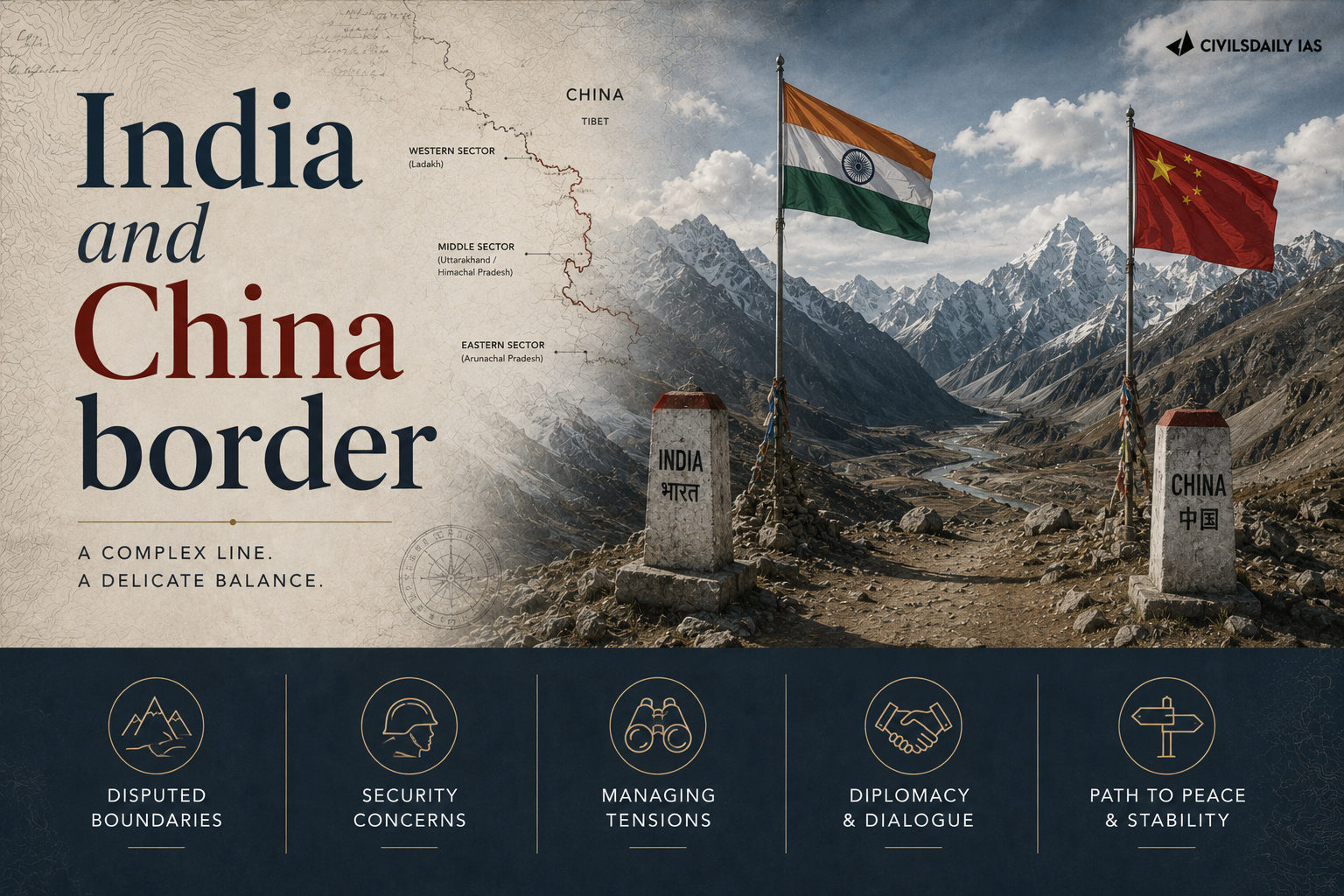
Why in the News
India and China have revived the formulation of an “Early and Substantial Harvest” on the boundary question in a joint document. The 25th round of talks between the Special Representatives (SRs), the designated political channel for the India-China boundary question, was held in Beijing. The readouts issued that evening avoided the phrase. An “Eight Points of Outcomes and Consensus” released a day later restored it. Point 3 tasked the Expert Group on Boundary Delimitation and the Working Group on Border Management with advancing discussions on an Early and Substantial Harvest of boundary delimitation and border management. Both bodies were set up a year ago under the Working Mechanism for Consultation and Coordination (WMCC), the official level channel that manages border affairs between the two foreign ministries, and their first task is still to agree on their own terms of reference. The phrase is India’s own coinage, and its reappearance does not establish that Beijing has accepted the Indian version of it rather than a partial settlement confined to the stretches where the two claims already coincide.
What is an “Early and Substantial Harvest”?
- A partial settlement taken ahead of a full one: It settles the boundary in the sectors where the two positions are closest, and leaves the harder sectors for later negotiation.
- India’s own formulation: After Beijing proposed settling the Sikkim Sector alone, India responded around 2019 with a counter proposal covering the Sikkim Sector together with the entire Middle Sector, with the boundary delineated along the watershed. China rejected it.
- The version China was willing to take: In later discussions Beijing agreed to include the Sikkim Sector and some undisputed areas of the Middle Sector only, which India found unacceptable.
Why does a sector by sector settlement cut against India’s negotiating position?
- Beijing accepting India’s terms would be expensive for it: The Indian formulation requires China to give up its claim to roughly 2,450 square kilometres in the Middle Sector, all of it south of the watershed boundary, covering Barahoti, Giu-Kaurik, Nilang-Jadhang, Sangcha Malla and Lapthal.
- The likelier outcome is an “agreement with holes”: A settlement can nominally cover both sectors while being confined to stretches where the claims already coincide, leaving the trijunctions and the contested pockets of the Middle Sector undefined.
- The asymmetry runs one way: India concedes ground where its own position is strong, with no movement in the Eastern and Western Sectors, where Beijing holds to “dong tiao xi rang”, meaning meaningful adjustments by India in the East and corresponding concessions by China in the West.
- It abandons the package principle: Article III of the Agreement on Political Parameters and Guiding Principles for the Settlement of the India-China Boundary Question, 2005 calls for a package settlement covering all sectors, precisely because the four sectors are strategically interlinked and require cross sector give and take.
Is the Sikkim Sector the settled case it is presented as?
- The agreed basis is internally contradictory: Both sides accept the Anglo-Chinese Convention of 1890 as the basis of the alignment. Article I of that Convention makes the watershed crest the boundary in its first sentence, then names Mount Gipmochi as the starting point on the Bhutan frontier in its second.
- The map record favours the watershed reading: British Indian maps of 1907 and 1913 placed the trijunction not at Gipmochi but roughly 6.5 kilometres to its north, on the true watershed crest.
- The two readings point to different trijunctions: India and Bhutan treat the watershed principle as controlling and place the trijunction at Batang La. China uses the literal reference to Gipmochi to push the trijunction south, onto the Jampheri Ridge.
- Silence would be read as concession: A Sikkim delimitation built on the 1890 text, unless it expressly repudiates Gipmochi, would be read in Beijing as India conceding the southern trijunction.
What would a Sikkim settlement do to Bhutan and to the Siliguri Corridor?
- India loses the standing to counsel Bhutan: Even a settlement that reserves the trijunction leaves India having settled out of turn nearby, which weakens its case against a bilateral Bhutan China deal.
- China’s standing offer to Bhutan gains momentum: Beijing’s package proposal would relinquish about 495 sq km of its claims in northern Bhutan in exchange for Bhutan ceding about 269 sq km in the northwest, including the Doklam Plateau.
- The strategic consequence is a line of sight: That exchange deepens China’s presence in the Chumbi Valley and opens a path to the Jampheri Ridge, from which the entire Siliguri Corridor, India’s sole overland link to its northeastern States, comes under direct observation.
- The ground has already shifted: Since the 2017 Doklam standoff China has spent years building roads, villages and military facilities across western Bhutan, and has gained de facto control over Doklam.
What would a genuine Early and Substantial Harvest require?
- Delineation on the highest watershed principle: The principle must apply across the entire stretch in both sectors, not selectively along the segments where the two positions already converge, since selective delineation serves no Indian purpose.
- Trijunctions kept out of the mandate: Batang La and any comparable point adjacent to a third country in the Middle Sector must be explicitly excluded from the Expert Group’s mandate and settled only in consultation with the country concerned, as the 2012 Common Understanding between the two SRs stipulates.
- Terms of reference that extend the Indian proposal: The mandate must carry the 2019 proposal forward in good faith rather than dilute it beyond recognition. Without acceptance of the highest watershed principle, silence on the trijunction is filled on the ground in Beijing’s favour in Bhutan.
What do the Eight Points leave unanswered?
- Package and piecemeal have not been reconciled: The Chinese readout reiterates a commitment to a package settlement, and no explanation has been offered for how that sits with a sector by sector approach.
- An Expert Group has been created without a framework: Article X of the 2005 Agreement requires the SRs to arrive at an agreed framework for a boundary settlement, which is then to provide the basis for delineation and demarcation by officials and surveyors of the two sides. No agreed framework exists yet.
- The operative word is not in the treaty: The 2005 Agreement does not use the term “delimitation” at all, and Chinese usage treats delimitation and demarcation as interchangeable. The open question is whether the SRs will pursue the agreed framework or leave it in abeyance while officials run a partial delimitation without one.
What else did the Eight Points carry, and what did they leave out?
- Incremental measures that belong to a separate track: Additional meeting points and hotlines for the General Level Mechanisms in the Eastern and Middle Sectors, continued pilgrimage and border trade, and a September meeting on trans border rivers are confidence building measures, not boundary settlement, and conflating the two in public discussion overstates the progress.
- Silence on the upstream dam: The document says nothing about the Medog County project on the Yarlung Tsangpo River. It records only that both sides will maintain communication on trans border river issues, including hydrological data sharing and renewal of the relevant memoranda of understanding, with no progress reported.
- The risk the September meeting has to raise: The project is the world’s largest hydropower plant, is being built close to the border in the Eastern Sector, and sits in a highly earthquake prone zone. Eg. The flash floods in Nepal on 26 August underscored what failure in such terrain does downstream.
- The 2005 Agreement is the only substantive result of the process: Twenty three years of SR talks have produced that one instrument, and China has sought to reinterpret and undermine it since its conclusion.
Challenges to an “Early and Substantial Harvest” settlement
- Nothing binds a partial settlement to the completion of the rest: A sector closed early removes the negotiating currency that was meant to buy movement elsewhere. Eg. The 1993 and 1996 agreements on peace and tranquillity along the Line of Actual Control did not prevent the 2020 standoff in eastern Ladakh.
The Fix: Write a linkage clause into the terms of reference making entry into force of any sectoral delimitation conditional on an agreed framework for the remaining sectors. - Delimitation on paper is not demarcation on the ground: A settled alignment still has to be surveyed and pillared across high altitude terrain where the two sides use different survey baselines. Eg. Friction points such as the Depsang Plains and Charding Ninglung Nala remain unresolved even after disengagement in eastern Ladakh.
The Fix: Constitute joint survey teams on an agreed geodetic datum before any delimitation text is initialled. - Infrastructure asymmetry keeps building while talks continue: Negotiation does not freeze construction, so the ground position moves during the negotiation itself. Eg. China’s dual use border villages along the Line of Actual Control settle civilians in disputed pockets and create a permanent presence.
The Fix: Tie each stage of the Expert Group’s work to verified parity in border infrastructure and force levels, reported to the WMCC. - No domestic ratification route exists for a territorial settlement: A boundary agreement alters the territory of the Union without any settled parliamentary process to approve it. Eg. Transferring enclaves under the 2015 Land Boundary Agreement with Bangladesh required the 100th Constitutional Amendment.
The Fix: Commit in advance to placing any boundary settlement before Parliament, so the negotiating mandate carries domestic legitimacy rather than acquiring it afterwards.
Conclusion
India’s boundary diplomacy now carries two objectives that do not sit together. One is to demonstrate movement after a long period without any. The other is to keep every sector on the table, so that a concession in one can be paid for in another. A settlement that closes the ground where India’s case is strongest, while the Eastern and Western Sectors stay frozen on Beijing’s terms, satisfies the first and forfeits the second. What to watch is whether the negotiating mandate now being drafted is narrow enough to keep third country trijunctions outside it, because silence on a trijunction is settled on the ground rather than at the table.
About the India-China Boundary Question
- An undefined line, not a boundary: The Line of Actual Control (LAC) runs about 3,488 km and has never been mutually delineated or demarcated, which is why patrolling patterns rather than an agreed line determine where standoffs occur.
- Western Sector: India relies on the Johnson Line of 1865 while China claims the Macartney-MacDonald Line of 1899. China occupies about 38,000 sq km of Aksai Chin.
- Eastern Sector: The alignment follows the McMahon Line drawn at the Simla Convention of 1914. China claims about 90,000 sq km of Arunachal Pradesh as “South Tibet”.
- The first framework instrument: The Agreement on the Maintenance of Peace and Tranquillity along the Line of Actual Control, 1993 committed both sides to resolve the question peacefully and to keep forces to a minimum along the line.
Challenges in India-China Relations
- A structurally lopsided trade relationship: India’s trade deficit with China reached an all time high of $112.16 billion in March 2026, which limits how much economic leverage India can apply in a political dispute. Eg. 98.5% of Indian imports from China are industrial goods, so a supply disruption transmits straight into Indian manufacturing.
The Fix: Tie production linked incentive disbursement in electronics, pharmaceutical intermediates and capital goods to verified reduction in single source imports. - Market access is not reciprocal: Indian information technology and pharmaceutical firms face opaque non tariff barriers in the Chinese market while Chinese goods enter India freely. Eg. Indian generic drug approvals in China have moved slowly despite India being the largest supplier of generics globally.
The Fix: Make market access parity a stated precondition in every sectoral dialogue, with a published register of pending Indian applications in China. - Beijing blocks India’s multilateral advancement: China withholds consensus on India’s entry to the Nuclear Suppliers Group and opposes a permanent seat for India on the United Nations Security Council. Eg. It repeatedly placed technical holds on listing Pakistan based terrorists at the UN, delaying the designation of Masood Azhar until 2019.
The Fix: Build the plurilateral route instead, converting Quad, Indo Pacific and export control group partnerships into standing sponsorship of India’s candidature. - The China Pakistan axis converts a bilateral dispute into a two front problem: The China Pakistan Economic Corridor (CPEC), a corridor of about $62 billion linking Kashgar to Gwadar, passes through territory India claims. Eg. It runs through Gilgit Baltistan, which is why India has formally protested the corridor’s alignment.
The Fix: Sustain the two front capability build up through the Vibrant Villages Programme and border road completion, rather than treating the western and northern borders as separate planning theatres.
[2026, GS2, 15 marks] “China’s Belt and Road Initiative (BRI) has transformed South Asia from a regional space into a theatre of great power competition.” Analyse the strategic implications of the BRI for India’s security and regional influence in South Asia.”
