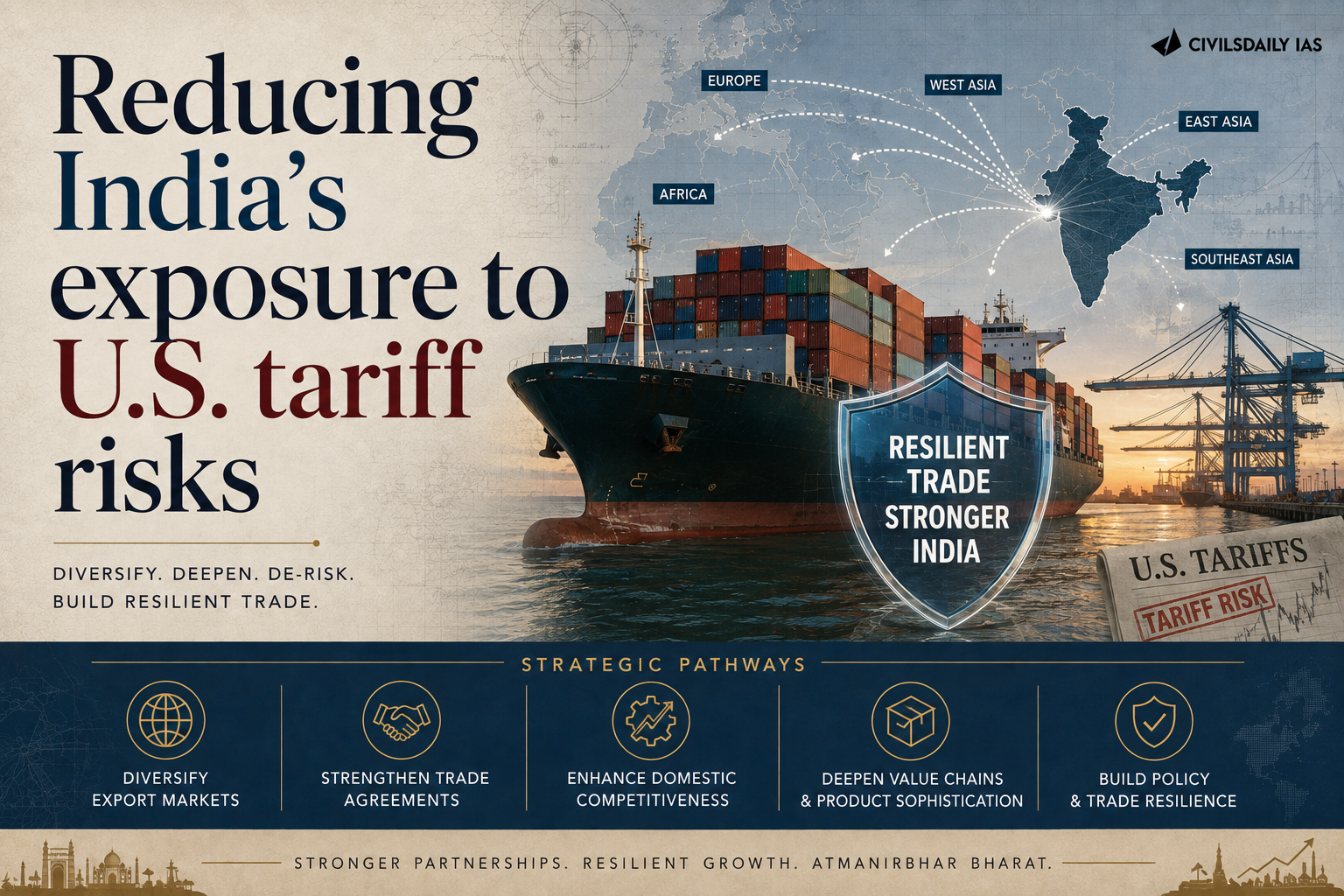
| Question (2025 – GS2): “Energy security constitutes the dominant kingpin of India’s foreign policy, and is linked with India’s overarching influence in Middle Eastern countries.” How would you integrate energy security with India’s foreign policy trajectories in the coming years? Linkage: This question directly addresses the concept of energy security as a “kingpin” of foreign policy. The U.S. sanctions act forces India to navigate its sovereign energy import strategy (specifically from Russia) while attempting to shield its vital foreign policy trajectories and trade arrangements with Western partners from massive tariff penalties. |
Mentor comment
The U.S. Senate has passed the Lindsey O. Graham Sanctioning Russia and Iran Act of 2026, authorising tariffs of up to 100% on countries among the top five importers of Russian crude or gas. Combined with existing forced-labour tariffs, India’s cumulative U.S. tariff exposure could reach 110%. The Act exposes a conflict between India’s energy security strategy and its trade relationship with the United States.
Why has Russian crude become a trade exposure rather than an energy choice?
- Diversification of supply produced concentration of risk: India moved towards Russian crude to reduce its import bill and gain room to manoeuvre amid global uncertainty, and that single decision now determines its tariff status in an unrelated market.
- The volumes are still rising: Imports nearly doubled within 2026, from 4.54 million metric tonnes (MMT) in January to 8.96 MMT in May.
- The cost is diplomatic before it is fiscal: Securing the supply has complicated the management of ties with the United States, which seeks to discourage these purchases, and the Russia sanctions legislation is the formal expression of that pressure.
How does India’s cumulative tariff reach 110 per cent?
- A tariff was already imposed before this Bill: The United States applied forced labour tariffs on 60 countries, including India, under Section 301 of the Trade Act of 1974, adding a 10% tariff on India in place of an expired 10% duty levied under Section 122.
- The sanctions provision stacks on top: If the Russia sanctions legislation becomes law, the additional 100% authorisation takes India’s cumulative tariff to 110%, among the highest applied to any country.
- The comparator is also India’s competitor: China’s cumulative tariff would reach 112.5%, since both countries are major importers of Russian crude, so relative price competitiveness in the United States market shifts less than the absolute number suggests.
What does a tariff confrontation cost the Indian economy?
- The method: Two global trade simulations were run using the Global Trade Analysis Project (GTAP) dataset and model, a general equilibrium framework that traces how a tariff shock in one market propagates through production, demand and trade flows in every other.
- The sanction scenario: Modelling a 110% United States tariff on India, with other countries facing forced labour tariffs and China facing 112.5%, India’s welfare declines by nearly $47 billion, and gross domestic product, output, domestic demand, exports and imports all contract.
- The trade contraction is the largest single effect: Aggregate exports fall by 5.1% and imports by 5.2%, reflecting disrupted trade flows and weaker economic activity. A prolonged tariff confrontation imposes substantial costs on India’s growth and trade performance.
Does export diversification offset the shock?
- The second scenario changes only the destination mix: The same tariff environment was modelled alongside export diversification, proxied by a full India-European Union free trade agreement.
- The direction of the result reverses: Welfare improves by $26.3 billion, gross domestic product turns positive, and sectoral output and domestic demand recover by around 1%.
- Trade integration replaces the lost market: Aggregate exports rise by 3.1% and imports by a moderate 2.6%, indicating stronger production and deeper integration with alternative markets.
- The policy implication is separable from the oil question: Even if India continues procuring Russian crude for energy security, the adverse effects of the tariffs are mitigated to a large extent by diversifying where it exports.
Why is diversification not a sufficient answer on its own?
- It depends on demand India does not control: Diversification works only to the extent that other markets can absorb additional Indian exports, and without adequate external demand it remains limited on paper.
- The United States cannot be written off: It remains one of India’s largest export destinations, so diversification is an addition to that market rather than a replacement for it.
- Domestic constraints cap the gain: Trade facilitation delays, non tariff barriers, weak logistics and standards, and a product mix concentrated in lower value goods all limit how much of a new market India can actually capture.
Challenges to export diversification as a response to tariff risk
- A free trade agreement is not the same as realised exports: Tariff concessions deliver nothing where Indian exporters cannot meet the destination market’s standards and compliance requirements. Eg. Indian shrimp and spice consignments have faced repeated European Union border rejections over antibiotic and pesticide residue limits.
The Fix: Fund accredited testing and certification laboratories at export clusters, so conformity assessment happens before shipment rather than at the importing port. - Rules of origin can neutralise a preference: A partner country can grant duty free access and still block goods that use imported inputs beyond a stated value addition threshold. Eg. Indian electronics assembly relies heavily on imported components, which restricts qualification under strict origin rules.
The Fix: Negotiate cumulation provisions that count inputs sourced from other partner economies towards the value addition requirement. - Logistics cost erodes the tariff advantage: Higher freight and dwell times offset the duty saved when the alternative market is farther away than the one being replaced. Eg. Container dwell time and inland haulage costs remain a recognised drag on the delivered price of Indian goods.
The Fix: Sequence dedicated freight corridor and port connectivity completion against the entry into force dates of the trade agreements being signed. - Concentration simply moves rather than disappears: Replacing dependence on one large market with dependence on one large agreement reproduces the same vulnerability under a different flag. Eg. The exposure being addressed here arose precisely because a single destination carried a disproportionate share of Indian exports.
The Fix: Set a ceiling share for any single destination in the export promotion strategy, and target Africa, Latin America and West Asia alongside the European Union.
Conclusion
The finding that matters here is that the loss is a function of market concentration rather than of the tariff itself. That reframes the policy problem: the question is not how to make the tariff go away, but how to make the destination mix wide enough that a tariff in any one market cannot set the direction of the whole economy. Trade agreements deliver that only when the supply side can use them, which means testing and certification capacity, faster clearance, and movement up the goods quality ladder have to be built before the agreements enter into force rather than after. The measure of success is not the number of agreements signed but the share of exports the largest single destination accounts for.
About India-United States Trade and Investment Ties
- Scale of the relationship: Bilateral trade between the two countries stood at $149.84 billion in 2025-26.
- India runs a surplus, and it is narrowing: India’s trade surplus with the United States narrowed to $34.4 billion in 2025-26 from $40.89 billion in the previous financial year.
- Investment flows both ways: The United States is the third largest investor in India, with cumulative foreign direct investment inflows of $70.65 billion between 2000 and 2025.
- Indian capital in the United States: About 163 Indian companies operating there have created over $40 billion in tangible investments.
Challenges in India-United States Relations
- Preferential access has already been withdrawn once: Trade concessions granted unilaterally can be revoked without negotiation, which makes them an unreliable base for export planning. Eg. The United States revoked India’s benefits under the Generalized System of Preferences in 2019, citing a lack of equitable access.
The Fix: Convert the interim trade arrangement into a binding bilateral trade agreement, so market access rests on treaty commitment rather than on unilateral grant. - Digital and data rules pull in opposite directions: Indian data localisation requirements conflict with the operating models of United States technology firms. Eg. The Digital Personal Data Protection Act, 2023 and its rules govern cross border transfer of personal data on terms those firms have contested.
The Fix: Negotiate an adequacy style mutual recognition arrangement covering data transfer, so compliance is assessed once rather than jurisdiction by jurisdiction. - Intellectual property standards remain contested: India is placed on the United States Priority Watch List for what is described as weak patent protection in pharmaceuticals. Eg. The dispute centres on Section 3(d) of the Patents Act, 1970, which bars patents on new forms of known substances without enhanced efficacy.
The Fix: Run a standing bilateral working group on patent examination practice, so the disagreement is litigated technically rather than through annual watch list designations. - Mobility restrictions hit India’s largest services export: Immigration and visa restrictions raise the cost of the delivery model on which Indian information technology services depend. Eg. A $100,000 fee on H-1B petitions materially changes the economics of onsite deployment.
The Fix: Conclude a social security totalisation agreement and push services mobility commitments into the trade negotiation rather than treating them as an immigration matter.
Back2Basics: Section 301 of the Trade Act of 1974
- What it is: A provision of United States trade law that allows the United States Trade Representative to act against a foreign country’s acts, policies or practices that are found to be unjustifiable or unreasonable and to burden United States commerce.
- What action it permits: It authorises retaliatory measures, including additional duties on imports from the country concerned, without requiring a prior finding by any multilateral body.
- Why it is contentious: Unilateral retaliation under it sits uneasily with the World Trade Organization dispute settlement system, which requires disputes to be adjudicated before countermeasures are applied.
- How India has encountered it: India has been the subject of Section 301 action before, including the investigation into its equalisation levy on digital services.
