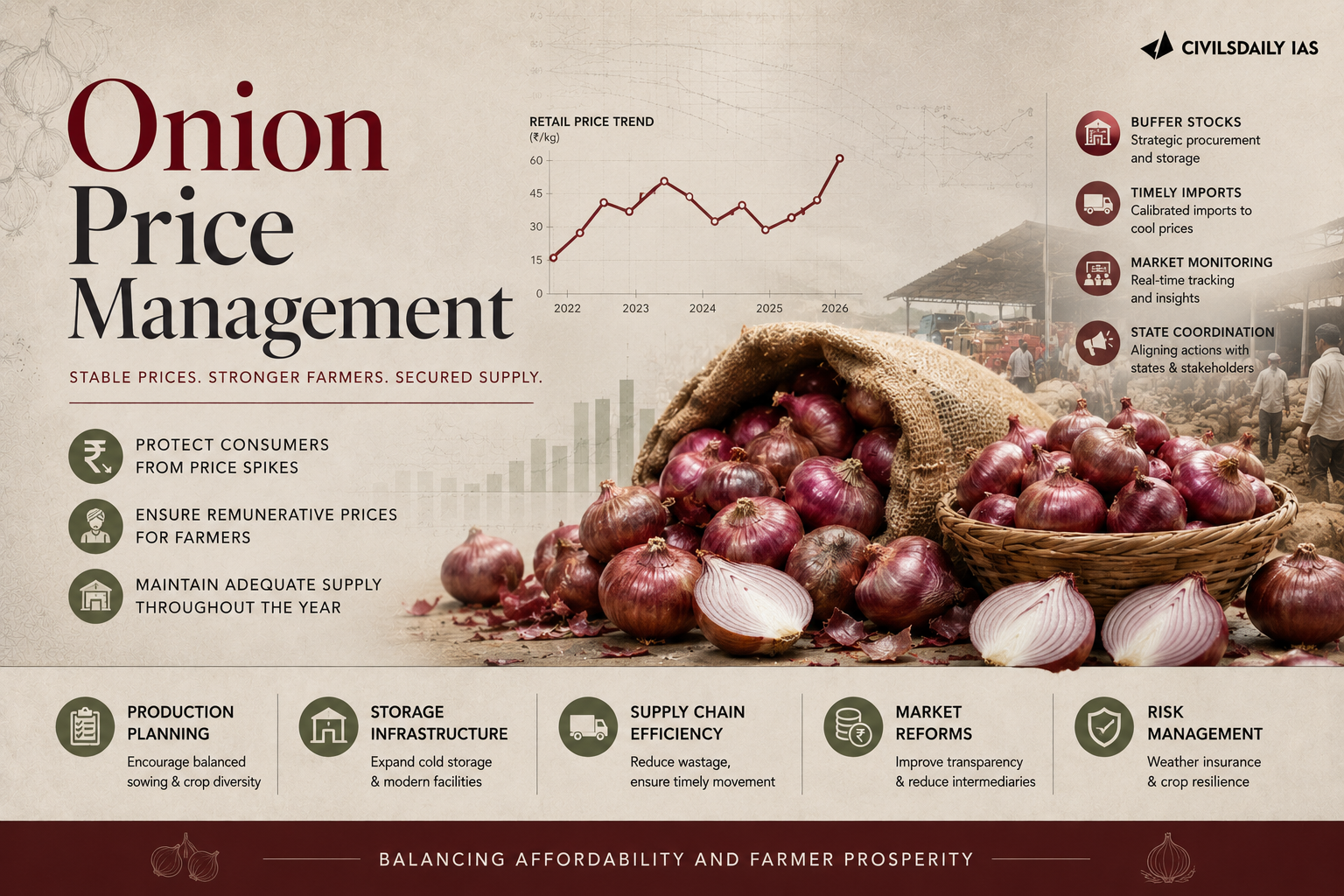
| Question (2024, GS3): “Elucidate the importance of buffer stocks for stabilizing agricultural prices in India. What are the challenges associated with the storage of buffer stock? Discuss. Linkage: This question directly addresses the core policy tool used in onion management: state-led procurement and buffer stocking to counter short-term price volatility. It highlights the storage and logistical bottlenecks that lead to post-harvest collapses. |
Mentor Comment
Onion price management has again run through a sequence of export restrictions and post collapse procurement, and neither has protected the farmer or the consumer. Since the 1960s Indian food policy has balanced affordable consumer prices against remunerative producer prices, with state intervention aimed at managing short term volatility rather than the underlying cause. Erratic weather and the absence of long term relief have made that balancing act harder to hold. The tension is that every corrective step arrives after farmers have already made production decisions and after prices have already collapsed, so the intervention reaches neither all farmers nor all grades of produce.
What has the Centre’s onion trade policy been since 2023?
- The export ban: The government banned onion exports from December 2023 to May 2024.
- The price floor that replaced it: A minimum export price of $550 per tonne was imposed, which sets the lowest price at which a consignment may legally leave the country and works as a soft restriction on exports. A 40 per cent export duty was imposed alongside it.
- The rollback: The duty was reduced to 20 per cent in September 2024 and abolished in April 2025.
Why does intervention after the event fail farmers?
- Policy changes after the sowing decision: The government often changes its position after farmers have made production decisions based on the price they expected.
- The procurement price was below cost: During the rabi harvest, onion farmers in Maharashtra, the country’s principal supplier, argued that the Centre’s procurement price of ₹12.35 per kg would not cover cultivation costs.
- The correction came too late for many: The Centre subsequently raised the price to up to ₹26.45 per kg. Many farmers could not capture the higher value, including some who had already sold at ₹1 per kg because of low quality and lack of storage.
- Coverage is partial by grade: Intervening after prices have already collapsed does not reach all farmers or all grades of produce.
What pressures exposed the flaw this year?
- Rainfall at the wrong point in the cycle: Abnormal rainfall at the time of harvest hit the crop directly.
- A kharif shortfall in the main supplying State: Maharashtra recorded a 5 per cent to 7 per cent drop in the kharif crop.
- Onion resists buffering: The known difficulties of storing onion and of maintaining large buffers compound every supply shock rather than absorbing it.
- Manipulation is the secondary issue: The government has alluded to some price manipulation, and the dominant problem remains that policy keeps reacting rather than acting in advance.
What proactive measures does the record point to?
- Storage: Improving storage options is the first named measure, since it is what allows a crop to be held past a price trough.
- Trade policy stability: A less erratic trade policy would let farmers price the export channel into their sowing decisions.
- Inter regional movement: Moving stock more efficiently between regions addresses the distribution failure rather than the production one.
- Price shock protection: Protecting farmers against price shocks is the fourth measure, and it operates before a collapse rather than after it.
Does Tamil Nadu’s targeted subsidy resolve the problem or move it?
- The design: Tamil Nadu will buy 1,000 tonnes of onions to distribute 1 kg per ration card at ₹35.
- What it gets right: The design discourages hoarding while allowing private retail prices to cool down.
- The delivery channel is the risk: Distribution runs through a dry grain public distribution system network, which was not built for a crop that spoils quickly.
- The economic case has a threshold: That case could collapse if post harvest losses exceed 10 per cent to 15 per cent, and onion is more susceptible to such losses than wheat or rice.
- Persistence is the second risk: The case also weakens if the subsidy has to be continued rather than used once.
- Replication would exhaust the buffer: If other States adopt similar measures, the Central buffer could be quickly exhausted, more so given this year’s high storage losses of around 30 per cent.
- Pressure transfers to the Centre: The State scheme will impose pressure on the Centre to maintain a steady supply behind it.
Challenges to stabilising onion prices
- Onion is bulky, perishable and stored without a cold chain: Farm level storage relies on ventilated structures whose losses rise sharply in a wet post monsoon. Eg. The traditional onion chawls of Nashik are open sided sheds with no humidity control.
The Fix: Link the storage capital subsidy to a verified ventilation and moisture standard rather than to built area alone. - Production is geographically concentrated: A weather event in one district cluster moves the national price because supply is not spread across regions. Eg. Lasalgaon in Nashik sets the reference price for the country’s onion trade.
The Fix: Build procurement and modern storage capacity in Madhya Pradesh, Karnataka and Gujarat so the national price is not set by one belt. - Sudden trade restrictions cost long term market access: Buyers who lose supply once diversify permanently, so the export channel is thinner when the surplus returns. Eg. Bangladesh and Sri Lanka shifted to Chinese, Pakistani and Egyptian onion during the Indian export restrictions.
The Fix: Announce any trade measure with a fixed minimum notice period and a stated expiry date written into the notification. - Procurement covers only a buffer, not the crop: Agency purchase is sized to stabilise consumer supply, so the price the farmer receives is still set by the open market. Eg. National Agricultural Cooperative Marketing Federation of India (NAFED) buying is confined to buffer accumulation and market release.
The Fix: Add a deficiency price payment triggered on the mandi price falling below assessed cultivation cost, paid directly rather than through purchase. - Farmers sow without a forward price signal: Acreage decisions are made months before the price is known, which is what produces the alternating glut and shortage. Eg. A remunerative rabi price pulls extra acreage into the next kharif sowing and depresses that crop’s price.
The Fix: Publish an official pre sowing advisory each season carrying expected national acreage and an indicative price band.
Conclusion
Onion policy is being run as a series of corrections applied after the price has already moved. What remains unreconciled is that every correction reaches the farmer after both the sowing decision and the distress sale are complete. Storage capacity and orderly movement of stock are the only interventions that operate before a collapse rather than after it. Whether the Centre holds one trade regime steady through a full price cycle is the test of whether the approach has changed.
