💥Join UPSC 2027,2028 Mentorship (July Batch) + XFactor Notes & Microthemes PDF

Author: Explains

  • [Burning Issue] India-Nepal Relations

    Basic features of Indo-Nepal treaty of peace and friendship

    1. Nepal is the only vital neighbour as it shares an open border with India.
    2. India and Nepal initiated their relationship with the signing ten articles treaty of 1950, “Indo-Nepal Treaty of Peace and Friendship”.
    3. The treaty allows free movement of people and goods between the two nations and a close relationship and collaboration on matters of defense and foreign policy.
    4. This allows the reciprocality for Nepalese and Indian citizens to move freely across the border without passport or visa, live and work in either country and own property or conduct trade or business in either country.
    5. However, a section of Nepalese received this treaty as violation of their sovereignty.
    6. The extensive Indian trade and economic influence was also resented by some in Nepal.
    7. In 1975 after the annexation of Sikkim by India, Nepal began openly lobbying for renegotiation of the treaty and proposed itself as a Zone of Peace between India and China.

    Importance of Nepal for India and vice-versa

    Cultural Importance

    1. While enjoying their own peculiarities, both India and Nepal share common culture and ways of life.
    2. Religion is perhaps the most important factor, and plays a predominant role in shaping the cultural relations between these two countries, marked by cross country pilgrimage on Char Dham Yatra, Pashupatinath Temple and some Buddhist sites.
    3. A considerable section of Nepalese comprises of madhesi population which has familial & ethnic ties with states of Bihar, UP.
    4. Although Nepal has its unique geography, history and cultural heritage still it is an integral part of the broader cultural history and tradition of Indian sub-continent.

    Strategic Importance

    1. Nepal is a buffer state between India and China.
    2. It has an open border with India which leads to problems such as illegal migrants, counterfeit currency entry, drug and human trafficking.
    3. Several Nepali Citizens are also deployed in Indian defense forces as well.

    Political Importance

    1. Constitutional turmoil is not new in Nepal. India has played a vital role in the democratic transition in Nepal against the monarch King Gyanendra.
    2. Nepali Congress (NC) is one of the country’s oldest parties which supports relations with India, but the communist parties show a tilt towards China.

    Economic Importance

    1. Nepal is a important export market for India.
    2. Himalayan rivers flowing through Nepal can be used for Hydroelectric power projects which will benefit border states of UP, Bihar and other adjacent areas.
    3. There are three major water deals between Nepal and India, namely the Kosi Agreement, the Gandak Treaty and the Mahakali Treaty. India also exports Power to Nepal.
    4. Also, Nepal is the largest borrower of Indian Currency in South Asia.

    Examples of bilateral cooperation

    1. The “Treaty of Peace and Friendship” was one of the landmark initiative of bilateral relations between India and Nepal.
    2. Operation Maitri of 2015 reiterated India’s commitment towards relations with Nepal. The search, rescue and relief operations carried out by Indians.
    3. Through this India once again proved its potential in role-playing and responsibility-bearing capacity in the region.
    4. India also announced a post-earthquake reconstruction package of US$ 1 bn for Nepal.
    5. India and Nepal have a Power Exchange Agreement since 1971 for meeting the power requirements in the border areas of the two countries.
    6. In 2014, PM Modi won hearts of Nepalese Population by his address in Nepal’s parliament.

    Irritants in bilateral ties

    Grudges of Nepal

    1. Anti-India Sentiment in Nepal is largely politically motivated as it is wrongly perceived as India’s backing to Monarchy.
    2. The issue of open borders has also been a point of debate in Nepal in recent years- Nepalese people argue that the India is benefiting more from it than Nepal.
    3. Nepal feels vulnerable and insecure because it is landlocked.
    4. Increasing Chinese presence in Nepal is one of the major concern for India. China’s move to extend the rail link to its border with Nepal can reduce Kathmandu’s dependence on India.
    5. Fundamentally these Chinese agencies are building up anti-India sentiments in Nepal.
    6. Nepal’s assent for “One Belt One Region” (OBOR) initiative of China is viewed by India with suspicion.

    Grudges of India

    Madhesi Issue

    1. Nepal adopted the new post-monarchy Constitution in 2015. Madhesi, a minority group residing in the Terai of Nepal, have been demanding a redrawing of federal boundaries.
    2. The Nepali constitution has given equal representation on the basis of “geographical area” triggering a demand for separate Madhesi province.
    3. Most of the key constitutional posts have been reserved for only citizens by descent hence surpassing Madhesis.
    4. In line with Madhesi Protest, Indian supply was blockaded at the border points leading to acute shortage of essential commodities.
    5. Nepal has accused India of imposing an undeclared blockade
    6. This angered a large part of the Nepalese population, allowing China to step in as an alternative.

    Human trafficking in Nepal

    1. An estimated 100,000–200,000 Nepalese in India are believed to have been trafficked.
    2. Sex trafficking is particularly rampant within Nepal and to India, with as many as 5,000–10,000 women and girls trafficked to India alone each year.

    Border Issue

    1. The unsettled border disputes at Kalapani and Susta have contributed substantially to the anti-Indian sentiments in Nepal.
    2. Border crossings from undesignated posts is a matter of content for India.

    India’s importance to Nepal

    1. India is the nearest foreign employer to Nepali Citizens, which provides various avenues of work and ease in assimilation into a foreign culture.
    2. India is the only potential neighbour who could harness Nepal’s hydropower.
    3. Moreover, Indian tourists are the major movers of Nepal’s tourism sector.

    Nepal’s Importance for India

    1. Nepal is a feasible market for Indian exports and attracts huge economic dependence on India.
    2. It acts as a strategic buffer state between India and China.
    3. As discussed earlier, India is the only beneficiary to harness its immense hydropower capacity.
    4. It is one of the major proponent and supporter of India’s interest on various International forums.

    Way Forward

    1. India can be the big-brother for Nepal in all sense.
    2. The onus is on India to rethink on a long-term basis how to recalibrate its relationship with Nepal provided Nepal should not ignore its dependence on India.
    3. India needs to continue to understand that there is another opportunity to rewrite bilateral and geopolitical history.
    4. India needs to also realize the new reality that its monopoly over geopolitics in Nepal is over, and there is another relationship that Nepal is nurturing.
    5. While China does not have people-to-people interactions with Nepal on a par with India, it has an open avenue for India to retain its strategic importance.
  • 8 October 2018 | Prelims Daily with Previous Year Questions

    Q.1) With reference to the National Aquatic Animal, the Gangetic Dolphins, which of the following statements is/are correct?

    1. Gangetic river dolphins fall under Schedule I of the Indian Wildlife (Protection) Act.
    2. The National Dolphin Research Centre (NDRC) is Asia’s first such research centre on Dolphins.
    3. Vikramshila WLS in Bihar is the only dolphin sanctuary in India.
    4. IUCN conservation status of Gangetic Dolphin is Critically Endangered.

    Select the correct codes:

    a) 2 and 3

    b) 1, 2 and 3

    c) 1 and 4

    d) All are correct

    Inspired by: India’s first dolphin research centre to come up soon in Patna

    https://www.civilsdaily.com/news/indias-first-dolphin-research-centre-to-come-up-soon-in-patna/

    Q.2) With reference to the maritime exercise JIMEX, consider the following statements:

    1. It is a biennial trilateral maritime exercise between Japan, India and Maldives.
    2. It is aimed to enhance interoperability, improve understanding and imbibe the best practices of each other.
    3. It is carried out in Harbour Phase as well as Sea Phase.

    Which of the given statements is/are correct?

    a) All are correct

    b) 1 and 2

    c) 2 and 3

    d) 1 only

    Inspired by: [pib] Bilateral Maritime Exercise JIMEX 18

    https://www.civilsdaily.com/news/pib-bilateral-maritime-exercise-jimex-18/

    Q.3) The report ‘Financial and Economic Impact of SBM in India (2017)’ is released by:

    a) WHO

    b) UNDP

    c) UNICEF

    d) UNECOSOC

    Inspired by: [pib] Beyond Dispute: The SBM Facts

    https://www.civilsdaily.com/news/pib-beyond-dispute-the-sbm-facts/

    Q.4) The National Annual Rural Sanitation Survey (NARSS) 2017-18 is conducted by an independent agency under:

    a) World Bank

    b) Asian Development Bank

    c) UN Environment

    d) WHO

    Inspired by: [pib] Beyond Dispute: The SBM Facts

    https://www.civilsdaily.com/news/pib-beyond-dispute-the-sbm-facts/

    Q.5) Which of the following pairs of the satellite navigation systems along with their countries is/are correctly matched?

    1. United States (GPS)
    2. Japan (QZSS)
    3. Russia (GLONASS)
    4. China Peoples Republic of China (BeiDou Navigation Satellite System) …
    5. European Union (Galileo)

    Select the correct codes:

    a) All of the above

    b) 1, 3, 4

    c) 1, 2 4, 5

    d) 1, 4, 5

    Inspired by: ISRO & ROSCOSMOS to work together for first Indian manned mission

    https://www.civilsdaily.com/news/isro-roscosmos-to-work-together-for-first-indian-manned-mission/


    For Solutions – Click Here

    Prelims Daily Archive – Click here


  • 08 October 2018 | High Relevance vs Low Relevance News

    Reading News for UPSC is utmost important and rising number of questions year on year in UPSC Prelims is a testimony of this

    We are starting a daily series where we will analyze news covered in The Hindu, Indian Express and other newspapers which are important from exam perspective and which are not

    Important news would have been covered in our daily news coverage in form of newscards.

    Unimportant ones will be mentioned here and a short description regarding why it is not relevant for the exam

    Click on news headlines to read the full news

    High Relevance News

    Explained: How to reach a 1.5-degree world

    https://www.civilsdaily.com/news/explained-how-to-reach-a-1-5-degree-world/

    Read about IPCC and recommendations in its latest report. Sentences are usually picked up from such reports for framing prelims as well as mains questions.

    ISRO & ROSCOSMOS to work together for first Indian manned mission

    https://www.civilsdaily.com/news/isro-roscosmos-to-work-together-for-first-indian-manned-mission/

    Read about India’s manned space program and Russia’s role in it. Can be useful for quoting in mains in questions related to India-Russia ties.

    India’s first dolphin research centre to come up soon in Patna

    https://www.civilsdaily.com/news/indias-first-dolphin-research-centre-to-come-up-soon-in-patna/

    Make notes about Gangetic dolphin and its features, habitat. Can be asked in Prelims.

    Low Relevance News

    India best for investments: PM

    PM Modi inaugurated Uttarakhand’s first investors summit on Sunday, saying India is the ideal investment destination in the world today with major social and economic changes sweeping the country

    No important points in the news from the exam perspective

  • [Burning Issue] Indo ASEAN Relations

    Why in News?

    • India invited all ten heads of state of the Association of Southeast Asian Nations (ASEAN) as chief guests at the Republic Day celebrations.
    • India and the ASEAN are also celebrating
    1. 25 years of their rapidly expanding partnership.
    2. 15 years of their Summit engagement.
    3. Five years of Strategic their Partnership.
    • In addition, ASEAN completed 50 years of its establishment.

    India-ASEAN Relations

    • Look-East Policy in 1992 gave an upthrust to India -ASEAN relation and helped India in capitalizing its historical, cultural and civilizational linkages with the region.
    • India entered into a Free Trade Agreement(FTA) in goods with the region in 2003 which has facilitated the bilateral trade which now stands at approximately USD 76 Billion.
    • The India-ASEAN Free Trade pact in services and investments, which was concluded in 2014 and came into effect a year later, has the potential to further reduce India’s trade deficit with ASEAN.
    • Further, the launch of Act East Policy in 2014 has added a new vigour to India-ASEAN relations.
    • ASEAN countries, owing to their strategic location in the Pacific Ocean, are also very crucial for maintaining the stability in the Indo-Pacific region.

    Five-key focus areas for India and ASEAN

    • Connectivity
      1. Physical connectivity remains a constraint in India-ASEAN trade relations.
      2. However, infrastructure projects like Trilateral Highway connecting India’s Northeast to Thailand, the Data Deep-sea Port in Myanmar, and the Kaladan Multi-modal Transit Transport Project have the potential to overcome the infrastructure bottleneck. Continued commitment and investment is needed.
      3. Apart from this, Non-tariff barriers should also be rationalized and the institutional mechanisms be streamlined to further augment the connectivity with the region.
    • Maritime Security
      1. The maritime space in today’s world plays a key role not only in economic development but also in security and connectivity.
      2. Piracy, disputes over resources, territorial claims, terrorism, China’s increasing assertiveness, and a fractured governance system are creating instability in the Indo-Pacific region.
      3. Thus, ASEAN India cooperation is imperative for maintaining peace and stability in the region.
    • Blue Economy
      1. Given India’s vast Exclusive Economic Zone(EEZ), there is huge potential in this sector that remains to be realized.
      2. India should deepen its engagement with ASEAN on this front through developing PPP models for fisheries sectors, knowledge sharing and joint efforts to conserve and manage coastal and marine resource.
    • The Digital Age

    Two things need to be considered under this :

    Inclusive Growth

    Technological disruptions may further increase inequality in incomes, digital access, and opportunities. Thus, India and ASEAN should focus on greater knowledge sharing and developing best practices for fostering inclusive growth.

    Cyber Security

    Policies governing cyberspace and cyber securities are in their nascent stage, in such scenario both India and ASEAN should seek to be a decisive voice in norm-setting, and in cultivating inter-regional cooperation for addressing cyber insecurity.

    • Migration
      1. Because jobless growth in India, unemployment is on rise. In such scenario, ASEAN nations can act as an important destination for Indian immigrant workers.
      2. On the other hand, job creation is expected to rise in ASEAN countries like Singapore and Malaysia. There are gaps in labour supply across different sectors in ASEAN nations.
      3. Therefore, both India and ASEAN should work together to reduce barriers to immigration, and facilitate the freer movement of labour between them, as they both stand to gain.

    Issues Hampering India-Asean Relations

    • In bilateral trade, there is an imbalance as the majority of ASEAN countries have strong manufacturing bases that rely on export while Indian export remains feeble. Moreover, the current policy under Make In India is to promote domestic production.
    • India still engages more with ASEAN countries on a bilateral basis rather than on a multilateral basis.
    • India’s has a limited capacity to provide development assistance and other financial relation. Moreover, ASEAN’s inclination to harness India for regional stability remains limited because of the presence of other regional powers like China.

    Conclusion

    • On the trade front, there are certain concerns related to Free Trade Agreement in services. Services being India’s domain, India need to work on these concerns on a priority to give an impetus to exports in services.
    • Efforts should also be made to finalise an agreement for free movement of labour so that both ASEAN and India could capitalize on each other’s resources
    • Further, with increasing assertiveness of China Indo-Pacific region and the uncertain Trump administration in U.S. A, the cooperation between India and ASEAN become all more important to maintain rule-based order and stability in the Indo-Pacific region
  • 6 October 2018 | Prelims Daily with Previous Year Questions

    Q.1) Exercise Sahyog HOP TAC-2018 is a bilateral coastal security exercise between India and which of the following countries?

    a) Bangladesh

    b) Myanmar

    c) Vietnam

    d) Cambodia

    Inspired by: India, Vietnam hold joint drill in Bay of Bengal

    https://www.civilsdaily.com/news/india-vietnam-hold-joint-drill-in-bay-of-bengal/

    Q.2) SEZs are set up under Special Economic Zones Act, 2005 as duty free enclave in India. Which of the following statements about SEZs is not correct?

    a) They shall be deemed to be foreign territory for the purposes of trade operations and duties and tariffs in India.

    b) Goods and services rendered from the SEZ are treated as imports into India.

    c) Exemption from State sales tax and other levies as extended by the respective State Governments.

    d) 100% Income Tax exemption on export income for SEZ units under Section 10AA of the Income Tax Act for lifetime operations.

    Inspired by: [pib] SEZ Policy Review Committee holds final meeting

    https://www.civilsdaily.com/news/pib-sez-policy-review-committee-holds-final-meeting/

    Q.3) With reference to the India’s first “Methanol Cooking Fuel Program”, which of the following statements is not correct?

    a) It is an initiative of a state-owned company, Northeast and Assam Petro-chemicals.

    b) It is Asia’s first cannisters based “Methanol Cooking Fuel Program”.

    c) The technology is very unique as it handles methanol extremely safely, does not need regulator or any piping system.

    d) Cooking with the help of Methanol is a costlier practice than traditional LPG.

    Inspired by: [pib] Launch of Methanol Cooking Fuel Program of India

    https://www.civilsdaily.com/news/pib-launch-of-methanol-cooking-fuel-program-of-india/


    Q.4) With reference to the Masala Bonds, consider the following statements:

    1. ‘Masala Bonds’ are Indian rupee denominated bonds issued in offshore capital markets which issued to offshore investors settled in dollars or any other currencies.
    2. It is used to refer to rupee-denominated borrowings by Indian entities in overseas markets.
    3. Masala bond was the first Indian bond to get listed in London Stock Exchange.

    Which of the given statements is/are correct?

    a) 1 and 2

    b) 2 and 3

    c) 1 and 3

    d) All are correct.

    Inspired by: [op-ed snap] Avoiding the currency basket case

    https://www.civilsdaily.com/news/op-ed-snap-avoiding-the-currency-basket-case/

    Q.5) “It is a method of using light to capture and manipulate tiny objects has changed the way we’re able to study microscopic life. It uses momentum of light beam called the momentum pressure. It can be used to sort healthy cells from infected ones, or identify those that might be cancerous. It is also possible to use them to measure both the minute movements of a trapped object (equivalent to a few atoms in diameter) and similarly tiny forces.”

    Which of the following devices is best described in the above paragraph?

    a) Optical Grafter

    b) Optical Tweezers

    c) Ophthalmic Refractometer

    d) Laser Glowforge

    Inspired by: [op-ed snap] Augmenting life — on Nobel Prize 2018

    https://www.civilsdaily.com/news/op-ed-snap-augmenting-life-on-nobel-prize-2018/


    For Solutions – Click Here

    Prelims Daily Archive – Click here

  • 5 October 2018 | Prelims Daily with Previous Year Questions


    Q.1) Under the Rashtriya Vayoshri Yojana (RVY), which of the following assisting living devices is/are distributed to the senior citizens?

    1. Tetra/Tripod
    2. BTE Hearing Aids
    3. Crutches
    4. Walking Sticks
    5. Spectacles

    Select the correct codes:

    a) 2, 3, 5

    b) 2, 3, 4

    c) 2 and 4

    d) All of the above

    Inspired by: [pib] Assistive Aids and Appliances distributed to Senior Citizens Under 58th Rashtriya Vayoshri Yojana Camp

    https://www.civilsdaily.com/news/pib-assistive-aids-and-appliances-distributed-to-senior-citizens-under-58th-rashtriya-vayoshri-yojana-camp/

    Q.2) With reference to the Global Renewable Energy Atlas, consider the following statements:

    1. It is a web platform that allows its users to find maps of renewable energy resources for locations across the world.
    2. It is an initiative of UNEP.

    Which of the given statements is/are correct?

    a) Both 1 and 2

    b) Only 1

    c) Only 2

    d) None of these

    Inspired by: [pib] 21 IORA Countries adopt the Delhi Declaration on Renewable Energy

    https://www.civilsdaily.com/news/pib-21-iora-countries-adopt-the-delhi-declaration-on-renewable-energy/

    Q.3) The Government E-Payments Adoption Ranking (GEAR) is released by:

    a) National Payments Corporations of India

    b) Visa

    c) RBI

    d) World Economic Forum

    Inspired by: India moves up 8 spots in e-payments adoption ranking

    https://www.civilsdaily.com/news/india-moves-up-8-spots-in-e-payments-adoption-ranking/

    Q.4) The Islands of Java and Sumatra are separated by:

    a) Makassar Strait

    b) Sunda Strait

    c) Bering Strait

    d) Tsugaru Strait

    Inspired by: India launches ‘Operation Samudra Maitri’ to help tsunami-hit Indonesia

    https://www.civilsdaily.com/news/india-launches-operation-samudra-maitri-to-help-tsunami-hit-indonesia/

    Q.5) Rashtriya Garima Abhiyaan’ is a national campaign to: (CSP 2016)

    a) rehabilitate the homeless and destitute persons and provide then with suitable sources of livelihood

    b) release the sex workers from the practice and provide them with alternative sources of livelihood

    c) eradicate the practice of manual scavenging and rehabilitate the manual scavenger

    d) release the bonded labourers free their bondage and rehabilitate them

    Inspired by: No trial in sewer death cases

    https://www.civilsdaily.com/news/no-trial-in-sewer-death-cases/

    For Solutions – Click Here

    Prelims Daily Archive – Click here

  • 06 October 2018 | High Relevance vs Low Relevance News

    Reading News for UPSC is utmost important and rising number of questions year on year in UPSC Prelims is a testimony of this

    We are starting a daily series where we will analyze news covered in The Hindu, Indian Express and other newspapers which are important from exam perspective and which are not

    Important news would have been covered in our daily news coverage in form of newscards.

    Unimportant ones will be mentioned here and a short description regarding why it is not relevant for the exam

    Click on news headlines to read the full news

    High Relevance News

    [pib] Atal Innovation Mission & SIRIUS sign MoU for promotion of innovative cooperation between students of India & Russia

    https://www.civilsdaily.com/news/pib-atal-innovation-mission-sirius-sign-mou-for-promotion-of-innovative-cooperation-between-students-of-india-russia/

    Read about Atal Innovation Mission. Can be asked in Prelims.

    India, Russia sign S-400 missile deal after summit

    https://www.civilsdaily.com/news/india-russia-sign-s-400-missile-deal-after-summit/

    Note details about S-400 system and its need for India. Important for Pre as well as Mains.

    [pib] India-China Trade

    https://www.civilsdaily.com/news/pib-india-china-trade/

    Important newscard highlighting the benefits that India could get from ongoing trade war. Must read for Mains.

    Low Relevance News

    Banks, telecom companies could be allowed to use Aadhaar, says Jaitley

    Finance Minister Arun Jaitley said that a Parliament-approved legislation can restore mandatory linking of biometric ID Aadhaar with mobile phones and bank accounts

    The Supreme Court had last month upheld the Constitutional validity of Aadhaar, the 12-digit biometric based unique identity number, but restricted its use by private entities like telecom operators for verifying the identity of the mobile phone user

    No important points in news from the exam perspective as this is just an idea floated by a minister.

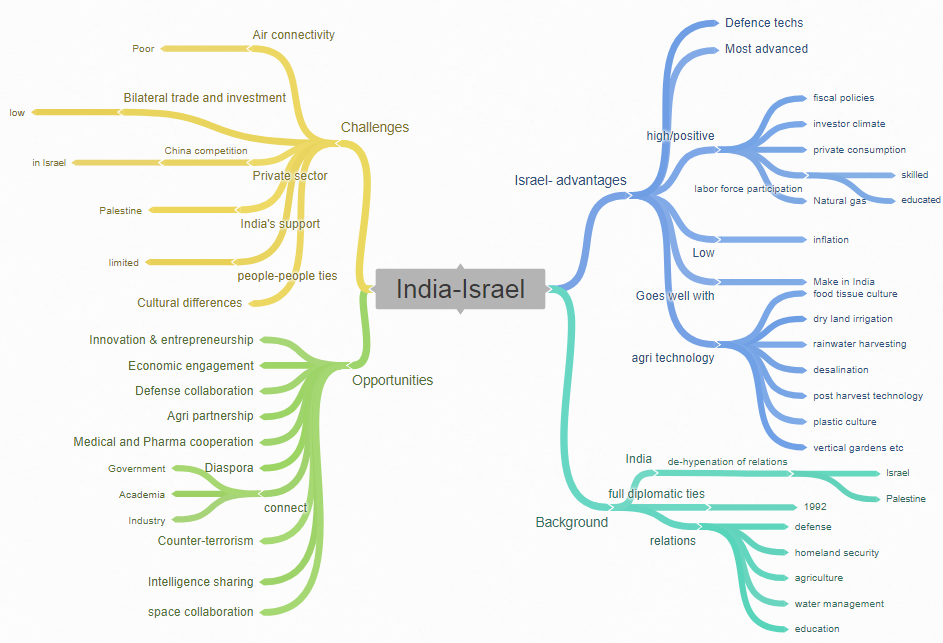
  • [Burning Issue] India Israel Relations

    Why in News

    The fact that an Indian Prime Minister is making a visit for the first time in 25 years since we established full diplomatic ties is significant and termed historic in itself. The focus of the visit signifies 25th anniversary of diplomatic ties has opened a new chapter in the Indo-Israel bonhomie.

    Advantage Israel

    1. Israel, led by strong growth of private consumption, low inflation, rising labor force participation, a positive investors’ climate because of low interest rates, natural gas finds and responsible fiscal policies, has a lot to offer.
    2. A modern economy like Israel goes well with our own flagship programmes like Make in India. Indian companies with their engineering and scale and Israeli companies with their innovation and technology can together stimulate our domestic manufacturing sector, particularly in defense.
    3. Israel, at the same time, is considered as the most advanced country in SW Asia and the Middle East in economic and industrial development.
    4. It is a developed country having a highly skilled and educated workforce. So, developing relations between the two is important.
    5. Israel has become one of the foremost technology superpowers in areas such as rainwater harvesting, use of oceanic water and using that for irrigation in the most dry land.
    6. Israel has transitioned from a water-deficit state to a water-surplus state, and has pioneered the water desalination technique, something that’s absolutely significant in the era of climate change, rapid loss of fresh water bodies, and rise in seawater levels.
    7. Israel achieved self -sufficiency in food production despite having 50% barren Land. Its 3.7% of workforce produces 97% of its own food. India could well follow its path by using techniques from it like Drip Irrigation, Post-Harvest technology, Food Tissue culture, Plastic Culture , Vertical gardens etc.

    Background of Indo- Israel relations

    1. Since India established full diplomatic ties with Israel in 1992, relations between the two countries have grown at an astonishing pace, covering a wide range of issues from defence and homeland security, to agriculture and water management, and now education and even outer space.
    2. The formal acknowledgement of the relationship at the highest levels leaving behind hesitations of history and India’s de-hyphenation of its Israel and Palestine policies for the first time (and taking the related course-correction measures such as rethinking India’s voting choices on anti-Israel resolutions at the UN and dropping the demand for East Jerusalem as capital of a future Palestinian state), is the turning point in the relations of both countries going forward.

    Key areas of Camaraderie, cooperation and coordination

    Hinged on defence, intelligence-sharing, counter-terrorism on one side and cooperation in water harvesting and agriculture on the other, there are a number of avenues in which India-Israel ties would be key to the emerging global order.

    • Economic Engagement: Israel, led by strong growth of private consumption, low inflation, rising labor force participation, a positive investors’ climate because of low interest rates, natural gas finds and responsible fiscal policies, has a lot to offer.  Policy initiatives on ease of doing business and the opening of defense, construction and pharma sectors have added to India’s attractiveness as an investment destination.
    • Defense collaboration: The India-Israel equation in defense has acquired strategic dimensions but there is need and opportunity to make it “more broad-based” through production and manufacturing partnerships. Israeli defense industries are well inclined towards joint ventures to give a boost to the ‘Make in India’ campaign.
    • Innovation and Entrepreneurship Culture: Israel embodies a culture of entrepreneurship highlighted by the power of innovation, global leadership in R&D spending and venture capital investment. A joint innovation and research and development fund can work wonders.

    A country that has no automotive industry for example, and yet they are the R&D centre for autonomous cars (self-driving) in the world.

    • Agricultural Partnership and Water Conservation: Arid land technology, biotechnology and a joint action plan to research India specific and export-oriented seeds deserve attention. Israel has tackled its rain deficiency by developing technology solutions for waste water management, purification, desalination techniques and water reuse in agriculture and industry. The Israeli dairy industry with its proven know-how and design, technology and genetic material can revolutionize the dairy industry in India.
    • Medical and Pharma sector cooperation: Medical technologies and devices could be the next growth areas for collaboration.
    • Diaspora potential: Another important factor in bilateral ties will be the Indian diaspora. Most Jewish Indians, about 80,000, have all moved here, and there are just about 4,000-5,000 left in India.
    • Academia-Industry- government Connect: We have to learn from their universities, how they have technology transfer companies based right on their campuses, who help convert theory into useful products in a very short period of time.
    • Counter-Terrorism and Intelligence Sharing: India and Israel are boosting up the counter-terrorism cooperation and sharing real-time intelligence on issues crucial to national security.
    • Military and Strategic Ties: Israel is the second-largest source of defense equipment for India, after Russia. Arms trade between the two nations reached almost $600 million in 2016. India has purchased Barak I missiles, 3 Phalcon AWACS, and Israeli spike anti-tank missiles from Israel. Israel is developing Barak 8 missile for Indian Navy and IAF and plans to purchase 2 more Phalcon AWACS are in progress.
    • Space Collaboration: In 2002, India and Israel signed a cooperative agreement promoting space collaboration. India has successfully launched TecSAR and RISAT-2 radar imaging satellites of Israelfrom PSLV of ISRO.

    Sticky Points in the Relations

    1. Bilateral Trade and investment still below potential: From just $200 million in 1992, bilateral trade (excluding defense) peaked at about $5 billion in 2012 but since then it has dropped to about $4 billion. Also, bilateral trade has not diversified much—diamonds and chemicals still make up for the large chunk of the pie.
    2. Private Sector still finding feet: Indian companies like Sun Pharma and ATG, a specialty tyre-maker, have big interests in Israel. But perhaps unsurprisingly, the Chinese are streets ahead of us in bilateral trade and their companies are investing heavily in Israel’s cutting-edge start-ups.
    3. Connectivity between two countries still poor with just one direct flight from Mumbai 3 times a week and no direct flights from Delhi.
    4. Historical retrenchment: India’s consistent support for a sovereign, independent, viable and united Palestinian state with East Jerusalem as its capital, living within secure and recognized borders, side by side and at peace with Israel and Pro-Arab stance has been a sticky point.
    5. Limited People to People ties and cultural differences: Israelis and Indian approach business differently and often find it difficult to get on the same page. Though formal ties were established in 1992, but the ideological divide resurfaces time and again.

    Way forward

    1. Investments to boost tourism, education and cultural ties and building bridges with the Indian diaspora in Israel can help significantly in this context. Indeed, these are the low-hanging fruits in the bilateral relationship that can be plucked right away.
    2. Taking cues of Israel’s industry-academia ecosystem, its innovation and start up culture and the state of art cutting edge technology across sectors; India can build mutual collaborations for present and future development.
    3. Tapping each other’s potential should be the imperative in the new “Strategic Partnership” to truly make “India-Israel is a match made in heaven”
  • [Video] GS 1 Mains 2018 Paper Analysis and Strategy for 2019 Mains

    Know more about our Mains Guidance Program 2019 and join here: https://www.civilsdaily.com/mains-ts-2019/

  • 4 October 2018 | Prelims Daily with Previous Year Questions

    Q.1)  Udyam Abhilasha, the Entrepreneurship Awareness Campaign is launched by-

    a) NITI Aayog

    b) SIDBI

    c) Ministry of Skill Development and Entrepreneurship

    d) Ministry of HRD

    Inspired by: [pib] Udyam Abhilasha

    https://www.civilsdaily.com/news/pib-udyam-abhilasha/

    Q.2) MASCOT the first robot to land on the surface of an asteroid is launched by:

    a) ISRO and NASA

    b) Japanese space agency- JAXA

    c) European Space Agency

    d) Russian Federal Space Agency

    Inspired by: Japan drops new robot on asteroid

    https://www.civilsdaily.com/news/japan-drops-new-robot-on-asteroid/

    Q.3) The Quintero One, a product recently launched is the name of an:

    a) Intercontinental Ballistic Missile

    b) Hyperloop Passenger Capsule

    c) Fastest Bullet Train

    d) Largest Turboprop Aircraft

    Inspired by: ‘1,200 km/hour’: World’s first Hyperloop passenger capsule unveiled

    https://www.civilsdaily.com/news/1200-km-hour-worlds-first-hyperloop-passenger-capsule-unveiled/

    Q.4) With reference to the Mission Gange Rafting Expedition, which of the following statements is/are correct?

    1. The mission is partnered by NITI Aayog.
    2. It will begin from Gangotri and conclude in the Bay of Bengal.
    3. It will be led by the first Indian woman to scale Mount Everest Ms. Bachendri Pal.

    Select the correct codes:

    a) All are correct.

    b) 1 only

    c) 2 only

    d) 3 only

    Inspired by: [pib] Rafting expedition “Mission Gange”

    https://www.civilsdaily.com/news/pib-rafting-expedition-mission-gange/


    Q.5) Global Skills Park (GSP) to be established in Madhya Pradesh is set to be financed by:

    a) BRICS Bank

    b) Asian Development Bank

    c) World Bank

    d) None of these.

    Inspired by: [pib] India and Asian Development Bank (ADB) sign up for India’s First Global Skills Park

    https://www.civilsdaily.com/news/pib-india-and-asian-development-bank-adb-sign-up-for-indias-first-global-skills-park/

    For Solutions – Click Here

    Prelims Daily Archive – Click here