💥Join UPSC 2027,2028 Mentorship (July Batch) + XFactor Notes & Microthemes PDF

Author: Urmila Singh

  • Nikaalo Prelims Spotlight || Organs of United Nations and Important Current Affairs Developments


    Dear Aspirants,

    This Spotlight is a part of our Mission Nikaalo Prelims-2023.

    You can check the broad timetable of Nikaalo Prelims here

    Session Details

    YouTube LIVE with Parth sir – 7 PM  – Prelims Spotlight Session

    Evening 04 PM  – Daily Mini Tests

    Join our Official telegram channel for Study material and Daily Sessions Here


    19th Apr 2023

    Principal Organs of the UN

    The United Nations is an international organization that strives to maintain world peace and ensure security for all mankind. It also strives to foster friendly relations among nations. 

    The UN functions through its 6 principal organs. They are:

    1. General Assembly
    2. Security Council
    3. Secretariat
    4. Economic and Social Council
    5. Trusteeship Council
    6. International Court of Justice

    The details of each of the organs are described below.

    General Assembly 

    The United Nations General Assembly (UNGA) is the chief policy-making and representative body of the UN.

    • It is the only UN body where all the UN members are represented. So, all 193 member countries are represented here.
    • The GA is headed by a President who is elected for a one-year tenure.
    • The GA is headquartered in New York, USA.
    • The UNGA meets once a year in September.
      • This annual GA session happens in the General Assembly Hall in New York.
    • The Assembly also meets at other times of the year depending on the tasks.
    • The UNGA can make recommendations to countries on matters within its competence.
    • Functions of the UNGA:
    • Consider and approve the UN budget and establish the financial assessments of member countries;
    • Elect the non-permanent members of the UN Security Council and the members of other UN organs and councils and, on the recommendation of the UNSC, appoint the Secretary-General;
    • Consider and make recommendations on the general principles of cooperation for maintaining international security and peace, including disarmament;
    • Discuss any question relating to international peace and security;
    • Discuss any question within the scope of the UN Charter;
    • Conduct studies and make recommendations to encourage global political cooperation, the codification and development of international law, the realization of human rights & fundamental freedoms, and international collaboration in the social, economic, cultural, humanitarian, health and educational fields;
    • Make recommendations for the peaceful settlement of any situation that might hamper the friendly relations between nations;
    • Consider reports from the various UN organs.
    • Voting in the UNGA:
    1. Every member has one vote in the GA.
    2. Most questions are decided by a simple majority, however, budgetary questions, election to the UNSC, and ECOSOC require a 2/3rd majority vote.
    3. In recent times, the UNGA has been striving to make decisions based on consensus among all member countries.

    Security Council

    The primary responsibility of maintaining peace and security in the world lies with the United Nations Security Council (UNSC).

    1. The UNSC has 15 member states, five of whom are permanent members. 
    2. The 10 non-permanent members are elected by the General Assembly for a term of two years each, on a regional basis.
      • Out of the 10 temporary members, five are from Asia or Africa, two are from Latin America, one from Eastern Europe, and two from Western Europe or other regions.
      • The five permanent member countries are the USA, the UK, France, Russia, and China.
      • Decisions are taken by the Council by vote, that is if 9 out of the 15 members vote ‘yes’. However, if any of the permanent members vote ‘no’, that is, use their veto power, then the resolution is not passed.
      • Each of the permanent members possesses the Veto Power to any resolution of the UNSC.
        • This is seen as the most undemocratic feature of the UN.
        • But, during the formation of the UN, the USA refused to be a part of the UN unless it was given the power to veto.
        • The League of Nations was an ineffective organization partly because of the absence of the US. Hence, this condition of the US was accepted.
        • Critics of the permanent members’ veto power also opine that it is this feature that prevents many conflicts from being resolved.
    3. The members of the UNSC must carry out the decisions taken by the Council; they are legally binding.
    4. The UNSC is headquartered in New York.

    Economic and Social Council (ECOSOC)

    The ECOSOC is the main body responsible for coordination, policy dialogue, policy review and recommendations on social, economic, and environmental issues, and also the implementation of internationally agreed development goals.

    1. It serves as the central mechanism for activities of the UN system and its specialized agencies in the economic, social, and environmental fields, supervising subsidiary and expert bodies.
    2. It is the UN’s pivotal platform for reflection, debate, and innovative thinking on sustainable development.
    3. The ECOSOC has 54 members that are elected by the General Assembly.
    4. Voting is by a simple majority and each member has one vote in the ECOSOC.
    5. The work of the UN’s specialized agencies like the FAO, UNICEF, the ILO, etc. are coordinated by the ECOSOC.
    6. The ECOSOC presidency is for one year, and it is headquartered in New York.

    Trusteeship Council

    The Trusteeship Council was established in 1945 under the UN Charter to administer the 11 Trust Territories after the Second World War.

    1. These were former colonies or dependent territories.
    2. Since the Council was created, many territories have become independent and are self-governing.
    3. The last Trust Territory to become independent was Palau in 1994.
    4. Hence, the Trusteeship Council suspended operations in 1994 and decided to meet as and when the occasion arises.

    International Court of Justice (ICJ)

    The ICJ is the chief judicial organ of the United Nations. 

    1. The ICJ’s seat is at The Hague, the Netherlands. (It is the only UN principal organ not located in New York, USA.)
    2. All 193 UN members are automatically a party to the ICJ.
    3. ICJ’s functions:
      • To settle in accordance with international law the legal disputes submitted to it by States.
      • To give advisory opinions on legal questions referred to it by duly authorized international organs and agencies.

    Secretariat

    The Secretariat comprises the UN Secretary-General and the thousands of staff who work at the UN HQ in New York.

    1. The Secretary-General is the chief administrative officer of the UN.
      • The Secretary-General is appointed by the GA on the recommendation by the UNSC.
      • He/she has a five-year renewable tenure.
      • The current and the ninth Secretary-General is a Portuguese national, António Guterres.
      • The Secretary-General can bring to the attention of the UNSC any issue which can be a threat to international peace and security.
    2. The staff who work at the Secretariat are hired internationally and also locally depending upon the job.
    3. They work at stations all over the world.
    4. Their work ranges from peacekeeping operations, surveying economic and social trends, mediating in international disputes, conducting international conferences to laying the groundwork for international agreements.
    5. The Secretariat has five regional commissions:
      1. ECA – Economic Commission for Africa
      2. ECE – Economic Commission for Europe
      3. ECLAC – Economic Commission for Latin America and the Caribbean
      4. ESCAP – Economic and Social Commission for Asia and the Pacific
      5. ESCWA – Economic and Social Commission for Western Asia.

    Important Current Affairs Developments

    Refer to current affairs magazine.

  • Nikaalo Prelims Spotlight || Bilateral Relations


    Dear Aspirants,

    This Spotlight is a part of our Mission Nikaalo Prelims-2023.

    You can check the broad timetable of Nikaalo Prelims here

    Session Details

    YouTube LIVE with Parth sir – 7 PM  – Prelims Spotlight Session

    Evening 04 PM  – Daily Mini Tests

    Join our Official telegram channel for Study material and Daily Sessions Here


    18th Apr 2023

    Bilateral Relations

    1. Technology Innovation Hubs (TIH)
      Joint India-US research projects will be implemented through TIH.
      About TIH
      • It comes under National Mission on Interdisciplinary Cyber- Physical Systems (NM-ICPS) and is aimed at providing requisite infrastructure (testbeds and data sets), enabling collaboration (e.g. on AI and wireless) and encouraging exchange
      programmes.
      NM-ICPS was launched in 2018 for 5 year period to enable academia-industrygovernment collaboration and provide technical support for CPS implementations.
      Activities under NM-ICPS are: Technology Development; Human Resources and Skill development; Entrepreneurship; Innovations and International Collaborations.
    2. Non-nuclear aggression agreement
      • The Non-nuclear aggression agreement is a bilateral and nuclear weapons control treaty between the two South Asian states, India and Pakistan, on the reduction (or limitation) of
      nuclear arms and pledged not to attack or assist foreign powers to attack on each’s nuclear installations and facilities.
      • The treaty barred its signatories to carry out a surprise attack (or to assist foreign power to attack) on each other’s nuclear installations and facilities.
      • The treaty provides a confidence-building security measure environment and refrained each party from “undertaking, encouraging, or participating in directly or indirectly, any action
      aimed at causing destruction or damage to any nuclear installation or facility in each country”.
      • Starting in January 1992, India and Pakistan have annually exchanged lists of their respective military and civilian nuclear-related facilities.
    3. Foundational agreements between India and US
      The United States signs “foundational agreements” with its defence partners. These are “routine” agreements and include:
      General Security of Military Information Agreement (GSOMIA):
      ● (a military information agreement) was the first of the foundational agreements to be signed in 2002
      ● It essentially guaranteed that the two countries would protect any classified information or technology that they shared
      ● It was aimed at promoting interoperability and laid the foundation for future US arms sales to the country.
      LEMOA (logistics exchange agreement):
      ● It was signed in 2016
      ● It provides the framework for sharing military
      logistics, for example for refueling and replenishment of
      stores for ships or aircraft transiting through an Indian/US facility
      COMCASA (communications security agreement):
      ● It was signed in 2018
      ● This enables the US to supply India with its
      proprietary encrypted communications equipment and
      systems, allowing secure peacetime and wartime
      communications between high-level military leaders on both sides.
      Basic Exchange Cooperation Agreement (BECA) signed in 2020:
      ● BECA will help India get real-time access to American geospatial intelligence that will enhance the accuracy of automated systems and weapons like missiles and armed drones.
      ● Through the sharing of information on maps and satellite images, it will help India access topographical and aeronautical data, and advanced products that will aid in navigation and targeting.
    4. Supporting Entrepreneurs in Transformation and Upskilling (SETU)
      Supporting Entrepreneurs in Transformation and Upskilling (SETU) will connect start-ups in India with USbased investors, mentors and leaders.
      • SETU is designed to break the geographical barriers between mentors based in US that are willing to invest in entrepreneurship and sunrise startups in India.
      • The interaction will be supported through the mentorship portal under the Startup India initiative MAARG, or the Mentorship, Advisory, Assistance, Resilience, and Growth program, which is a single-stop solution finder for startups in India.
      • The core functions of MAARG are to improve ease of access, use Artificial Intelligence for Matchmaking, schedule meetings virtually, host masterclasses, provide a custom dashboard
      for relevant information, analytics, features, etc., host cohort-based programs that will allow startup ecosystem enablers to be become a part of the program and enable outcome driven
      activities.
    5. International North-South Transport Corridor (INSTC)
      INSTC is a 7,200-km multi-modal transport corridor that combines road, rail and maritime routes connecting Russia and India via Central Asia and Iran. The corridor is expected to consolidate the emerging Eurasian Free Trade Area.
      • Legal Framework: The legal framework for the INSTC is provided by a trilateral agreement signed by India, Iran and Russia at the Euro-Asian Conference on Transport in 2000.
      Significance of INSTC:
      • Reduce freight costs by 30% and the journey time by 40% in comparison with the conventional deep-sea route via the Suez Canal
      • Complement East-West axis: INSTC can shape a north-south transport corridor that can complement the east-west axis of the China-led Belt and Road Initiative (BRI).
      • Bypass Pakistan to access Afghanistan, Central Asia and beyond
      • Departure from non-alignment to multi-alignment: E.g., India’s working under QUAD, SCO and INSTC.
      • ‘Chabahar Day’ is observed to promote Chabahar – Ministry of Port, Shipping and Waterways (MoPSW) in association with India Ports Global observed ‘Chabahar Day’ to mark the Chabahar – Link to INSTC – Connecting Central Asian Markets.
    6. Mahakali Treaty
      Mahakali Treaty is an agreement between the Government of Nepal and the Government of India regarding the development of watershed of Mahakali River. The treaty recognizes the Mahakali River as a boundary river between the two countries.
    7. Kushiyara river treaty between India and Bangladesh
      ● A memorandum of understanding (MoU) was signed on sharing of the waters of the Kushiyara river(distributary of the Barak river)which flows through Assam, and then on to
      Bangladesh.
      What is the Kushiyara agreement?
      ● Under the agreement, Bangladesh will be able to withdraw 153 cusecs (cubic feet per second) of water from the Kushiyara which will solve the water crisis for farmers of Sylhet.
      ● The water of Kushiyara will be channelled through the Rahimpur Canal project in Sylhet.
      ● Rahimpur canal is the only supplier of water from the Kushiyara to the region.
    8. Indus Water Treaty
      India and Pakistan signed the treaty in 1960 after nine years of negotiations, with the Washington-based World Bank being a signatory.
      The treaty sets out a mechanism for cooperation and information exchange between the two countries regarding their use of the rivers.
      Under the Indus Water Treaty (IWT), all the waters of the eastern rivers—Sutlej, Beas, and Ravi—is allocated to India for
      unrestricted use.
      The waters of western rivers—Indus, Jhelum, and Chenab have been assigned largely to Pakistan.

      Permanent Indus Commission:
      ● The Permanent Indus Commission is a bilateral commission of officials from India and
      Pakistan, created to implement and manage goals of the Indus Waters Treaty, 1960.
      ● The Commission according to the treaty must meet regularly at least once a year, alternately
      in India and Pakistan.
      The functions of the Commission are:
      ● to study and report to the two Governments on any problem relating to the development on
      the waters of the rivers.
      ● to solve disputes arising over water sharing.
      ● to arrange technical visits to projects’ sites and critical river head works.
      ● to undertake, once in every five years, a general tour of inspection of the Rivers for
      ascertaining the facts.
      ● to take necessary steps for the implementation of the provisions of the treaty.

  • Nikaalo Prelims Spotlight || Important Conventions, Important Regional Groupings


    Dear Aspirants,

    This Spotlight is a part of our Mission Nikaalo Prelims-2023.

    You can check the broad timetable of Nikaalo Prelims here

    Session Details

    YouTube LIVE with Parth sir – 7 PM  – Prelims Spotlight Session

    Evening 04 PM  – Daily Mini Tests

    Join our Official telegram channel for Study material and Daily Sessions Here


    17th Apr 2023

    Trans-Pacific Partnership

    • The Trans-Pacific Partnership (TPP), or the Comprehensive and Progressive Agreement for Trans-Pacific Partnership (CPTPP), is a trade agreement between Australia, Brunei Darussalam, Canada, Chile, Japan, Malaysia, Mexico, New Zealand, Peru, Singapore, the United States (until 23 January 2017) and Vietnam
    • The TPP began as an expansion of the Trans-Pacific Strategic Economic Partnership Agreement (TPSEP or P4) signed by Brunei Darussalam, Chile, New Zealand, and Singapore in 2005
    • The TPP contains measures to lower both non-tariff and tariff barriers to trade and establish an investor-state dispute settlement (ISDS) mechanism
    • The agreement will enter into force after ratification by all signatories if this occurs within two years
    • APEC members may accede to the TPP, as may any other jurisdiction to which existing TPP members agree. After an application for membership is received, a commission of parties to the treaty negotiates conditions for accession.

    BRICS

    • BRICS is the acronym coined for an association of five major emerging national economies: Brazil, Russia, India, China and South Africa.
    • Originally the first four were grouped as “BRIC” (or “the BRICs”), before the induction of South Africa in 2010.
    • The BRICS members are known for their significant influence on regional affairs; all are members of G20.
    • Since 2009, the BRICS nations have met annually at formal summits. China hosted the 9th BRICS summit in Xiamen on September 2017, while Brazil hosted the most recent 11th BRICS summit on 13-14 November 2019.

    New Development Bank and the Fortaleza Declaration

    • During the sixth BRICS Summit in Fortaleza (2014), the leaders signed the Agreement establishing the New Development Bank (NDB).
    • In the Fortaleza Declaration, the leaders stressed that the NDB will strengthen cooperation among BRICS and will supplement the efforts of multilateral and regional financial institutions for global development, thus contributing to collective commitments for achieving the goal of strong, sustainable and balanced growth.
    • The bank was established in July 2015 by the BRICS countries (Brazil, Russia, India, China and South Africa).
    • The aim of the bank is to mobilize funding for infrastructure and sustainable development.
    • Its ownership structure is unique, as the BRICS countries each have an equal share and no country has any veto power.
    • In this sense, the bank is a physical expression of the desire of emerging markets to play a bigger role in global governance.
    • NDB was created to help fill the funding gap in the BRICS economies and was intended to grow its global scope over time.
    • The bank, with its subscribed capital base of US$50bn, is now poised to become a meaningful additional source of long-term finance for infrastructure in its member countries.

    Regional Comprehensive Economic Partnership (RCEP)

    • The Regional Comprehensive Economic Partnership (RCEP) is a trade deal that was being negotiated between 16 countries.
    • They include the 10 ASEAN members and the six countries with which the bloc has free trade agreements (FTAs) — India, Australia, China, Korea, Japan, and New Zealand.
    • The purpose of the deal is to create an “integrated market” spanning all 16 countries.
    • This means that it would be easier for the products and services of each of these countries to be available across the entire region.

    RCEP – India

    • It comprises half of the world population and accounts for nearly 40% of the global commerce and 35% of the GDP. RCEP would have become the world’s largest FTA after finalisation, with India being the third-biggest economy in it.
    • Without India, the RCEP does not look as attractive as it had seemed during negotiations.
    • Divided ASEAN – ASEAN has been keen on a diversified portfolio so that member states can deal with major powers and maintain their strategic autonomy. ASEAN member states have tried to keep the U.S. engaged in the region.
    • Act East policy has been well received. With China’s rise in the region, ASEAN member states have been keen on Indian involvement in the region.
    • Indo-Pacific – India’s entire Indo-Pacific strategy might be open to question if steps are not taken to restore India’s profile in the region.
    • Rejected China’s dominance – India signalled that, despite the costs, China’s rise has to be tackled both politically and economically.

    Shanghai Cooperation Organisation (SCO)

    • After the collapse of the Soviet Union in 1991, the then security and economic architecture in the Eurasian region dissolved and new structures had to come up.
    • The original Shanghai Five were China, Kazakhstan, Kyrgyzstan, Russia and Tajikistan.
    • The SCO was formed in 2001, with Uzbekistan included. It expanded in 2017 to include India and Pakistan.
    • Since its formation, the SCO has focused on regional non-traditional security, with counter-terrorism as a priority:
    • The fight against the “three evils” of terrorism, separatism and extremism has become its mantra.
    • Today, areas of cooperation include themes such as economics and culture.

    India’s entry to the SCO

    • India and Pakistan both were observer countries.
    • While Central Asian countries and China were not in favour of expansion initially, the main supporter — of India’s entry in particular — was Russia.
    • A widely held view is that Russia’s growing unease about an increasingly powerful China prompted it to push for its expansion.
    • From 2009 onwards, Russia officially supported India’s ambition to join the SCO. China then asked for its all-weather friend Pakistan’s entry.

    The Bay of Bengal Initiative for Multi-Sectoral Technical and Economic Cooperation (BIMSTEC)

    • The Bay of Bengal Initiative for Multi-Sectoral Technical and Economic Cooperation (BIMSTEC) is a regional organization comprising seven Member States lying in the littoral and adjacent areas of the Bay of Bengal constituting a contiguous regional unity. This sub-regional organization came into being on 6 June 1997 through the Bangkok Declaration.
    • The regional group constitutes a bridge between South and South-East Asia and represents a reinforcement of relations among these countries.
    • BIMSTEC has also established a platform for intra-regional cooperation between SAARC and ASEAN members.  The BIMSTEC region is home to around 1.5 billion people which constitute around 22% of the global population with a combined gross domestic product (GDP) of 2.7 trillion economies. In the last five years, BIMSTEC Member States have been able to sustain an average 6.5% economic growth trajectory despite a global financial meltdown.

    SAARC & SAARC Countries

    • The South Asian Association for Regional Cooperation (SAARC) is a regional intergovernmental organization and geopolitical union in South Asia.  Its member states include Afghanistan, Bangladesh, Bhutan, India, Nepal, the Maldives, Pakistan and Sri Lanka.  SAARC was founded in Dhaka in 1985.
    • Its secretariat is based in Kathmandu.
    • The organization promotes the development of economic and regional integration.
    • It launched the South Asian Free Trade Area in 2006.
    • SAARC maintains permanent diplomatic relations at the United Nation as an observer and has developed links with multilateral entities.
    • Observers Of SAARC: – States with observer status include Australia, China, the European Union, Iran, Japan, Mauritius Myanmar, South Korea and the United States.

    Association of Southeast Asian Nations (ASEAN)

    • The Association of Southeast Asian Nations is a regional intergovernmental organization comprising ten Southeast Asian countries
    • It promotes Pan-Asianism and intergovernmental cooperation and facilitates economic, political, security, military, educational and socio-cultural integration amongst its members and other Asian countries
    • It members are Indonesia, Malaysia, the Philippines, Singapore, Thailand, Brunei, Cambodia, Laos, Myanmar, and Vietnam
    • ASEAN shares land and maritime borders with India, China
    • ASEAN is an official United Nations Observer.

    The Nuclear Suppliers Group (NSG)

    • The Nuclear Suppliers Group (NSG) is a group of nuclear supplier countries that seeks to contribute to the non-proliferation of nuclear weapons through the implementation of two sets of Guidelines for nuclear exports and nuclear-related exports.
    • One of the critical elements for inclusion into the NSG is that the member countries need to signatories of the NPT, a proposal which India has categorically disagreed.
    • However considering India’s history of nuclear non-proliferation, the US and subsequently the NSG have shown some recognition and granted India with the waiver of dealing with other countries for nuclear technology.

    Organisation for the Prohibition of Chemical Weapons (OPCW)

    • OPCW is an intergovernmental organization and the implementing body for the Chemical Weapons Convention, which entered into force on 29 April 1997
    • The OPCW, with its 193 member states, has its seat in The Hague, Netherlands, and oversees the global endeavour for the permanent and verifiable elimination of chemical weapons
    • The organization promotes and verifies the adherence to the Chemical Weapons Convention, which prohibits the use of chemical weapons and requires their destruction
    • Verification consists both of evaluation of declarations by member states and onsite inspections
    • The OPCW has the power to say whether chemical weapons were used in an attack it has investigated
    • The organization was awarded the 2013 Nobel Peace Prize “for its extensive efforts to eliminate chemical weapons”

    The Australian Group

    • The Australia Group is a multilateral export control regime (MECR) and an informal group of countries (now joined by the European Commission) established in 1985 (after the use of chemical weapons by Iraq in 1984) to help member countries to identify those exports which need to be controlled so as not to contribute to the spread of chemical and biological weapons
    • The group, initially consisting of 15 members, held its first meeting in Brussels, Belgium, in September 1989. With the incorporation of India on January 19, 2018, it now has 43 members, including Australia, the European Commission, all 28 member states of the European Union, Ukraine, and Argentina
    • The name comes from Australia’s initiative to create the group. Australia manages the secretariat
    • The initial members of the group had different assessments of which chemical precursors should be subject to export control
    • Later adherents initially had no such controls
    • Today, members of the group maintain export controls on a uniform list of 54 compounds, including several that are not prohibited for export under the Chemical Weapons Convention but can be used in the manufacture of chemical weapons
    • In 2002, the group took two important steps to strengthen export control
    • The first was the “no-undercut” requirement, which stated that any member of the group considering making an export to another state that had already been denied an export by any other member of the group must first consult with that member state before approving the export
    • The second was the “catch-all” provision, which requires member states to halt all exports that could be used by importers in chemical or biological weapons programs, regardless of whether the export is on the group’s control lists.
    • Delegations representing the members meet every year in Paris, France

    WTO

    • US, UK and a few other countries set up, an interim organisation about trade named GATT (General Agreement on Tariff and Trade) in 1947
    • GATT was biased in favour of the developed countries and was called informally as the Rich men’s club.
    • So, the developing countries insisted on setting up the International Trade Organisation (ITO)
    • That’s the reason, the United Nations Conference on Trade and Development (UNCTAD) was set up in 1964 as an alternative, on the recommendation of the UN committee
    • Next development comes in Uruguay Round of GATT, it sought to expand the scope of the organisation by including, services, investment and intellectual property rights (IPR)
    • Agreements were ratified by the legislatures of 85 member-countries by year-end 1994.
    • On such rectification, the WTO started functioning from Jan 1, 1995, Marrakesh Agreement>

    Functions of WTO

    • The WTO deals with regulation of trade in goods, services and intellectual property between participating countries.
    • It provides a framework for negotiating trade agreements and a dispute resolution process aimed at enforcing participants’ adherence to WTO agreements, which are signed by representatives of member governments and ratified by their parliaments.

    G20

    • Formed in 1999, the G20 is an international forum of the governments and central bank governors from 20 major economies.
    • Collectively, the G20 economies account for around 85 percent of the Gross World Product (GWP), 80 percent of world trade.
    • To tackle the problems or the address issues that plague the world, the heads of governments of the G20 nations periodically participate in summits.
    • In addition to it, the group also hosts separate meetings of the finance ministers and foreign ministers.
    • The G20 has no permanent staff of its own and its chairmanship rotates annually between nations divided into regional groupings.

    Aims and objectives

    • The Group was formed with the aim of studying, reviewing, and promoting high-level discussion of policy issues pertaining to the promotion of international financial stability.
    • The forum aims to pre-empt the balance of payments problems and turmoil on financial markets by improved coordination of monetary, fiscal, and financial policies.
    • It seeks to address issues that go beyond the responsibilities of any one organisation.

    Member Countries

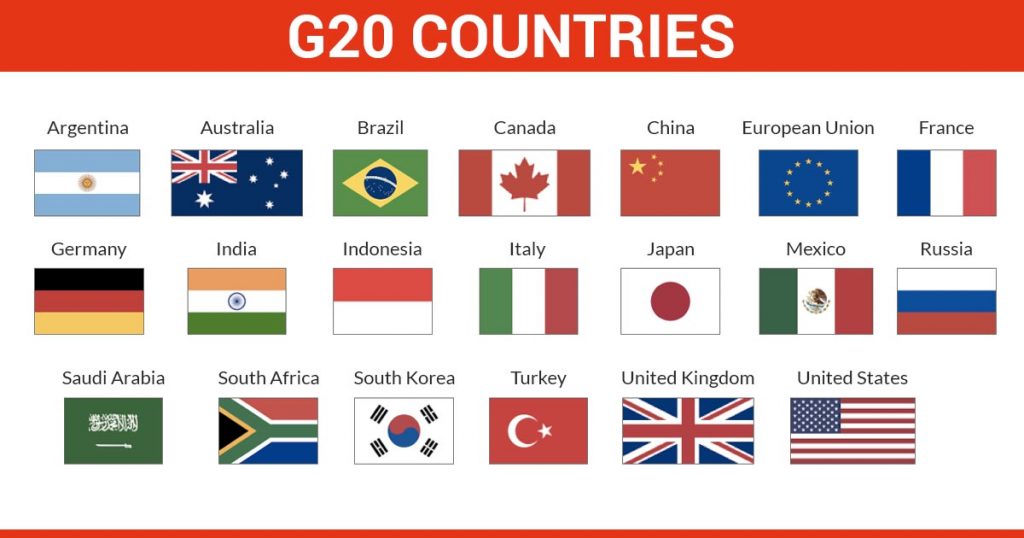
    The members of the G20 consist of 19 individual countries plus the European Union (EU).

    • The 19 member countries of the forum are Argentina, Australia, Brazil, Canada, China, France, Germany, India, Indonesia, Italy, Japan, Mexico, Russia, Saudi Arabia, South Africa, South Korea, Turkey, United Kingdom and the United States.
    • The European Union is represented by the European Commission and by the European Central Bank.

     Who are the G20 Sherpas?

    • A Sherpa is the personal representative of a head of state or government who prepares an international summit, particularly the annual G7 and G20 summits.
    • Between the summits, there are multiple Sherpa conferences where possible agreements are laid out.
    • This reduces the amount of time and resources required at the negotiations of the heads of state at the final summit.
    • The Sherpa is generally quite influential, although they do not have the authority to make a final decision about any given agreement.
    • The name is derived from the Sherpa people, a Nepalese ethnic group, who serve as guides and porters in the Himalayas, a reference to the fact that the Sherpa clears the way for a head of state at a major summit.

    G7

    • The G7 or the Group of Seven is a group of the seven most advanced economies as per the International Monetary Fund (IMF).
    • The seven countries are Canada, USA, UK, France, Germany, Japan and Italy. The EU is also represented in the G7.
    • These countries, with the seven largest IMF-described advanced economies in the world, represent 58% of the global net wealth ($317 trillion).
    • The G7 countries also represent more than 46% of the global gross domestic product (GDP) based on nominal values, and more than 32% of the global GDP based on purchasing power parity.
    • The requirements to be a member of the G7 are a high net national wealth and a high HDI (Human Development Index).