[WpProQuiz 1266]
[WpProQuiz_toplist 1266]
UPSC 2023 countdown has begun! Get your personal guidance plan now! (Click here)

[WpProQuiz 1266]
[WpProQuiz_toplist 1266]
UPSC 2023 countdown has begun! Get your personal guidance plan now! (Click here)
[WpProQuiz 1268]
[WpProQuiz_toplist 1268]
UPSC 2023 countdown has begun! Get your personal guidance plan now! (Click here)
[WpProQuiz 1265]
[WpProQuiz_toplist 1265]
UPSC 2023 countdown has begun! Get your personal guidance plan now! (Click here)
Dear Aspirants,
This Spotlight is a part of our Mission Nikaalo Prelims-2023.
You can check the broad timetable of Nikaalo Prelims here
YouTube LIVE with Parth sir – 1 PM – Prelims Spotlight Session
Evening 04 PM – Daily Mini Tests
Telegram LIVE with Sukanya ma’am – 06 PM – Current Affairs Session
Join our Official telegram channel for Study material and Daily Sessions Here
10th Mar 2023
Understanding Inflation
Inflation: Inflation is when the overall general price level of goods and services in an economy is increasing. As a consequence, the purchasing power of the people are falling.
Inflation Rate: Inflation Rate is the percentage change in the price level from the previous period.
Inflation Rate= {(Price in year 2 – Price in year 1)/ Price in year 1} *100
Whole sale Price Index: WPI is used to monitor the cost of goods and services bought by producer and firms rather than final consumers. The WPI inflation captures price changes at the factory/wholesale level.
GDP Deflator: GDP Deflator is the ratio of nominal GDP to real GDP. The nominal GDP is measured at the current prices whereas the real GDP is measured at the base year prices.
The Difference
| Consumer Price Index | GDP Deflator |
| CPI reflects the price of goods and services bought by the final consumers. | GDP deflator reflects the price of all the goods and services produced domestically. |
| Example: Suppose the price of a satellite to be launch by ISRO increases. Even though the satellite is part of the GDP of India, but it is not a part of normal CPI index, since we don’t consume satellite. | The price rise of the ISRO satellite will be reflected in GDP deflator. |
| Similarly, India produces some crude oil, but most of the oil/petroleum is imported from the West Asia, as a result, when the price of oil/petroleum product changes, it is reflected in CPI basket as petroleum products constitute a larger share in CPI. | The price change of oil products is not reflected much in the GDP deflator since we do not produce much crude oil. |
| The CPI compares the price of a fixed basket of goods and services to the price of the basket in the base year. | The GDP deflator compares the price of currently produced goods and services to the price of the same goods and services in the base year. Thus, the group of goods and services used to compute the GDP deflator changes automatically over time. |
Producer Price Index
PPI measures the average change in the sale price of goods and services either as they leave the place of production or as they enter the place of production. Moreover, PPI includes services also.
The PPI measure the price changes from the perspective of the seller and differs from CPI which measures price changes from buyer perspective.
Causes of Inflation
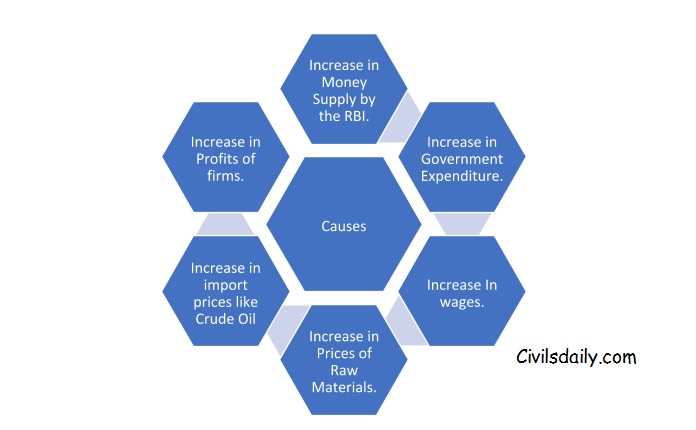
Inflation is mainly caused either by demand Pull factors or Cost Push factors. Apart from demand and supply factors, Inflation sometimes is also caused by structural bottlenecks and policies of the government and the central banks. Therefore, the major causes of Inflation are:
Demand and Supply factors can be further sub divided into the following:
Inflationary Gap: the Inflationary gap is a situation which arises when Aggregate demand in an economy exceeds the Aggregate supply at the full employment level.

Deflationary Gap: Deflationary Gap is a situation which arises when Aggregate demand in the economy falls short of Aggregate Supply at the full employment level.
Stagflation: The falling growth along with rising prices makes cost push inflation more dangerous than the demand-pull inflation. The situation of rising prices along with falling growth and employment is called as stagflation.
Hyperinflation: Hyperinflation is a situation when inflation rises at an extremely faster rate. The rate of inflation can increase from 50 times to 300 times. The major causes of the hyperinflation are; government issuing too much currency to finance its deficits; wars and political instabilities and unexpected increase in people’s anticipation of future inflation.
Structural Inflation
Deflation: Deflation is when the overall price level in the economy falls for a period of time.Deflation is when, for instance, the price of a basket of goods has fallen from Rs 100 to Rs 80. It’s the reduction in overall prices of goods.
Disinflation: Disinflation is a situation in which the rate of inflation falls over a period of time. Remember the difference; disinflation is when the inflation rate is falling from say 5% to 3%.
Headline versus Core Inflation
The headline inflation measure demonstrates overall inflation in the economy. Conversely, the core inflation measures exclude the prices of highly volatile food and fuel components from the inflation index.
Core inflation excludes the highly volatile food and fuel components and therefore represents the underlying trend inflation.
What is monetary policy?
As the name suggests it is policy formulated by monetary authority i.e. central bank which happens to be RBI in case of India.
It deals with monetary i.e money matters i.e. affects money supply in the economy.
Eg. CRR,SLR,OMO,REPO etc
What is fiscal policy then?
It is formulated by finance ministry i.e. government. It deals with fiscal matters i.e. matters related to government revenues and expenditure.
Revenue matters- tax policies, non tax matters such as divestment, raising of loans, service charge etc
Expenditure matters– subsidies, salaries, pensions, money spent on creation of capital assets such as roads, bridges etc.
Monetary policy and fiscal policy together deal with inflation.

Let us now understand how RBI formulates monetary policy to control inflation
It’s clear from what we have learnt so far that to control inflation, RBI will have to decrease money supply or increase cost of fund so that people do not demand goods and services.
Tools available with RBI

They are of two types
RBI Tools for Controlling Credit/Money Supply
Broadly speaking, there are two types of methods of controlling credit.

| M1 | M2 | M3 | M4 |
| It is also known as Narrow Money. | It is a broader concept of the money supply. | It is also known as Broad Money. | M4 includes all items of M3 along with total deposits of post office saving accounts. |
| M1= C+DD+OD
C= Currency with Public. DD= Demand Deposit with the public in the Banks. OD= Other Deposits held by the public with RBI. |
M2= M1 + Saving deposits with the post office saving banks.
M1 is distinguished from M2 because the post office saving deposits are not as liquid as Bank deposits. |
M3 = M1+ Time Deposits with the Bank.
Time deposits serve as a store of wealth and represent a saving of the people and are not as liquid as they cannot be withdrawn through cheques or ATMs as compared to money deposited in Demand deposits. |
M4= M3+Total Deposits with Post Office Saving Organisations.
M4 however, excludes National Saving Certificates of Post Offices. |
| It is the most liquid form of the money supply. | M3 is the most popular and essential measure of the money supply. The monetary committee headed by late Prof Sukhamoy Chakravarty recommended its use for monetary planning in the economy. M3 is also called Aggregate Monetary Resource |
[WpProQuiz 1264]
[WpProQuiz_toplist 1264]
UPSC 2023 countdown has begun! Get your personal guidance plan now! (Click here)
Dear Aspirants,
This Spotlight is a part of our Mission Nikaalo Prelims-2023.
You can check the broad timetable of Nikaalo Prelims here
YouTube LIVE with Parth sir – 1 PM – Prelims Spotlight Session
Evening 04 PM – Daily Mini Tests
Telegram LIVE with Sukanya ma’am – 06 PM – Current Affairs Session
Join our Official telegram channel for Study material and Daily Sessions Here
9th Mar 2023
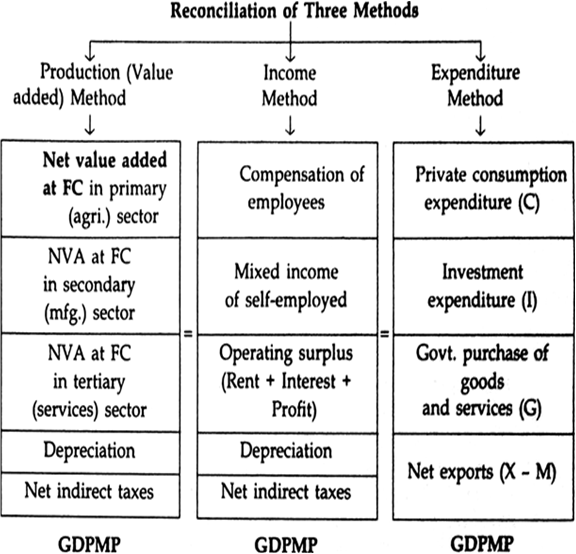
National income accounting refers to the set of methods and principles that are used by the government for measuring production and income, or in other words economic activity of a country in a given time period.
The various measures of determining national income are GDP (Gross Domestic Product), GNP (Gross National Product), and NNP (Net National Product) along with other measures such as personal income and disposable income.
National income accounting equation is an equation that shows the relationship between income and expense of an economy and other categories. It is represented by the following equation:
Y = C + I + G + (X – M)
Where
Y = National income
C = Personal consumption expenditure
I = Private investment
G = Government spending
X = Net exports
M = Imports
The most important metrics that are determined by national income accounting are GDP, GNP, NNP, disposable income, and personal income.
(A) Problems in Income Method:
(B) Problems in Product Method:
(C) Problems in Expenditure Method:
The list of schemes can be found here
https://www.civilsdaily.com/type/govt-schemes/
[WpProQuiz 1261]
[WpProQuiz_toplist 1261]
UPSC 2023 countdown has begun! Get your personal guidance plan now! (Click here)
Dear Aspirants,
This Spotlight is a part of our Mission Nikaalo Prelims-2023.
You can check the broad timetable of Nikaalo Prelims here
YouTube LIVE with Parth sir – 1 PM – Prelims Spotlight Session
Evening 04 PM – Daily Mini Tests
Telegram LIVE with Sukanya ma’am – 06 PM – Current Affairs Session
Join our Official telegram channel for Study material and Daily Sessions Here
7h Mar 2023
Following Are The Major Amendments Made In The Constitution
Acquired the Dadra, Nagar and Haveli as a Union Territory from Portugal.
Added Goa, Daman and Diu to the Indian Union.
Made Nagaland a state and provided special provisions for it.
Added Sindhi as the 15th language in the Eighth Schedule.
This Amendment Act was brought in the aftermath of the Golaknath case (1967) in which the Supreme Court held that the Parliament could not take away any fundamental rights through the constitutional amendment.
It removes the privy purses and privileges of the former monarchical rulers of princely states.
It changed Articles 101 and 190 and provided that The Chairman/Speaker of the house can reject the resignation of MP if he found it ingenuine or non-voluntary.
Gave a full-fledged State status to Sikkim and repealed the Tenth Schedule.
It is also known as the ‘ Mini-constitution’, as it made very comprehensive changes to the constitution of India.
This was also the comprehensive amendment which was mainly brought to undo the actions of the 42nd amendment. It also introduced some important provisions.
The Tenth schedule was added as a measure to the anti-defection issues.
The legal voting age changed from 21 to 18 years for Lok Sabha as well as Legislative Assemblies.
Added Konkani, Manipuri, and Nepali languages in the Eighth Schedule.
Provided Service Tax under Article 268-A – which was levied by Union and collected and appropriated by the Union as well as the States.
Added Bodo, Dogri (Dongri), Maithili, and Santhali in the Eighth schedule
Provided for the extended reservation for the SCs and STs and special representation to the Anglo-Indian community in the Lok Sabha and the state legislative assemblies for ten more years (Article 334).
Provided for Goods and Service Tax (GST).
The National Commission for Backward Classes (NCBC) became a constitutional body.
Granted 10% Reservation for Economically Weaker Sections of citizens of classes other than the classes mentioned in clauses (4) and (5) of Article 15
Changed the reservation of seats for SCs and STs in the Lok Sabha and state assemblies from Seventy years to Eighty.
Ended the reservation of seats for the Anglo-Indian community in the Lok Sabha and state assemblies.