Mains Ready By December. Smash Mains & Smash PYQ Admissions Open

GS Paper: GS2-18.Bilateral, regional and global groupings and agreements involving India and/or affecting India’s interests.

  • Western sanctions on Russia are like none the world has seen

    Context

    Economic measures to cut Russia off from the world’s financial arteries are the most powerful implements a West unwilling to meet a nuclear adversary on the battlefield has dared wield in response to the invasion of Ukraine.

    Use of sanctions

    • The use of sanction has boomed over the past few decades.
    • Since 2000 the number of individuals and entities on America’s sanctions list has risen more than tenfold to 10,000.
    • Ever more governments, keen to punish military aggression or human-rights abuses but reluctant to go to war over them, have embraced the tactic.

    Sanctions against Russia

    •  After debating whether to make it much harder for Russian banks to process international payments by shutting them out of SWIFT—some European countries feared it would hurt their own banks, too—Western allies agreed to try targeting seven of them, though it has steered clear of Sberbank, Russia’s largest by assets, which plays a big role in processing energy payments. 
    • The most potent financial sanctions, though, have been aimed not at Russia’s commercial banks but at its central bank.
    • In the eight years since annexing Crimea made Russia the target of a first wave of sanctions, Russia has built up reserves (they now total $630bn) and shifted their composition away from dollars to help insulate the economy from further punishment.
    • But reserves become moot, whatever the currency in which they are held, if they cannot be used.
    • America, acting with Europe, has banned a range of parties from transactions with Russia’s central bank.
    • The West has also frozen most of the bank’s assets outside Russia.

    How it will affect Russian economy

    • Within hours of the sanctions taking effect, Russia’s central bank raised its main interest rate from 9.5% to 20% in an attempt to shore up the currency.
    •  Export controls will limit the components Russia can buy for its military and high-tech sectors, denying it goodies ranging from cutting-edge machinery to microchips.
    • The measures apply not just to goods made in America, but to those containing American technology that are made in and shipped from third countries, such as China.
    • For now, consumer goods dear to ordinary Russians like smartphones and home appliances are exempted from such measures.
    • But Apple is no longer selling iPhones or other kit in Russia. It is one of a fast-growing number of Western companies getting out.

    Effectiveness of sanctions

    • Measuring sanctions’ success is hard, not least because of the difficulty of disentangling their effects from other economic, and on occasion military, forces, but there have been few outright successes.
    • A recent success was the squeeze on Libya by America and allies in the 1990s and early 2000s.
    • A mix of sanctions and financial inducements persuaded Muammar Qaddafi to end his wmd programme and stop funding terrorism.
    • The apparent failures of sanctions are many.
    • Sometimes this is because they are fundamentally symbolic, or weakened by interest groups in the countries imposing them.
    • Though the point of sanctions is to exploit asymmetries, doing much more harm to the adversary than to yourself, there are always burdens to be borne by some.
    • There is also a loss to the economy as a whole.
    • The cost of compliance with sanctions for banks and companies has rocketed over the past decade.
    • Financial institutions alone spent over $50bn worldwide in 2020 on screening clients for sanctions risks, according to LexisNexis, a data firm.
    • One thing which weakens sanctions is leakiness. Despite America’s maximum-pressure measures, Iran manages to export an estimated 1m barrels of oil per day as middlemen find ways to disguise the origin of shipments.

    Risks associated with sanctions

    • Collateral damage: The more powerful sanctions are, the greater the risk of collateral damage, particularly when targeted regimes are indifferent to the suffering of citizens.
    • Work in favour of regime: Increasing the harm done can work at least in part in the government’s favour.
    • In Venezuela, a significant number of those opposed to President Nicolás Maduro and his henchmen also oppose the American sanctions putatively aimed at dislodging them.
    • Increase the closeness between countries: Sanctions can also push countries they target into each other’s arms.
    • Russia and China—hit with American sanctions over its mistreatment of Uyghurs as well as its suspected tech-spying—are enjoying their friendliest relations for decades.
    • Alternative infrastructure: It encourages those who fear them to develop alternative financial and technological infrastructures.
    • China is pushing hard in that direction.
    • As well as trying to boost its chip-making, it is creating its own version of swift, called cips, which simplifies cross-border payments in yuan, and developing a digital currency.
    • It has a long way to go.
    • Though usage of the yuan as a currency for international payments is at an all-time high, at just over 3% of the total it still pales beside the dollar, at 40%.
    • As the world economy reels from financial crises, nationalism, trade wars and a global pandemic, sanctions are aggravating existing tensions within globalisation.

    Conclusion

    When used in earnest, sanctions can inflict heavy economic costs on both sides on top of the deprivation inflicted in targeted countries. Even then, they do not always work.

    UPSC 2022 countdown has begun! Get your personal guidance plan now! (Click here)
  • Fragmenting world order, untied nations

    Context

    The outcome that should worry us apart from the devastating consequences for the Ukrainian nation, is the impact the Ukraine crisis is having on the global world order, which is fragmenting in every respect of global interconnectedness — in terms of international cooperation, security, military use, economic order, and even cultural ties.

    Implications of war for global order

    1] Question mark on the relevance of the UN and Security Council

    • Russia’s actions in Ukraine may, in terms of refusing to seek an international mandate, seem no different from the war by the United States in Iraq in 2003, Israel’s bombing of Lebanon in 2006 and the Saudi-coalition’s attacks of Yemen in 2015.
    • But Ukraine is in fact a bigger blow to the post-World War order than any other.
    • It run counter to the UN Charter preamble, i.e. “to save succeeding generations from the scourge of war…”, “to practice tolerance and live together in peace with one another as good neighbours”, as well as Articles 1 and 2 of the ‘Purposes and Principles’ of the United Nations (Chapter 1).
    • Meanwhile, in their responses, other P-5 members such as the United States, the United Kingdom and France did not seek to strengthen the global order either, imposing sanctions unilaterally rather than attempting to bring them to the UN.

    2] Declining nuclear safeguards

    • Russian military’s moves to target areas near Chernobyl and shell buildings near the Zaporizhzhia nuclear power plant show an alarming nonchalance towards safeguards in place over several decades.
    • The world must also consider the cost to the nuclear non-proliferation regime’s credibility: Ukraine and Libya that willingly gave up nuclear programmes have been invaded, while regimes such as Iran and North Korea can defy the global order because they have held on to their nuclear deterrents.

    3] Use of non-state actors

    • There are also the covenants agreed upon during the global war on terrorism, which have been degraded, with the use of non-state actors in the Ukraine crisis.
    • For years, pro-Russia armed militia operated in the Donbas regions, challenging the writ of the government in Kyiv.
    • With the arrival of Russian troops, the Ukrainian President, Volodymyr Zelensky, has invited all foreign fighters to support his forces to the country.

    4] Fragmentation of global financial order

    • While analysts have pointed out that the sanctions announced so far do not include some of Russia’s biggest banks in order to avoid the disruption of oil and gas from Russia, the intent to cut Russia out of all monetary and financial systems remains.
    • The arbitrary and unilateral nature of western sanctions rub against the international financial order set up under the World Trade Organization (that replaced the General Agreement on Tariffs and Trade, or GATT).
    • The obvious fallout of this “economic cancel culture” will, without doubt, be a reaction — a pushback from Russia and an exploration of alternative trading arrangements with countries such as China, India and much of the Eastern Hemisphere which continue to trade with Moscow.
    • For the S-400 missile defence deal, for example, New Delhi used a rupee-rouble mechanism and banks that were immunised from the U.S.’s CAATSA sanctions (or Countering America’s Adversaries Through Sanctions Act) for advance payments.

    5] Isolation of Russia

    • While several governments including the U.S., the U.K. and Germany have persistently said that their quarrel is not with Russian citizens but with their leadership, it is clear that most of their actions will hurt the average Russian citizen.
    • Some of this isolation of its citizens will work to the favour of an increasingly authoritarian Kremlin.
    • Mr. Putin’s response to the banning of Russian channels in Europe and its allies has been to use the western media ban as a pretext to ban opposition-friendly Russian channels as well.

    Takeaways for India

    • India’s abstentionist responses and its desire not to be critical of any of the actions taken by the big powers might keep Indians safe in the short term.
    • But in the long term, it is only those nations that move proactively to uphold, strengthen and reinvent the global order that will make the world a safer place.

    Conclusion

    The events over the past two weeks, set in motion by Russia’s declaration of war on Ukraine, have no doubt reversed many of the ideas of 1945 and 1990, fragmenting the international order established with the UN, ushering in an era of deglobalisation and bringing down another Iron Curtain.

    UPSC 2022 countdown has begun! Get your personal guidance plan now! (Click here)

  • Analysing India’s stand on the war on Ukraine

    Context

    Russia’s invasion of Ukraine has placed considerable moral responsibility on India. However, at the United Nations (UN), India has refused to condemn the violation of the rights of the Ukrainians.

    Issues involved in India’s vote

    1] Commitment to principles

    • National interest: One of the arguments justifying India’s stance is that in international affairs, a country must be guided by its national interest and not some abstract principles.
    • It is pointed out that due to the very high dependence of India on the Soviet Union for defence equipment and the likely need of support on the Pakistan issue in the Security Council, India must not offend Russia by condemning the invasion.
    • Why India should condemn Russia: If a people’s principles are their most deeply held beliefs about how the world must be ordered, then their interest lies in ensuring that their principles prevail in international relations.
    • Thus, if India does not want to see itself to be the victim of territorial aggression in the future, it must communicate strongly on the world stage that it condemns the Russian invasion of Ukraine.

    2] India-West relations

    • In the 1950s the West was clearly unsympathetic to India, playing its card openly on the Kashmir issue at the UN as early as 1947.
    • On the other hand, the Soviet Union, the precursor to the present-day Russian state, had rescued India several times by exercising its veto in the UN Security Council.
    • Now, close to 75 years later, the situation has changed.
    • Public opinion in the West does not favour unconditional support of Pakistan vis-à-vis India while Russia encourages Pakistan.
    • Moreover, we know by now that some limited support at the UN matters little, as taking the Kashmir issue to the UN Security Council has not got Pakistan to withdraw from the territory it occupied.

    3] India’s dependence on Russia for defence supplies

    •  It is indeed correct that India relies on the Russians for such equipment and their spare parts.
    • At the same time there is a global market for arms. It is not evident that anything withheld by the Russians cannot be sourced from that market.
    •  For India to base its public stance on the Russian invasion of Ukraine on the assured supply of armaments is to really drag ourselves down to the bottom of the pit in terms of ethics.

    4] East-West conflict argument

    • Another argument is that this is a conflict between the east and the west, and India should stay out of it.
    • To say that this is just another east-west conflict from which India should stay out is tantamount to seeing the Russian invasion and the brave defence of their country by the Ukrainians as a mere marital squabble.
    • India had refused in 1956 to condemn the Soviet invasion of Hungary, its action today is much worse.

    Conclusion

    India must take a long view of how it wants to engage with it. Its actions so far leave it in the company of Russia and China.

    UPSC 2022 countdown has begun! Get your personal guidance plan now! (Click here)

  • Geneva Conventions and the Russia-Ukraine War

    As the evidence of casualties in the civilian population continues to mount, the world will increasingly look to the Geneva Conventions in the Russia-Ukraine conflict.

    Geneva Conventions Guidelines for Wartime

    • These are a set of four treaties, formalized in 1949, and three additional protocols, which codify widely accepted ethical and legal international standards for humanitarian treatment of those impacted by war.
    • The focus of the Conventions is the:
    1. Treatment of non-combatants and prisoners of war, and
    2. Not the use of conventional or biological and chemical weapons

    What are the four Geneva Conventions?

    (1) First Geneva Convention: Health and Medical Issues

    • It protects wounded and sick soldiers on land during war.
    • This convention extends to medical and religious personnel, medical units, and medical transport.
    • It has two annexes containing a draft agreement relating to hospital zones and a model identity card for medical and religious personnel.

    (2) Second Geneva Convention:  Offshore Protection

    • It protects wounded, sick and shipwrecked military personnel at sea during war.
    • This convention also extends to hospital ships and medical transports by sea, with specific commentary on the treatment and protections for their personnel.

    (3) Third Geneva Convention: Treatment of Prisoners of War (PoW)

    It applies to prisoners of war, including a wide range of general protections such as humane treatment, maintenance and equality across prisoners, conditions of captivity, questioning and evacuation of prisoners, transit camps, food, clothing, medicines, hygiene and right to religious, intellectual, and physical activities of prisoners.

    (4) Fourth Geneva Convention: Civilian protection of occupied territory ***

    • It particularly applies to the invasion of Ukraine by Russian military forces.
    • It protects civilians, including those in occupied territory.
    • Comprising 159 articles, it outlines the norms for this critical dimension of conflict.

    Extent of the Fourth Geneva Convention amid the Ukraine-Russia War

    • Along with the Additional Protocols of 1977, the Fourth Convention expounds upon the:
    1. General protection of populations against certain consequences of war
    2. Conduct of hostilities and the status and
    3. Treatment of protected persons
    4. Distinguishing between the situation of foreigners on the territory of one of the parties to the conflict and that of civilians in occupied territory
    • This convention also spells out the obligations of the occupying power vis-à-vis the civilian population and outlines detailed provisions on humanitarian relief for populations in occupied territory.

    Which countries are signatories?

    • The Geneva Conventions have been ratified by 196 states, including all UN member states.
    • The three Protocols have been ratified by 174, 169 and 79 states respectively.

    Russia and these conventions

    • In 2019, perhaps anticipating the possibility of its invading Ukraine in the near future, Russia withdrew its declaration under Article 90 of Protocol 1.
    • By withdrawing this declaration, Russia has pre-emptively left itself with the option to refuse access by any international fact-finding missions to Russian entities.
    • Not withdrawing could have find Russia responsible for violations of the Geneva Conventions standards.
    • Further, the four conventions and first two protocols of the Geneva Conventions were ratified by the Soviet Union, not Russia.
    • Hence there is a risk of the Russian government of the day disavowing any responsibility under the Conventions.

    What would be the steps for potential prosecution under the Conventions?

    • Under Article 8 of the Rome Statute of the ICC, it is the ICC that has jurisdiction in respect of war crimes, in particular “when committed as part of a plan or policy or as part of a large-scale commission of such crimes.”

    To what extent have Geneva Conventions been upheld worldwide in recent years?

    • Amnesty International notes that there has been a blatant disregard for civilian protection and international humanitarian law in armed conflicts where four of the five permanent members of the UN Security Council are parties.
    • Specifically, Amnesty cited:
    1. US-led coalition’s bombing of Raqqa in Syria, which left more than 1,600 civilians dead
    2. Destruction of civilian infrastructure and lives in Aleppo and Idlib by Russian forces
    3. Leading to mass displacement of millions
    4. War in Yemen where the Saudi Arabia and the UAE-led coalition, backed by the West, killed and injured thousands of civilians, fuelling a full-blown humanitarian crisis


    UPSC 2022 countdown has begun! Get your personal guidance plan now! (Click here)

  • What is ‘Most Favoured Nation’ Status?

    The United States, the European Union, Britain, Canada and Japan are to move jointly to revoke Russia’s “most favoured nation” (MFN) status over its invasion of Ukraine.

    What is MFN status?

    • The World Trade Organization’s 164 members commit to treating other members equally so they can all benefit from each other’s lowest tariffs, highest import quotas and fewest trade barriers.
    • This principle of non-discrimination is known as most favoured nation (MFN) treatment.
    • There are some exceptions, such as when members strike bilateral trade agreements or when members offer developing countries special access to their markets.
    • For countries outside the WTO, such as Iran, North Korea, Syria or Russian ally Belarus, WTO members can impose whatever trade measures they wish without flouting global trading rules.

    Removal of MFN status

    • There is no formal procedure for suspending MFN treatment and it is not clear whether members are obliged to inform the WTO if they do so.
    • India suspended Pakistan’s MFN status in 2019 after a suicide attack by a Pakistan-sponsored group.
    • Pakistan never applied MFN status to India.

    What does losing MFN status mean?

    • Revoking Russia’s MFN status sends a strong signal that the US and its Western allies do not consider Russia a economic partner in any way, but it does not in itself change conditions for trade.
    • It does formally allow the Western allies to increase import tariffs or impose quotas on Russian goods, or even ban them, and to restrict services out of the country.
    • They could also overlook Russian intellectual property rights.
    • Ahead of MFN status removal, the United States had already announced a ban on imports of Russian oil and gas.


    UPSC 2022 countdown has begun! Get your personal guidance plan now! (Click here)

  • Biological and Toxin Weapons Convention (BTWC)

    India has emphasized on following the Biological and Toxin Weapons Convention (BTWC) at the UNSC meeting on Ukraine.

    Why in news?

    • The meeting came after a request from Russia, who claimed that the US is involved in bioweapon manufacture in war-torn Ukraine.
    • However, Washington has strongly dismissed this claim.

    What is BTWC?

    • The Biological and Toxin Weapons Convention (BTWC) was the first multilateral treaty categorically banning a class of weapon.
    • It is a treaty that came into force in 1975 and prohibits the development, production, acquisition, transfer, stockpiling and use of biological weapons.
    • A total of 183 countries are party to the treaty that outlaws bioweapons, including US, Russia and Ukraine.

    Obligations of the treaty

    • The treaty prohibits the development, stockpile, production, or transfer of biological agents and toxins of “types and quantities” that have no justification for protective or peaceful use.
    • Furthermore, the treaty bans the development of weapons, equipment, or delivery systems to disseminate such agents or toxins.
    • Should a state possess any agent, toxin, or delivery system for them, they have nine months from entry into force of the treaty to destroy their stockpiles, or divert them for peaceful use.
    • The convention stipulates that states shall cooperate bilaterally or multilaterally to solve compliance issues.
    • States may also submit complaints to the UNSCR should they believe another state is violating the treaty.

    Issues with the treaty

    • There is no implementation body of the BTWC, allowing for blatant violations as seen in the past.
    • There is only a review conference that too every five years to review the convention’s implementation, and establish confidence-building measures.

    Signatories to the BTWC

    • The Convention currently has 183 states-parties, including Palestine, and four signatories (Egypt, Haiti, Somalia, and Syria).
    • Ten states have neither signed nor ratified the BWC: Chad, Comoros, Djibouti, Eritrea, Israel, Kiribati, Micronesia, Namibia, South Sudan, and Tuvalu.


    UPSC 2022 countdown has begun! Get your personal guidance plan now! (Click here)

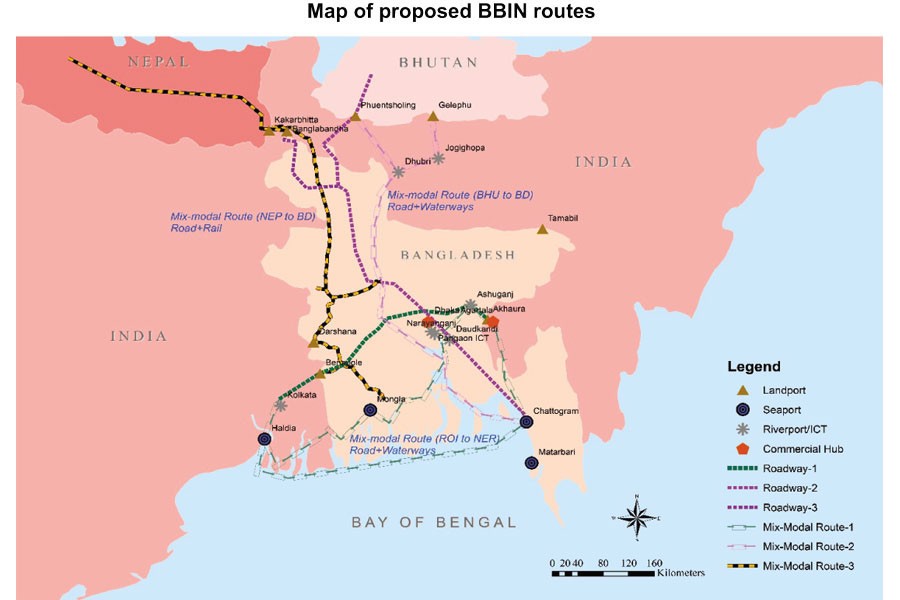
  • Motor Vehicles Agreement (MVA) of the BBIN

    With Bhutan continuing to sit out the Motor Vehicles Agreement (MVA) of the sub-regional Bangladesh-Bhutan-India-Nepal (BBIN) grouping, a meeting of the other three countries was held to discuss the next steps in operationalizing the agreement for the free flow of goods and people between them.

    What is Motor Vehicles Agreement (MVA)?

    • India, Nepal, Bhutan and Bangladesh signed a Motor Vehicles Agreement (MVA) for the Regulation of Passenger, Personal and Cargo Vehicular Traffic among the four South Asian neighbours.
    • It was signed on 15 June 2015 at the BBIN transport ministers meeting in Thimpu, Bhutan.
    • The act will facilitate a way for a seamless movement of people and goods across their borders for the benefit and integration of the region and its economic development.

    Key terms of the Agreement

    • Trans-shipment of goods: Cargo vehicles will be able to enter any of the four nations without the need for trans-shipment of goods from one country’s truck to another’s at the border.
    • Free transport: The agreement would permit the member states to ply their vehicles in each other’s territory for transportation of cargo and passengers, including third-country transport and personal vehicles.
    • Electronic permit: As per the agreement each vehicle would require an electronic permit to enter another country’s territory, and border security arrangements between nations’ borders will also remain.
    • Ultra-security: Vehicles are fitted with an electronic seal that alerts regulators every time the container door is opened.

    Implementation status of the agreement

    • The agreement will enter into force after it is ratified by all four member nations.
    • The agreement has been ratified by Bangladesh, India and Nepal.
    • The lower house of the Bhutanese parliament approved the agreement in early 2016, but it was rejected by the upper house in November 2016.
    • Bhutan has requested for a cap to be fixed on the number of vehicles entering its territory

    What next?

    • India remains “hopeful” that Bhutan could change its position on the project, it was decided at a meeting in November 2021 to go ahead for now, given that there are no new signals from Thimphu on the project.
    • Progress on the seven-year-old project has been slow, despite several trial runs being held along the Bangladesh-India-Nepal road route for passenger buses and cargo trucks.
    • There are still some agreements holding up the final protocols.

    Back2Basics: Bangladesh, Bhutan, India, Nepal (BBIN)

    • BBIN Initiative is a sub-regional architecture of countries in Eastern South Asia, a sub-region of South Asia.
    • The group meets through the official representation of member states to formulate, implement and review quadrilateral agreements across areas such as water resources management, connectivity of power, transport, and infrastructure.


    UPSC 2022 countdown has begun! Get your personal guidance plan now! (Click here)

  • What is the Temporary Protection Directive of the EU?

    Responding to the crisis, EU Member States made the unprecedented decision to activate a major European Union’s Council Directive, known as the Temporary Protection Directive (TPD).

    What is Temporary Protection?

    • The EU Commission describes “temporary protection” under the TPD as an “exceptional measure to provide immediate and temporary protection to displaced persons from non-EU countries and those unable to return to their country of origin”.
    • The directive applies when there is a risk that the standard asylum system is struggling to cope with demand stemming from a mass influx risking a negative impact on the processing of claims.

    Objectives of this protection

    1. To both establish minimum standards for giving temporary protection to displaced persons
    2. To promote a balance of effort between Member States in receiving and bearing the consequences of receiving such persons

    Why establish standards?

    The Commission gives two reasons for doing so:

    • It reduces disparities between the policies of EU States on the reception and treatment of displaced persons in a situation of mass influx.
    • It promotes solidarity and burden-sharing among EU States with respect to receiving large numbers of potential refugees at one time.”

    What obligations does the TPD place upon EU states?

    According to the European Commission, the TPD “foresees harmonised rights for the beneficiaries of temporary protection”, which include:

    • Residence permit for the duration of the protection (which can last from 1-3 years),
    • Appropriate information on temporary protection,
    • Access to employment,
    • Access to accommodation or housing,
    • Access to social welfare or means of subsistence,
    • Access to medical treatment,
    • Access to education for minors,
    • Opportunities for families to reunite in certain circumstances, and
    • Guarantees for access to the normal asylum procedure

    The TPD also contains provisions for the return of displaced persons to their country of origin, unless they have committed serious crimes or they “pose a threat to security from the benefit of temporary protection”.


    UPSC 2022 countdown has begun! Get your personal guidance plan now! (Click here)

  • How invasion of Ukraine could transform nuclear landscape of Asia

    Context

    Russian President Vladimir Putin’s nuclear sabre-rattling in Ukraine, has triggered a far more consequential debate on the importance of atomic weapons in deterring Chinese expansionism.

    Background

    • Ukraine agreed in 1994 to give up the nuclear weapons that it inherited from the Soviet Union in return for guarantees on Kyiv’s sovereignty and territorial integrity.
    • Clearly, those legal guarantees were no substitute for nuclear weapons.

    Changing stand on nuclear weapons

    • Debate in Japan: In an important statement last week, the former prime minister of Japan, Shinzo Abe, called for a national debate on hosting American nuclear weapons on Japanese soil.
    • One element of the debate is the fact that nuclear weapons remain the greatest deterrent, especially against a vastly superior adversary.
    • Korea strengthening nuclear deterrence: In South Korea, which is electing its president this week, front-runner Yoon Suk-yeol has talked of strengthening Seoul’s nuclear deterrence against both Pyongyang and Beijing.
    • Taiwan and Australia developing nuclear submarine: Taiwan, is reportedly developing a nuclear-powered submarine that could offer some deterrence against a Chinese invading force.
    • Australia, which is working with the UK and the US to build nuclear-powered submarines, is accelerating the project after the Ukraine invasion.

    Threat of escalation to nuclear war

    • The threat of escalation to the nuclear level was very much in the mind of NATO’s military planners when the alliance refused to be drawn into a firefight with Russia in Ukraine.
    • Moscow is also conscious of the fact that there are two nuclear weapon powers in Europe — Britain and France.
    • Nuclear sharing arrangement: Russia is also aware of the “nuclear sharing” arrangements between the US and some European allies — Belgium, Germany, Italy, and the Netherlands.
    • Under this framework, European allies host US nuclear weapons on their soil and authorise their armed forces to deliver American nuclear weapons on Russia.
    • Nuclear sharing also involves continuous consultations on nuclear doctrine and the planning of nuclear operations.
    • The US and its allies are also pursuing a “hybrid war” that boosts Ukrainian resistance against Russian armed forces and raises military, economic, and political costs of Moscow’s aggression.

    Threat of China invading Taiwan

    • Taiwan is far more important for Asian (and global) security than Ukraine is for Europe.
    • Taiwan sits at the heart of the Western Pacific and straddles the sea line of communication in the world’s most dynamic economic arena.
    • It is the main source of silicon chips for the world.
    • When China conquers Taiwan it will dramatically transform the geopolitics of Asia.
    • As Putin becomes more dependent on China, Russia is bound to back Xi Jinping’s ambitions in Asia.
    • This is the context in which China’s eastern neighbours are taking a fresh look at the nuclear option.
    • Nuclear sharing arrangement: On the nuclear front, the debate in Japan and South Korea is about potential nuclear sharing arrangements with the US.
    • In Taiwan and Australia, the emphasis is on developing nuclear-powered submarines.
    • Deployment of strategic weapons: The US too is debating the deployment of new strategic weapon systems in Asia that might encourage China to pause before trying to emulate Russia’s Ukraine adventure.

    Consider the question ” Russia’s invasion of Ukraine is going to transform the nuclear landscape of Asia. Comment.”

    Conclusion

    One way or another, Russia’s war in Ukraine is bound to transform the Asian nuclear landscape.

  • The complexities for implementing a No-Fly Zone

    The North Atlantic Treaty Organization (NATO) Secretary General stated that the organisation would not designate the Ukrainian airspace as a ‘No Fly Zone’ which he said would lead to a full-fledged war in Europe, involving many more countries and resulting in greater human suffering.

    What is a No-Fly Zone ?

    • In simple terms, a No-Fly Zone refers to a particular airspace wherein aircraft, excluding those permitted by an enforcement agency, are barred from flying.
    • Articles under Chapter VII of the United Nations Charter dealing with Action with Respect to Threats to the Peace, Breaches of the Peace, and Acts of Aggression’ are invoked to authorise a potential no-fly zone.
    • Article 39 dictates the United Nations Security Council (UNSC) to determine the probable existence of any threat to peace or an act of aggression.
    • It suggests further measures, if required, are to be carded out in accordance to Article 41 and 42 to restore international peace and security.
    • No fly zones have been implemented without UN mandate too.

    Cases of implementation

    • In 1991 after the first Gulf War, U.S. and its coalition partners imposed two no fly zones over Iraq to prevent Saddam Hussain born attacking ethnic groups.
    • In non-combat situations, No fly zones can be imposed permanently and temporarily over sensitive installations or for high profile events like Olympics.

    What is the feasibility of ‘No fly zone over Ukraine?

    • No-fly zone declarations are essentially a compromise in situations demanding a response to ongoing violence, but full military intervention is politically untenable.
    • NATO has previously imposed No-Fly Zones in non-member states like Libya and Bosnia. With Russia it fears a full-fledged war in Europe.
    • It has been demanding that NATO scale back to the pre-1997 arrangements. Both Russia and Ukraine are not members of NATO.
    • Due to this the idea of imposing a no fly zone’ over Ukraine has been rejected outright.
    • If implemented, it means NATO deploying aircraft and assets which would result in a direct confrontation with Russia.

    What are the broad contours in a No-Fly Zone?

    • The UNSC had banned all flights in the Libyan airspace post adoption of Resolution 1973 in 2011 in response to the Libyan Civil War.
    • Member slates were asked to deny permission to any Libyan registered aircraft to use the territory without requisite approval.
    • Further, the member states could bar any entity from flying if they found reasonable grounds to believe the aircraft is ferrying lethal or non-lethal military equipment.
    • Member states were permitted to allow flights whose sole purpose was humanitarian, such as delivery of medical supplies and food, chauffer humanitarian workers and related assistance, or evacuating foreign nationals from the territory.


    UPSC 2022 countdown has begun! Get your personal guidance plan now! (Click here)