Mains Ready By December. Smash Mains & Smash PYQ Admissions Open

GS Paper: GS2-18.Bilateral, regional and global groupings and agreements involving India and/or affecting India’s interests.

  • India suspends Indus Water Treaty

    Why in the News?

    In response to the Pahalgam Terror Attack, India has officially announced the suspension of the Indus Waters Treaty (IWT) with Pakistan.

    About the Indus Water Treaty (IWT)

    • IWT was signed between India and Pakistan on September 19, 1960, with mediation from the World Bank.
    • The treaty allocates the Western rivers (Indus, Chenab, and Jhelum) to Pakistan, and the Eastern rivers (Ravi, Beas, and Sutlej) to India.
    • Approximately 80% of the water is allocated to Pakistan, with 20% to India.
    • The Permanent Indus Commission was established to facilitate communication and dispute resolution.
    • The treaty includes a three-step process for resolving disputes, which involves the Permanent Indus Commission, Neutral Experts (appointed by World Bank), and a Court of Arbitration if needed.

    Implications of Suspension:

    • India’s Opportunities:
      • Though not immediately, but India can now control the water flow from the Indus River system, allowing it to divert, stop, or alter the flow of water.
      • India can expand hydroelectric projects on the Western rivers, such as the Kishanganga and Ratle Hydroelectric Projects, with more projects under scrutiny.
    • Impact on Pakistan:
      • Agriculture: Pakistan’s agricultural sector heavily depends on the Indus River, and any disruption could cause food insecurity and economic distress for millions of farmers.
      • Power Supply: Pakistan’s hydroelectric power generation depends on the water flow, with Tarbela Dam (on the Indus River) and Mangla Dam (on the Jhelum River) facing reduced water supplies, leading to electricity shortages.

    Alternatives for Pakistan:

    • No Legal Exit: No legal exit clause in the treaty; also, India cannot unilaterally suspend it.
    • Dispute Resolution: Pakistan can approach the Permanent Indus Commission, request Neutral Experts, or escalate to the World Bank’s Court of Arbitration.
    • International Diplomacy: Pakistan may seek diplomatic solutions through international forums, including leveraging support from other nations.
    [UPSC 2009] Consider the following statements:

    1. The Baglihar Power Project had been constructed within the parameters of the Indus Water Treaty.

    2. The project was completely built by the Union Government with loans from Japan and the World Bank.

    Options: (a) 1 only * (b) 2 only (c) Both 1 and 2 (d) Neither 1 nor 2

    [UPSC 2021] With reference to the Indus River system, among the following four rivers, one of them joins the Indus directly:

    Options: (a) Chenab (b) Jhelum (c) Ravi (d) Sutlej


  • [23rd April 2025] The Hindu Op-ed: Exploring India’s potential in the Arctic region

    PYQ Relevance:

    [UPSC 2018] Why is India taking keen interest in resources of Arctic Region?

    Linakge: India’s interest in the Arctic’s resources, which is a central theme in the Article. This article highlights the Arctic as a “critical energy source for the Global South” and mentions India’s potential stake in the “massive resources” of the region.


    Mentor’s Comment:  Global trade is shifting due to U.S. pressures and climate change, prompting countries to explore new supply chains and routes. The Arctic, while warning of a climate crisis, offers major geopolitical and economic potential. As new trade paths open, India must ensure it has a role in future Arctic opportunities without harming the fragile environment.

    Today’s editorial highlights why the Arctic region matters for the world and India. This topic is useful for GS Paper 2 (international relations) and GS Paper 3 (environment and economy) in the mains exam.

    _

    Let’s learn!

    Why in the News?

    India should have a voice in the future economic opportunities of the Arctic, without rushing to exploit its resources recklessly.

     [ 23rd April 2025] The Hindu Op-ed: Exploring India’s potential in the Arctic region

    What is the Northern Sea Route (NSR)? 

    • The Northern Sea Route (NSR) is a new Arctic sea route connecting the Atlantic Ocean to the Pacific Ocean, running along the northern coast of Russia.
    • It provides the shortest maritime route between Europe and Asia, significantly reducing shipping distances. Eg: Shipping from Rotterdam to Shanghai via the NSR cuts the journey by around 30%, reducing travel time by approximately 10 days.

    How could it transform global trade?

    • Reduced Freight Costs: By providing a more direct and shorter route, the NSR can substantially lower shipping costs, as vessels spend less time on the water and consume less fuel. Eg: The cost savings from the reduced travel time and fuel consumption can incentivize global shipping companies to shift their operations to the NSR, especially for bulk goods and high-value cargo.
    • Expedited Global Trade: The NSR could drastically speed up the flow of goods, particularly for time-sensitive cargo like electronics, automotive parts, and perishable goods, thus improving global trade efficiency. Eg: In 2018, a Chinese cargo ship made a successful voyage through the NSR, delivering goods from China to Europe in a record time of 18 days, compared to the traditional 40+ days via the Suez Canal.
    • Opening New Markets: The NSR could lead to the development of new ports and shipping routes in the Arctic, creating economic opportunities for the countries surrounding the region. It can also open up access to new markets that were previously difficult to reach. Eg: As traffic on the NSR increases, ports like Murmansk in Russia and Pevek in the Arctic will see growth, transforming them into significant maritime hubs.

    Why is the Arctic region becoming geopolitically and economically important for India?

    • New Trade Routes: The Northern Sea Route (NSR) opens shorter, more efficient shipping lanes between Europe and Asia, benefiting India’s trade by reducing shipping times and costs. Eg: The NSR offers India quicker access to European markets, enhancing trade competitiveness.
    • Energy Resources: The Arctic region holds vast untapped oil and natural gas reserves, offering India potential access to energy resources vital for its growing needs. Eg: Arctic exploration could help diversify India’s energy sources, ensuring a more secure supply.
    • Climate Research: The Arctic’s rapid changes influence global climate patterns, impacting India’s monsoon and agricultural productivity. Eg: Research on the Arctic’s climate helps India prepare for shifts in its monsoon patterns and protect food security.
    • Geopolitical Influence: India’s involvement in Arctic governance could strengthen its global position and foster partnerships with key nations like Russia and the U.S. Eg: By engaging in Arctic policy, India enhances its diplomatic and strategic ties with major global players.
    • Maritime Security: India’s access to the Arctic region can improve its maritime security and help protect vital trade routes. Eg: Strengthening Arctic partnerships can ensure India’s strategic interests in the region are safeguarded.

    When did India formalise its Arctic policy, and what are its key goals?

    Focus Area Key Objectives
    Scientific Research and Climate Understanding Enhance scientific knowledge about the Arctic’s effect on global climate, especially the Indian monsoon and agriculture. Strengthen research stations like Himadri and use space technology for Arctic studies.
    Environmental Protection and Sustainable Development Promote protection of the Arctic environment and support sustainable development. Encourage responsible use of resources and partner with Arctic nations on green energy.
    Enhanced International Cooperation and Capacity Building Actively participate in Arctic governance (e.g., Arctic Council), improve India’s expertise in Arctic studies, and collaborate on digital connectivity and indigenous knowledge exchange.

    Who are India’s potential strategic partners in the Arctic region?

    • Russia: India sees Russia as a key partner in the Arctic due to its extensive Arctic coastline and expertise in Arctic navigation. The two countries have established a working group under the bilateral intergovernmental commission to explore opportunities in Arctic trade routes like the Northern Sea Route (NSR) and potential joint ventures. Eg, the Chennai-Vladivostok Maritime Corridor is seen as a bridge to the NSR.
    • Japan and South Korea: Japan and South Korea are also critical partners due to shared concerns over China’s increasing influence in the Arctic. These nations and India aim to promote a more inclusive Arctic Council and ensure equitable access to Arctic resources, countering Chinese dominance in the region.

    What are the challenges involved? 

    • Harsh Environmental Conditions: The Arctic’s extreme weather and icy waters present significant challenges for navigation and shipping. India will need to invest heavily in specialised ice-breaking fleets and infrastructure to ensure safe and efficient passage along the Northern Sea Route (NSR). Eg, the need for shipbuilding suited to Arctic conditions was highlighted in India’s 2025-26 Budget.
    • Geopolitical Tensions: The Arctic region is becoming a battleground for global powers, with competing interests between the U.S., Russia, and China. India faces the dilemma of balancing relations with both Russia and the Western bloc while ensuring its interests in Arctic trade routes and resources. Eg, supporting Russia’s Arctic ambitions could align India with China’s Polar Silk Road, creating a potential conflict with U.S. interests.
    • Environmental Impact and Climate Change: Exploiting Arctic resources poses risks to the fragile ecosystem, and climate change further exacerbates these concerns. India must balance its commercial interests with environmental responsibility, ensuring that Arctic exploration does not contribute to further ecological degradation. Eg, global temperatures breaching 1.5°C in 2024 highlight the urgency of sustainable development in the Arctic.

    How should India balance environmental concerns with commercial interests in the Arctic? (Way forward) 

    • Sustainable Resource Management: India should advocate for responsible exploration and use of Arctic resources, ensuring that commercial activities do not harm the fragile environment. This includes supporting international regulations on sustainable practices and climate-resilient policies. Eg, India’s engagement in the Arctic Council can help influence global guidelines for Arctic resource extraction, focusing on minimal environmental disruption.
    • Collaborative Efforts with Like-minded Nations: India should collaborate with countries that share its concerns about environmental protection, such as Japan and South Korea, to promote sustainable Arctic governance. By forging partnerships focused on environmental preservation and responsible trade, India can secure both economic opportunities and environmental integrity. Eg, India, Japan, and South Korea have common interests in mitigating Chinese influence in Arctic policies, emphasising eco-friendly development.
  • India-Middle-East-Europe-Economic Corridor (IMEEC)

    Why in the News?

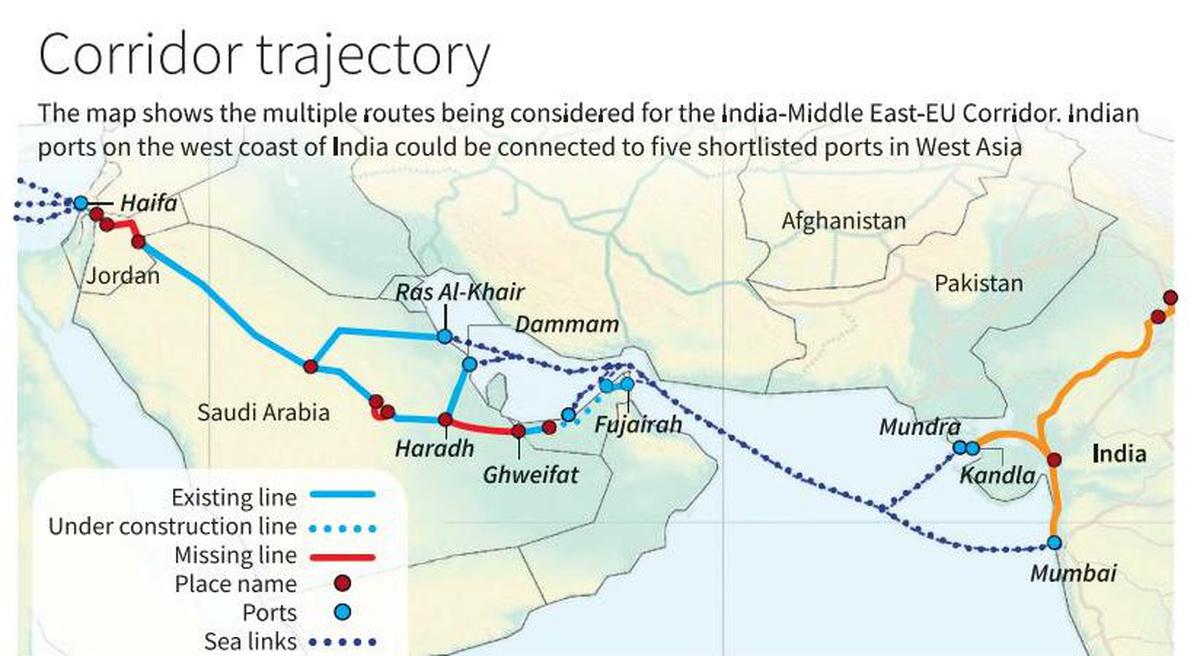
    India and Italy have decided to enhance cooperation in trade, defence, clean energy, and high technology while working jointly on the India-Middle-East-Europe-Economic Corridor (IMEEC).

    imeec

    About IMEEC Project:

    • IMEEC is a key initiative under the Partnership for Global Infrastructure and Investment (PGII), aimed at infrastructure development in developing regions.
    • It was formally endorsed on September 10, 2023, during the 2023 G20 New Delhi summit.
    • Signatories include: India, United States, UAE, Saudi Arabia, France, Germany, Italy, and the European Union.
    • Objective: To integrate Asia, Europe, and the Middle East to boost economic cooperation, trade, and regional connectivity.
    • IMEEC consists of two main corridors:
      1. East Corridor: Connecting India to the Arabian Gulf.
      2. Northern Corridor: Connecting the Gulf region to Europe.
    • Key Ports to be Connected:
      • India: Mundra, Kandla, Jawaharlal Nehru Port Trust (Mumbai).
      • Middle East: Fujairah (UAE), Jebel Ali (Dubai), Dammam (Saudi Arabia).
      • Israel: Haifa Port.
      • Europe: Piraeus (Greece), Messina (Italy), Marseille (France).

    Significance of the Project:

    • IMEEC will create a cost-efficient ship-to-rail transit network, enhancing existing transport links.
    • The project will transform regional trade dynamics and foster sustainable economic growth.
    [UPSC 2023] With reference to India’s projects on connectivity, consider the following statements:

    1. East-West Corridor under Golden Quadrilateral Project connects Dibrugarh and Surat.

    2. Trilateral Highway connects Moreh in Manipur and Chiang Mai in Thailand via Myanmar.

    3. Bangladesh-China -India -Myanmar Economic Corridor connects Varanasi in Uttar Pradesh with Kunming in China.

    Which of the statements given above is/are correct?

    (a) 1 only (b) 2 only (c) Both 1 and 2 (d) Neither 1 nor 2


  • SAARC Development Fund (SDF)

    Why in the News?

    With recent cuts in USAID funding the South Asian Association for Regional Cooperation (SAARC) Development Fund (SDF), with a capital base of $672 million and $1.5 billion in authorized funds, is gaining attention.

    About the SAARC Development Fund (SDF):

    • The SDF was established in 2010 by SAARC member countries: Afghanistan, Bangladesh, Bhutan, India, Maldives, Nepal, Pakistan, and Sri Lanka.
    • It focuses on social, economic, and infrastructure development across SAARC countries.
    • It has evolved from SAARC Fund for Regional Projects (SFRP) and SAARC Regional Fund (SRF) proposed in 1990.
    • In 2005, the SDF was reconstituted as the umbrella financial mechanism for all SAARC projects.
    • Finally, it was endorsed in 2006; Charter signed in 2008 during the 15th SAARC Summit in Colombo.
    • Its permanent Secretariat opened in Thimphu, Bhutan, in 2010.

    Funding Mechanism:

    • The SDF has authorized funds of $1.5 billion, with a capital base of $672 million.
    • It aims to expand its credit portfolio to $300 million in the coming years.
    • Member countries contribute to the SDF’s capital, and the funds are allocated for regional projects based on proposals from member states.
    • It operates on a collaborative funding model, with contributions from both the government and development partners.
    [UPSC 2016] The term ‘Regional Comprehensive Economic Partnership’ often appears in the news in the context of the affairs of a group of countries known as:

    (a) G20 (b) ASEAN (c) SCO (d) SAARC


  •  A regional revival: On the BIMSTEC summit    

    Why in the news?

    The sixth BIMSTEC summit was held last week in Bangkok, where leaders from seven neighbouring countries came together. At a time when the world is facing many challenges, the summit gave a chance to restart and strengthen the BIMSTEC group, which had been inactive for a long time.

    What is the BIMSTEC?

    • BIMSTEC was established in the year 1997. It is a group of 7 countries around the Bay of Bengal that work together to boost regional cooperation in areas like trade, transport, energy, security, and disaster management.
    • It connects South Asia (like India, Bangladesh, Nepal) with Southeast Asia (like Myanmar, Thailand), helping in regional development and integration, especially where SAARC has been inactive.

    What was the significance of the sixth BIMSTEC summit held in Bangkok amidst global turbulence?

    • Revitalisation of BIMSTEC Platform: The summit marked a renewed push to activate BIMSTEC after years of stagnation. Eg: Despite challenges like the Myanmar-Thailand earthquake, the summit was successfully held.
    • Advancement in Connectivity Projects: It accelerated infrastructure and connectivity plans across the region. Eg: The India-Myanmar-Thailand Trilateral Highway was highlighted as a key BIMSTEC initiative.
    • Strengthening Economic Cooperation: Economic integration was prioritised through trade and commerce mechanisms. Eg: A BIMSTEC Chamber of Commerce and plans for a Free Trade Agreement (FTA) were discussed.
    • Focus on Disaster Management: The region’s vulnerability to natural disasters was acknowledged with steps toward collective preparedness. Eg: The summit called for a joint disaster management mechanism for BIMSTEC countries.
    • Platform for Crucial Bilateral Engagements: It provided leaders a forum to address bilateral tensions diplomatically. Eg: PM of India met Bangladesh and Nepal leaders to discuss border issues and political concerns.

    Why has BIMSTEC gained importance over SAARC and other regional groupings in recent years?

    • Exclusion of Pakistan: BIMSTEC avoids the India-Pakistan rivalry that has long paralyzed SAARC. Eg: The 19th SAARC summit (2016) was cancelled after India pulled out due to the Uri attack; BIMSTEC continues to function without such deadlocks.
    • Regional Connectivity: BIMSTEC focuses on tangible infrastructure and economic integration projects across member states. Eg: The India-Myanmar-Thailand Trilateral Highway enhances trade and links India’s Northeast with Southeast Asia.
    • Act East Policy Alignment: BIMSTEC aligns with India’s strategic aim of connecting South Asia with Southeast Asia. Eg: Inclusion of Thailand and Myanmar allows India to implement its Act East Policy, which SAARC cannot facilitate.
    • Multi-sectoral Functional Cooperation: BIMSTEC has a broader and more practical agenda covering trade, security, energy, and disaster management. Eg: The 2024 BIMSTEC summit advanced plans for a joint disaster management mechanism and free trade agreements.
    • India’s Strategic Diplomatic Shift: India has redirected its focus from SAARC to BIMSTEC as a preferred platform for regional cooperation. Eg: India hosted the BIMSTEC outreach summit during BRICS 2016, signaling its priority shift away from SAARC.

    What is the importance of the India-Myanmar-Thailand Trilateral Highway? 

    • Enhances Regional Connectivity: The highway links India’s North-East with Southeast Asia, boosting physical and economic integration. Eg: It connects Moreh (India) to Mae Sot (Thailand) via Myanmar.
    • Promotes Trade and Commerce: It facilitates smoother movement of goods and services, reducing transport costs and time. Eg: Indian exporters can access new markets in Thailand and beyond with greater ease.
    • Boosts Tourism and Cultural Exchange: Improved road connectivity encourages people-to-people contact and tourism flows. Eg: Tourists from India can travel by road to explore Myanmar and Thailand’s heritage sites.
    • Strategic and Geopolitical Value: Strengthens India’s Act East Policy and counters the influence of China in the region. Eg: The highway gives India a direct land route to ASEAN, reducing dependence on maritime routes.
    • Development of India’s North-East: Integrates the North-Eastern states into regional value chains and boosts local economies. Eg: States like Manipur and Assam benefit from increased trade and infrastructure development.

    What was outlined in the ‘Vision 2030’ document?

    • Negotiation of a Free Trade Agreement (FTA): Plans to push forward a comprehensive BIMSTEC Free Trade Agreement to enhance regional economic integration and trade cooperation.
    • Customs Cooperation: Emphasis on Customs agreements to facilitate smoother and faster movement of goods across borders within the region.
    • Disaster Management Mechanism: Given the region’s vulnerability to natural disasters, the document stresses the importance of building a joint disaster management system.
    • Connectivity Infrastructure: Support for ongoing projects like the India-Myanmar-Thailand Trilateral Highway, aimed at improving physical connectivity, particularly with India’s North-East as a BIMSTEC “hub”.
    • Institutional Strengthening: Proposals to establish a BIMSTEC Chamber of Commerce to enhance business-to-business ties and private sector collaboration across the member states.

    What are the challenges of all regional groups with India?

    • Political Tensions: Regional groupings often get stalled due to bilateral political disputes involving India. Eg: SAARC remains non-functional due to India-Pakistan tensions, especially post-Uri attack (2016).
    • Asymmetry in Size and Power: India’s economic and geopolitical dominance leads to perceptions of hegemony by smaller neighbours. Eg: In BBIN, Bhutan’s Parliament rejected the Motor Vehicles Agreement over concerns of being overwhelmed by Indian traffic and influence.
    • Slow Implementation of Projects: Despite grand plans, execution of connectivity and trade projects is slow due to bureaucratic delays and lack of coordination. Eg: The India-Myanmar-Thailand Trilateral Highway has faced repeated delays due to funding and infrastructure gaps.
    • Security and Border Issues: Unresolved border disputes and cross-border issues hinder trust-building and cooperation. Eg: India-Nepal tensions over the Kalapani-Limpiyadhura border issue affected ties and stalled broader regional engagement.
    • Divergent National Interests: Different domestic priorities and political transitions often reduce commitment to collective goals. Eg: In BIMSTEC, Myanmar’s internal conflict and military rule have made coordination on democratic and humanitarian issues more complex.

    Way forward: 

    • Institutional Strengthening and Timely Implementation: Regional groupings must develop stronger institutional frameworks to ensure accountability, faster execution of projects, and reduced dependence on political goodwill. Eg: Establishing a BIMSTEC Secretariat with enhanced powers and resources can streamline coordination, monitor progress, and push for timely completion of initiatives like the Trilateral Highway and FTA.
    • Mutual Trust and Inclusive Diplomacy: India should promote inclusive dialogue, address concerns of smaller neighbours, and adopt a consultative rather than prescriptive approach to regional leadership Eg: Reviving BBIN talks with Bhutan through confidence-building measures or sustained bilateral dialogues with Nepal and Bangladesh can reduce friction and enhance collaboration.

    Mains PYQ: 

    [UPSC 2022] Do you think that BIMSTEC is a parallel organisation like the SAARC? What are the similarities and dissimilarities between the two? How are Indian foreign policy objectives realized by forming this new organisation?

    Linkage: BIMSTEC and its relationship with SAARC, which is central to the context of article about BIMSTEC being conceived as a bridge and gaining importance due to SAARC’s inactivity.

  • Ottawa Convention

    Why in the News?

    NATO members including Poland, Finland, and the three Baltic states (Estonia, Latvia, and Lithuania) have recently expressed intentions to withdraw from the Ottawa Convention.

    About the Ottawa Convention

    • The Ottawa Convention is an international treaty adopted in 1997 aimed at banning the use, production, stockpiling, and transfer of anti-personnel mines.
    • It is also known as the ‘Anti-Personnel Mine Ban Treaty.’
    • It specifically targets anti-personnel mines and EXCLUDES anti-vehicle mines, remote-controlled mines, and other types of munitions.
    • Signatories: 165 countries had joined by March 2025.
      • But major powers like the United States, China, Russia, India, and Israel have not signed.
    • Key Features: Signatories must destroy all stockpiled anti-personnel mines within 4 years of ratification, with some allowances for mines retained for training.

    Objectives of the Treaty

    • End Human Suffering: The primary goal is to end the human suffering caused by landmines.
    • Prevent Civilian Casualties: It seeks to prevent civilian casualties, especially long after conflicts have ended.
    • Rehabilitation and Restoration: The treaty also aims to assist in the rehabilitation of victims and the restoration of land previously mined for civilian use.

    Significance of the Convention

    • Victims’ Profile: According to the International Committee of the Red Cross (ICRC), more than 80% of mine victims are civilians.
    • Convention Provisions: The convention includes provisions to assist victims, many of whom suffer permanent disabilities such as loss of limbs.
    [UPSC 2015] Which among the following are Nuclear Weapons States as recognized by the Treaty on the Non-Proliferation of nuclear weapons, commonly known as Nuclear Non-Proliferation Treaty (NPT)?

    1. China 2. France 3. India 4. Israel 5. Pakistan

    (a) 1 and 2 only (b) 1, 3, 4 and 5 only (c) 2, 4 and 5 only (d) 1, 2, 3, 4 and 5


  • China-India ties across the past and into the future

    Why in the News?

    On April 1, China and India celebrated 75 years of diplomatic relations. Despite some challenges, their bond has kept growing, just like the Yangtze and Ganges rivers.

    What are the key factors that have influenced China-India relations over the past 75 years?

    • Strategic Leadership & Diplomatic Initiatives: Leaders have played a pivotal role in shaping ties at critical junctures. Example: In 1950, Nehru and Mao established diplomatic relations, and in 1988, Rajiv Gandhi’s visit to China helped normalize relations after the 1962 war.
    • Border Disputes & Security Concerns: The unresolved boundary issue has been a major friction point. Example: The 1962 India-China War and recent tensions in Ladakh (Galwan clash, 2020) highlight ongoing territorial disputes.
    • Economic Engagement & Trade Relations: Bilateral trade has expanded significantly, despite political tensions. Example: Trade increased from under $3 billion in 2000 to $138.5 billion in 2024, making China India’s largest trading partner.
    • Multilateral Cooperation & Global Governance: Both nations collaborate in international forums but also compete for regional influence. Example: India and China work together in BRICS, SCO, and G-20 but differ in strategies for regional dominance (e.g., Indo-Pacific and BRI).
    • Cultural & People-to-People Ties: Historical and civilizational ties continue to foster mutual understanding. Example: The influence of scholars like Rabindranath Tagore and the contribution of Dr. Kotnis in China during WWII symbolize enduring cultural bonds.

    How have the leaders of China and India guided their bilateral relations during critical historical junctures?

    • Establishment of Diplomatic Ties (1950): Prime Minister Jawaharlal Nehru and Chairman Mao Zedong formalized relations, making India the first non-socialist country to recognize the People’s Republic of China.
    • Normalization Post-1962 War (1988): Prime Minister Rajiv Gandhi’s visit to China marked a turning point, leading to agreements on peace and cooperation, setting the stage for improved ties.
    • Economic & Strategic Engagement (2003-2013): Under Atal Bihari Vajpayee and Hu Jintao, India recognized Tibet as part of China, and China acknowledged Sikkim as part of India, fostering trade and diplomatic ties.
    • Informal Summits for Stability (2018-2019): Prime Minister Narendra Modi and President Xi Jinping held informal summits in Wuhan (2018) and Mamallapuram (2019) to ease tensions and enhance strategic trust.
    • Crisis Management & Recent Diplomatic Talks (2023-2024): Amid border tensions, diplomatic channels, such as the Special Representatives’ talks and Foreign Minister-level dialogues helped maintain stability and explore solutions.

    How can China and India promote a multipolar world and protect developing countries’ interests?

    • Strengthening Multilateral Organizations: Both nations actively contribute to BRICS, the Shanghai Cooperation Organisation (SCO), and the G-20 to ensure developing countries have a greater voice in global governance.
    • Advocating for Fair Trade and Economic Policies: They push for reforms in the World Trade Organization (WTO) and International Monetary Fund (IMF) to make global trade and financial systems more inclusive and equitable.
    • Enhancing South-South Cooperation: Initiatives like China’s Belt and Road Initiative (BRI) and India’s Development Partnership Administration (DPA) can support infrastructure, healthcare, and education in Africa, Latin America, and Asia.
    • Promoting an Inclusive Global Order: China and India have called for United Nations (UN) Security Council reforms to give more representation to emerging economies, ensuring a balanced global power structure.
    • Joint Climate and Sustainable Development InitiativesThey collaborate in forums like the International Solar Alliance (ISA) and advocate for climate justice, ensuring fair access to green technology and funding for developing nations.

    What steps can China and India take to strengthen their bilateral economic and trade cooperation? (Way forward)

    • Enhancing Trade Facilitation and Reducing Barriers: Both nations can work towards reducing tariffs and non-tariff barriers to improve market access. Example: Streamlining customs procedures and regulatory harmonization can facilitate smoother trade in key sectors like pharmaceuticals, electronics, and textiles.
    • Boosting Investments and Joint Ventures: Encouraging mutual investments in infrastructure, manufacturing, and technology sectors to foster economic interdependence. Example: China’s investment in India’s mobile phone sector (e.g., Xiaomi and Oppo factories in India) can be expanded to other industries like renewable energy and automobile manufacturing.
    • Strengthening Supply Chain Resilience: Both countries can collaborate to create diversified supply chains and reduce overdependence on Western markets. Example: Joint production and R&D in semiconductor manufacturing to reduce dependency on third-party nations.
    • Promoting Digital and Financial Cooperation: Expanding digital economy collaboration, including fintech, e-commerce, and AI-driven solutions. Example: Enabling regulated entry of Indian fintech firms into China’s market and vice versa, similar to how Chinese tech firms like Alibaba and Tencent have invested in Indian startups.
    • Expanding Multilateral and Regional Cooperation: Strengthening collaboration in platforms like BRICS, SCO, and RCEP to enhance economic integration. Example: Coordinating policies on global trade issues like WTO reforms, climate finance, and digital trade governance to promote shared economic interests.

    Mains question for practice:

    Question: ‘Quadrilateral Security Dialogue (Quad)’ is transforming itself into a trade bloc from a military alliance, in present times – Discuss. [UPSC 2020]

    Linkage: Quad, a strategic dialogue involving India, the US, Japan, and Australia, which is widely seen as a counter to China’s growing influence in the Indo-Pacific. Understanding the Quad’s evolving nature is crucial for analyzing India’s strategic choices in relation to China.

  • India’s geopolitical vision should be larger

    Why in the News?

    Earlier this month, Russian President Vladimir Putin thanked leaders, including PM of India, for helping to end the Ukraine- Russia war. This was appreciated in India, but it raises a key question—why doesn’t India engage more in global conflict resolution?

    Why has India refrained from playing a more active political role in global conflicts despite its past interventions in regional crises?

    • Focus on Economic Growth: India has prioritized economic development over geopolitical interventions to strengthen its position as the world’s fifth-largest economy. Example: Since the early 2000s, India has focused on domestic growth and international trade rather than direct involvement in conflicts like the Syrian civil war.
    • Risk of Straining Bilateral Relations: Engaging in conflicts could upset key diplomatic partnerships and economic ties with different nations. Example: India has refrained from directly criticizing Russia over the Ukraine war to maintain strong trade relations, especially in energy and defense.
    • Multi-Alignment Strategy over Direct Intervention: India prefers to maintain balanced relations with global powers rather than taking sides in conflicts. Example: During the Israel-Gaza crisis, India condemned terrorism but avoided taking an active role in mediation.
    • Regional Conflicts Best Handled by Key Players: India often views conflicts as better managed by regional stakeholders or major global powers. Example: In West Asia, India has significant economic interests but does not intervene like Turkey or Saudi Arabia in conflicts such as the Yemen civil war.
    • Avoiding Overstretching Diplomatic and Military Resources: Actively engaging in multiple conflicts could strain India’s diplomatic bandwidth and military capacity. Example: While India plays a crucial role in Indo-Pacific security (e.g., QUAD), it has avoided direct involvement in conflicts like the South China Sea dispute.

    What are the key reasons behind India’s geopolitical reticence, and how do they impact its global ambitions?

    • Economic Prioritization Over Geopolitical Involvement: India has focused on economic growth, infrastructure development, and poverty reduction rather than engaging in global conflicts. This has strengthened India’s economy but has limited its influence in global strategic affairs. Example: India avoided a major role in the Ukraine-Russia war to protect trade and energy interests.
    • Balancing Strategic Partnerships: India follows a multi-alignment policy, maintaining good relations with diverse global powers. This ensures economic and diplomatic stability but restricts India from taking firm stances on contentious global issues. Example: India has strong ties with both the U.S. and Russia, leading to neutral stances in conflicts like Ukraine.
    • Reluctance to Meddle in Complex Regional Conflicts: India prefers not to intervene in regions where dominant players (e.g., U.S., China, EU) have vested interests. This often makes India appear as a passive actor rather than a decisive global leader. Example: India refrained from mediating in the Israel-Palestine conflict, unlike Qatar and Turkey.
    • Lack of Institutional Mechanisms for Conflict Mediation: India does not have a formal diplomatic framework for mediation in global conflicts. This limits India’s credibility as a conflict-resolution leader despite its historical role in peacekeeping. Example: Unlike Norway’s role in the Sri Lanka peace process, India avoided direct mediation post-2009.
    • Fear of Strategic Overstretch and Retaliation: Actively engaging in conflicts could lead to economic sanctions, diplomatic backlash, or military confrontations. This cautious approach preserves internal stability but weakens India’s claim for a UNSC permanent seat and a stronger global role. Example: India has not taken a proactive role in Afghanistan’s political transition to avoid provoking regional powers like China and Pakistan.

    Which countries or regions are currently filling the space left by India’s limited involvement in international conflict mediation?

    • China – Expanding Diplomatic and Strategic Mediation: China has positioned itself as a key mediator in conflicts, using economic influence and strategic partnerships. Example: In 2023, China brokered a historic diplomatic agreement between Saudi Arabia and Iran, reducing tensions in the Middle East.
    • Turkey and Qatar – Active Engagement in Regional Conflicts: These countries have taken up mediation roles, particularly in the Middle East and Afghanistan, leveraging their geopolitical positions and relationships with conflicting parties. Example: Qatar facilitated negotiations between the U.S. and the Taliban, leading to the 2020 U.S.-Taliban peace deal.
    • European Union – Diplomatic Initiatives and Soft Power: The EU engages in conflict resolution through diplomatic channels, economic incentives, and humanitarian aid. Example: The EU has played a mediatory role in the Armenia-Azerbaijan conflict over Nagorno-Karabakh, facilitating peace talks and ceasefire agreements.

    Way forward: 

    • Develop Institutional Frameworks for Mediation and Peacebuilding: Establish specialized diplomatic institutions focused on conflict resolution, leveraging India’s experience in UN peacekeeping and historical ties with developing nations. Example: Creating an “India Peace Mediation Initiative” under the Ministry of External Affairs to offer diplomatic and humanitarian support in global conflicts.
    • Strengthen Strategic and Economic Diplomacy for Conflict Prevention: Enhance regional cooperation through trade, infrastructure projects, and multilateral platforms like BRICS and the G20 to prevent conflicts at their roots. Example: Expanding India’s diplomatic role in West Asia and Africa through economic investments and diplomatic engagement to foster long-term stability.

    Mains question for practice:

    Question: The West is fostering India as an alternative to reduce dependence on China’s supply chain and as a strategic ally to counter China’s political and economic dominance.’ Explain this statement with examples. [UPSC 2024]

    Linkage: India’s potential role in the global balance of power and how external actors perceive India’s strategic significance in countering a major global power is an important theme. A larger geopolitical vision for India would involve strategically navigating such external expectations and leveraging its position to advance its own interests.

  • [28th March 2025] The Hindu Op-ed: U.S. defence ties — India needs to keep its eyes open

    PYQ Relevance:

    Question: What is the significance of Indo-US defence deals over Indo-Russian defence deals? Discuss with reference to stability in the Indo-Pacific region. (UPSC 2020)

    Linkage: This question linked with the growing technological reliance on the U.S. in a critical area of India’s defense. India’s future military capabilities might depend on how the U.S. values India in its strategic plans.


    Mentor’s Comment: India’s defence public sector undertakings primarily serve the armed forces, making them heavily dependent on state-run manufacturers. The Aatmanirbhar Bharat initiative has further increased this reliance, adding pressure on the Indian Air Force (IAF), which is struggling with a declining squadron strength due to Hindustan Aeronautics Limited’s (HAL) slow production. After the IAF chief raised concerns at Aero India-2025, efforts were promised to speed up Tejas Mk1A fighter jet deliveries. A private company recently built the first rear fuselage for Tejas, marking progress. Meanwhile, the Defence Ministry is reviewing a report on the IAF’s requirements, including potential imports.

    Today’s editorial examines India’s defense sector and its reliance on other countries. This analysis is useful for GS Paper 2 and 3 in the UPSC Mains.

    _

    Let’s learn!

    Why in the News?

    Recently, the IAF chief raised concerns at Aero India-2025, efforts were promised to speed up Tejas Mk1A fighter jet deliveries.

    What are the key concerns of the Indian Air Force (IAF) regarding the dependence on Hindustan Aeronautics Limited (HAL) for fighter aircraft production?

    • Production Delays – HAL’s slow manufacturing rate has led to a depletion of IAF’s squadron strength, impacting operational readiness. Example: Delay in the production of Tejas MK1A jets has strained the IAF’s fighter jet availability.
    • Over-Reliance on a Single PSU – The IAF lacks alternative domestic suppliers, making it dependent on HAL despite inefficiencies. Example: Limited private sector involvement has only recently started with private firms producing Tejas components.
    • Quality and Upgradation Issues – HAL’s track record in upgrading older aircraft and ensuring high-quality production has been inconsistent. Example: Issues with Sukhoi Su-30MKI maintenance and Tejas Mk1A’s delayed improvements.

    What are the concern related to  reliability of India’s strategic partnership with the United States in the defense sector?

    • Policy Volatility and Shifting Alliances – The U.S. has a history of changing its foreign policy based on geopolitical interests, making long-term defense commitments uncertain.Example: The U.S.-Pakistan alliance weakened when Washington’s strategic focus shifted, leading to reduced military support for Islamabad.
    • Dependency on Critical Components – India’s indigenous fighter programs, like Tejas Mk2 and AMCA, rely on American engines, creating a risk of supply disruptions due to geopolitical tensions.Example: The U.S. previously blocked the supply of F414 jet engines to Turkey, highlighting the risks of dependency.
    • Short-Lived Defense Initiatives – Several past U.S.-India defense agreements have not led to meaningful technology transfers or long-term collaboration. Example: The 2012 ‘Defense Technology and Trade Initiative’ (DTTI) promised cutting-edge tech transfer but failed to deliver substantial results.

    How does the SIPRI report reflect India’s position in global arms imports? 

    • Second-Largest Arms Importer – India remains the world’s second-largest arms importer, reflecting its continued reliance on foreign defense equipment despite domestic production efforts. Example: The Stockholm International Peace Research Institute (SIPRI) report (2020-24) highlights that India’s arms imports still dominate globally, second only to Saudi Arabia.
    • Decline in Imports but Persistent Dependence – India’s arms imports decreased by 9.3% compared to 2015-19, but high-value systems like fighter jets, tanks, and missile defense systems continue to be sourced from abroad. Example: India imports S-400 missile systems from Russia and MQ-9B drones from the U.S., showing that critical defense needs are still met through foreign procurement.
    • Shift in Supplier Dynamics – While Russia remains India’s largest arms supplier, its share in Indian imports has decreased, with the U.S., France, and Israel gaining ground. Example: The Rafale jets from France and MH-60R Seahawk helicopters from the U.S. demonstrate India’s diversification in defense partnerships.

    Who benefits from India’s indigenous fighter production, and what risks remain in foreign dependency?

    Beneficiaries of India’s Indigenous Fighter Production Description Example
    Indian Armed Forces Ensures timely supply, reduces reliance on imports, and enhances operational preparedness. Tejas Mk1A, developed by HAL, offers a modern, cost-effective alternative to imported jets.
    Indian Defense Industry & Economy Boosts domestic manufacturing, generates employment, and fosters R&D in advanced technologies. Private firms like Tata Advanced Systems and L&T contribute to fighter jet production, strengthening India’s defense sector.
    Strategic Autonomy & Geopolitical Leverage Reduces dependence on foreign suppliers, allowing independent defense decisions. BrahMos missile production (India-Russia collaboration) enables exports, enhancing global influence.
    Risks of Foreign Dependency Description Example
    Supply Chain Vulnerabilities Dependence on foreign components (e.g., engines, avionics) can lead to disruptions during geopolitical tensions. Tejas Mk1A and AMCA jets rely on U.S. GE-F404 and GE-F414 engines, making supply uncertain due to policy shifts.
    Technology Denial & Cost Escalation Foreign suppliers may withhold critical technologies or impose high costs for upgrades and maintenance. U.S. sanctions after India’s 1998 nuclear tests restricted access to crucial defense tech, impacting the LCA Tejas program.
    Strategic Dependence & Policy Uncertainty Over-reliance on a single country can compromise strategic autonomy. The U.S. restricted F-16 spare parts supply to Pakistan during strained relations, a risk India could face with any single defense partner.

    Where does India stand in balancing defense partnerships while maintaining strategic autonomy? (Way forward)

    • Diversification of Defense Suppliers – India sources military equipment from multiple countries to avoid over-reliance on any single nation.Example: India procured S-400 missile systems from Russia, Rafale jets from France, and MH-60R Seahawk helicopters from the U.S., ensuring flexibility in its defense strategy.
    • Indigenous Defense Development – India is focusing on self-reliance through initiatives like Aatmanirbhar Bharat, reducing long-term dependency on foreign suppliers. Example: The development of Tejas Mk1A fighter jets, Advanced Medium Combat Aircraft (AMCA), and BrahMos missile systems (jointly developed with Russia) aims to strengthen indigenous capabilities.
    • Strategic Alliances Without Military Alignment – India engages in defense collaborations without entering formal military alliances, ensuring diplomatic flexibility. Example: While India has signed defense agreements with the U.S. (BECA, LEMOA, COMCASA) and conducts military exercises like Malabar with the Quad nations, it remains non-aligned, maintaining its independent foreign policy.
  • China ties — beware conciliation without deterrence 

    Why in the News?

    India is adopting a conciliatory approach towards China, with improving ties since the 2020 border clashes.

    Why has India adopted a more conciliatory stance towards China in recent months?

    • De-escalation of Border Tensions: India and China have gradually disengaged from multiple friction points along the Line of Actual Control (LAC) since the 2020 Galwan clashes. Example: In October 2023, both sides agreed to withdraw troops from the last two major standoff points in eastern Ladakh.
    • Economic Considerations: China remains India’s largest trading partner, with bilateral trade reaching record levels despite political tensions. Example: In 2023, India’s imports from China exceeded $100 billion, highlighting the economic interdependence.
    • Strategic Uncertainty in U.S. Policy: With the U.S. showing unpredictability under the Trump administration, India may seek to hedge its bets by stabilizing ties with China. Example: Trump’s reluctance to support Ukraine and potential shifts in U.S. Asia policy raise concerns about long-term American commitments.
    • Focus on Domestic Growth and Development: India aims to maintain economic stability and avoid prolonged military confrontations that could divert resources from development. Example: Infrastructure projects like “Make in India” and semiconductor manufacturing require a stable geopolitical environment.
    • Maintaining Diplomatic Leverage: A balanced approach allows India to engage with multiple global powers while keeping strategic options open. Example: While signaling reconciliation with China, India continues military exercises with the Quad (U.S., Japan, Australia) to maintain leverage.

    How does the shifting U.S. foreign policy under the Trump administration impact India’s strategic choices regarding China?

    • Uncertainty Over U.S. Security Commitments: Trump’s ambiguous stance on global security, including reduced support for Ukraine, raises doubts about America’s reliability in countering China’s aggression. Example: The U.S. halted intelligence sharing on Russian missile threats to Ukraine, signaling potential unpredictability in military alliances.
    • Possibility of a U.S.-China Grand Bargain: Trump’s transactional diplomacy suggests he may prioritize economic deals with China over strategic containment, potentially sidelining India’s concerns. Example: His approach to Russia—offering compromises for economic gains—hints at a similar possibility with China, affecting Indo-U.S. strategic alignment.
    • Pressure on India to Strengthen Self-Reliance: With the U.S. potentially scaling back its role in Asia, India must enhance its military capabilities and deepen partnerships with other allies. Example: India has intensified defense cooperation with Japan, Australia, and France while increasing indigenous military production (e.g., Tejas fighter jets, submarine projects).

    What military limitations has India faced in recent years despite rising security challenges?

    • Delayed Modernization and Declining Defense Budget: India’s defense spending as a share of GDP has steadily declined over the past decade, limiting critical investments in military modernization. Example: The Indian Air Force still operates outdated MiG-21 fighters, with delays in acquiring Rafale jets and indigenous Tejas aircraft.
    • Slow Progress in Indigenous Defense Manufacturing: Despite initiatives like Atmanirbhar Bharat (Self-Reliant India), India remains dependent on foreign arms suppliers, leading to procurement delays. Example: The Project 75I submarine program has seen repeated delays, affecting the Navy’s ability to counter China’s growing maritime presence.
    • Limited Military Buildup Despite Border Tensions: After the 2020 Ladakh standoff, India disengaged from key incursion sites but did not significantly increase troop deployments or infrastructure in vulnerable areas. Example: While China rapidly built roads, bridges, and airstrips near the Line of Actual Control (LAC), India’s infrastructure development in border areas has lagged.

    Who are India’s key partners in military cooperation? 

    • United States (U.S.): India and the U.S. have strengthened defense ties through agreements like COMCASA, BECA, and LEMOA, facilitating intelligence sharing and logistics support. Example: India participates in the Malabar naval exercise with the U.S., enhancing interoperability in the Indo-Pacific region.
    • Russia: Russia remains a key defense supplier, providing advanced weaponry, including fighter jets, submarines, and missile systems. Example: India procured the S-400 air defense system from Russia despite U.S. pressure and CAATSA sanctions concerns.
    • France: France is a crucial partner in aerospace and naval defense cooperation, supplying high-end military equipment. Example: India acquired Rafale fighter jets from France and is collaborating on Scorpene-class submarines under Project 75.
    • Israel: India-Israel defense ties focus on advanced technology, particularly in missile defense, drones, and cyber warfare. Example: India procured Barak-8 missile defense systems and Heron UAVs from Israel for border security.
    • Quad Partners (Japan & Australia): India’s partnerships with Japan and Australia focus on maritime security, intelligence sharing, and defense exercises. Example: The India-Japan 2+2 ministerial dialogue and AUSINDEX naval exercise with Australia boost strategic ties in the Indo-Pacific.

    How can operational coordination help strengthen India’s strategic position? (Way forward)

    • Enhanced Interoperability with Allies: Regular joint exercises improve coordination between India and its military partners, ensuring seamless cooperation in real-world conflicts. Example: The Malabar Naval Exercise with the U.S., Japan, and Australia enhances India’s naval capabilities in the Indo-Pacific.
    • Force Multiplication through Intelligence Sharing: Coordinated intelligence sharing provides India with real-time situational awareness, helping in threat assessment and strategic planning. Example: BECA agreement with the U.S. enables India to access geospatial intelligence, improving precision targeting and surveillance.
    • Deterrence Against Aggression: Strengthened operational coordination signals military preparedness, discouraging adversaries from engaging in aggressive actions. Example: Joint patrols with France in the Indian Ocean demonstrate India’s extended reach and deterrence capabilities.

    Mains PYQ:

    Question: ‘The West is fostering India as an alternative to reduce dependence on China’s supply chain and as a strategic ally to counter China’s political and economic dominance.’ Explain this statement with examples. (UPSC 2024)

    Reason: This question directly addresses the strategic implications of China’s rise and India’s potential role in countering it, which is relevant to the theme of deterrence.